Normandy Cheeses
Watch the curd settle into a Camembert de Normandie mould.
Watch the curd settle into a Camembert de Normandie mould. At least five deposits go in, each separated by at least 40 minutes. If you came looking for fast food, the curd has other plans. Elsewhere in Normandy, Livarot wears bands to hold its shape as it ripens. [1, 3, 5]
These are two of Normandy’s four EU protected cheeses, alongside Pont-l’Évêque and Neufchâtel. All start with cow’s milk, but their rinds, textures and characters head in wonderfully different directions. Behind your board lie lush pasture and apple orchards: grass for the dairy herds, apples for the cider poured beside their cheeses. [1, 2, 3, 4, 5, 8]
Start with the fields, linger in the orchards
Before you look at the cheese, take in the fields. Here in northern France, beside the English Channel, the Pays d’Auge has an oceanic climate and predominantly clay soils that favour grass. The damp, clay-rich ground of the Pays de Bray suits pasture too. INAO, France’s national institute for origin and quality, identifies these conditions as part of the connection between the cheeses and their production areas. [4, 5]
Hedgerows divide the fields, while orchards bring apple growing into this dairy landscape. Follow the regional tourism board’s route through the Pays d’Auge and you meet cheese producers and cider makers on the same itinerary. Their work shares a landscape before its results meet again at your table. [14]
Milk carries that connection from green field to cheeseboard. Then the paths separate, into white, mould-ripened surfaces and washed rinds, with different ways of draining and maturing the curd. You will find contrasts here, rather than one flavour that neatly sums up Normandy. [1, 2, 3, 4]
Meet the Normande cow and her place in the rules
For Livarot, the Normande cow is more than part of the view. The dairy herd must consist exclusively of Normande cattle. Pont-l’Évêque sets a different threshold: at least half the dairy cows on each holding must be Normande. Both protected cheeses give the breed an explicit place in their rules, but not the same one. [1, 2, 5]
Both specifications require dairy cows to graze for at least six months a year, with detailed provisions for grassland and feed. Breed tells you which animals supply the milk; grazing requirements govern how they are kept and fed. These commitments belong to the named cheeses, not to every cheese made elsewhere in Normandy. [1, 2]
At the counter, a picture of a Normande cow will only get you so far. Read the cheese’s full designation, then look for the maker’s information. You can then distinguish a regional association from an actual production rule.
Get to know all four protected names
Camembert de Normandie, Pont-l’Évêque, Livarot and Neufchâtel are Normandy’s four AOP cheeses. AOP stands for Appellation d’origine protégée, the French expression for protected designation of origin, or PDO. Within the EU, it ties a named product to a defined geographical area and a specification setting its production requirements. [1, 2, 3, 4, 8]
Their territories overlap, but you cannot draw one tidy boundary around them all. Camembert de Normandie and Pont-l’Évêque draw on defined areas in Calvados, Eure, Manche and Orne. Livarot is rooted more narrowly in the Pays d’Auge. Neufchâtel belongs to the Pays de Bray, with its area reaching into Oise beyond Normandy’s administrative boundary. [1, 2, 3, 4, 6, 7]
The place lists in the specifications decide eligibility, not the countryside pictured on the wrapper. Look for the complete name rather than a village scene or a general reference to Normandy. The guide to protected names explains the wider system; here, begin with four separate cheeses, each with its own rules. [1, 2, 3, 4, 6, 7]
Camembert de Normandie: look beneath the white bloom
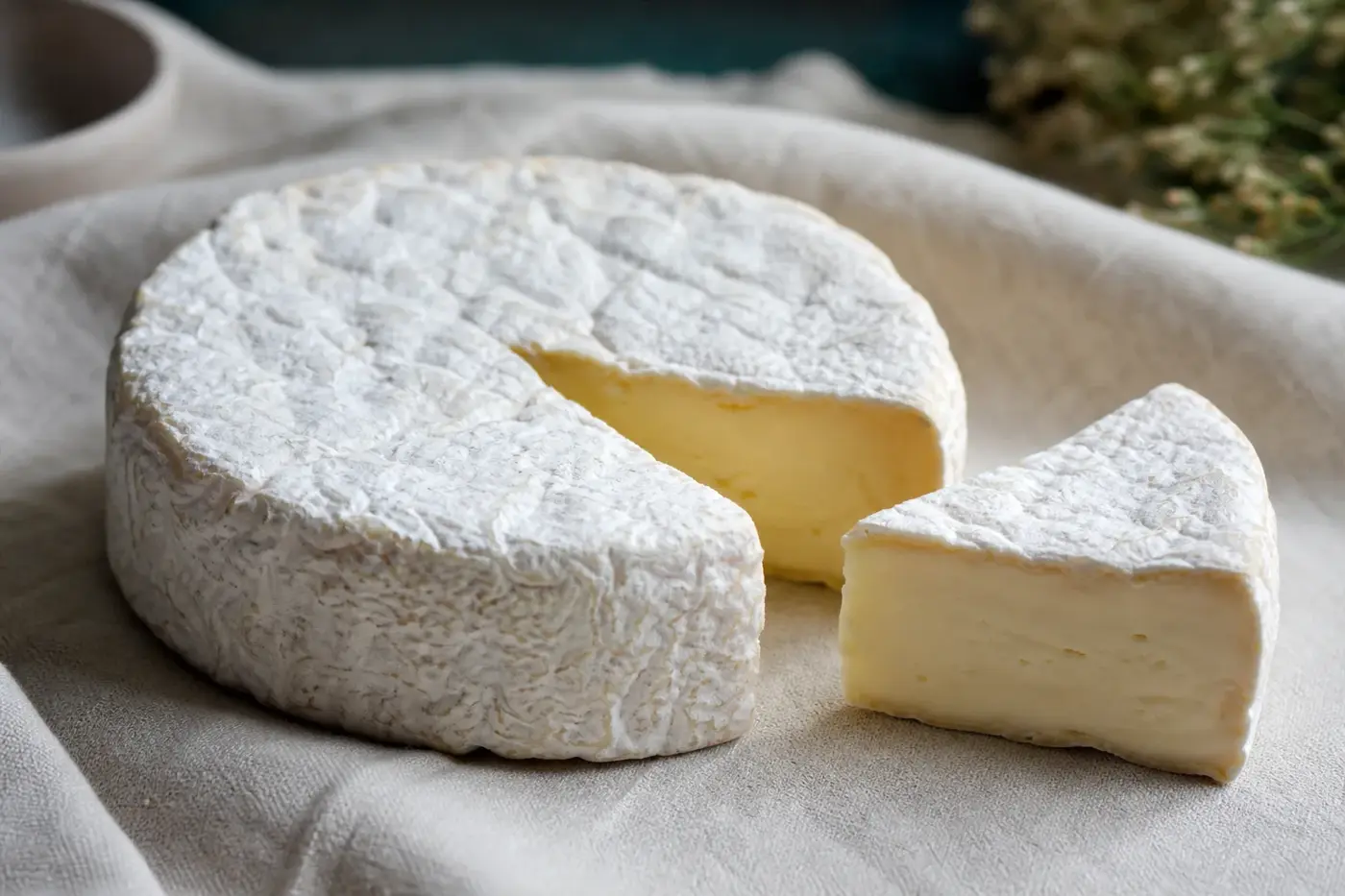
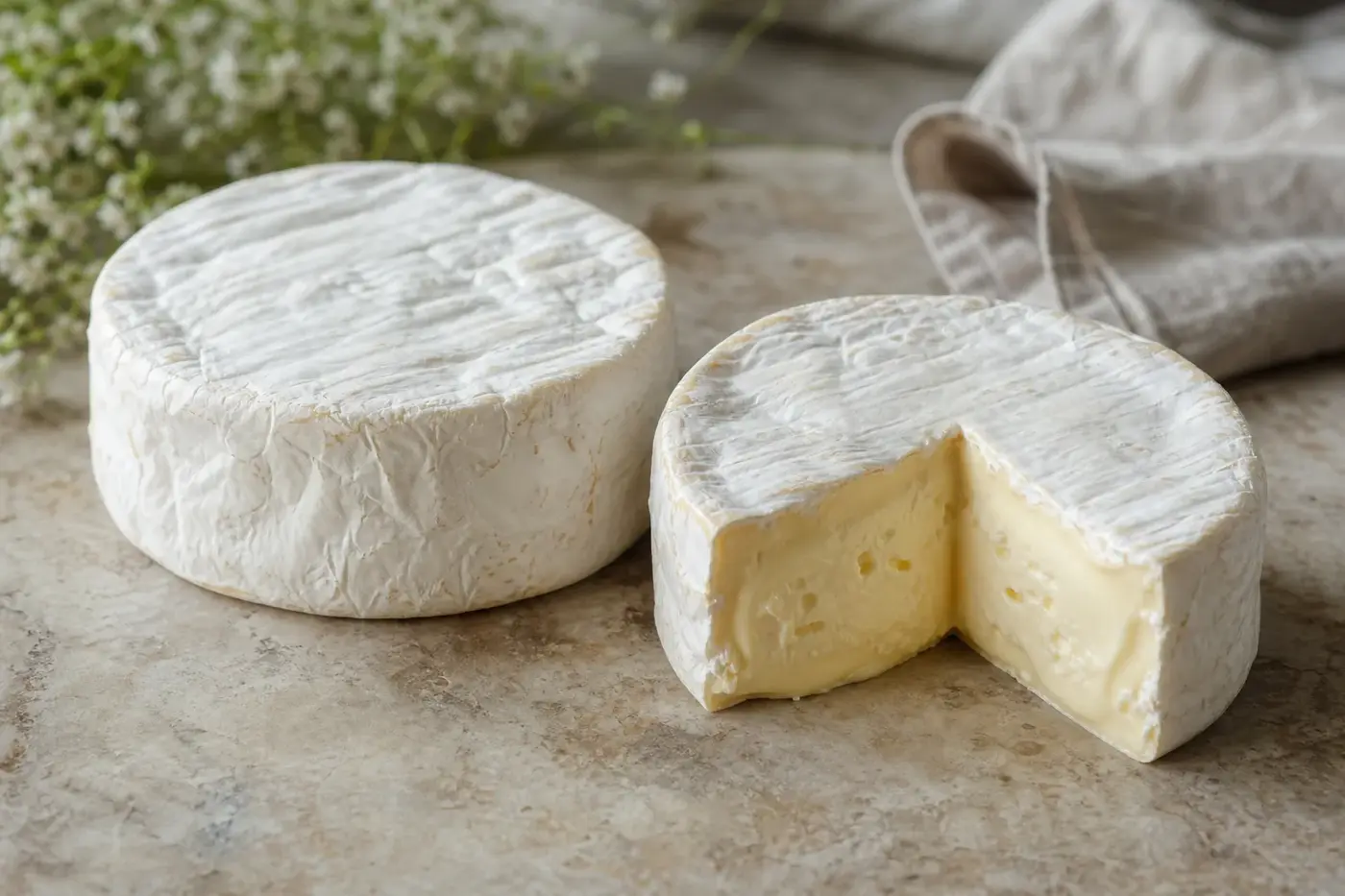
Cut beneath Camembert de Normandie’s white bloom and you find an ivory to pale-yellow paste. The bloom is a fine growth of ripening mould on the surface. Once ripened through, the paste becomes smooth and supple, while the flavour moves from milky and mild towards something more pronounced and fruity. [3]
Raw cow’s milk is compulsory, and moulding follows a deliberate rhythm. The curd, meaning the coagulated milk solids, enters the mould in at least five successive deposits, separated by at least 40 minutes. Both manual ladling and specified automated equipment are permitted. If hand-ladling matters to you, ask the maker rather than assuming it from the AOP name. [3]
Keep “Camembert de Normandie” together when you read the label. The regional producer organisation identifies that full name with its raw-milk AOP cheese, while camembert alone appears on a much wider range of products. That distinction is worth keeping close as you explore the broader camembert style. [9]
Pont-l’Évêque: make room for a gentler square
Pont-l’Évêque brings a different shape and feel to your board. Usually recognised as a square, it also has an authorised rectangular format. INAO describes a brushed and/or washed rind, whitish to reddish, around a supple, non-sticky paste coloured ivory to straw-yellow. Beside white-rinded Camembert de Normandie, the difference is clear before you taste anything. [2, 7]
Do not let that reddish rind decide the tasting for you. INAO describes a mild flavour with milky, vegetal and sometimes lightly smoky aromas. The aroma offers more detail than the restrained flavour might first suggest. Give yourself time to find those quieter distinctions, rather than expecting an aggressively strong cheese. [7]
Ask the seller about format and maturity. Shape helps you recognise Pont-l’Évêque, but the maker and the condition of that particular cheese help you choose it. Tell the seller whether you want supper tonight or a board later in the week, and ask which example suits your plans.
Livarot: follow the bands and take in the aroma
You can spot Livarot by its encircling bands and reddish washed rind. Inside is a supple yellow paste; the surface is slightly sticky. Washing means tending the rind with a liquid solution during maturation, and the specification requires at least three washes with salted water. Ripening cultures and annatto may be added. [1]
Those bands do more than give Livarot its distinctive outline. INAO explains that they help the cheese hold its shape during ripening. The requirement is three to five turns around the cheese, and the standard 4/4 format must use plant bands called laîches. Look for the encircling turns, rather than insisting on five separate strips. [1, 5]
The aroma is powerful and persistent, but do give the paste your attention too. INAO describes it as slightly salty and yielding, with hay, animal and smoky notes. Calling it simply “strong” leaves much of the pleasure unexplored. Notice the smell, saltiness, texture and flavour left after swallowing as separate parts of your tasting. [5]
Neufchâtel: look beyond the lovely heart
The heart may catch your eye first, but INAO records six authorised forms for Neufchâtel. To understand its character, look back to the curd, which is drained and pressed before moulding. Preparation includes a long lactic coagulation, where acid development helps set the milk. A relatively short maturation follows. [4]
This method gives you something quite different from another Camembert de Normandie. INAO describes young Neufchâtel as fresh-tasting, acidic and salty, with aromas of cream and fresh milk. With further maturation, that freshness retreats. More pronounced, animal aromas develop beneath its bloomy character. [4]
If fresh and tangy sounds like your sort of cheese, choose a younger example. For more developed aromas, ask the monger about a mature one. The heart makes an attractive serving shape, but maturity tells you much more about what you are about to eat.
Let the maker and maturity lead the conversation
Put your curiosity to work at the counter. Ask about milk treatment, draining, rind care and maturation. Camembert de Normandie requires raw milk; for any other cheese, check the treatment declared for that product rather than guessing from a familiar shape. The guide to milk treatments gives you useful words for that conversation. [3]
A protected specification sets the framework, but maturity changes what you taste within it. Camembert de Normandie moves from milky mildness towards more pronounced fruitiness. Neufchâtel loses some youthful freshness as its aromas develop. When choosing, put the maker’s name and a description of maturity beside the protected name. [3, 4]
Make your question concrete: is this cheese still relatively firm, or has it softened through? Explain when you intend to serve it, so the seller has something useful to work with. Comparing two makers then becomes more revealing than choosing one to represent an entire appellation.
Save a little curiosity for Normandy’s other cheeses
The protected quartet is not the whole dairy story. A local tourism listing from the Souleuvre valley documents sheep’s milk becoming fresh cheeses, fromage blanc, faisselles, tommes and blue cheese. Leave room in your exploring for these local farm cheeses too. [10]
Fresh cheese with bread offers a different sort of meal from a board of ripened cheeses. Ask where it was made, whose milk was used and how the producer describes it. Those answers help you meet the individual product, while keeping its Normandy connection distinct from an AOP designation.
This page summarises published guidance from the official sources it cites. It is not medical advice. Guidance differs between countries and changes over time, so check the current source for where you live, and ask your doctor, midwife, pharmacist or dietitian about your own circumstances.
Buy for the occasion, store with care
Start with the full name, then check the maker, milk treatment, date marking and storage instructions. At a counter, explain when you will eat the cheese and ask about its current texture. Buy a manageable selection that suits your plans. A splendid board does not require all four, however persuasive the cheese counter becomes.
If you follow Food Standards Agency guidance in England, Wales and Northern Ireland, keep your fridge between 0 and 5 °C. The agency says dairy products belong in the fridge and advises following the packaging’s storage instructions and date marks. Keep that packaging after purchase, so the information stays with the cheese. [12]
Arrange your fridge so you can identify each cheese and its instructions without unwrapping everything. Storing cheese at home has more on wrapping and handling different styles. Before you buy, reading a cheese label helps you separate the product’s identity from the pictures around it.
Bring bread, apples and cider to your tasting
For your first Normandy board, choose contrasts rather than matching maturities. A younger Neufchâtel, a supple Pont-l’Évêque and an aromatic Livarot give you three different qualities to explore. Add Camembert de Normandie if you want to compare the two bloomy-rinded cheeses directly.
Begin with plain bread and sliced apples. Try each cheese alone, then add one accompaniment at a time. You will find the differences easier to notice, and each cheese gets some attention without a crowded supporting cast.
Cider brings the countryside back into your tasting. The regional tourism board documents a tasting pairing all four cheeses with different local ciders, with apple juice for younger participants. At home, offer a small cider serving only to adults of legal drinking age, with apple juice as an alcohol free option. Make juice or water equally easy to choose. [11]
People who are pregnant, driving, taking medicines that interact with alcohol, or recovering from alcohol dependence should not drink. Consult the NHS or the relevant national authority for advice. Keep those needs in mind when planning what you will serve. [15]
Give your tasting a simple rhythm:
- Put out only what you intend to serve. Following FSA advice for England, Wales and Northern Ireland, keep chilled food outside the fridge for the shortest possible preparation time, with a maximum of four hours. [12]
- Ask the seller which cheese is mildest at its current maturity, and begin there. Save the most persistent aromas for later; the best order depends on the cheeses in front of you.
- Compare the paste before adding bread or fruit. Is it firm or yielding? Notice saltiness and acidity separately from the aromas you find after swallowing.
- Note the maker and the cheese’s condition, not just its name. “Young, fresh and tangy” or “supple, with a persistent aroma” gives you something useful to ask for next time.
Want to follow one contrast further? Choose two examples of the same cheese from different makers, rather than continually enlarging the board. Ask for their milk treatment and maturity to be recorded with their names. Then compare them under the same serving conditions.
Keep the maker’s description separate from what you notice yourself. Both belong in your notes, but they tell you different things. That small distinction gives your next comparison a clearer starting point.
Keep exploring, one good question at a time
- How to Tell Cheese Styles Apart: Milk, Rind, Texture and Method: discover where these four cheeses sit among broader styles.
- Protected Names Explained: PDO, PGI and TSG: separate origin protection from the other terms on a label.
Questions people ask
What are the four protected Normandy cheeses?
They are Camembert de Normandie, Pont-l’Évêque, Livarot and Neufchâtel. All four are made from cow’s milk and have AOP protection.
Is Camembert de Normandie always made with raw milk?
Yes, raw cow’s milk is compulsory for Camembert de Normandie. The word camembert alone appears on a much wider range of products.
What is the difference between Pont-l’Évêque and Livarot?
Pont-l’Évêque is usually square, with a mild flavour and a supple paste. Livarot has a reddish washed rind, encircling bands and a powerful, persistent aroma.
How does Neufchâtel change as it matures?
When young, Neufchâtel tastes fresh, acidic and salty, with aromas of cream and fresh milk. As it matures, its freshness recedes and more pronounced animal aromas develop.
How should Normandy cheese be stored?
The Food Standards Agency advises keeping dairy products in the fridge and following the packaging’s storage instructions and date marks. Its guidance for England, Wales and Northern Ireland says the fridge should be kept between 0 and 5 °C; see the agency’s guidance for details.
Sources
- Ministère de l’Agriculture. Cahier des charges de l’appellation d’origine « Livarot », associated with notice AGRT1421335V, Bulletin officiel of 25 September 2014. Official specification linked by INAO.
- Ministère de l’Agriculture. Cahier des charges de l’appellation d’origine « Pont-l’Évêque », associated with notice AGRT1512588V, Bulletin officiel of 11 June 2015. Official specification linked by INAO.
- Cahier des charges de l’appellation d’origine « Camembert de Normandie », approved by Décret n° 2013-1059 of 22 November 2013. Copy supplied through the regional AOP producer organisation’s website.
- INAO. Neufchâtel, online product entry, printable edition, undated; accessed November 2026. Product, sensory description and geographical account.
- INAO. Livarot, online product entry, undated; accessed November 2026. Product, sensory description, pastoral setting and banding.
- Ministère de l’Agriculture. Camembert de Normandie AOP : le goût unique du lait cru et des pâturages, 16 March 2026. Used for the departmental location of production.
- INAO. Pont-l’Évêque, online product entry, undated; accessed November 2026. Product, rind care, sensory description and geographical account.
- Fromages AOP de Normandie. Les 4 fromages AOP de Normandie, undated online edition; accessed November 2026. Producer organisation’s explanation and identification of the quartet.
- Fromages AOP de Normandie. Le Camembert de Normandie, undated online edition; accessed November 2026. Producer organisation’s account of the full protected designation and raw-milk production.
- Office de Tourisme du Pays de Vire. Bergerie de la Souleuvre, Produits laitiers à Carville, undated online listing; accessed November 2026. Evidence of local on-farm sheep’s milk cheesemaking and its product range.
- Normandie Tourisme. Dégustation de fromages et cidres normands, online edition containing 2026 visitor information; accessed November 2026. Documented cider pairings and apple-juice alternative.
- Food Standards Agency. How to chill, freeze and defrost food safely, published 18 December 2017, online edition accessed November 2026. Applies to England, Wales and Northern Ireland.
- Food Standards Agency. Alerts, live official index; accessed November 2026. Consulted for the editorial recall check.
- Normandie Tourisme. Entre pommes et fromages, undated online itinerary; accessed November 2026. Regional context linking the Pays d’Auge’s cheese and cider producers.
This desk-researched guide compares published specifications, official product descriptions and regional records, with household storage guidance attributed separately to the Food Standards Agency.
Last checked: November 2026
Last checked November 2026.
The editors suggest you read next
French Cheese: The Complete Guide
Picture Normandy’s pastures, then follow the milk towards the Loire’s goat dairies, the Jura’s shared cheesemaking traditions and the sheep country of the Pyrenees.