Cheese Professional Organisations and Honours
A pin, a medal and a personalised diploma: a successful candidate receives all three on joining the Italian delegation of the Guilde Internationale des Fromagers.
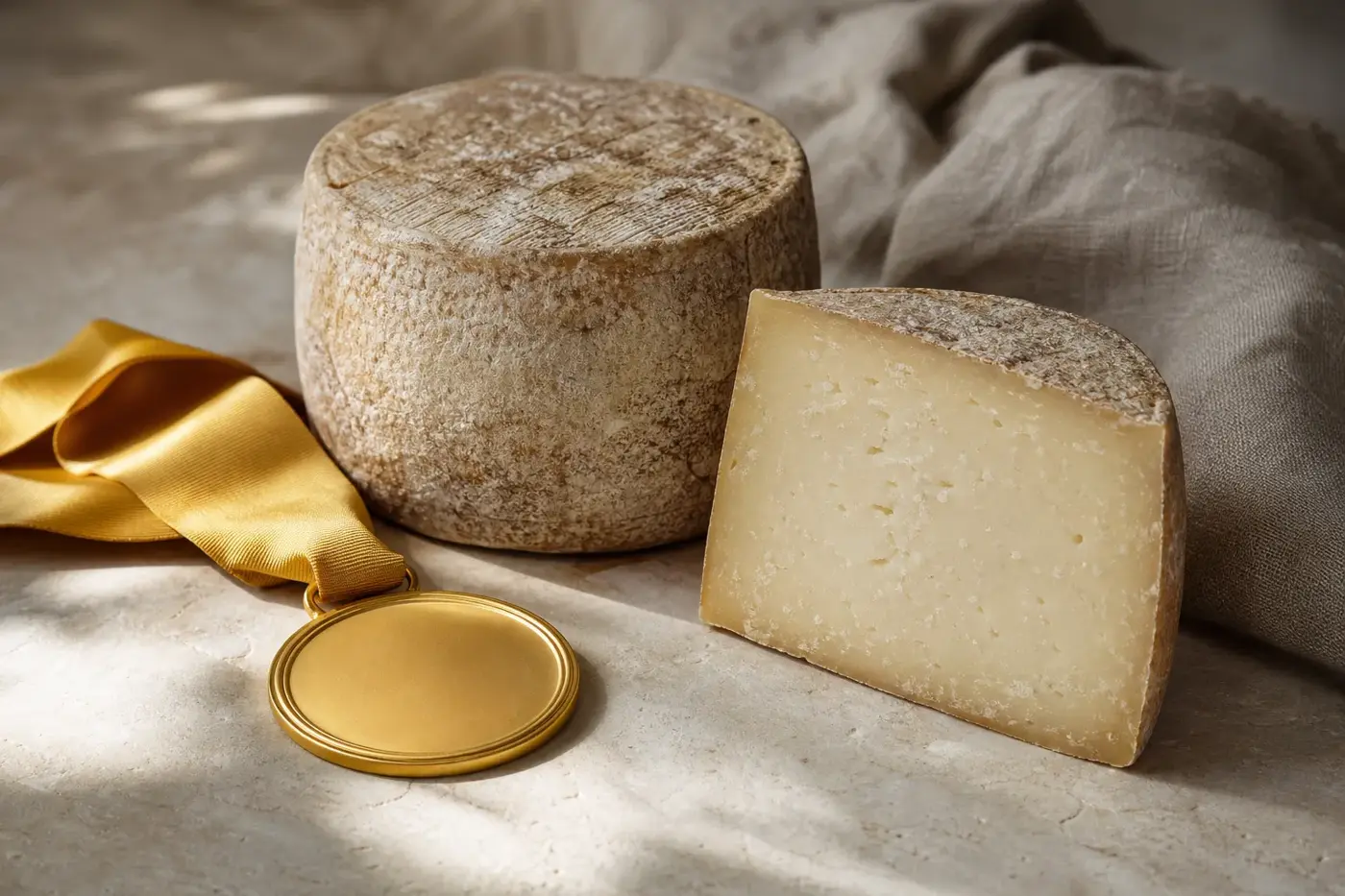
A pin, a medal and a personalised diploma: a successful candidate receives all three on joining the Italian delegation of the Guilde Internationale des Fromagers. The ceremony welcomes a person into a cheese community. [5] A World Cheese Awards medal recognises something quite different: an entered cheese. An SCA membership gives a cheesemaker access to technical support. [1,2,4,12]
Put those distinctions side by side and you can see why the details matter. They tell you who supports the trade, what someone has learnt or contributed, and how judges assessed a particular product. Even in cheese, not every badge belongs on the same lapel.
Look beyond the badge
First, ask what is being recognised. A trade association brings businesses or individuals together for representation, information and practical support. A guild builds professional fellowship and recognises participation or contribution. An educational body sets a syllabus and assessments, while a product competition judges entries under its own rules. [1,4,6,12]
Be precise: membership of which body, certification at which level, recognition for what work, or a medal in which competition? Several distinctions can sit beside the same name, but reading each in full tells you more than treating them as interchangeable badges of expertise. For a broader introduction, begin with the complete cheese guide.
The SCA: practical support behind the cheese
Behind the cheese are technical questions, practical decisions and a need for representation. The Specialist Cheesemakers Association (SCA) describes its mission as encouraging excellence in cheesemaking through best practice, technical information, representation to government and networking. Its focus is the artisan and speciality cheese sector, with membership support reaching the UK, Ireland and the wider international trade. [1,3]
You do not have to make cheese to find a place here. Membership categories include cheesemakers, retailers and wholesalers, suppliers and associates, and also accommodate environmental health officers. Associates include chefs, caterers and interested consumers, connecting the people making cheese with those selling it, supplying equipment or supporting the sector. [2]
For cheesemaker, retailer and wholesaler members, the SCA lists technical documents, a technical query service and its Assured Code of Practice. Support also includes participation in its Primary Authority partnership, workshops and seminars. Its secretariat represents members on trade and market access issues, giving a small dairy a practical reason to join: access to informed professional support. [3]
The Guilde: a welcome among cheese people
Companionship and passing on knowledge sit at the heart of the Guilde Internationale des Fromagers. This French non-profit association has an international network of cheesemakers, dairy producers, processors, affineurs, meaning cheese maturers, traders and retailers. Its associated Confrérie de Saint-Uguzon also welcomes people from gastronomy, science, journalism and other interested circles. [4]
Induction, called intronisation, brings a person into that community. The Italian delegation describes two application routes: you can put yourself forward or be proposed by a member. Its council evaluates applications, and successful candidates receive that ceremonial welcome with a pin, medal and personalised diploma. This is the Italian delegation’s published process; if you are applying elsewhere, approach your own delegation. [5]
Guilde induction recognises admission to a professional community, rather than a regulated qualification. To check a claim to a regulated qualification, ask for its awarding organisation, assessment and relevant regulator record. A ceremonial diploma and an examination certificate record different routes to recognition. [5,6,9]
The Academy of Cheese: give your learning a direction
The Academy of Cheese offers four certifications: Level One Associate, Level Two Member, Level Three Fellow and Master of Cheese. Its structured study route welcomes enthusiasts as well as professionals. The Academy describes its accreditation as industry recognised; regulated status is a separate question, checked through the relevant regulator for the jurisdiction. [6]
Keep the full title when describing Level Two Member: it is the name of an educational certification. Shorten it to “membership” and you lose that distinction. The Academy says learners complete each level and pass its examination before progressing; its published FAQ describes online examinations for Levels One, Two and Three, with practical assessment introduced at Master of Cheese. [6,7]
You can choose classroom teaching, live virtual teaching or self-study within the same certification framework. [6,7] Pick the approach that suits how you learn and the assessment you want to undertake. The separate courses and qualifications guide covers detailed course selection, but the distinction here is simple: completing assessed study is different from joining a professional network.
The American Cheese Society: put experience to the test
Your working experience counts towards the route to becoming an ACS Certified Cheese Professional, usually written ACS CCP. [9,10] The credential offers a useful international comparison within the American Cheese Society (ACS). Its activities bring together membership, educational resources, a conference, competition and certification. [8]
As of November 2026, ACS gives two eligibility routes: 4,000 hours of documented cheese work during the previous six years, or 2,000 hours of such work plus 2,000 hours combining work and eligible education or professional development. Relevant work includes cheesemaking, retail, wholesale, importing, teaching and other cheese professions. Read ACS’s definitions before counting your hours towards an application. [10]
The CCP examination comprises 150 multiple-choice questions, with a maximum of three hours. It assesses cheese knowledge and best practices across professional roles. [9] Certification requires renewal every three years; ACS currently specifies 1,000 hours combining relevant work, education or professional development over that period, and reserves discretion to require continuing education credits. [11]
If you are looking into a credential, ask whether certification is current, not just when the original examination was passed. ACS provides a certification directory alongside its programme information. That gives you a clear starting point for the enquiry. [8,11]
Three competitions, three different stories
A competition’s entry pool and award structure shape what its results mean. These three events use different frameworks, so a little context makes their medals much more useful to you. The comparison reflects organiser information for November 2026; entrants should consult the relevant year’s schedule. [12,14,17]
| Competition | Organiser | What can enter | How awards work |
|---|---|---|---|
| World Cheese Awards | Guild of Fine Food. [12] | International dairy cheese entries from eligible producers, importers, distributors and independent retailers. Trade entries need producer details. [12] | Bronze, Silver, Gold and Super Gold; an International Supreme Jury selects the World Champion. [12] |
| British Cheese Awards, now British & Irish Cheese Awards | Royal Bath & West Society. [14] | Cheeses produced in Britain and Ireland, with separate results for retailers and other entrants. [14,15] | Points determine Bronze, Silver and Gold; the competition culminates in a Supreme Champion. [14,15] |
| International Cheese and Dairy Awards | ICDA organising team, within the International Cheese & Dairy Expo. [16,17] | Cheese and other dairy classes, with eligibility specified for UK, non-UK or all producers. [17] | Expert panel assessment, class awards and trophies, with separate retailer classes. [17] |
The World Cheese Awards’ published 2026 judging date is 12 November 2026. On 7 November 2026, that judging was still ahead. [13] Give a badge carrying a season that spans two years the same close attention: match it to the organiser’s actual result record.
What takes a cheese from tasting table to trophy?
Flavour, texture, aroma, presentation and technical merit all feature in the ICDA’s general entry guidance. It describes blind judging by industry panels, although particular class descriptions can expressly permit branded packaging. Read the class rules alongside the competition name: they explain how a cheese will be assessed. [17]
Categories set the terms of the comparison. The ICDA schedule separates cheeses by criteria including style, production location and market channel, and allows a product to enter more than one relevant class. [17] If you would like to understand the style differences before comparing results, turn to the guide to cheese styles.
A medal, a category championship and an overall title mark different stages or kinds of recognition. At the British & Irish Cheese Awards, published medal results exclude entries that failed to reach the necessary points. The World Cheese Awards’ published award list includes Super Gold as well as Gold, Silver and Bronze, alongside the overall World Champion. [12,15]
The result records the cheese presented to the judges. Organisers’ sample-based entry and judging procedures make an award a judgement of that entered sample, not a promise that every cheese or batch will taste identical. Assess a later batch in its own right, using the competition result as helpful context. [13,17]
Follow that medal back to the cheese
Start with the organiser’s record. An award logo, cropped badge or retailer’s shortened description can send you looking, but the official result supplies the detail you need. A medal deserves admiration, not a free pass past the small print.
- Find the competition and year. Look for the official results for that edition. The British & Irish Cheese Awards results page separates 2026 from earlier years and provides retailer and non-retailer downloads. [15]
- Match the exact cheese. Compare the product name and named producer with the result. The World Cheese Awards publishes company and product names as entered, so pay close attention to spelling and product identity. [12]
- Read the category. Establish whether the result concerns a style class, retailer entry, territorial award or another defined group. The ICDA schedule shows how much the class description can change the comparison. [17]
- Confirm the award level. Use the organiser’s exact wording. Gold, Super Gold and an overall championship are distinct descriptions; keeping the full title preserves the result’s meaning. [12]
If several versions of a cheese share a family name, ask the seller which one matches the award entry. Look for the specified maturity, format or other distinguishing description wherever the official record supplies it. A producer may offer several products, so attach the result to the named cheese, not the whole range.
Keep the result beside the product information as you compare them. The guide to reading a cheese label helps with the next part of your enquiry. Record six things: competition, edition, cheese, producer, category and the exact award. Together, they give you enough detail to return to the claim and check it again later.
MBE and OBE: the person behind the honour
UK national honours recognise a person’s achievement or service. MBE means Member of the Order of the British Empire; OBE means Officer of the Order of the British Empire. Government guidance describes an MBE as recognising outstanding achievement or service to the community with significant, long-term impact. An OBE recognises a major local role, including work that has made someone known nationally in their field. [18,19]
For someone working in cheese or dairy, the published citation explains which service was recognised. The honour belongs to the person and their contribution; a competition medal belongs to its recorded product result. Keep those meanings distinct when you read a business biography placing national honours beside industry distinctions. [18,19]
If you want to nominate someone, start with the GOV.UK honours guidance. It directs nominators to routes for people contributing in the UK or overseas. Focus on the person’s achievement and impact: an honours committee decides whether an honour is awarded and which one. You put forward the person, rather than selecting an MBE or OBE. [18,19]
Choose the route that means something to you
For professional support, begin with the work you do. If you are a cheesemaker seeking technical discussion and representation, the SCA’s membership categories and services are a useful place to start. For international fellowship and recognition, explore the Guilde and the admission process published by the relevant local delegation. [2,3,4,5]
For a credential, compare entry requirements, syllabus, assessment and upkeep. The Academy offers a progressive study route beginning with Level One, while ACS CCP combines documented professional experience with an examination and recurring renewal. Look at the learning or experience each route records, then consider how well it fits your work. [6,9,10,11]
For award-winning cheeses, build a shortlist from official results, then choose a style and maturity you enjoy. Ask a cheesemonger to identify the exact award-winning product and explain how the piece available now relates to it. The most useful recommendation brings three things together: the result, a clear product identity and a description of the cheese in front of you.
Questions people ask
What is the difference between joining a cheese guild and gaining a qualification?
Guilde induction admits a person to a professional community rather than conferring a regulated qualification. The Academy of Cheese offers certifications through a structured study and examination route.
How do I join the Guilde Internationale des Fromagers?
The Italian delegation says you can put yourself forward or be proposed by a member. Its council evaluates applications, while applicants elsewhere should approach their own delegation.
How do I become an ACS Certified Cheese Professional?
As checked in November 2026, ACS offered two eligibility routes based on documented hours of cheese work, with eligible education or professional development counting towards one route. Candidates also take a 150 question examination, and certification requires renewal every three years.
What does a World Cheese Awards medal mean?
The World Cheese Awards gives Bronze, Silver, Gold and Super Gold awards, and an International Supreme Jury selects the World Champion. An award records the judges’ assessment of the entered sample, rather than promising that every cheese or batch will taste identical.
How can I check whether a cheese has won an award?
Start with the organiser’s official results for the relevant competition and year. Match the exact cheese and producer, then check the category and the organiser’s wording for the award.
Sources
- Specialist Cheesemakers Association, About Us, undated live statement, checked November 2026.
- Specialist Cheesemakers Association, Become a Member, live membership categories, checked November 2026.
- Specialist Cheesemakers Association, Membership Benefits, undated live description, checked November 2026.
- Guilde Internationale des Fromagers, About us, undated live statement, checked November 2026.
- Guilde Internationale des Fromagers, Italian delegation, Cerimonia di Intronizzazione: come iscriversi o suggerire un nuovo Socio, undated live admission guidance, checked November 2026.
- Academy of Cheese, Study Cheese, live certification framework, checked November 2026.
- Academy of Cheese, FAQ's, live certification and assessment guidance, checked November 2026.
- American Cheese Society, Home, live programme and resource navigation, checked November 2026.
- American Cheese Society, Certified Cheese Professional® (CCP) Exam, live page including 2026 examination arrangements, checked November 2026.
- American Cheese Society, Eligibility Criteria, live certification requirements, checked November 2026.
- American Cheese Society, Recertification, live requirements including the 2026 renewal period, checked November 2026.
- Guild of Fine Food, World Cheese Awards, Terms & Conditions, published May 2026.
- Guild of Fine Food, World Cheese Awards, 2026 event and entry information, checked November 2026.
- Royal Bath & West Society, About, British & Irish Cheese Awards live description, checked November 2026.
- Royal Bath & West Society, Results, British & Irish Cheese Awards, including 2026 result downloads and medal inclusion rule.
- International Cheese and Dairy Awards, 2026 entry portal, and International Cheese & Dairy Expo, official event website, checked November 2026.
- International Cheese and Dairy Awards, International Cheese & Dairy Awards Schedule, 2026 edition.
- UK Government, Nominate someone for an honour or award: Types of honours and awards, live guidance, checked November 2026.
- UK Government, Nominate someone for an honour or award: Overview, live guidance and nomination routes, checked November 2026.
Researched through the organisations' own membership, certification and competition documents, with UK Government guidance used for national honours.
Last checked: November 2026
Last checked November 2026.
The editors suggest you read next