Recommended Cheese Books: An Annotated Reading Guide
You spot the Cheddar first.
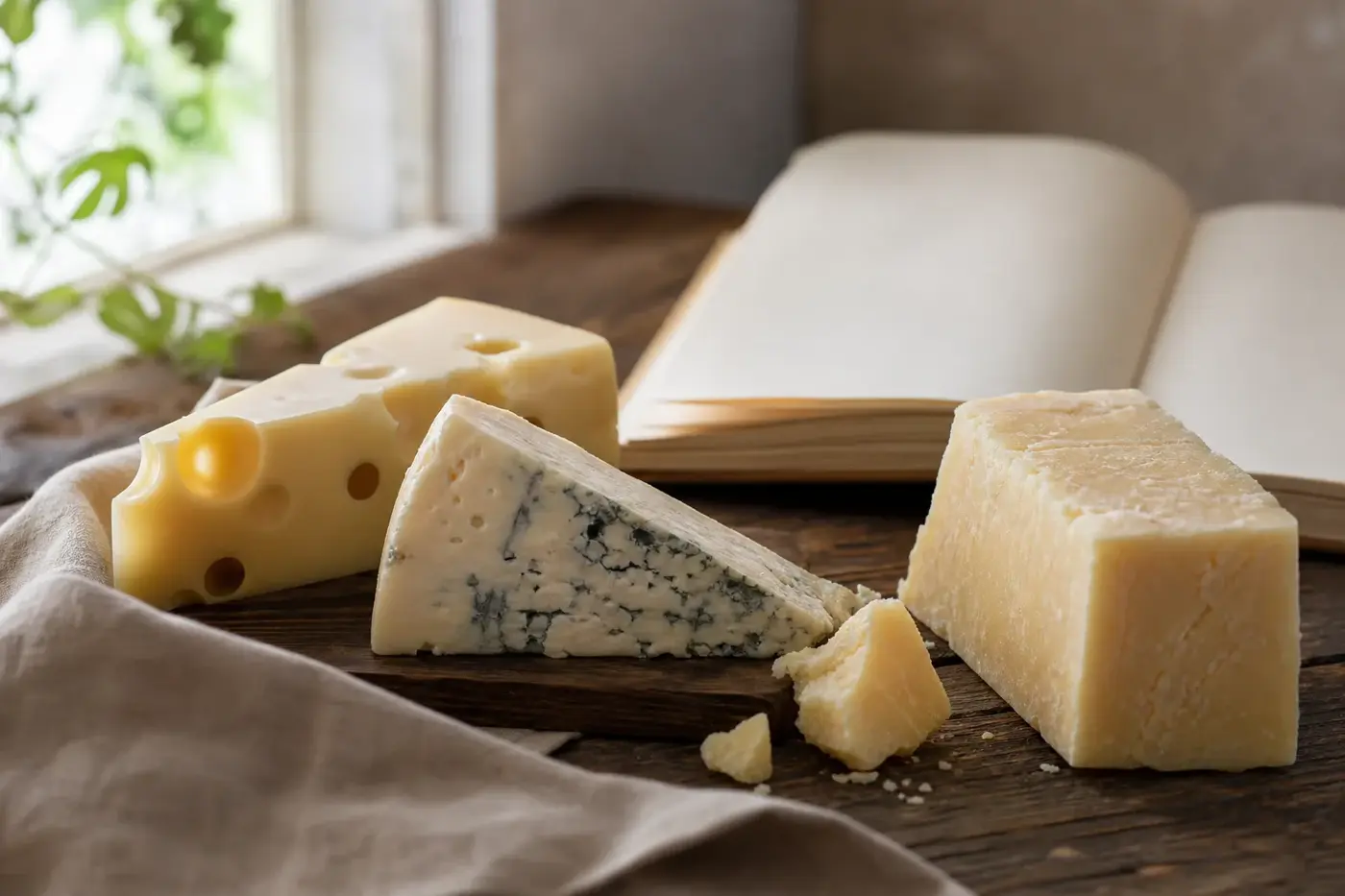
You spot the Cheddar first. The Swiss and blue look familiar, too, and suddenly the cheese counter feels less like an exam. In Liz Thorpe’s The Book of Cheese, those three are among nine “gateway” cheeses: familiar favourites that lead you towards their neighbours, without making you learn a map first. [3]
That is a deliciously approachable place to begin. If people and places draw you in faster than flavour charts, try Ned Palmer instead. For a deeper adventure, build your shelf around three questions: what cheese tastes like, how it works, and how it came to be.
Seven books, seven ways into cheese
These seven books take you from choosing cheese and exploring flavour to reference, history, science and cheesemaking. The selection draws on publisher descriptions, bibliographic records and available contents or extracts. The reading order and suitability recommendations are editorial judgements based on those materials.
If you are starting from scratch, Thorpe offers the clearest first step. Which cheeses do you already enjoy? That question gives you something useful to take to the next cheese counter, especially alongside the guide to telling cheese styles apart.
Let your curiosity choose the route:
| What would you like to know? | Start here | Turn to this next |
|---|---|---|
| What might I enjoy next? | The Book of Cheese | Cheese Primer |
| How do people and places shape cheese? | Palmer’s British Isles history | Cheese and Culture |
| Why does cheese behave this way? | The Science of Cheese | The Oxford Companion to Cheese |
| What underpins natural cheesemaking? | The Art of Natural Cheesemaking | Scientific reading and specialist tuition |
These are routes, not rankings. Rural history and the science of melting call for different guides. Follow the question that makes you reach for a book, rather than the one you think sounds most impressive.
Cheese Primer: pull up a chair with an opinionated cheesemonger
Steven Jenkins. Workman Publishing Company, paperback published 1 November 1996. ISBN 9780894807626. The publisher calls it Cheese Primer, without an initial “The”. [1]
Buying, serving and discovering regions give Jenkins’s book its practical backbone. You move from introductory material and the cheese counter into France, Italy, Switzerland, the British Isles, Spain, the United States and other producing countries. It is a substantial geographical introduction, with a cheesemonger’s concerns guiding the journey. [1, 2]
The attraction is the voice. The publisher explicitly offers Jenkins’s considered opinions, so expect an experienced advocate whose preferences invite you to answer back. You are allowed to disagree with a book, even a substantial one.
Choose it for: sharpening your questions at the cheese counter and connecting individual cheeses with their regions. Agreement with every judgement is not a condition of learning what to ask.
Keep the date in mind: this edition belongs to 1996, including its references to suppliers, imports and availability. Read the regional chapters alongside current sources. Treat the practical details as a historical picture, not today’s shopping checklist.
The Book of Cheese: let your favourite flavours lead
Liz Thorpe. The Book of Cheese: The Essential Guide to Discovering Cheeses You’ll Love. Flatiron Books, 26 September 2017. ISBN 9781250063458. [3]
Thorpe begins with what you already like. Her nine familiar “gateway” cheeses organise the journey instead of country or milk species, with Swiss, blue and Cheddar among the publisher’s examples. Flavour and aroma wheels, charts and photographs help you move from familiar favourites towards related cheeses. [3]
For a beginner, this is a welcoming arrangement. You need not memorise a continent’s worth of names before the book becomes useful. Start with one recognisable style, then go looking for its neighbours.
Choose it for: deciding what to explore next and finding words for what you enjoy. A preference becomes much more useful when you can describe it to someone across a cheese counter.
Make the gateways work for you: treat each grouping as a learning device, then explore individual cheeses’ production and origins separately. Pick a familiar style, identify its appeal and take that observation to a cheesemonger. “I like a firm texture but want something less sharp” gives someone a question they can help answer.
The Oxford Companion to Cheese: follow a question down the shelves
Edited by Catherine Donnelly.
Sooner or later, “what should I try next?” becomes a more particular question. That is your cue to reach for The Oxford Companion to Cheese. Its place here is as a reference for deeper investigation, rather than an easy first guide to choosing cheese. [4]
Give yourself a question before opening it. Note the term, cheese or process you want to understand, find the relevant entry and record references that might take you further. Keep the entry’s explanation distinct from the evidence behind it.
Choose it for: building a research habit and moving beyond an introductory account. A good reference work helps you find the next source, as well as answering the question that brought you to it.
Leave room to pause: keep a notebook of connected questions rather than trying to remember everything at once. If several unfamiliar production terms arrive together, return to how cheese is made, then pick up the detailed reading again. You want connections you can follow, not every entry committed to memory in one sitting.
Cheese and Culture: look beyond the cheeseboard
Paul Kindstedt. Cheese and Culture: A History of Cheese and its Place in Western Civilization. Chelsea Green Publishing, paperback published 3 January 2013. ISBN 9781603585064. [5]
Step back from an individual cheese and the picture opens out. Technology sits within environment, society and culture, and those connections drive Kindstedt’s approach. The publisher describes a story running from the Neolithic period through later historical eras, exploring how cheesemakers and their circumstances shaped what they produced. [5]
After a tasting or shopping guide, this gives you a wider view. Your attention moves from the cheese itself to the society around its production. The pleasure of eating leads to the equally absorbing question of how it all came about.
Choose it for: exploring a food’s development through technology, environment and social organisation. This is history with cheese at the centre of the enquiry, rather than simply on the table.
Notice the boundaries: Western civilisation is the focus named in the subtitle. You get a substantial historical perspective within that scope. Other regional histories can join it as your interests widen.
Take one period at a time rather than rushing through the centuries. In your notes, give the author’s historical argument one column and the evidence offered for it another. That lets you enjoy the narrative’s sweep while keeping sight of questions worth closer research.
A Cheesemonger’s History of the British Isles: meet the people behind the cheese
Ned Palmer. Profile Books, hardback published 24 October 2019; paperback published 1 October 2020. Paperback ISBN 9781788161176. [6]
Palmer starts behind a cheese counter and asks how today’s assortment came to be. If stories draw you in more readily than classifications, the opening offers a persuasive invitation. A familiar encounter with cheese becomes a much bigger historical question.
The story unfolds across ten periods, each accompanied by a cheese that helps characterise its era. Palmer’s introduction explains his route through the histories of Britain and Ireland. Historical questions, cheesemonger knowledge and accounts of makers all have a place along the way. [6, 7]
Choose it for: an accessible journey through British and Irish cheese. People and individual cheeses give you something to hold on to as the history becomes less familiar.
Follow the thread: this is a geographically focused history with a clear authorial perspective. The modern cheese accompanying each period gives you a way into that chapter’s subject. It is an invitation to explore, not a reason to stop asking questions.
When an episode catches your attention, turn to Palmer’s sources and further reading. His structure gives you a route through the history and places to pause. Take those pauses as opportunities to pursue something beyond the narrative.
The Art of Natural Cheesemaking: meet the thinking behind the methods
David Asher. Chelsea Green Publishing, 8 July 2015. ISBN 9781603585781. [8]
Asher has a case to make, as well as methods to explain. Practical cheesemaking comes with an explicit preference for traditional, non-industrial approaches. That philosophy gives the book its character and makes reading it alongside other sources particularly valuable.
The publisher describes coverage of milk, cultures, rennet, salt, equipment and ripening spaces. Maintaining bacterial and fungal cultures is part of the territory, too. Raw milk also falls within the book’s stated scope. [8]
Choose it for: investigating Asher’s approach to cultures, ingredients and small-scale practice. Keep his philosophy in view as you explore the methods, rather than treating the two as separate subjects.
Put science first: understand the scientific principles before examining where his choices differ from other approaches. Before attempting a method, obtain specialist instruction that checks its safety-critical controls against guidance for your country.
You may also encounter Asher’s Milk Into Cheese, published by Chelsea Green and dated 11 July 2024. The publisher describes it as a companion expanding the earlier book’s coverage. Compare it as a separate work, not as an assumed revised edition of this one. [9]
The Science of Cheese: get curious about the melt
Michael H. Tunick. Oxford University Press, 2014 bibliographic record. Print ISBN 9780199922307. [10, 11]
Watch what cheese does when heated and you have something tangible to puzzle over. Tunick uses melting, texture and sensory questions as ways into the science. The structure offers a useful bridge between general curiosity and technical study.
His contents connect stretched-curd cheeses with melting, surface-mould cheeses with sensory questions, cheddared cheeses with texture, and washed-curd cheeses with feed and milk species. Introductory chapters cover milk, cheesemaking and ageing. You can start with a familiar observation and follow it towards the explanation underneath. [10]
Choose it for: understanding why production choices lead to different textures, aromas and behaviour in cooking. Here, an everyday observation becomes a scientific question you can pursue.
Give yourself room: expect more technical vocabulary than a discovery guide needs. Read selectively at first, using the glossary and references to support whichever chapters catch your interest. There is no obligation to swallow the glossary whole.
If you are a curious cook, try one scientific chapter and note a practical question it raises. If you hope to make cheese, take those questions to a tutor. Understanding an explanation and controlling a process in practice are different learning tasks, and both deserve your attention.
Find a reading route you will want to follow
New to cheese? Begin with a favourite
Start with Thorpe and explore one familiar gateway. Then try a regional chapter from Jenkins, or choose Palmer if a story keeps you turning pages. Keep a short list of questions, not a long list of cheeses you feel obliged to memorise.
Curious cook? Give your kitchen questions a page
Begin with Thorpe to clarify your preferences, then turn to Tunick’s chapters on texture and melting. Give your notebook three headings: what the book explains, what you notice in cooking, and what remains uncertain. Keep your observations separate from explanations still awaiting examination.
Aspiring cheesemaker? Learn what every control does
Read milk treatment explained and the production overview before approaching a recipe collection. Follow with Tunick, then consider Asher’s philosophy alongside specialist teaching. Ask a tutor what each control does, how you measure it and what happens when a batch misses it.
Experienced enthusiast? Let the authors talk to each other
Make the Oxford Companion the centre of a question-led reading programme. Add Kindstedt for a broad historical argument, Palmer for Britain and Ireland, and Jenkins for a strongly expressed cheesemonger’s perspective. Compare how they frame the same subject, rather than expecting everyone to agree.
Choosing your copy: the details worth a closer look
Check the ISBN, format and publication statement when choosing your copy. Profile’s UK catalogue lists Palmer’s 2019 hardback, 2020 paperback and 2021 audiobook as separate format records. A later date on a different format does not, by itself, tell you that the text has been substantially revised. [6]
For the other books, use the identified ISBNs to consult a publisher’s current UK listing or a library catalogue. Availability changes, and an international publisher record answers a different question from a UK supplier’s listing. Look for an explicit edition statement or description of revisions.
Older books belong alongside contemporary regulations, protected-name status and food safety guidance. For current protection questions, follow protected names explained to the relevant official records. Let the book open the subject, then use those records for the current position.
For storage in England, Northern Ireland and Wales, the Food Standards Agency advice recorded in November 2026 is to keep your fridge between 0 and 5 °C and follow the storage instructions on packaging. Keep those practical instructions close at hand. [12]
For milk questions, go directly to the FSA’s current raw drinking milk guidance, keeping its stated subject distinct from a cheesemaking method. [13] Follow cheese food safety guidance to the country-specific official sources relevant to your circumstances.
General information only, not medical advice: follow the official guidance where you live.
Questions people ask
Which cheese book is best for a beginner?
The guide recommends Liz Thorpe’s The Book of Cheese as the clearest starting point. It begins with cheeses you already enjoy and leads towards related cheeses.
Which book explores the history of British and Irish cheese?
Ned Palmer’s A Cheesemonger’s History of the British Isles follows the histories of Britain and Ireland through their cheeses. It brings together historical questions, cheesemonger knowledge and accounts of makers.
Which book explains why cheese melts or develops different textures?
Michael H. Tunick’s The Science of Cheese connects stretched curd cheeses with melting and cheddared cheeses with texture. It also covers milk, cheesemaking and ageing.
Is Milk Into Cheese a revised edition of The Art of Natural Cheesemaking?
The publisher describes David Asher’s Milk Into Cheese as a companion that expands the earlier book’s coverage. The guide says to treat it as a separate work rather than assume it is a revised edition.
What fridge temperature does the Food Standards Agency recommend for storing cheese?
For England, Northern Ireland and Wales, the Food Standards Agency advises a fridge temperature between 0 and 5 °C and following the storage instructions on packaging. Consult the Food Standards Agency’s current guidance.
Sources
[1] Hachette Book Group. Cheese Primer, Workman Publishing Company, paperback record dated 1 November 1996. Publisher record.
[2] Indiana University Libraries, IUCAT. Cheese primer / Steven Jenkins, first-edition bibliographic record, Workman, 1996. Library record.
[3] Macmillan, Flatiron Books. The Book of Cheese: The Essential Guide to Discovering Cheeses You’ll Love, publication record and description, 26 September 2017. Publisher record.
[4] fromage.co.uk. A019 commissioning brief, supplied November 2026. Establishes the requested title, editor and reference role of The Oxford Companion to Cheese.
[5] Chelsea Green Publishing. Cheese and Culture: A History of Cheese and its Place in Western Civilization, paperback record and description, 3 January 2013. Publisher record.
[6] Profile Books. A Cheesemonger’s History of the British Isles, format records and publisher description, 2019, 2020 and 2021. Publisher records.
[7] Palmer, Ned. A Cheesemonger’s History of the British Isles, Profile Books, 2019, publisher-supplied extract: copyright page, contents and introduction, pp. 7 to 9. Publisher extract.
[8] Chelsea Green Publishing. The Art of Natural Cheesemaking: Using Traditional, Non-Industrial Methods and Raw Ingredients to Make the World’s Best Cheeses, publication record and description, 8 July 2015. Publisher record.
[9] Chelsea Green Publishing. Milk Into Cheese: The Foundations of Natural Cheesemaking Using Traditional Concepts, Tools, and Techniques, publication record and description, 11 July 2024. Publisher record.
[10] Tunick, Michael H. The Science of Cheese, Oxford University Press, 2014 record and contents displayed in Google Books. Bibliographic record and contents.
[11] FAO AGRIS, record supplied by the US National Agricultural Library. The science of cheese, Oxford University Press, 2014. Library record.
[12] Food Standards Agency. How to chill, freeze and defrost food safely, published 18 December 2017, current retrieved guidance for England, Northern Ireland and Wales. Official guidance.
[13] Food Standards Agency. Raw drinking milk, published 9 January 2018, current retrieved guidance for England, Northern Ireland and Wales. Official guidance.
Researched through publisher catalogues, library records, available book extracts and official Food Standards Agency guidance; reading routes and suitability assessments are editorial synthesis.
Last checked: November 2026
Last checked November 2026.
The editors suggest you read next
Cheese Courses and Qualifications
Twenty-five cheeses in front of you, each with something to teach your palate.