Cheese, Saturated Fat and the Dairy Matrix: What the Evidence Says
On one side of a controlled trial sits 120 g of full-fat Cheddar.
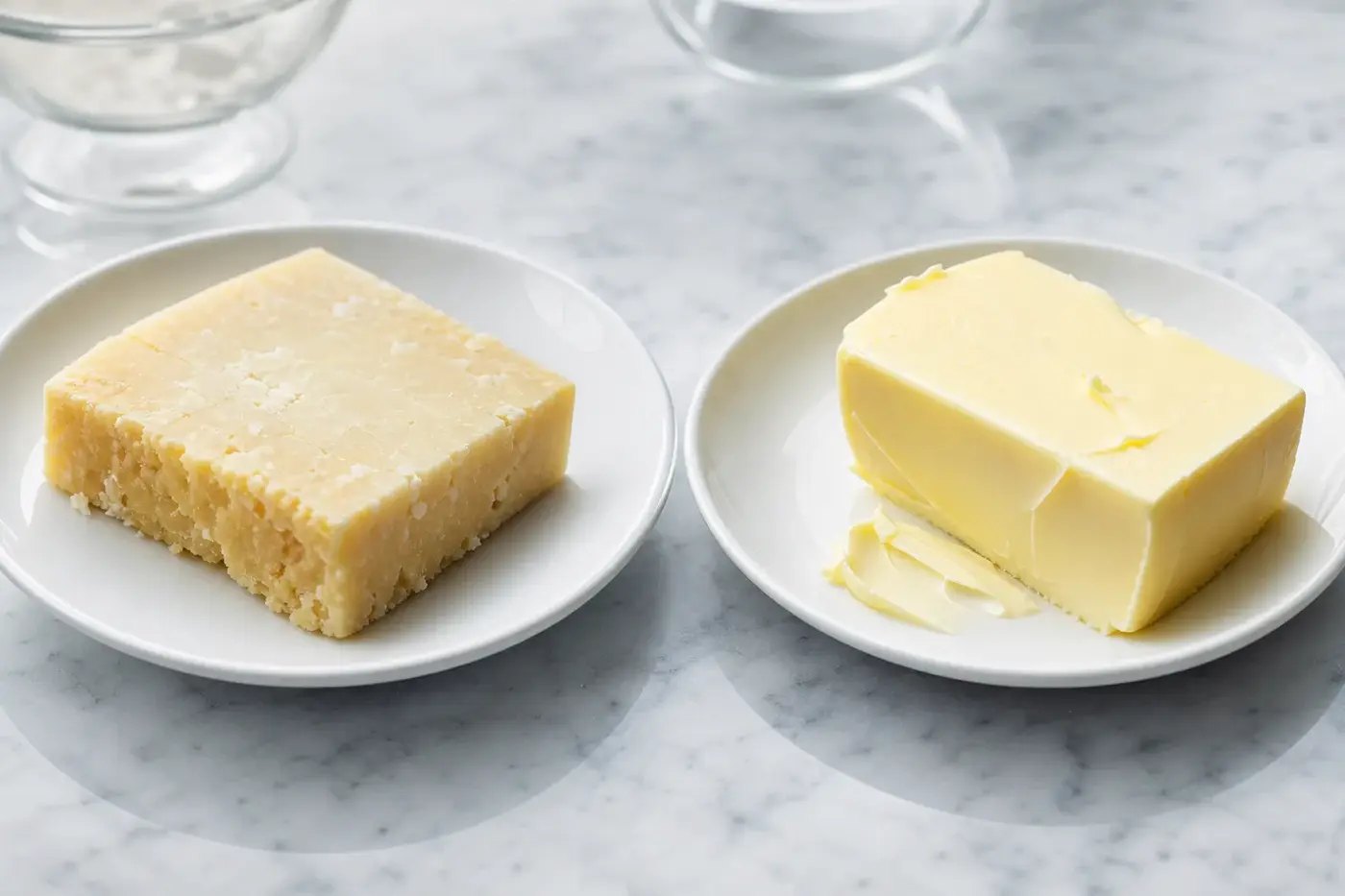
On one side of a controlled trial sits 120 g of full-fat Cheddar. On the other, a butter-based comparison supplying a similar amount of dairy fat. The Cheddar produces a greater reduction in LDL cholesterol. Same sort of fat, different food, different response. [1]
That gives you a question worth following: does fat behave differently inside cheese? The dairy matrix, the food's structure and the nutrients held within it, offers a plausible explanation. This evidence distinguishes between foods; it does not establish cheese as a heart-health food. [1]
Saturated fat and LDL: get to know the difference
Saturated fat and blood cholesterol are related, but they are not the same substance. Saturated fat is a category of fat whose fatty acids have no carbon-to-carbon double bonds. Cheese contains saturated and unsaturated fatty acids, so the saturated fat figure on your label tells only part of its total fat story. [2]
LDL stands for low-density lipoprotein, a particle carrying cholesterol in your blood. According to the UK NHS, eating too much saturated fat can raise LDL cholesterol. That increases the risk of heart disease and stroke. [3]
The UK Scientific Advisory Committee on Nutrition, SACN, assessed controlled trials and prospective studies in its 2019 report. It concluded that reducing saturated fat lowers LDL cholesterol and reduces cardiovascular and coronary heart disease events. Evidence was stronger for replacing saturated fat with polyunsaturated fat than for several other replacements. [4]
Keep that wider picture beside you as you explore cheese research. Comparing cheese with butter tells you which of those two foods produces a different response. Your everyday question is separate: what happens when either food replaces something else?
Inside cheese, everything has its place
Picture fat held inside a protein-rich cheese structure, with calcium alongside it. Does your body respond differently when that fat arrives as butter, with the other nutrients supplied separately? That question is at the heart of dairy matrix research. [1]
The matrix means both a dairy food's physical structure and its combination of nutrients. A nutrition panel gives you an inventory of fat, protein and other nutrients, but says little about their arrangement. It is a guest list, not a seating plan.
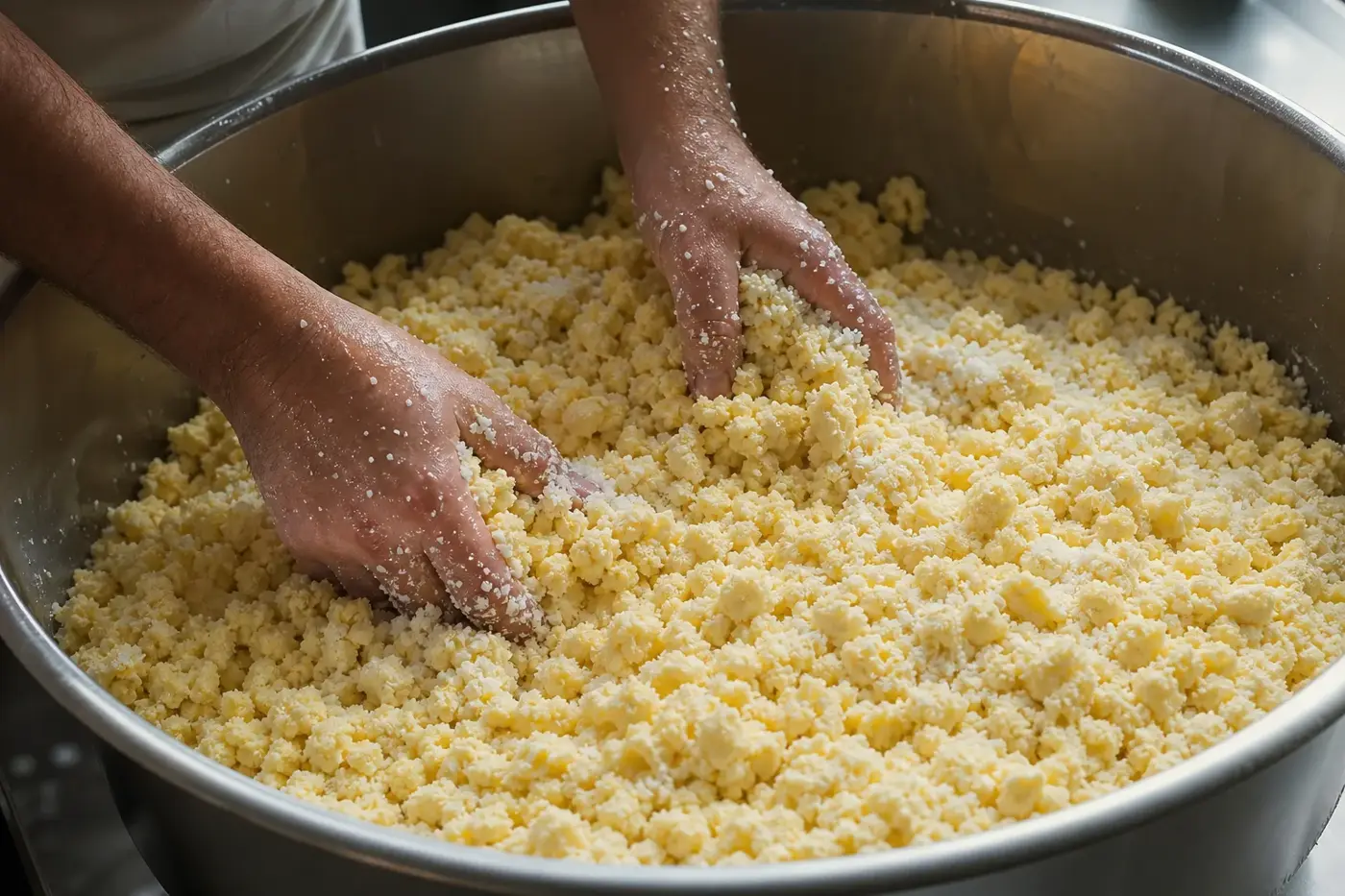
Cheesemaking turns milk from a liquid dispersion into curd, the coagulated, protein-rich material from which cheese is formed. Draining whey, the liquid released from curd, removes water and some dissolved constituents. The retained fat, protein and minerals become concentrated, in proportions that depend on the method. You can follow the fuller process in how cheese is made.
Matrix research asks whether that arrangement changes the body's response. It is why “dairy” can be too broad a category for a research question: milk, cheese and butter have distinct structures and nutrient combinations. A finding about one cannot simply be handed to the others. [1]
Calcium and fermentation: looking for the explanation
Calcium, cheese structure and fermentation have all been proposed as explanations for different responses to dairy foods. You might be tempted to pick a favourite explanation. The trial cited here, however, establishes no individual mechanism. [1]
Showing an effect and explaining it are different jobs. A trial can demonstrate different cholesterol responses under particular conditions. Discovering what caused the difference needs further measurements and comparisons.
The clearest structural question sounds simple: if you match the amounts of fat, protein and calcium, do you also match the response? If not, their arrangement becomes a candidate explanation. Researchers must also account for nutrients' different chemical forms, participants' adherence and the rest of their diets. [1]
Fermentation is especially hard to separate from finished cheese. It happens alongside changes in acidity, moisture and protein structure. To identify its contribution, researchers need a comparison that separates fermentation from those accompanying changes. Cheese against butter alone cannot settle it.
When Cheddar and butter entered the trial
A six-week randomised study published in 2018 tested dairy fat in different structures. It recruited adults aged at least 50 with overweight: 203 were randomised and 164 completed the intervention. The principal comparisons supplied approximately 40 g of dairy fat daily. [1]
| Food supplied each day | What the comparison explored | What happened to cholesterol |
|---|---|---|
| 120 g full-fat Cheddar | Fat held within the cheese structure | Greater LDL reduction than the butter-based comparison |
| Reduced-fat Cheddar plus 21 g butter | Fat held partly within cheese | A response between the other two |
| 49 g butter, protein powder and calcium supplement | Similar nutrients supplied separately | Smaller LDL reduction than full-fat cheese |
The diets were matched as closely as possible for energy, fat, casein protein and calcium. Participants otherwise lived freely, with restrictions on other dairy intake. The main analysis included 127 participants who met the adherence threshold. [1]
There are important limits to keep in view. Unequal withdrawals and this analysis approach introduce potential bias. Dairy businesses supplied study foods, and the paper disclosed industry funding and affiliations. [1]
Even with those limits, this tells you more than a comparison between cheese and an unspecified “usual diet”. It examines similar nutrient packages arriving in different forms. Those quantities belong to the experimental design, though, not to a suggested daily cheese portion.
What cholesterol results can, and cannot, tell you
You can measure blood cholesterol before and after a relatively short dietary intervention. Investigating heart attacks and strokes generally takes much larger populations and longer follow-up. These are different research tasks, answering different questions.
The cheese matrix trial measured metabolic markers over weeks, not cardiovascular events. Its findings describe responses to the foods and quantities tested during that period. They do not reach beyond those conditions. [1]
SACN's broader assessment considered blood lipids and clinical outcomes. It found evidence that reducing saturated fat lowered cardiovascular events, while effects on cardiovascular mortality were less clear. Events and deaths are distinct outcomes: a non-fatal heart attack still matters. [4]
LDL is an intermediate marker relevant to cardiovascular risk; a heart attack is an eventual event. Turning a particular food comparison into an exact reduction in future heart attacks would need evidence beyond a short feeding trial. That is a bigger claim than this study can support.
Following cheese eaters through the years
The European EPIC study followed 418,329 participants across nine countries. Higher cheese intake was associated with a lower risk of ischaemic stroke, the type caused by an interrupted blood supply. Researchers assessed diets using country-specific questionnaires, calibrated against 24-hour dietary recalls. [5]
For each additional 30 g of cheese daily, the reported hazard ratio was 0.88, with a 95% confidence interval of 0.81 to 0.97. That is equivalent to a 12% lower relative rate in the study population. It describes an association, not a prediction of what happens if you add cheese to your diet. [5]
Prospective cohort studies like this record people's diets, then follow their subsequent health. They can explore outcomes beyond the reach of a short dietary trial. But participants choose their food rather than receiving a randomly assigned diet.
Those everyday choices make the results more complicated to interpret. Food questionnaires rely on recall and portion estimates, while diets may change after assessment. A broad cheese category can also gather together products with different compositions.
Statistical adjustment addresses recorded differences between participants. It cannot remove every influence of smoking, activity, income or the surrounding diet. Those influences still matter when you read the findings.
Then you come back to the replacement question. People eating more cheese necessarily eat a different combination of other foods. An association with cheese may partly reflect that combination, rather than an isolated effect of cheese itself.
Less saturated fat: what goes on your plate instead?
“Eat less saturated fat” gives you only half the story. The other half is the food supplying the energy you have displaced. Without it, you miss an important part of the evidence.
SACN recommends substituting unsaturated fats for saturated fats. Its assessment found that replacing saturated fat with polyunsaturated or monounsaturated fats lowered LDL cholesterol. Replacing it with carbohydrate lowered both LDL and HDL cholesterol, although many studies did not adequately distinguish carbohydrate types. [4]
An original US cohort analysis shows why that distinction deserves your attention. Researchers repeatedly assessed diet in two large cohorts and modelled substitutions between nutrients. Replacing 5% of dietary energy from saturated fat with polyunsaturated fat was associated with 25% lower coronary heart disease risk. Replacement with carbohydrate from whole grains was associated with 9% lower risk. [6]
Replacing saturated fat with refined starches or added sugars was not significantly associated with lower coronary risk. These were statistical estimates from observational data, not randomly assigned food swaps. Even so, they show why refined carbohydrate and unsaturated fat are different comparators. [6]
For practical UK guidance, the NHS identifies olive and rapeseed oils, nuts and other foods as sources of unsaturated fats. Its advice is to replace saturated fat with some unsaturated fat. Simply swapping one high-saturated-fat food for another is not the same thing. [3]
Your daily total includes what is on the cheeseboard
The NHS advice for November 2026 is that the average man should eat no more than 30 g of saturated fat a day, and the average woman no more than 20 g. That covers your whole diet. Cheese, butter, meat, pastries and other sources all count towards it. [3]
SACN's population recommendation is that saturated fatty acids contribute no more than about 10% of dietary energy. Its subsequent statement clarifying how energy recommendations are expressed retains that recommendation. The population percentage and the NHS's practical gram figures communicate dietary guidance in different ways. [2,4]
Cheese can form part of a balanced diet, according to the NHS. Because it can be high in saturated fat and salt, the NHS advises paying attention to how much and how often you eat it. It also recommends choosing lower-fat dairy options. [7]
To connect your label to your plate, multiply the per-100-g figure by the portion weight, then divide by 100. For a 30 g portion, multiply by 0.3. This works for saturated fat and salt alike; 30 g is a calculation example here.
Look at the whole dish, too. NHS suggestions include using less cheese or a lower-fat cheese in sauces, and choosing vegetable-based toppings instead of extra cheese and cured meat. These changes address the meal as a whole. The cheese matrix cannot be expected to compensate for everything alongside it. [8]
Give your cheese label a closer look
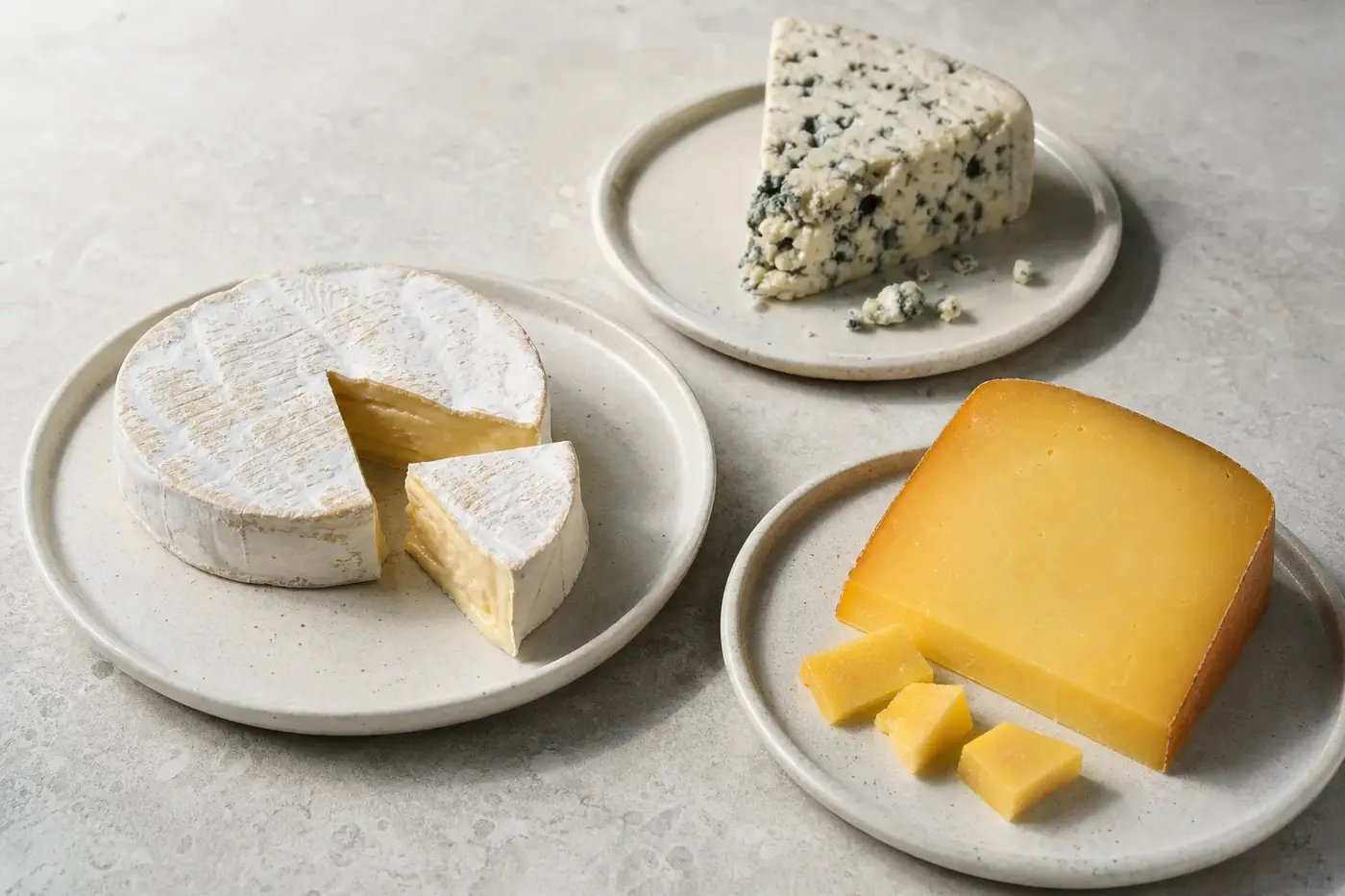
Start with the nutrition label when you compare individual cheeses. Fresh, ripened, full-fat and reduced-fat products differ in composition and structure. A particular Cheddar intervention cannot establish identical effects for every cheese you might choose. [1,7]
UK food composition tables provide typical values, not definitive figures for every product. Your individual cheese may differ from its database entry. Keep that distinction in mind when you compare figures. [9]
| Cheese | Saturated fat per 100 g | Saturated fat per 30 g | Salt per 100 g | Salt per 30 g |
|---|---|---|---|---|
Compare equal weights first, then look at how much you actually eat. A cheese with less saturated fat per 100 g may contribute more if your serving is substantially larger. Read saturated fat and salt separately, too: less of one does not guarantee less of the other.
Salt deserves a place in this conversation alongside cholesterol. According to the UK NHS, too much salt can raise blood pressure, increasing the risk of heart attacks and strokes. Adults should have no more than 6 g of salt daily, including salt already present in food. [10]
The NHS recommends comparing labels and eating salty foods, including cheese, less often or in smaller amounts. In your sandwich or cooked dish, bread, sauces and cured meat may contribute salt too. Cheese is only one part of that meal's total. [10]
For help comparing saturated fat and salt on a product, see how to read a cheese label.
Bring the evidence back to your plate
The most useful question is specific: how much cheese, in what meal, replacing what? It keeps your attention on the food you actually eat, rather than on a single nutrient in isolation.
UK guidance supports keeping track of cheese portions, choosing lower-fat options where suitable and replacing some saturated fat elsewhere with unsaturated fat. You can make those practical decisions while staying curious about cheese's structure, fermentation and composition. [3,7]
The dairy matrix makes food-level research more informative by encouraging comparisons between actual foods. Matching nutrient totals does not automatically make foods interchangeable. At your table, the soundest application is to consider the cheese, its quantity and the rest of your diet together.
General information only, not medical advice: follow the official guidance where you live.
Questions people ask
What is the dairy matrix?
The dairy matrix means both the physical structure of a dairy food and its combination of nutrients. Researchers are investigating whether fat within the protein rich structure of cheese, alongside calcium, behaves differently from fat eaten as butter.
Does cheese affect cholesterol differently from butter?
In a 2018 trial, full fat Cheddar produced a greater reduction in LDL cholesterol than a butter based comparison supplying a similar amount of dairy fat. The trial did not establish which feature of cheese caused the difference, and it measured metabolic markers rather than heart attacks or strokes.
Does eating cheese reduce the risk of stroke?
The European EPIC study found an association between higher cheese intake and a lower risk of ischaemic stroke. Because participants chose their own diets, the result does not establish that cheese caused the difference or predict what will happen to an individual.
How much saturated fat and salt does the NHS advise adults to have?
The NHS advises that the average man should eat no more than 30 g of saturated fat a day and the average woman no more than 20 g. It also advises adults to have no more than 6 g of salt daily. These totals include all sources in the diet; see the NHS guidance cited on the page [3, 10].
How can I compare saturated fat and salt in different cheeses?
The NHS recommends comparing labels. To work out the amount in a portion, multiply the figure per 100 g by the portion weight, then divide by 100. Check saturated fat and salt separately, since a reduction in one does not guarantee a reduction in the other; see the NHS guidance cited on the page [7, 10].
Sources
-
The American Journal of Clinical Nutrition. “Dairy matrix effects: response to consumption of dairy fat differs when eaten within the cheese matrix-a randomized controlled trial”. Volume 108, issue 4, 2018, pages 667 to 674. Full paper, including methods, results, limitations and declarations. Retrieved paper.
-
Scientific Advisory Committee on Nutrition. SACN statement on expressing energy, fat and carbohydrate intakes and recommendations. Updated 31 December 2025. Official statement.
-
NHS. Fat: the facts. Current online guidance retrieved November 2026. Official guidance.
-
Scientific Advisory Committee on Nutrition. Saturated fats and health. Final report, 2019, particularly summary paragraphs S.18 to S.24 and the cardiovascular outcomes assessment. Official report.
-
European Heart Journal. “The associations of major foods and fibre with risks of ischaemic and haemorrhagic stroke: a prospective study of 418 329 participants in the EPIC cohort across nine European countries”. Volume 41, issue 28, 2020, pages 2632 to 2640. Retrieved abstract and methods summary. Study record.
-
Journal of the American College of Cardiology. “Saturated Fats Compared With Unsaturated Fats and Sources of Carbohydrates in Relation to Risk of Coronary Heart Disease: A Prospective Cohort Study”. 2015. Retrieved PubMed abstract. Study record.
-
NHS. Dairy and alternatives in your diet. Current online guidance retrieved November 2026, particularly “Cheese”. Official guidance.
-
NHS. How to eat less saturated fat. Current online guidance retrieved November 2026. Official guidance.
-
Public Health England. McCance and Widdowson's The Composition of Foods Integrated Dataset 2021: user guide. 2021, pages 4 to 6. Official user guide.
-
NHS. Salt in your diet. Page reviewed 17 April 2023; retrieved November 2026. Official guidance.
This desk-researched article compares official UK dietary guidance with a retrieved randomised trial and original cohort study abstracts, distinguishing measured results from proposed explanations.
Last checked: November 2026
Last checked November 2026.
The editors suggest you read next
Cheese and Health: What the Evidence Says
Put cheese and butter side by side on your plate.