Grate, slice or crumble your Cheddar. Before the first bite, you are already meeting a cheesemaker’s balancing act. In one reduced-fat Cheddar experiment, more salt made the cheese harder, less moist and less bitter. But the most highly salted cheeses had less desirable body characteristics: salt, it turns out, does not deserve an unlimited invitation.[1]
Salt seasons cheese, controls moisture and steers the microbial activity that develops texture and flavour. Take some away, and the cheesemaker has to rebalance the process. Your part is simpler: read the label, then think about how much you will eat.[1,2]
Before your first bite, salt is already busy
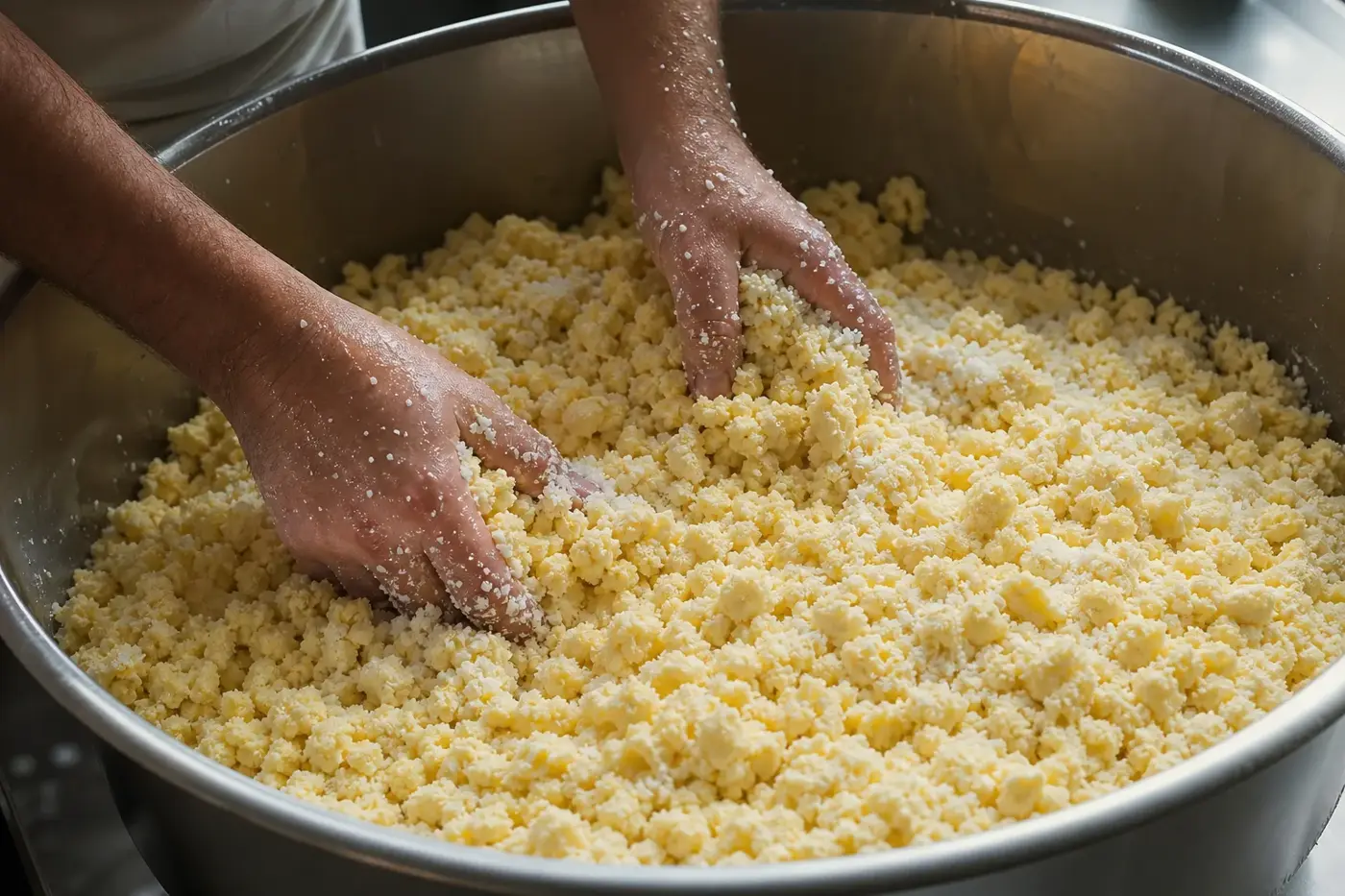
Long before cheese reaches your plate, salt is shaping it. Cheesemaking begins with curd, the protein-rich material separated from whey, the liquid portion of milk. Salt affects how much moisture stays behind and how that water interacts with the cheese’s proteins.
In the reduced-fat Cheddar experiment, researchers divided curd between three salting treatments. The more highly salted cheeses held less moisture and were harder in instrumental texture tests.[1] That little scattering of salt had quite a job description.
Salt also helps set the pace of fermentation and ripening. Starter bacteria turn milk sugar into acid; bacteria and enzymes then keep changing the cheese as it ripens. In that same experiment, higher salt concentrations slowed protein breakdown and the general rate of ripening.[1]
You taste salt’s contribution twice over: in saltiness itself, and in its influence on ripening and texture. Higher levels reduced bitterness, but the most highly salted cheeses had less desirable body characteristics. The aim is balance, not simply adding more.[1] Follow the whole journey in how cheese is made.
Three ways salt finds its way into cheese
Salt can join the curd before a cheese takes shape, or travel in from the outside. Cheesemakers have three approaches, each bringing salt into the cheese a little differently:
- Salting curds: dry salt is mixed through drained curd before moulding or pressing. This was the approach used in the experimental Cheddar methods discussed here.[1,2]
- Dry-surface salting: salt goes onto the outside of a formed cheese, then moves inward.
- Brining: the cheese is immersed in a salt solution, allowing salt to enter through its surface.
Each route gives salt a different pattern of distribution. While it travels through the cheese, the surface and centre need not have identical concentrations.
Salt influences microbial growth, too, but it does not guarantee freedom from harmful microbes. A 2024 experimental Cheddar study found that substantial salt reduction changed the microbial community, alongside texture and composition.[2] Salt belongs within a wider set of controls, explored in cheese food safety.
A familiar name does not tell the whole salt story
You cannot judge a cheese’s salt content by its name alone. It varies substantially between styles, and between products carrying the same name. A UK survey published in 2014 examined packaging information for 612 cheeses collected in 2012.[3]
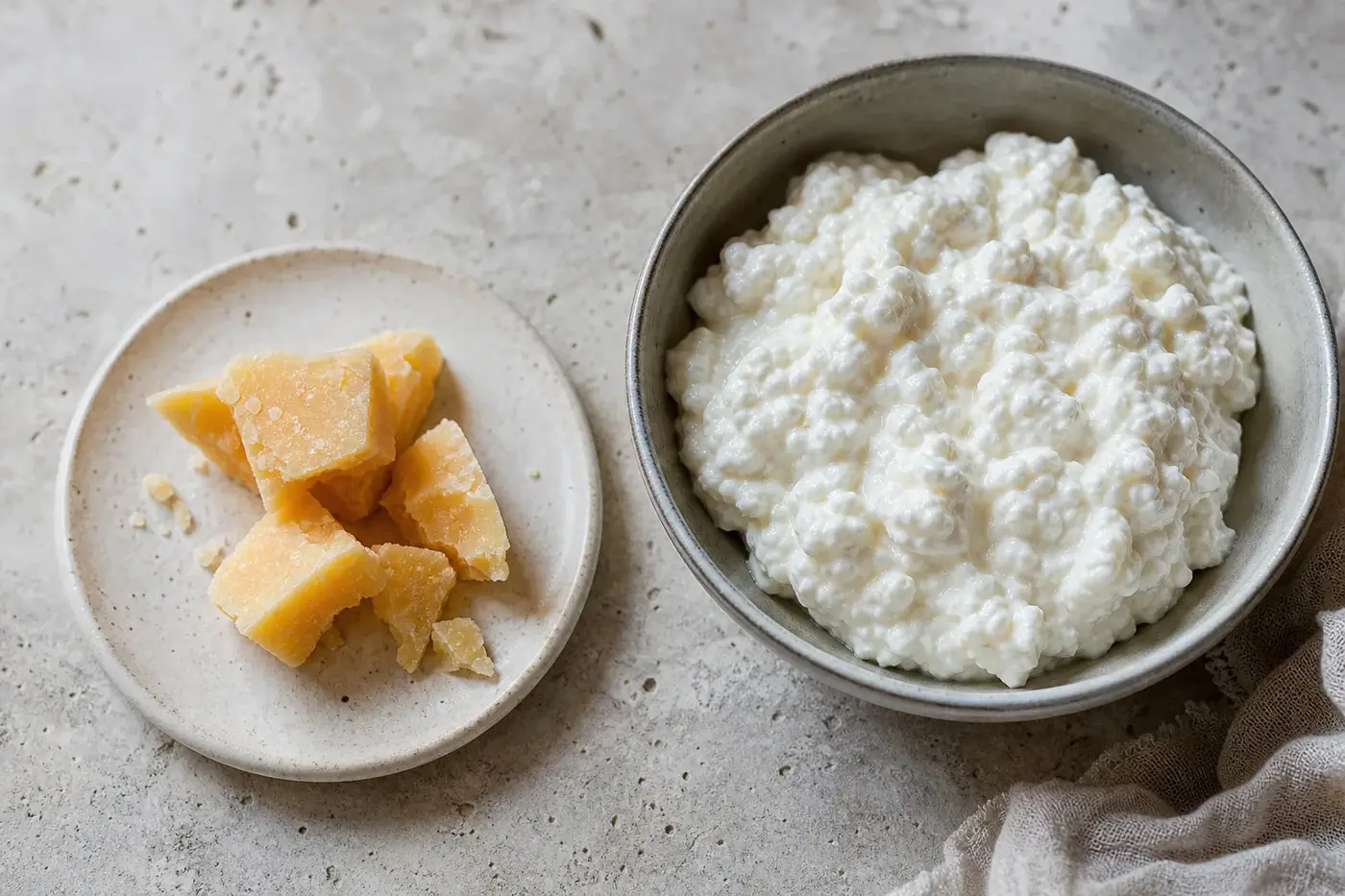
Cottage cheese had the lowest average salt concentration among the survey’s categories. Halloumi and imported blue cheeses had the highest averages.[3] That gives you useful context, but it cannot replace a look at the cheese in your hand.
Those figures capture the variation that existed at the time. They came from labels, not independent laboratory measurements. When you choose today, use the current pack’s nutrition declaration.[3]
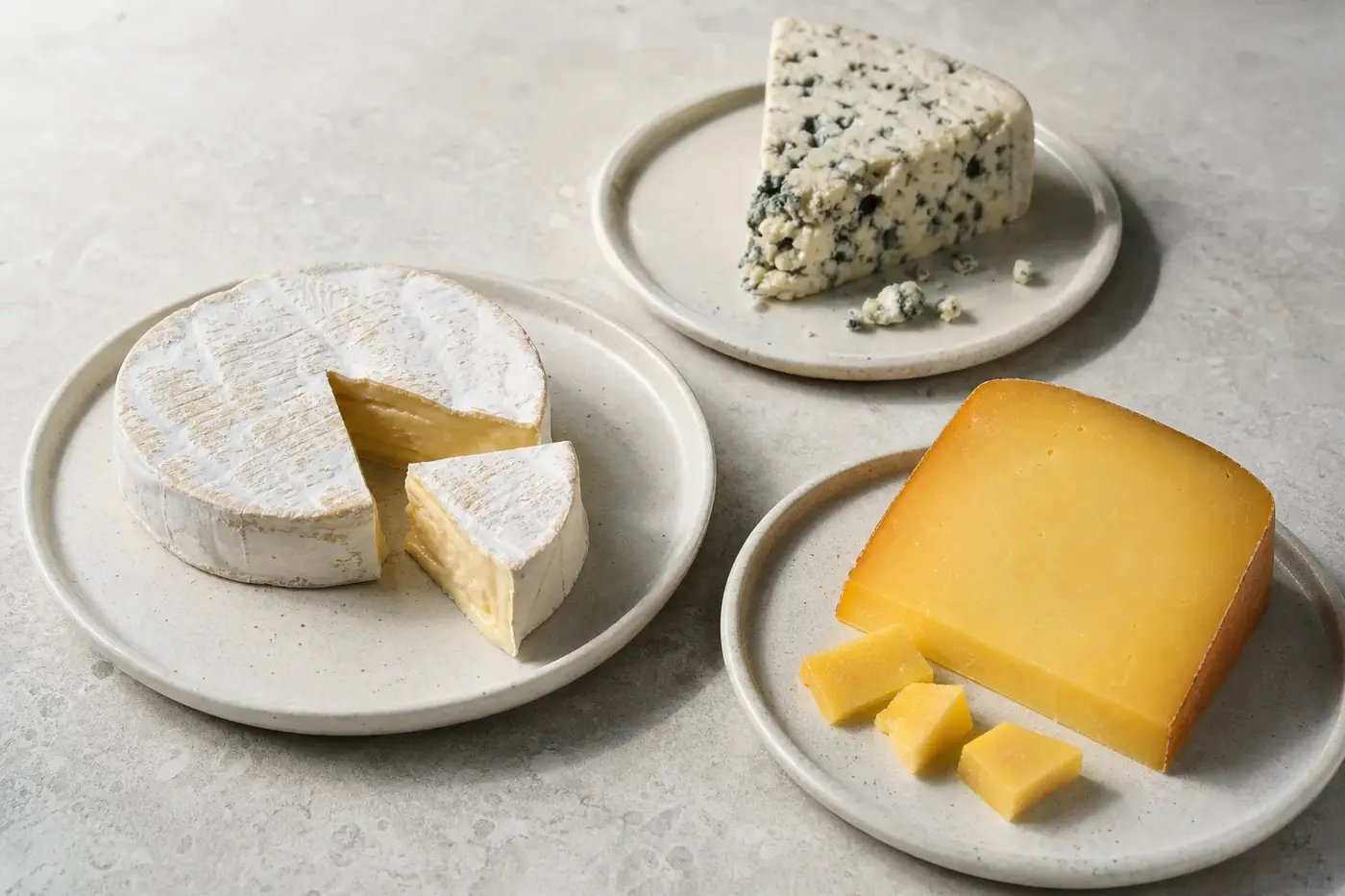
Age is no reliable shortcut either. Salt added, moisture retained and manufacturing method all matter, and the survey found differences within individual categories.[1,3] “Mature” tells you something different from measured salt concentration. A younger cheese is not automatically lower in salt.
Before setting aside a favourite style, compare two versions of it. Their labels may reveal a useful difference, while allowing the cheese to keep its familiar place in your meal.[3,6]
Sodium or salt? Make the label speak your language
Turn over a pack and you may find sodium rather than salt. Ordinary food salt is sodium chloride. Sodium is the component used to calculate the salt equivalent in UK nutrition information.
That calculation includes sodium naturally present in food, as well as sodium supplied by salt or other ingredients, the Food Standards Agency explains.[4] Keep the units consistent and the arithmetic is straightforward:
Salt equivalent = sodium × 2.5
Sodium = salt equivalent ÷ 2.5
For example, 240 mg sodium gives 600 mg salt equivalent, or 0.6 g. Multiplying milligrams by 2.5 still leaves you with milligrams. Divide by 1,000 to turn that result into grams.[4]
A sodium figure and a salt figure can look quite different while describing exactly the same food. That is also why the nutrition declaration tells you more than searching for “salt” in the ingredients: it accounts for total sodium.[4] Find your way around the rest in reading a cheese label.
Look at your day, not just your cheese
The NHS recommends no more than 6 g salt a day for adults and children aged 11 years and over. That includes salt already in food, plus anything added during cooking or at the table. Younger children have lower recommended maximum amounts.[5]
Eating too much salt can cause high blood pressure, which increases the risk of heart attacks and strokes, the NHS states.[5] The useful measure is your whole day’s intake, rather than a serving of cheese considered on its own.
Bread, sauces, cheese and other foods all contribute to that total. You can keep cheese in the meal while changing its quantity, choosing a lower-salt version or adjusting what goes alongside it. Each offers a practical way to act on the guidance.[5]
Give the label a closer look
For UK foods, NHS guidance in November 2026 gives these thresholds.[6] Use them to put the pack’s salt figure in context.
| Where your food sits | Salt per 100 g |
|---|---|
| Low | 0.3 g or less |
| Between low and high | More than 0.3 g and up to 1.5 g |
| High | More than 1.5 g |
Start with per 100 g, so you compare products on equal terms. Then work out what your portion contributes. Concentration helps you choose between foods; portion size tells you how much salt you actually eat.[6]
Look closely at the serving size on the front of the pack, too. A smaller manufacturer-defined serving can make the figure look lower, even when the food contains more salt per 100 g. The NHS specifically advises checking whether the manufacturer’s idea of a portion matches yours.[6]
Put a salt figure on your portion
You need just two things: the pack’s salt figure and the weight of cheese you plan to eat. Put them into this calculation:
Salt in the portion = salt per 100 g × portion weight in grams ÷ 100
These examples use hypothetical concentrations, not measurements of named cheeses. The 30 g quantity is a worked example, not a prescribed serving.
| Example salt concentration | Salt in your 30 g portion | Salt in your 50 g portion |
|---|---|---|
| 1.0 g per 100 g | 0.30 g | 0.50 g |
| 1.5 g per 100 g | 0.45 g | 0.75 g |
| 2.0 g per 100 g | 0.60 g | 1.00 g |
In the last example, 30 g of cheese supplies 0.60 g salt. That is 10% of the NHS 6 g daily maximum for people aged 11 and over.[5]
A kitchen scale makes the figures easier to picture. Weigh what you normally grate, slice or crumble once, then apply the pack’s figure. If you grate cheese into a shared dish, calculate the salt in the whole amount first, then divide by the number of equal portions.
Notice how quantity changes the comparison. Here, 50 g of the hypothetical 1.0 g cheese supplies more salt than 30 g of the hypothetical 1.5 g cheese. The lower concentration tells you only part of the story.
Give the rest of your plate some attention
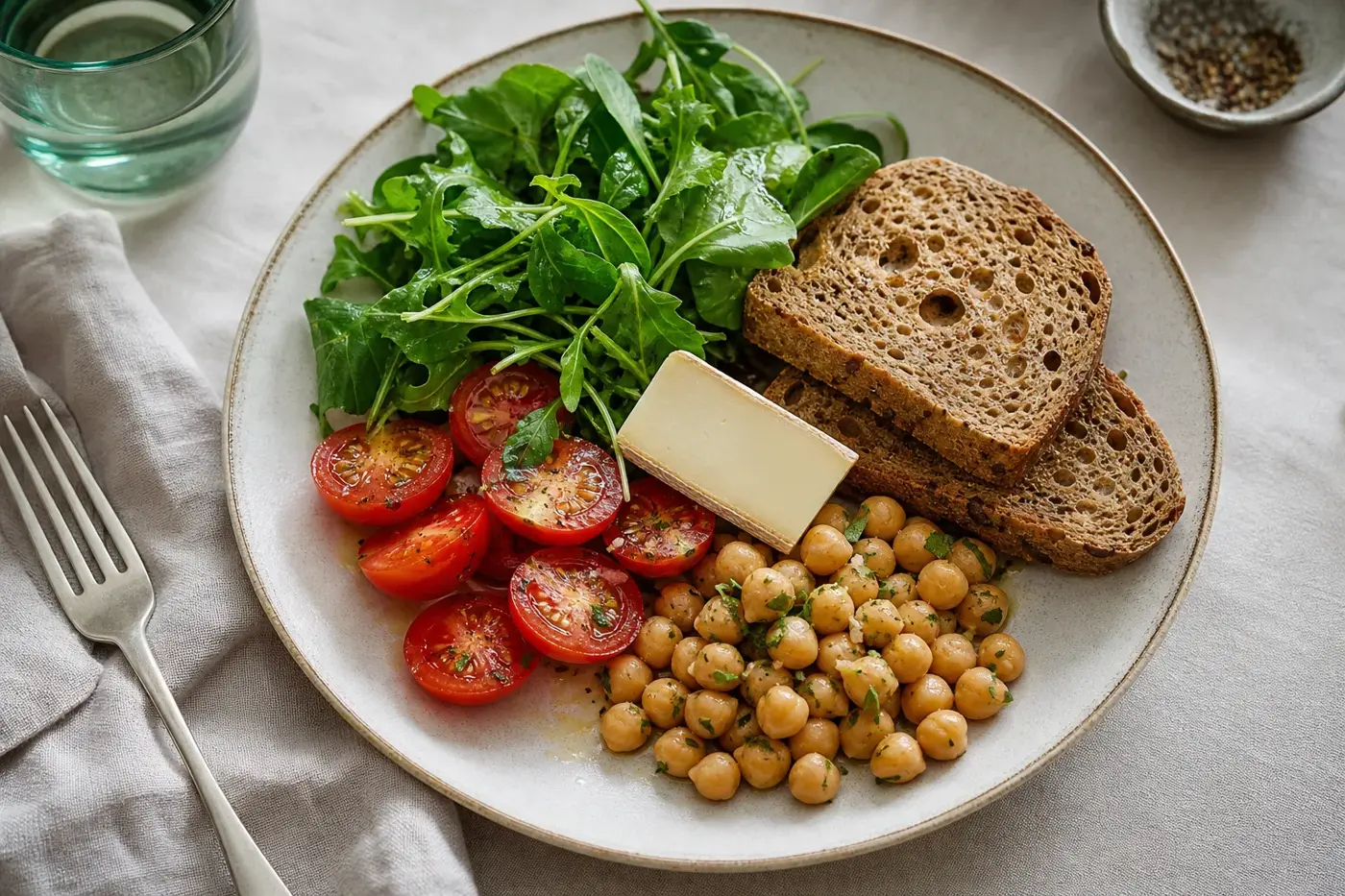
A cheese meal gives you several places to adjust salt, not just the cheese itself. The NHS recommends eating salty foods less often or in small amounts, comparing labels, and using herbs, spices, garlic or lemon juice instead of extra salt.[5] Here is how you can bring that advice to your plate:
- Choose your cheese quantity. Weigh it before adding it to a sandwich, salad or shared dish.
- Check the bread or crackers. Compare their per 100 g figures, then account for the amount you serve.
- Look beyond the cheese. Cured meat, olives, pickles and sauces can add further salt.[5]
- Add some contrast. Try cucumber, tomatoes, apple or vegetable sticks rather than another salty accompaniment.
- Taste before you season. Let the cheese flavour the finished dish before deciding whether it needs extra salt.[5]
Take a cheese sandwich. You can adjust the cheese, bread, filling and condiments, rather than focusing on one ingredient alone. Keep the cheese you enjoy, measure the amount, add vegetables and compare the mustard or pickle with alternatives.
Make that comparison at the quantity you will actually eat. A lower-salt accompaniment helps most when its serving size makes sense too, not just when its per 100 g figure looks favourable.
Less salt means more than a recipe adjustment
For a cheesemaker, reducing salt means changing more than the seasoning. Government’s Salt reduction targets for 2024, published in September 2020, set voluntary targets for cheese categories. For Cheddar and similar hard-pressed cheeses, these were 1.66 g salt per 100 g as a sales-weighted average and 1.90 g per 100 g as a maximum target. Other categories have different targets.[7]
These are industry reformulation benchmarks, not the NHS high-salt threshold. In January 2026, a government parliamentary answer continued to describe the salt reduction programme as voluntary. It also said planning for future monitoring was ongoing.[8]
The experimental work shows why reformulation needs care. Changing salt in the reduced-fat Cheddar experiment changed moisture, hardness, bitterness and ripening.[1] Adjusting one ingredient affected several characteristics of the cheese.
In the 2024 study, researchers compared three salt treatments using texture measurements, microbial sequencing and chemical analysis. The larger reduction brought more substantial changes in composition and microbial communities.[2]
Manufacturers therefore have to consider flavour, texture, spoilage, shelf life and safety together. A reduced-salt formulation needs assessment as a complete product. Public Health England’s preferred approach was gradual reduction in overall saltiness, giving consumers’ palates time to adjust.[7]
Ask about potassium substitutes before you choose
Some sodium-reduction approaches replace part of the sodium chloride with potassium chloride.[2] If you have been advised to restrict sodium or potassium, discuss your choices with your doctor, pharmacist or dietitian. That includes talking before you rely on potassium-based salt substitutes.
Your medicines matter here. UK NHS guidance in November 2026 says people taking ramipril should not use salt substitutes containing potassium, because these can raise blood potassium too much.[9] Its chronic kidney disease guidance explains that a dietitian can advise how much potassium, phosphate and salt to include when blood results show raised mineral levels.[10]
Bring the product’s ingredients and nutrition information to that conversation. They help answer the question that matters for you: how does this product fit your dietary advice and medicines?[9,10]
Keep your cheese in the wider picture
Salt is one useful comparison, alongside how much you eat and what else is in the meal. For the broader picture, start with Cheese: The Complete Guide, then explore the Cheese and Health hub’s wider evidence and nutrition coverage.
If another dietary question is guiding your choice, give it its own attention. The guide to lactose in cheese explores a different component of the food. Keeping those questions separate helps you use the label for the comparison you actually need.
General information only, not medical advice: follow the official guidance where you live.
Questions people ask
Which cheeses contain the least salt?
In a UK survey published in 2014, cottage cheese had the lowest average salt concentration among the categories examined. Salt varied between products of the same style, so check the current pack’s nutrition declaration.
How much salt can I have each day?
The NHS recommends no more than 6 g of salt a day for adults and children aged 11 and over. This includes salt in food and salt added during cooking or at the table. Younger children have lower recommended maximum amounts, as explained in the NHS salt guidance.
How can I tell if cheese is high in salt?
The NHS classifies food with more than 1.5 g salt per 100 g as high in salt, and 0.3 g or less per 100 g as low. Compare the per 100 g figures, then calculate the salt in the portion you eat. See the NHS food label guidance for its thresholds.
Why is salt added to cheese?
Salt seasons cheese, affects how much moisture it retains and influences the microbial activity involved in ripening. In a Cheddar experiment, higher salt concentrations slowed protein breakdown and the general rate of ripening.
Are potassium salt substitutes suitable for everyone?
NHS guidance says people taking ramipril should not use salt substitutes containing potassium because these can raise blood potassium too much. The NHS chronic kidney disease guidance explains that a dietitian can advise on potassium and salt when blood results show raised mineral levels. Check the relevant NHS guidance and discuss your circumstances with your doctor, pharmacist or dietitian.
Sources
- Journal of Dairy Science, “Influence of salt on the quality of reduced fat cheddar cheese”, volume 81, issue 5, 1998, pages 1214 to 1221. Experimental comparison of three curd-salting treatments; abstract retrieved through the US National Library of Medicine.
- Foods, “The Effect of Salt Reduction on the Microbial Community Structure and Metabolite Composition of Cheddar Cheese”, volume 13, article 4184, published 23 December 2024. Full paper, including manufacturing methods, texture measurements, microbial sequencing and chemical analysis.
- BMJ Open, “Cross-sectional survey of salt content in cheese: a major contributor to salt intake in the UK”, volume 4, e005051, 2014. Full paper reporting a 2012 survey of 612 products.
- Food Standards Agency, “Q and A document: nutritional requirements of Regulation (EU) No 1169/2011”, undated document, retrieved November 2026, question 4. Explains total sodium and the multiplication factor of 2.5.
- NHS, “Salt in your diet”, page last reviewed 17 April 2023, retrieved November 2026. Daily maximum amounts, blood pressure advice and practical reduction measures.
- NHS, “Food labels”, page last reviewed 30 June 2026. UK salt thresholds, per 100 g comparisons and manufacturer-defined portions.
- Public Health England, Salt reduction targets for 2024, September 2020, introduction, sodium replacers section and table 1, cheese categories. Publication page also retrieved November 2026.
- UK Parliament, written question HL13321, government answer dated 13 January 2026. Describes the voluntary programme and ongoing planning for monitoring.
- NHS, “Common questions about ramipril”, page last reviewed 18 March 2026, section “Is there any food or drink I need to avoid?”
- NHS, “Chronic kidney disease: Living with”, page last reviewed 22 March 2023, section “Getting dietary advice”.
Researched from UK public health guidance, government reformulation documents and published cheese experiments, with a historical label survey used to establish variation.
Last checked: November 2026
Last checked November 2026.
The editors suggest you read next
Cheese and Health: What the Evidence Says
Put cheese and butter side by side on your plate.