Farmhouse, Artisan and Industrial Cheesemakers Explained
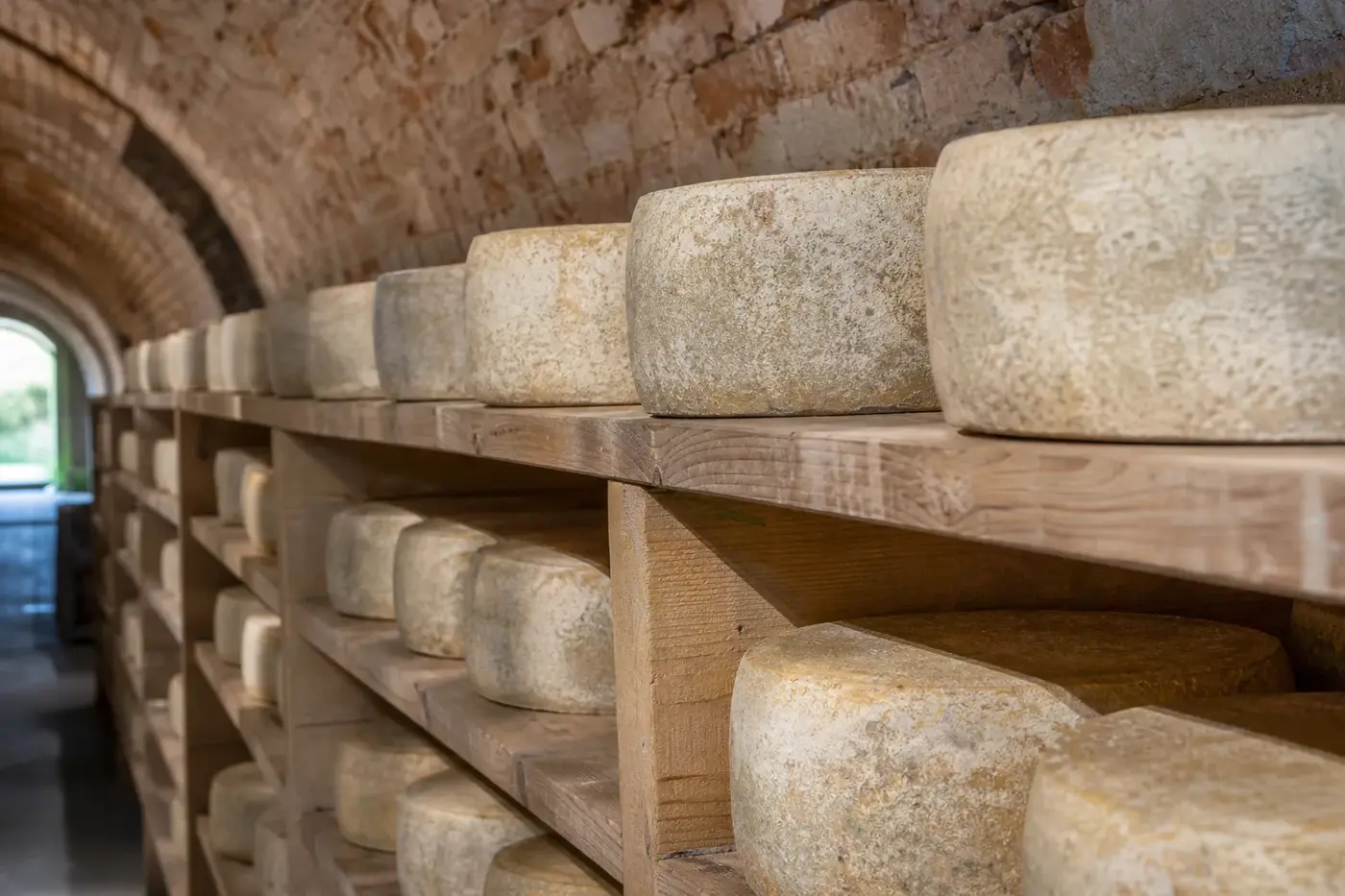
Slabs of curd are turned and stacked by hand.
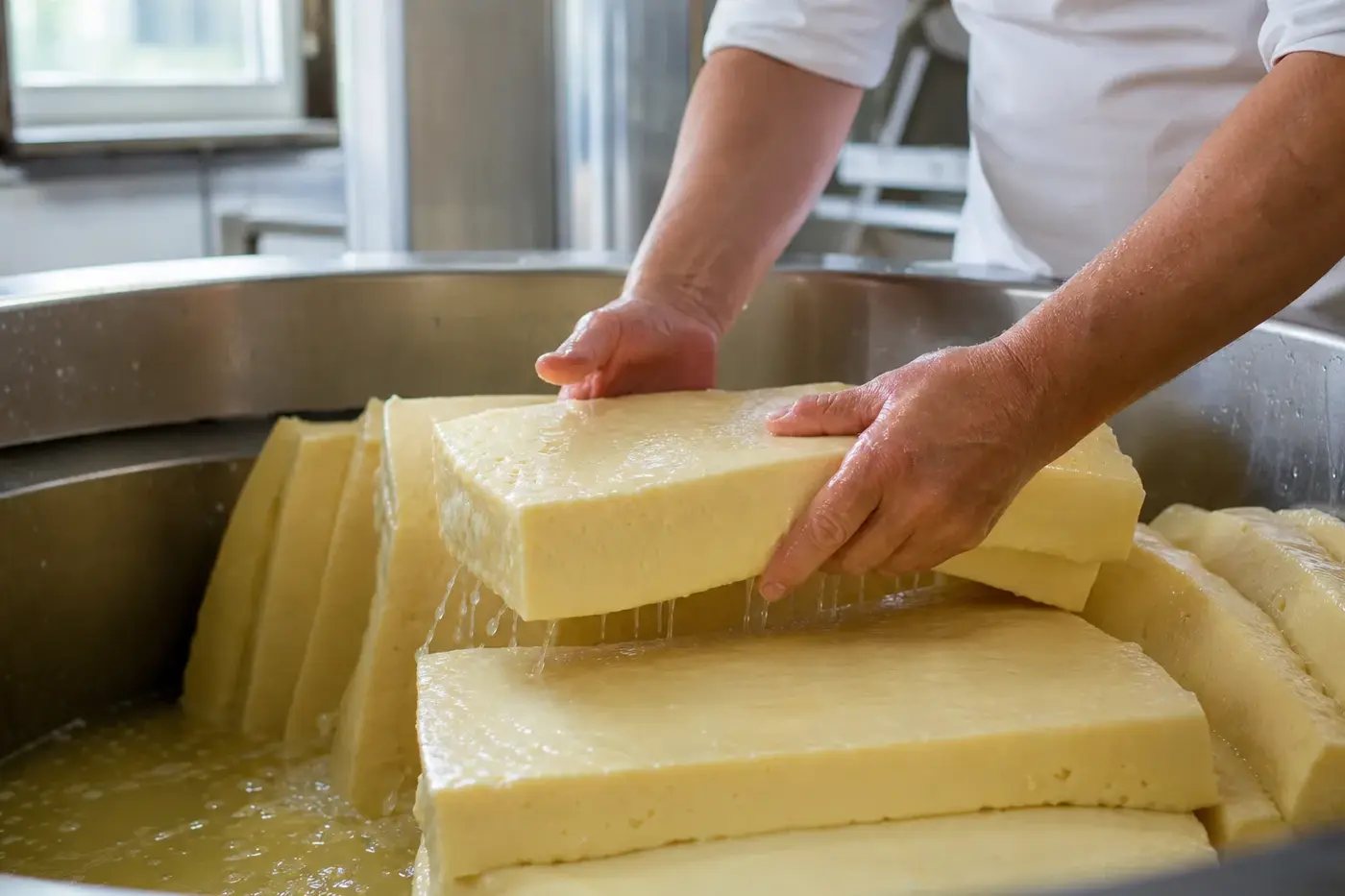
Slabs of curd are turned and stacked by hand. Nearby, stainless steel vats do their part. You might expect these to belong to different worlds, but both appear in the specification for West Country Farmhouse Cheddar. Tradition and controlled equipment are quite happy sharing a dairy.[2]
Follow the milk and the story gets more interesting. It might travel straight from a farm's milking parlour to its cheese vat, or arrive at a dairy from several farms. Farmhouse points to a farm connection, artisan to skilled making, and industrial to organised production at larger scale. These descriptions overlap: they are not a cheese league table.[1][3][4]
Farmhouse: follow the milk through the farm gate
With farmhouse cheese, you can often follow a wonderfully direct journey. Traditionally, milk production and cheesemaking happen in one place, with cheese made on the farm, often using its own animals' milk. Still, there is a useful question to ask: does every drop come from those animals, or does the maker buy milk too?[1][2]
West Country Farmhouse Cheddar's specification allows more than one farmer working with one herd. Milk can come from makers' farms and other farms, with supplies from outside the defined area permitted during shortages. A farm setting tells you one thing. An exclusively own-herd milk supply tells you another.[2]
Artisan: find the skilled hands and judgement
Who decides that the curd is ready? Which jobs happen by hand, and how is the cheese selected as it matures? These questions take you closer to artisan cheesemaking than a production figure ever could. The useful part of the description is the skilled making behind it.
Ford Farm gives you something more substantial to explore. The maker says it sources milk from local dairy herds, works almost exclusively by hand, and grades its Cheddars during ageing before deciding when to release them. That is the maker's own account of sourcing, work and selection. Each detail tells you more than artisan alone.[3]
Industrial: give precision a fair hearing
Picture larger quantities of milk moving through organised, controlled operations. Tetra Pak's equipment handbook describes systems for milk preparation, curd handling, forming and ripening, including mechanised and automated equipment. Industrial tells you how production is organised. It does not hand you an ingredient list or tell you how the cheese tastes.[4]
You appreciate control when you want cheese to cut, grate or behave predictably in cooking. Milk composition, culture activity and moisture are among the variables being managed. Look at the methods and the intended result: automation involves technical choices. Handwork needs measurements and repeatable controls too.[4][5]
Three descriptions can fit one cheese
Instead of sorting cheese into three separate boxes, ask three questions. Where is it made, how much skilled intervention shapes it, and how is production organised? A single dairy can answer all three. Farm premises, hand cheddaring and controlled equipment can belong to the same process.[2][4]
The West Country specification makes that overlap easy to picture. It describes stainless steel vats, curd cut by hand or with knives attached to paddles, and cheddaring by hand. During cheddaring, slabs of curd are turned and stacked to help drain whey, the liquid separated from the curd. Equipment and traditional method work together.[2]
Milk provenance: an address is only the beginning
Picture three places: where the animals were milked, where the cheese was made, and where it matured. A dairy's address answers only one of those questions. Both the West Country specification and Ford Farm's account show why a maker's name need not lead you to a single milk herd.[2][3]
Ask whether the milk comes from the maker's own herd, named supplying farms or a wider collection pool. Does that arrangement stay the same throughout the year? If a particular farm or breed matters to you, those answers establish the connection. A rural picture on the wrapper cannot do quite so much.
Milk, cultures and ageing: get the conversation going
Start with milk treatment rather than production scale. Single Gloucester's published specification permits pasteurised or unpasteurised cows' milk, so even a defined protected cheese can allow both. To explore the differences, see raw milk, thermised and pasteurised cheese.[6]
Next, ask about starter cultures, the microorganisms that develop acidity and help shape flavour and texture. Tetra Pak describes cultures selected for particular characteristics and supplied frozen or freeze-dried, alongside bulk starters prepared at a dairy. Which approach does your maker use? Buying a culture does not, by itself, tell you how much craft goes into the cheese.[5]
Maturation brings another set of decisions. Ford Farm describes repeated grading before release: making curd and selecting finished cheese call for distinct judgements. Ask about age, wrapping or rind treatment, and who decides a batch is ready. For the sequence behind it all, read how cheese is made.[3]
Protected names: the small print tells a bigger story
A protected designation of origin, or PDO, gives a registered name specific requirements. As of November 2026, the Great Britain register lists West Country Farmhouse Cheddar Cheese and Single Gloucester as registered PDOs. Their specifications offer more precise answers than farmhouse or artisan used as general descriptions.[7][8]
For West Country Farmhouse Cheddar Cheese, the Great Britain specification defines the production area as Dorset, Somerset, Devon and Cornwall. It requires at least nine months' maturation. Before you take the name to mean every drop of milk is local, read its milk sourcing exceptions too.[2]
Single Gloucester's Great Britain specification requires cows' milk produced in Gloucestershire. Production is connected to farms maintaining registered Gloucester cattle, with milk from other breeds allowed as supplementation under stated conditions. The specification describes a mild lactic flavour and smooth texture. Those belong to this specified cheese, not to farmhouse cheese as a whole.[6]
Want to separate the production rules from the territory where a name has protection? Turn to protected names explained.
Scottish guidance: put appealing words to work
An appealing label should give you useful information, not just a pleasant feeling. A Scottish farmers' market guide published in 2012 discusses descriptive terms including farmhouse and hand made. It recommends informative labelling, evidence for claims, and attention to how the average consumer understands ambiguous wording. That is the scope of this guidance, not the complete current UK legal position.[1]
Take that approach to the cheese counter. Does farmhouse mean made on the farm, what does artisan describe here, and which steps are hand-made? An adjective earns its place when it leads to a factual answer. For help separating descriptions from the surrounding information, see how to read a cheese label.
This page summarises published guidance from the official sources it cites. It is not medical advice. Guidance differs between countries and changes over time, so check the current source for where you live, and ask your doctor, midwife, pharmacist or dietitian about your own circumstances.
Safety and quality: give each its own questions
Raw and pasteurised milk cheeses both need careful production controls. In England, Wales and Northern Ireland, the Food Standards Agency describes food safety management procedures based on hazard analysis and critical control points, known as HACCP. This approach identifies hazards and the measures needed to remove them or reduce them to an acceptable level.[9]
Official approval guidance for England, Wales and Northern Ireland says certain dairy establishments supplying other businesses require approval. Most businesses outside those requirements need registration. In Scotland, Food Standards Scotland identifies local authorities as responsible for approving dairy establishments. The responsible authority determines which route applies to each operation.[10][11]
For flavour and quality, turn your attention back to the cheese itself. Consider its intended texture, maturation, condition and suitability for what you want to do with it. Consistency can be welcome, and so can an explained difference between batches. Ask what the maker is aiming for, then judge whether this cheese delivers: a production category cannot do that for you.[3][4]
Welfare and environment: follow each claim to its source
For animal welfare, your questions lead back to the supplying farms, whatever the dairy's size. England's cattle welfare code covers stockmanship, housing, feeding, herd health and lameness. Ask about those conditions in the maker's herd or on suppliers' farms. Farmhouse and industrial tell you little about them.[12]
With environmental claims, first establish what was measured. Was it milk production, dairy energy, maturation, transport, packaging or the whole chain? Check that comparisons use the same amount and type of cheese, and ask which period they cover. An improvement in one defined area should not become a verdict on the whole business.
Treat small, local and hand-made as invitations to find out more. For certification, ask for the scheme, certifying body and scope: which named farm, product or operation does it cover? A specific, documented answer gives you more to go on than an adjective with several possible meanings.
Maker, affineur, monger: meet the people behind your cheese
The cheesemaker turns milk into cheese, an affineur specialises in maturation, and a cheesemonger selects and sells it. One business can do all three jobs. Ford Farm's published account, for instance, describes making, ageing and grading within its own operation.[3]
You can explore available maker, affineur and cheesemonger profiles in the Cheesemakers, Affineurs and Cheesemongers hub. Follow the handovers: who supplied the young cheese, who matured it, and who selected this batch? Naming those people gives you a clearer story than awarding the shop all the credit. Plenty happened before the cheese reached its counter.
Take a little curiosity to the cheese counter
Pick the questions that matter to the cheese you want to buy. There is no need to turn every purchase into an interview. If the shop cannot answer, ask for the maker's information:
- Who made this cheese, and where was the milk produced?
- Does the milk come from the maker's own animals, named supplying farms, or a wider pool?
- Is the milk raw, thermised or pasteurised, and what does the maker declare?
- Which jobs are done by hand, and which use equipment?
- Who matured this batch, for how long, and how was it selected?
- For a protected name, which specification applies to this cheese?
- What evidence supports any welfare, environmental or certification claim?
Start with the milk, the maker and the maturation. Whatever the label says, those answers give you something concrete to compare.
Questions people ask
What is the difference between farmhouse, artisan and industrial cheese?
Farmhouse describes a connection to the farm, artisan emphasises skilled making, and industrial describes organised production at larger scale. The descriptions can overlap and are not a ladder of quality.
Must farmhouse cheese be made from the farm's own milk?
Not necessarily. The West Country Farmhouse Cheddar specification allows milk from makers' farms and other farms, with provision for supplies from outside the defined area during shortages.
Is artisan cheese always made by hand?
Artisan describes skilled making, so it is useful to ask which operations are done by hand. Ford Farm says it carries out its process almost exclusively by hand and grades its Cheddars during ageing before deciding when to release them.
Can a protected cheese be made with raw or pasteurised milk?
The answer depends on the cheese's specification. Single Gloucester's published specification permits either pasteurised or unpasteurised cows' milk.
What is the difference between a cheesemaker, an affineur and a cheesemonger?
A cheesemaker turns milk into cheese, an affineur specialises in maturation, and a cheesemonger selects and sells it. One business may perform all three roles.
Sources
- Food Standards Agency and Scottish farmers' market partners. Food Safety and Labelling Guide for Farmers' Markets in Scotland, second revision, March 2012, particularly the descriptive terms discussion on printed pages 25 to 26. Hosted by Food Standards Scotland.
- Department for Environment, Food & Rural Affairs. Product specification: West Country Farmhouse Cheddar, undated summary linked from the current Great Britain register entry, sections 4.2, 4.3 and 4.5.
- Ford Farm. [About us](../about-us/), undated company account, retrieved November 2026. Milk sourcing, handwork and grading are the maker's own descriptions.
- Tetra Pak. Dairy Processing Handbook: Cheese, chapter 16, online edition retrieved November 2026. Tetra Pak supplies dairy processing equipment and has a commercial interest in the technologies described.
- Tetra Pak. Dairy Processing Handbook: Cultures and starter manufacture, chapter 12, online edition retrieved November 2026.
- Department for Environment, Food & Rural Affairs. Product specification: Single Gloucester, undated summary linked from the current Great Britain register entry, sections 4.2 to 4.6.
- Department for Environment, Food & Rural Affairs. [West Country Farmhouse Cheddar Cheese](../west-country-farmhouse-cheddar-cheese/), Great Britain protected food name register, published 4 January 2021, retrieved November 2026.
- Department for Environment, Food & Rural Affairs. [Single Gloucester](../single-gloucester/), Great Britain protected food name register, published 4 January 2021, retrieved November 2026.
- Food Standards Agency. Managing food safety, current online guidance retrieved November 2026, particularly food safety management procedures and traceability.
- Food Standards Agency. Applying for approval of a meat or food establishment, current online guidance retrieved November 2026.
- Food Standards Scotland. Local authority approvals, current online guidance retrieved November 2026.
- Department for Environment, Food & Rural Affairs. Code of recommendations for the welfare of livestock: cattle, England, 2003 code, HTML edition published January 2024, retrieved November 2026.
Researched through official register entries and their linked specifications, food authority guidance, an official welfare code and attributed industry accounts, with buying questions developed as editorial synthesis.
Last checked: November 2026
Last checked November 2026.
The editors suggest you read next
Neal's Yard Dairy
Under the railway arches in Bermondsey, cheeses are being turned, brushed and washed.