Paxton & Whitfield
A crumbly piece of Lancashire or a soft cheese beginning to flow: you can almost feel the decision forming.
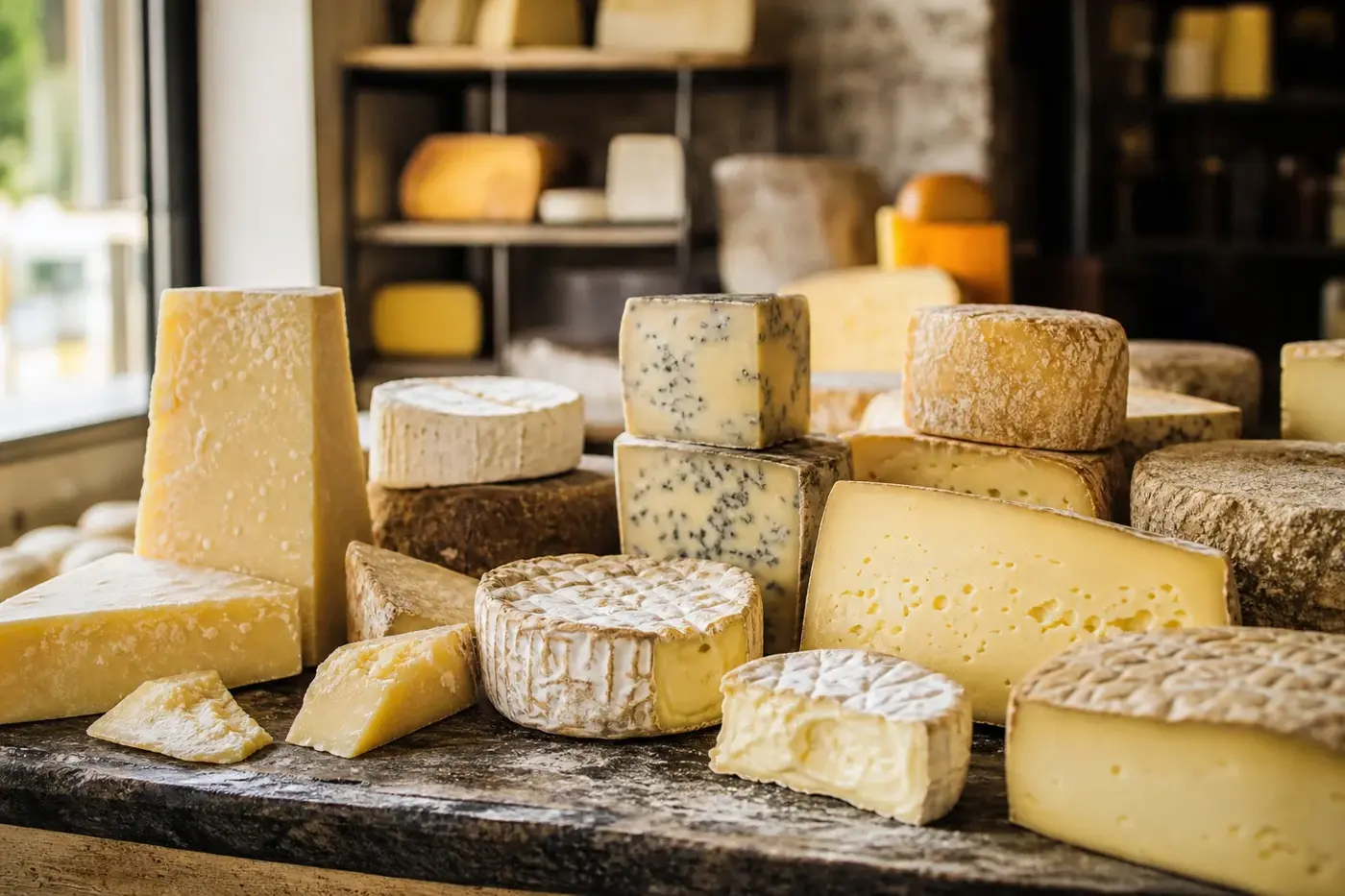
A crumbly piece of Lancashire or a soft cheese beginning to flow: you can almost feel the decision forming. At Paxton & Whitfield, choosing is only the start. Judging condition, cutting carefully and explaining character are the work behind the counter. Your main task is resisting the urge to call everything “one for later”.
The published story begins with a cheese stall at Clare Market, off the Aldwych, in 1742. [4] Today, the historic Jermyn Street shop is its most familiar face. Behind it sits a wider business of retail, wholesale, maturation and cheese education, supported by a cheese-care team in the Cotswolds. [7][8]
| At a glance | The details |
|---|---|
| The business | Specialist cheesemonger, retailer, wholesaler and cheese maturer. [7][8] |
| Where the story starts | Origins in 1742; the company dates its named partnership to 1797. [4] |
| Legal entity | Paxton & Whitfield Limited, company number 04179878, incorporated on 15 March 2001. [1] |
| Business status | Active at Companies House as of November 2026. [1] |
| Controlling shareholder | The Arthouse Glasgow Limited, recorded with at least 75% of shares and voting rights; notified on 25 June 2025. [2] |
| Ultimate parent | The corporate chain remains unresolved and needs further research. |
| Where to visit | Jermyn Street and Cale Street in London, Bath and Canterbury, listed in November 2026. [7] |
| Current Royal Warrant | Published records differ; see below. |
| Official website | Paxton & Whitfield’s company website. [4] |
Meet the people between dairy and dinner
A cheesemaker turns milk into cheese. A cheesemonger chooses finished or developing cheeses, cares for them and helps you find the right ones. Paxton & Whitfield describes direct relationships with producers and a dedicated team looking after both hard and soft cheeses. [8]
Some cheeses need longer maturation, known as affinage. Others call for shorter ripening, careful handling and a well-judged moment of sale. The company describes these as distinct jobs, rather than one ageing programme for everything on the counter. [8]
Try asking, “Which cheese is ready for the meal I have planned?” It may lead you somewhere more rewarding than “Which cheese is famous?” A little knowledge of cheese styles gives you a useful way into that conversation.
From a Clare Market stall to Jermyn Street
Stephen Cullum established the Clare Market stall in 1742, according to the company’s history. His son Sam developed the business and brought in Harry Paxton and Charles Whitfield. Their surnames became the name above the shop. [4]
There is more than one beginning to this story. First came the market business, then the named partnership, then the moves that eventually brought it to its present address.
| Date | The next chapter |
|---|---|
| 1742 | Stephen Cullum establishes the market business. [4] |
| 1797 | The named partnership begins. [4] |
| 1835 | The business moves to 18 Jermyn Street. [4][6] |
| 1896 | The business moves to 93 Jermyn Street. [4][6] |
That familiar address belongs to a later chapter, not the partnership’s foundation. When you follow a business this far back, those distinctions help keep the story straight.
Not all of that history survives on paper. A serious fire destroyed the company’s records, files and documents, its 2020 historical article explains. The surviving company account describes a wartime turn towards general groceries, followed by renewed relationships with British cheesemakers after the Second World War. It is the company’s narrative, rather than a surviving contemporary record of every event. [5]
Royal connections, with a present-day question
Queen Victoria granted Paxton & Whitfield its first Royal Warrant in 1850, according to the company. Both its heritage page and its Royal Warrant Holders Association profile record the connection. [4][15]
What does that mean for the business? The Association describes recognition of an ongoing supply of goods or services to a Royal Household. Granted for up to five years, a warrant allows the Royal Arms to be used in the appointed trading capacity. A named individual is responsible for their correct use. [14]
For the present appointment, the published records tell different stories. Paxton & Whitfield’s heritage page records an appointment to King Charles III in 2024. The Association profile cited here still describes appointments from Queen Elizabeth II and the former Prince of Wales. Those accounts need reconciling before the current position is clear. [4][15]
Find your counter, know the company
The trading story stretches back centuries, but the present limited company dates from 2001. Companies House records The Arthouse Glasgow Limited as its controlling shareholder, notified on 25 June 2025. [1][2]
That company’s own control record identifies Andrew Brownsword Hotels Ltd as holding at least 75% of its shares. Together, these filings give you a more precise corporate picture than the older account of personal ownership in the company’s history. [1][2][3]
If you would rather begin with the cheese, head for a counter. The shop directory lists these addresses:
- London: 93 Jermyn Street.
- Chelsea: 22 Cale Street.
- Bath: 20 Green Street.
- Canterbury: 55 Palace Street. [7]
You can buy in the shops or through the website. Home delivery, selected click-and-collect services and wholesale supply are also advertised. Before travelling or ordering, consult the current shop and delivery pages for accessibility, collection arrangements and delivery coverage. [7][9]
Let your appetite lead the conversation
Start with the occasion, rather than a famous name. In a September 2026 company interview, the incoming Jermyn Street manager emphasised welcoming, personal service and helping customers discover unfamiliar cheeses. Sinodun Hill and Mrs Kirkham’s Lancashire were among the suggested starting points, taking the conversation beyond familiar continental names. [6]
Give your cheesemonger a clear brief. When will you eat it, how many people are sharing, and does it follow a meal? Say which flavours and textures you enjoy. Then ask what is showing particularly well and will suit your serving day.
Talk quantities at the same time. A substantial cheese lunch needs a different portion from a small course after dinner. Agree a total weight, then divide it between a few contrasting cheeses. Counting wedges without considering their size is an optimistic sort of arithmetic.
Be specific about pleasure, too. Crumbly or flowing, fresh-tasting or strongly developed, a restrained blue or an assertive one? These are conversation starters, not formal grades. You do not need specialist vocabulary to explain what you enjoy.
Behind the counter, timing makes the difference
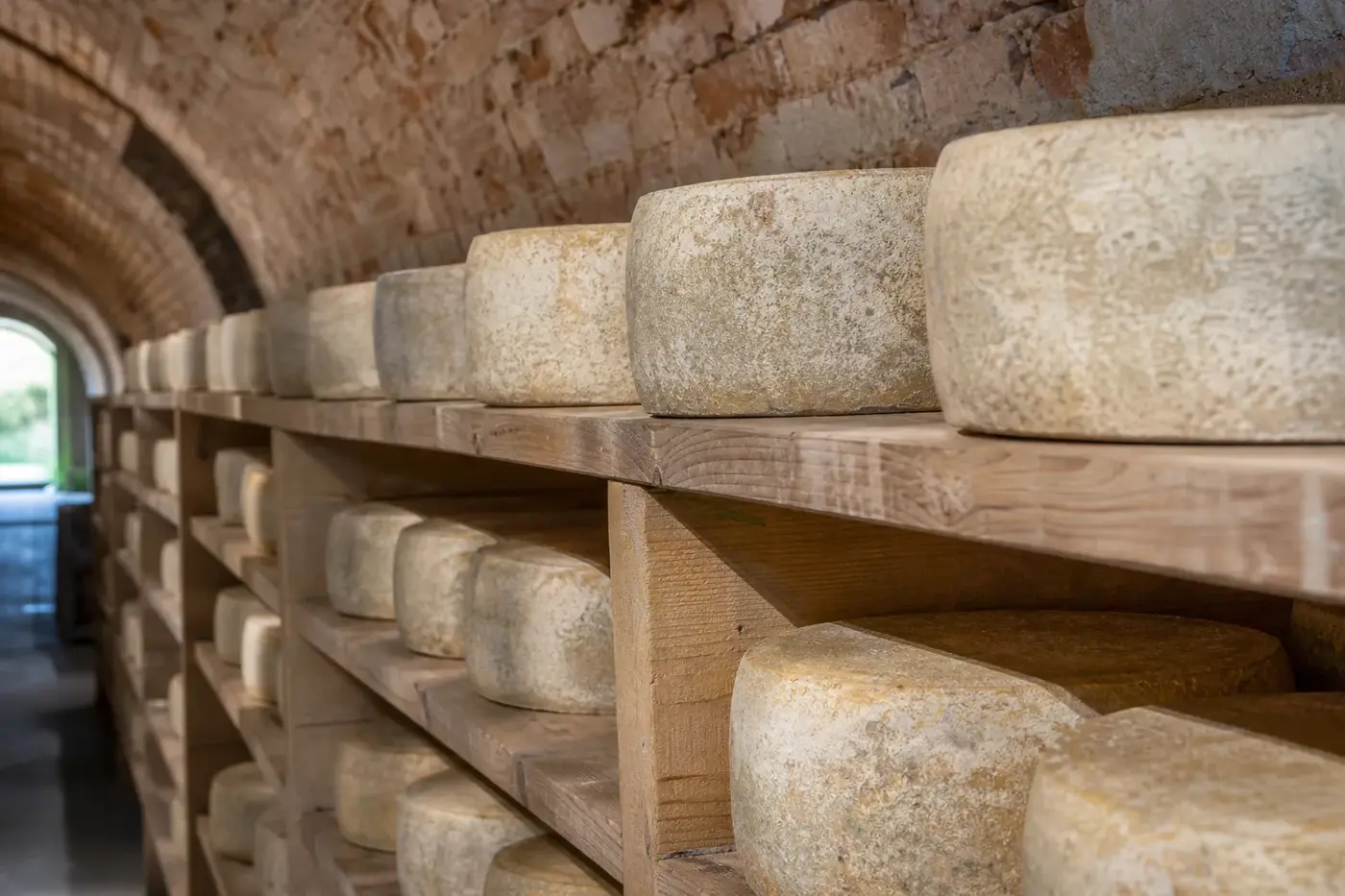
A hard cheese maturing over time and a soft cheese approaching sale need different treatment. Paxton & Whitfield describes a Cotswolds team doing both jobs: longer-term maturation of hard cheeses, and shorter-term ripening and care of smaller soft cheeses. Its heritage timeline records a move to new warehouse and maturation facilities in 2022. [4][8]
You do not see all that work when choosing a wedge, but it matters to the cheese in front of you. For the maker and maturation story of any particular cheese, look at its individual product information. Those details belong to that cheese, not automatically to the whole range. [8]
Cutting deserves your attention, too. The Mrs Kirkham’s Lancashire listing says the company selects smaller wheels for its counters. It normally combines multiple ordered quantities into one larger piece unless you ask otherwise. If you need separate portions for different households or occasions, say so when ordering. [10]
Get acquainted with the cheeses and their makers
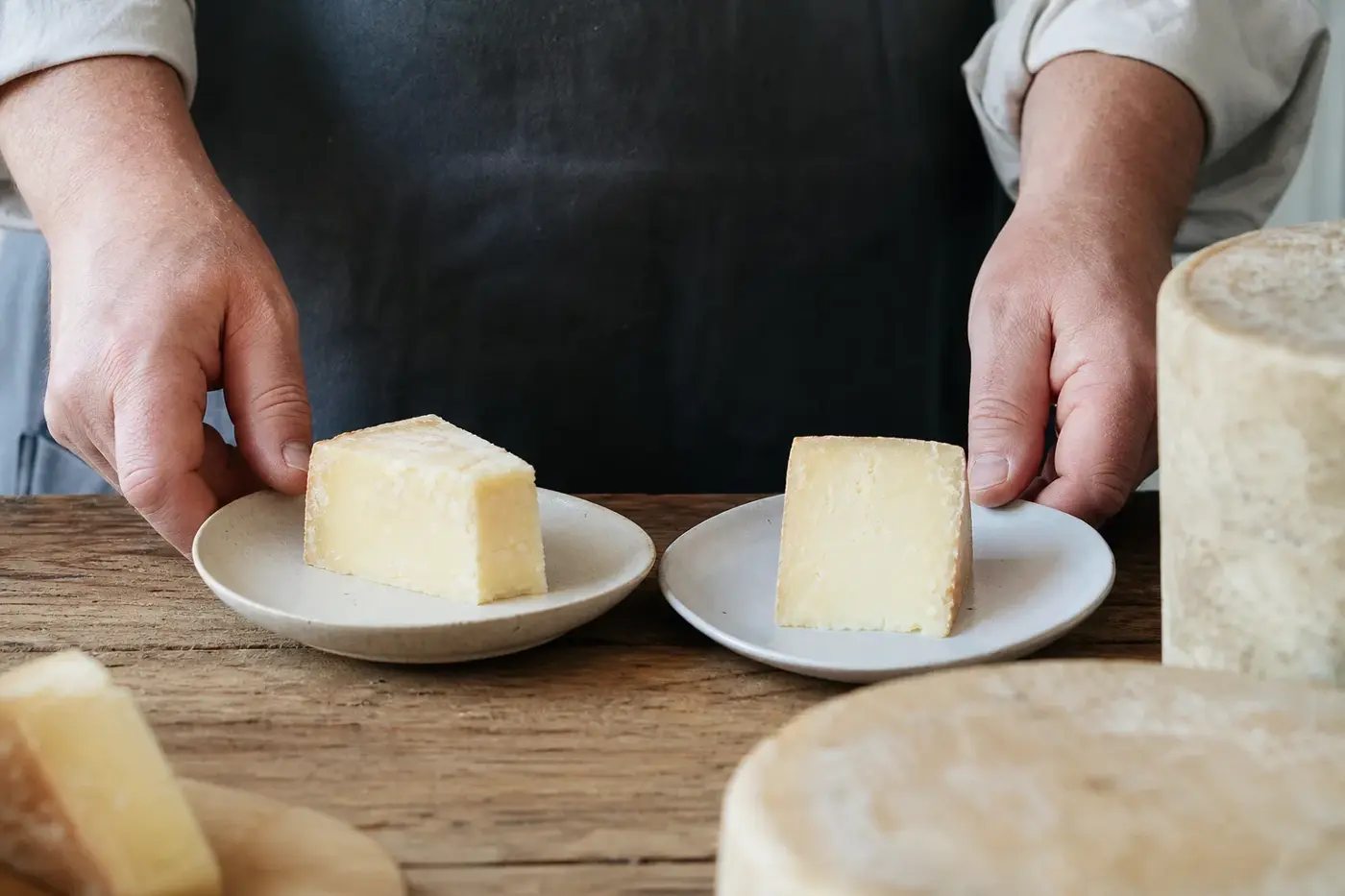
Picture two quite different textures on your plate. Paxton & Whitfield describes Mrs Kirkham’s Lancashire as light and crumbly, with a fresh lactic character. Its Sinodun Hill notes describe a wrinkled rind around a mousse-like cheese with citrus character. [10][11]
Those retailer descriptions give you useful points of comparison. They also open up another part of the story: the merchant choosing the cheese and the maker producing it are not interchangeable.
| Cheese | Meet the maker | What the published material tells you |
|---|---|---|
| Mrs Kirkham’s Lancashire | Mrs Kirkham’s, Beesley Farm, Goosnargh | Paxton & Whitfield names the farm and describes selecting wheels for its counters. [10] |
| Sinodun Hill | Norton and Yarrow Cheese | The listing names the maker and describes a soft goat’s milk cheese. [11] |
| Tunworth | Hampshire Cheese Company | The producer names Paxton & Whitfield as a supplier; the cheesemonger lists the cheese. [12][13] |
| Bleu des Basques | Producer not established in the cited material | Featured in a September 2026 company interview. [6] |
Tunworth’s producer describes specialist merchants advising on storage and presenting cheese at suitable ripeness. From the supplier’s side, the relationship involves more than moving a product from one counter to another. Advice and condition are part of the job, and part of what you take home. [13]
This page summarises published guidance from the official sources it cites. It is not medical advice. Guidance differs between countries and changes over time, so check the current source for where you live, and ask your doctor, midwife, pharmacist or dietitian about your own circumstances.
Make room for clear questions about milk and allergens
“Goat’s milk” answers one question, not all of them. It does not tell you whether a cheese is pasteurised. The Sinodun Hill listing identifies animal species, pasteurisation and ingredients separately. Ask for each piece of information you need. [11]
For the English shops, relevant Food Standards Agency guidance distinguishes food sold loose, food prepacked for direct sale and other prepacked food. Businesses must provide the required allergen information in a format suited to how food is packaged and sold. With online orders, that information must be available before purchase and when delivered. [16]
Tell staff about an allergy before you choose. Ask about cross-contact during cutting and packing, and keep the supplied information with the cheese. For the broader distinctions, see reading a cheese label and milk allergy and lactose intolerance.
If you need pregnancy advice in the UK, turn to the current NHS guidance in source [18]. Use that guidance for your decisions, rather than relying on a cheese’s name or style alone.
Give your cheese a good journey home
Keep each cheese with its wrapping and any date or storage instructions. If you are unsure how long a cut portion will keep, ask before you leave the shop.
For England, Wales and Northern Ireland, the FSA advises keeping a domestic fridge at 5 °C or below and following food storage instructions. Cheese that needs chilling should go into the fridge promptly after purchase or delivery. [17]
Paxton & Whitfield’s cheese-care page says larger pieces generally keep better than small ones, and recommends eating cut cheese promptly. Treat that as quality guidance alongside the particular product’s storage and date instructions. [19]
When serving, take out only what you expect to eat. Consult the NHS advice in source [20] for current guidance on chilled food. The fuller home storage guide explains how to organise cheese between meals.
The daily work behind a long story
History gives Paxton & Whitfield context, but the daily work explains its place in British cheesemongering. That means relationships with producers of named cheeses, conversations with customers, maturation, and supply to restaurants, hotels and retailers. The company also describes training chefs and front-of-house teams, taking cheese knowledge beyond its own counters. [8]
For you, the value arrives at the table: cheese in good condition, in an appropriate portion, with its character understood. A producer makes it; a knowledgeable merchant helps you choose and enjoy it. Hampshire Cheese Company’s account of working with specialist suppliers brings that relationship into focus. [13]
Questions people ask
When was Paxton & Whitfield founded?
Its history begins with Stephen Cullum’s cheese stall at Clare Market in 1742. The named partnership began in 1797.
Where are Paxton & Whitfield’s shops?
Its shop directory lists 93 Jermyn Street and 22 Cale Street in London. It also lists shops at 20 Green Street in Bath and 55 Palace Street in Canterbury.
Does Paxton & Whitfield have a Royal Warrant?
The company dates its first Royal Warrant, from Queen Victoria, to 1850. Its current appointment is unverified because published records differ.
Does Paxton & Whitfield mature its own cheeses?
The company describes a Cotswolds team responsible for longer maturation of hard cheeses and shorter ripening and care of soft cheeses. It moved to new warehouse and maturation facilities in 2022.
How should I store cheese at home?
For England, Wales and Northern Ireland, the Food Standards Agency advises keeping a domestic fridge at 5 °C or below and following food storage instructions. See its guidance in source [17].
Sources
- Companies House, Paxton & Whitfield Limited: company overview, live register, checked November 2026.
- Companies House, Paxton & Whitfield Limited: persons with significant control, live register, including notification dated 25 June 2025, checked November 2026.
- Companies House, The Arthouse Glasgow Limited: persons with significant control, live register, including notification dated 1 August 2023, checked November 2026.
- Paxton & Whitfield, About us: our heritage, undated live page, checked November 2026. Company historical account and statements about its facilities.
- Paxton & Whitfield, A slice of British cheese history, 1 September 2020, checked November 2026. Company historical account.
- Paxton & Whitfield, Meet Steven Sweet, our new Jermyn Street Manager, 26 September 2026, checked November 2026. Company interview.
- Paxton & Whitfield, Our shops, undated live directory, checked November 2026.
- Paxton & Whitfield, Wholesale, undated live page, checked November 2026. Company description of sourcing, maturation, training and supply.
- Paxton & Whitfield, Delivery, undated live page, checked November 2026.
- Paxton & Whitfield, Mrs Kirkham’s Lancashire, undated product listing, checked November 2026. Retailer’s maker identification, selection practices and tasting notes.
- Paxton & Whitfield, Sinodun Hill, undated product listing, checked November 2026. Retailer’s maker identification, product declarations and tasting notes.
- Paxton & Whitfield, Tunworth, undated product listing, checked November 2026.
- Hampshire Cheese Company, Specialist supplier feature: Paxton & Whitfield, 22 February 2023, checked November 2026. Producer’s account of its commercial supplier relationship.
- Royal Warrant Holders Association, What is a Royal Warrant?, live institutional explanation, checked November 2026.
- Royal Warrant Holders Association, Paxton & Whitfield Ltd, undated company profile, checked November 2026.
- Food Standards Agency, Allergen guidance for food businesses, updated 17 July 2026, applicable to England, Northern Ireland and Wales, checked November 2026.
- Food Standards Agency, How to chill, freeze and defrost food safely, published 18 December 2017, current online guidance, applicable to England, Northern Ireland and Wales, checked November 2026.
- NHS, Foods to avoid in pregnancy, current online guidance, checked November 2026.
- Paxton & Whitfield, Cheese care, undated live page, checked November 2026.
- NHS, Listeriosis, current online guidance, checked November 2026.
- Food Standards Agency, Alerts, live official alert index, retrieved November 2026.
This piece was researched from company filings, company and producer publications, Royal Warrant Holders Association records and official food guidance; no visit or tasting was undertaken.
Last checked: November 2026
Last checked November 2026.
The editors suggest you read next
Farmhouse, Artisan and Industrial Cheesemakers Explained
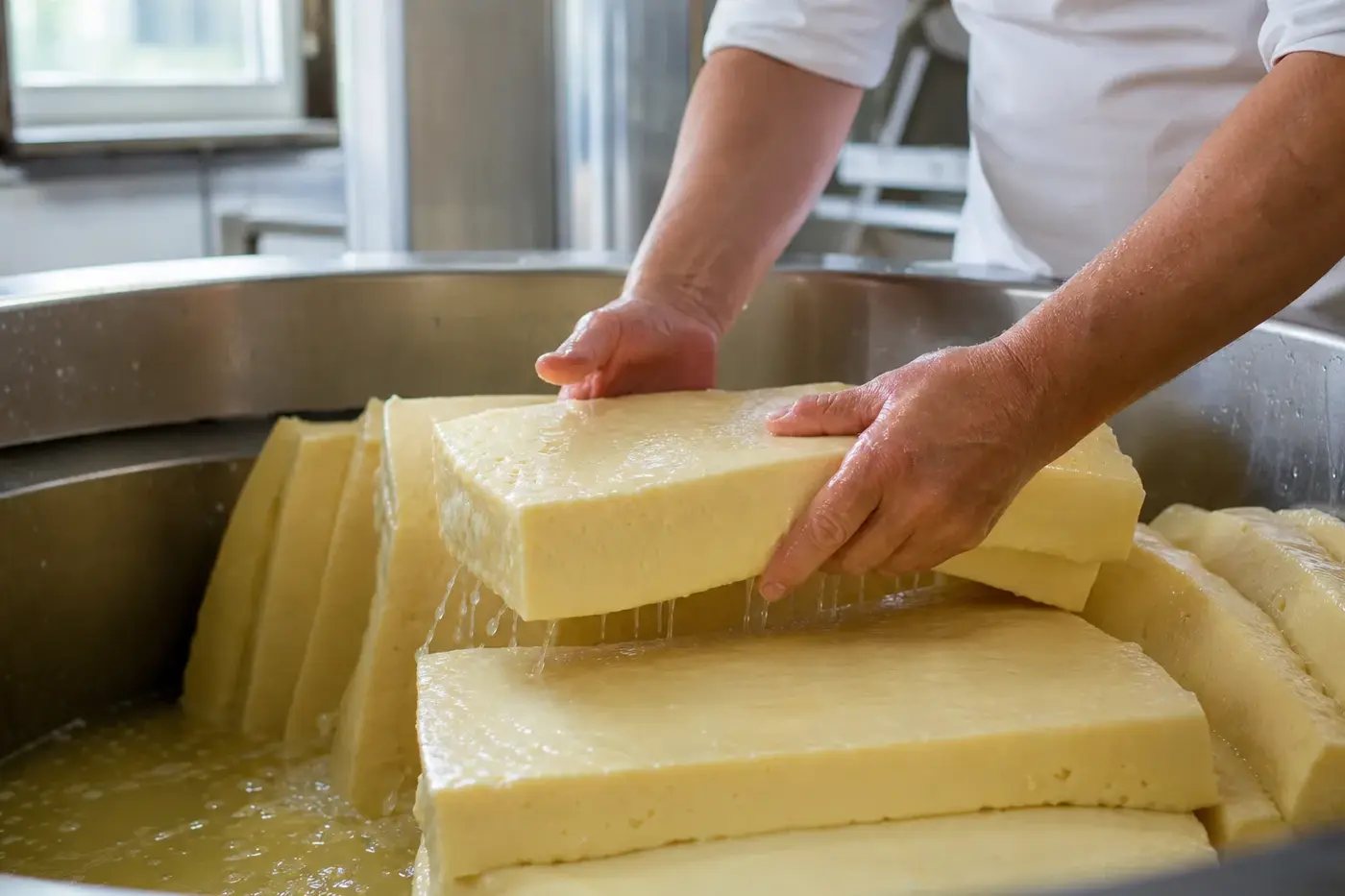
Slabs of curd are turned and stacked by hand.