Formaggio di Fossa di Sogliano
Down go the cloth bags of cheese, into sandstone pits beneath the hills around Sogliano al Rubicone.
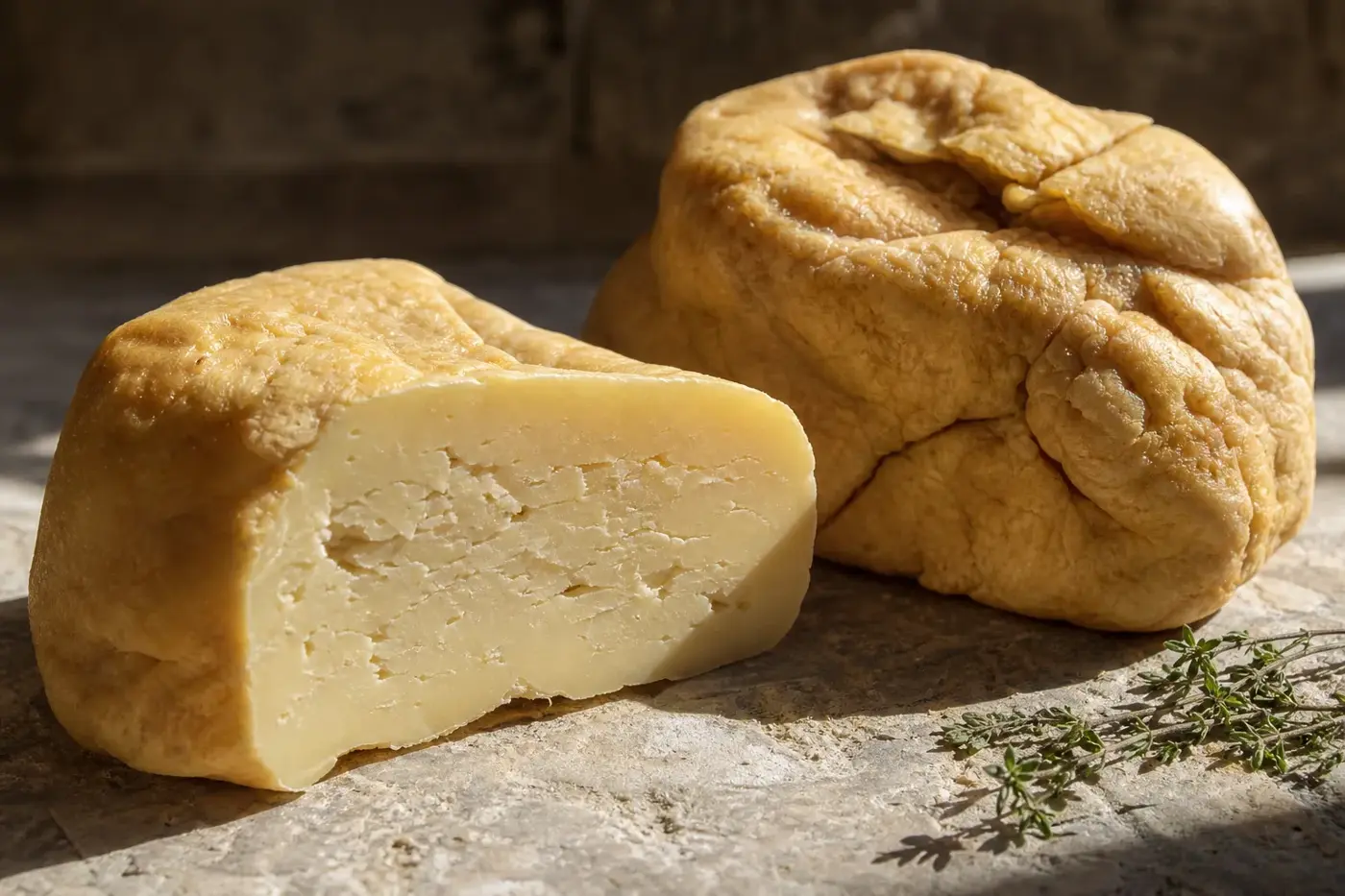
Down go the cloth bags of cheese, into sandstone pits beneath the hills around Sogliano al Rubicone. The infossatori, specialists in underground maturation, pack them in and seal them away for 80 to 100 days. When the cheeses emerge, compressed and irregular, you can see what close quarters have done to them.
You can taste the transformation, too. Formaggio di Fossa di Sogliano is registered as a PDO in the EU and Great Britain. Cow’s milk, sheep’s milk and mixed-milk versions each bring their own character to the specified method.[1][2][6][8]
| What you might want to know | The detail |
|---|---|
| The name to look for | Formaggio di Fossa di Sogliano.[1][4] |
| EU designation and identifier | Protected designation of origin, PDO-IT-0580; published standard amendment PDO-IT-0580-AM01.[1][4] |
| EU registration instrument | Commission Regulation (EC) No 1183/2009, adopted 30 November 2009 and published 3 December 2009.[5] |
| Great Britain registration | Registered PDO; UK scheme registration dated 31 December 2020 at 23:00. Register information: November 2026.[6] |
| Where it must be made | Specified territories in Emilia-Romagna and Marche, Italy.[2][4] |
| Milk permitted | Whole sheep’s milk, whole cow’s milk, or a mixture of at least 20% sheep’s milk and no more than 80% cow’s milk; raw or pasteurised.[3] |
| Time it must mature | Before the pit: 60 to 240 days. Sealed pit maturation: 80 to 100 days.[3][8] |
| Size and shape you can expect | Irregular cheeses weighing 500 to 1,900 g, with little or no distinct rind.[2] |
| Northern Ireland status | Not established here. |
| Switzerland status | Not established here. |
| United States status | Not established here. |
| Typical ageing | Not established here. |
| Coagulant permitted | Natural rennet.[3] |
Follow the cheese into the hills
Sogliano al Rubicone gives the cheese its name, but your map needs to stretch beyond one town. The territory reaches across the foothills and hills along the Apennine ridge between Romagna and Marche. Here, the underground chambers are excavated in sandstone formations.[1]
The legal area includes the provinces of Forlì-Cesena, Rimini, Ravenna, Pesaro-Urbino, Ancona, Macerata and Ascoli Piceno, plus specified municipalities in the province of Bologna. Milk production, cheesemaking, maturation and pit ageing must all take place within the defined area. Portioning and packaging are geographically controlled too.[2][8]
A label bearing Sogliano’s name does not, then, necessarily place the dairy beside the town’s pits. To trace your cheese’s journey, ask which dairy made it and which infossatore managed its underground maturation. The dairy and the pit operator each have a part in the finished piece.
A protected name with a particular meaning
Formaggio di Fossa di Sogliano entered the EU register through Regulation (EC) No 1183/2009. Published on 3 December 2009, it provided for entry into force on the twentieth day following publication. An approved standard amendment followed in January 2025.[1][5]
PDO means protected designation of origin. The complete name identifies cheese meeting the specification’s geographical and production requirements. Underground maturation alone does not qualify it: the milk, place and production method must meet the requirements too.[2]
That distinction comes in handy at the cheese counter. “Pit-aged cheese” describes a maturation method; Formaggio di Fossa di Sogliano identifies this specified product. You can explore the broader picture in protected cheese names.
Great Britain also lists the name separately as a registered PDO on its own register. That establishes its GB status. Protection in other markets depends on the arrangements there.[6]
Start your tasting with the milk
Sheep, cow or a mixture? Before you break off a piece, the milk offers your first clue to its character. The specification permits pecorino, entirely sheep’s milk; vaccino, entirely cow’s milk; and misto, a mixture.[3]
Misto must contain at least 20% sheep’s milk and no more than 80% cow’s milk. All three versions may use raw or pasteurised whole milk. A shared underground method still leaves plenty of room for different flavours.[3]
The official description calls pecorino aromatic and intense, with varying degrees of slight pungency. Vaccino is fine and delicate, moderately salty and slightly acidic, with a touch of bitterness. Misto combines savoury and sweeter impressions, also with bitter notes.[1]
So don’t expect every pit-aged cheese to taste equally forceful. For a gentler introduction, ask to compare vaccino with pecorino. For a more revealing tasting, choose cheeses with recorded dairy, pit and maturation details, then notice how the milk fits into each cheese’s journey.
Leave it for summer, return in November
Imagine handing your cheese to an infossatore for the summer, then coming back to collect it in November. That is the pattern described in Sogliano’s municipal guide. At the heart of the tradition is a relationship between cheese owners and the specialists who look after their cheese underground.[7]
The guide records 1974 as the first edition of Sogliano’s cheese fair. It marks a modern milestone in the town’s public celebration of the cheese. A local story, though, gives the pits a more dramatic beginning.[7]
The pit operator Fosse Venturi recounts how cheese may have been hidden from passing troops, then discovered to have changed during burial. Concealment is offered as a possible explanation for the method’s origins. The story turns on the surprise of what came back out.[10]
To date a pit’s earliest use, you need the dated document itself. The practical continuity is easier to follow: owners entrust their cheese to someone with the chamber, equipment and knowledge to manage its stay. The infossatore’s work begins well before the lid closes.
The cheese has a life before the pit
By the time it goes underground, this cheese has already matured. First, natural rennet sets the milk into curd; the specification requires this coagulant and prohibits additives. The curd is then broken and put into moulds to drain its whey.[3]
Next comes manual pressing and/or a warm draining stage. Salting may be dry or in brine. These steps prepare the cheese for the maturation still to come.[3]
Before infossatura, the placing of the cheese in the pit, maturation lasts 60 to 240 days. At loading, each cheese must be clean and free from mould, with no whey on its surface. It goes into an uncoloured cloth bag, secured with suitable ties.[3][8]
Each bag carries the pit establishment’s identification and the batch identification, marked directly or on attached tags. That keeps different consignments connected to their origins through loading, maturation and unloading.[3] For the curd and drainage stages behind it all, see how cheese is made.
Straw, wooden boards and a sealed lid
Before the next load arrives, wheat straw helps prepare the chamber. The specification calls for the pit to be opened and aired, then treated with fire and smoke from small quantities of straw. Once the fire is out, the ash is removed.[2]
Untreated wooden boards form a raised floor. Underneath, space allows fatty liquid released during maturation to drain away. Upright reeds support a lining of wheat straw at least 10 cm thick around the walls.[2]
The cloth bags are stacked towards the pit’s mouth. After a settling period of no more than ten days, suitable cheese may be added to fill any space that has appeared. This is close packing with a very particular timetable.[2]
Food-suitable uncoloured cloth and/or straw covers the load. A wooden lid closes the chamber, sealed with plaster or the specified mortar. The cheese then remains underground for 80 to 100 uninterrupted days, during which opening is prohibited.[1]
Spring loading runs from 1 March to 20 June; summer loading runs from 21 June to 21 September. Each pit may complete no more than two cycles in a calendar year. Prescribed recovery periods and winter rest belong to the schedule too.[2]
Finally comes sfossatura, the opening and removal stage. The seal is broken and the chamber ventilated before operators descend. The regional authority describes a controlled procedure that protects workers as well as governing how the cheese is handled.[8]
Look past the dents to the friable heart
If you prefer your cheese perfectly round, this one has other ideas. Caseificio Pascoli describes cheeses pressing against one another underground, releasing fat and becoming deformed as they mature. The shape that emerges records that pressure, rather than preserving the tidy outline of the caciotta that went in.[9]
The official specification describes an exterior ranging from ivory-white to amber-yellow. It is commonly moist and greasy, with a rind that is absent or barely perceptible. Inside, you find a semi-hard, readily friable paste, coloured white-amber or slightly straw-coloured.[2]
Then take in the aroma. The specification describes persistent woodland undergrowth, with mould and truffle notes. Those official tasting descriptors give you something more precise to explore than simply “a strong cheese”.[1]
At the table, start outside and work in. Look at the surface and shape, break off a small piece, then explore aroma and flavour. How it breaks tells you something different from how it smells, helping you distinguish the physical effects of compression from taste differences associated with the milk.
Keep an eye on both ageing clocks
Two clocks shape Formaggio di Fossa di Sogliano. The first counts the 60 to 240 days of maturation before burial. The second counts the sealed underground stage, so pit days alone leave a substantial stretch of the cheese’s development out of the picture.[3][8]
Milk choice matters, but so does the pressure a cheese experiences among neighbouring bags. Pascoli’s production account describes fat release and mutual compression. It connects the finished appearance to conditions inside a fully loaded chamber.[9]
The official account also identifies anaerobic fermentation as part of the transformation. This is ripening in an enclosed environment without normal air exchange. It helps explain the scant separation between rind and paste, and the cheese’s vulnerability to drying and hardening once it leaves the pit.[1]
For a useful comparison, record the milk type, dairy, pit operator, spring or summer cycle and any stated age. Taste each cheese before adding accompaniments. Go beyond “strong” or “mild” and note aroma, acidity, bitterness, pungency and texture: the differences become much easier to recognise.
Give the first bite to the cheese
Before you reach for anything sweet, taste a small piece alone. Sogliano’s municipal guide recommends honey, caramelised figs, preserves and savor, a local sweet preserve. Each offers a way to explore sweetness against the cheese’s pronounced character.[7]
For your first serving, plain bread, cheese and a little honey placed separately are enough. You get a clear first taste of the cheese. Then you and anyone sharing it can decide how much sweetness to add.
Offer water alongside the bread, fruit and honey. Keep the accompaniments separate and try them in turn. Notice what each does to your impression of the cheese before bringing everything together.
For the kitchen, the municipal guide names cappelletti, passatelli and gnocchi. Pascoli also publishes ravioli ideas combining pit-aged cheese with other dairy ingredients.[7][9] A little crumbled over a familiar pasta or gnocchi dish makes an uncomplicated introduction.
Taste before adding more. You want to recognise what this particular cheese contributes, rather than lose its character among the other ingredients. Let it join the conversation without taking over the entire dinner.
Choose your piece, then keep it well
Start with the complete registered name and the milk type. Official labelling requirements identify raw-milk versions with “da latte crudo”. Spring and summer pit cycles are distinguished by PRM and EST, small details that help you follow your piece’s production history.[1]
Ask your cheesemonger which dairy made it and who operated the pit. Ask about the packaging instructions, too. Whole cheeses and portions may be distributed in several specified formats, including vacuum packs, film-wrapped trays and food-grade paper.[8]
The packaging has a practical purpose. Once the cheese leaves the pit, its surface is particularly susceptible to drying. Paying attention to how it is packed helps you understand how to care for the piece you take home.[8]
At home, follow the pack’s storage instructions and date markings. In England, Wales and Northern Ireland, the Food Standards Agency advises keeping the fridge at 5 °C or below.[12] For wrapping and everyday handling, turn to storing cheese at home.
General information only, not medical advice: follow the official guidance where you live.
Questions people ask
What is Formaggio di Fossa di Sogliano?
It is an Italian cheese matured in sandstone pits and registered as a protected designation of origin in the EU and Great Britain. Its defined production area includes specified territories in Emilia Romagna and Marche.
What milk is used to make it?
It can be made from whole sheep’s milk, whole cow’s milk or a mixture. The mixed version must contain at least 20% sheep’s milk and no more than 80% cow’s milk.
How long is the cheese aged underground?
It spends 80 to 100 days in a sealed pit, which cannot be opened during that time. Before burial, it matures for 60 to 240 days.
What does Formaggio di Fossa di Sogliano taste like?
The sheep’s milk version is aromatic and intense, while the cow’s milk version is fine and delicate, with a touch of bitterness. The mixed version combines savoury and sweeter impressions with bitter notes. The official aroma description includes woodland undergrowth, mould and truffle.
How should I store Formaggio di Fossa di Sogliano?
Follow the pack’s storage instructions and date markings. In England, Wales and Northern Ireland, the Food Standards Agency advises keeping the fridge at 5 °C or below; check its current guidance.
Sources
- European Commission, Publication of an approved standard amendment to a product specification, C/2025/474, 22 January 2025, including the consolidated single document for Formaggio di Fossa di Sogliano. Official publication.
- MASAF, Decreto 1 agosto 2024: Modifica ordinaria al disciplinare di produzione della denominazione di origine protetta “Formaggio di Fossa di Sogliano”, including Annex A. Decree and consolidated specification.
- MASAF, Disciplinare di produzione della denominazione di origine protetta “Formaggio di Fossa di Sogliano”, consolidated specification incorporating the 2024 changes. Product specification.
- MASAF, Elenco delle denominazioni italiane, iscritte nel Registro delle denominazioni, list dated 22 October 2025, row 112. Official list.
- European Commission, Commission Regulation (EC) No 1183/2009 of 30 November 2009, Official Journal L 317, 3 December 2009, pages 34 to 35. Registration regulation.
- Department for Environment, Food & Rural Affairs, Formaggio di Fossa di Sogliano, GB protected food name register entry, published 4 January 2021. GB register entry.
- Visit Sogliano al Rubicone, Guida Sogliano 2020, section “Formaggio di Fossa di Sogliano DOP”, pages 14 to 15. Municipal visitor guide.
- Regione Emilia-Romagna, Riunione di pubblico accertamento per la Dop Formaggio di Fossa di Sogliano, 2 May 2024, updated 9 December 2024. Regional production summary.
- Caseificio Pascoli, E’ tempo di formaggio di fossa; ottima la produzione 2019/20, un po’ di storia e qualche ricetta, undated producer account referring to the 2019/20 production. Commercial producer source. Production account and cooking suggestions.
- Fosse Venturi, Storia Formaggio di Fossa di Sogliano, undated pit-operator account. Commercial producer source. Recorded local tradition.
- Consorzio Vini di Romagna, Formaggio di Fossa di Sogliano DOP: il tesoro sotterraneo della cucina romagnola, undated wine-industry account. Regional pairing suggestions.
- Food Standards Agency, How to chill, freeze and defrost food safely, current online guidance for England, Northern Ireland and Wales, retrieved November 2026. Official chilling guidance.
Researched from official registration instruments and specifications, regional and municipal publications, attributed producer accounts and official food-handling guidance; no site tasting or recipe testing was undertaken.
Last checked: November 2026
Last checked November 2026.
The editors suggest you read next
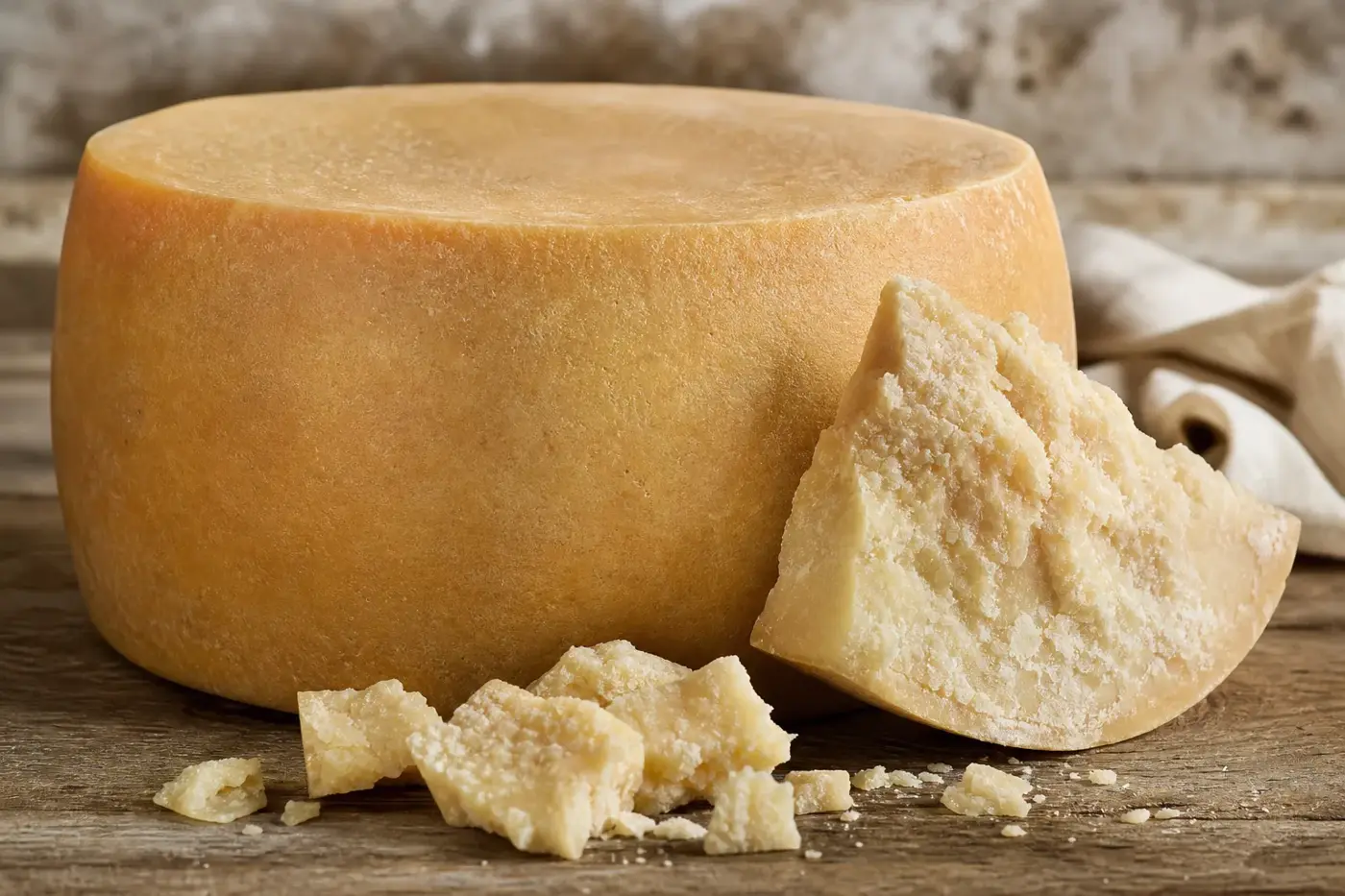
Parmigiano Reggiano
Break into a wheel of Parmigiano Reggiano and flakes fall away, revealing a finely granular cheese, pale straw to straw in colour.