Formai de Mut dell'Alta Valle Brembana
Look at the freshly cut face: little eyes scattered through ivory to pale straw paste, compact yet elastic beneath a thin natural rind.
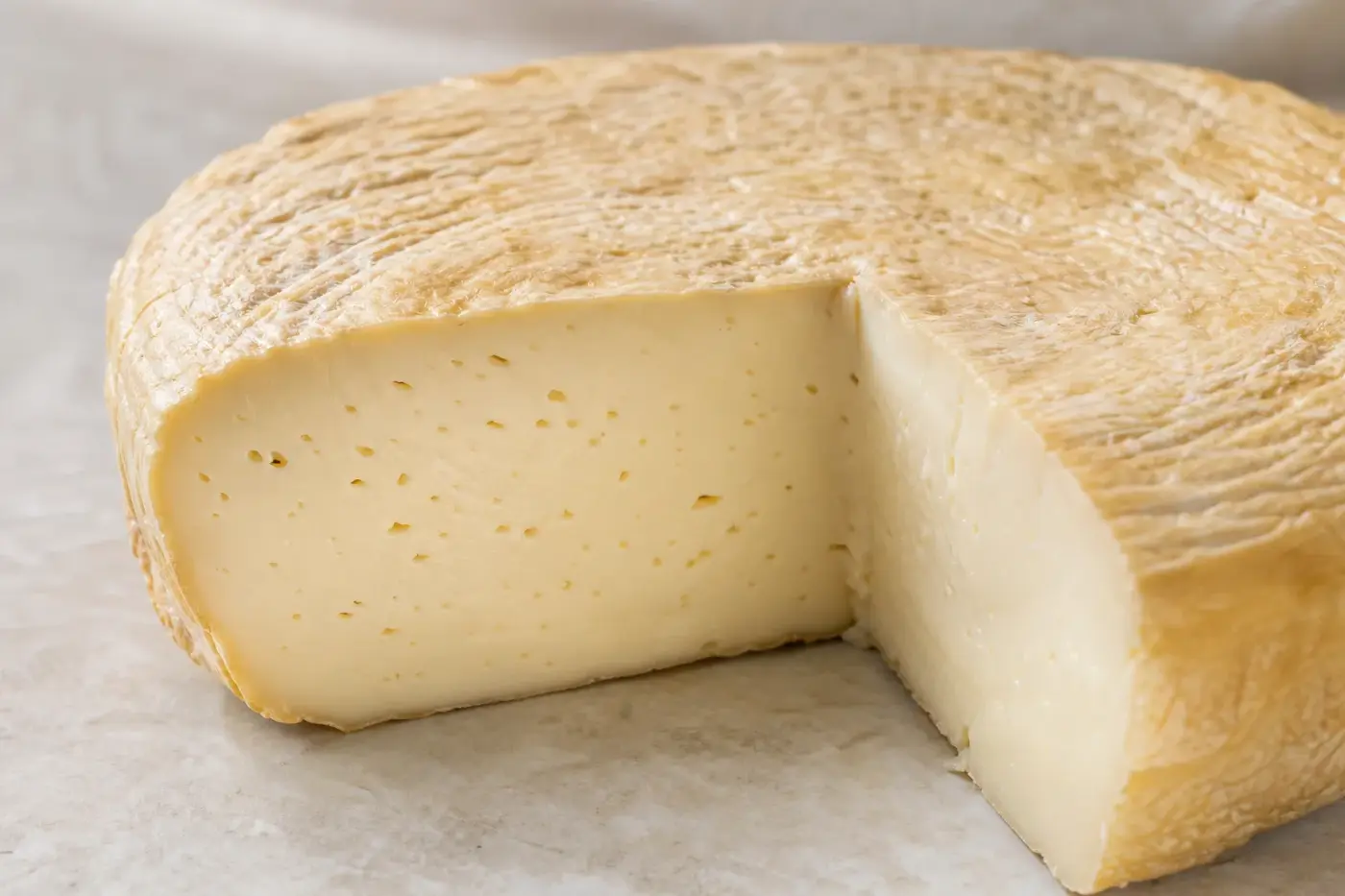
Look at the freshly cut face: little eyes scattered through ivory to pale straw paste, compact yet elastic beneath a thin natural rind. Formai de Mut dell'Alta Valle Brembana brings you whole raw cow's milk from Lombardy, with EU protected designation of origin (PDO) status. Its story moves between high summer pastures and dairies lower in the valley, two settings in the same mountain cheese tradition. [1,2]
Get acquainted with your mountain cheese
Registered name: Formai de Mut dell'Alta Valle Brembana. [1]
EU authority: European Commission. Register identifier: Unconfirmed. PDO-IT-0009-AM01 refers to an amendment application. [8]
EU status, November 2026: Registered PDO; specification amended by Implementing Regulation (EU) 2023/342. [1]
Great Britain, Northern Ireland, Switzerland and United States status: Unconfirmed.
Production area: Twenty-one municipalities in the upper Brembana Valley, Bergamo province, Lombardy, Italy. [1]
Milk: Whole raw cow's milk. Coagulant: Bovine rennet. Starter: Natural starter or selected culture permitted. [1]
Maturation: At least 45 days; more than six months for Riserva. [1,7]
Format: Cylindrical; approximately 8 to 12 kg, 30 to 40 cm across and 8 to 10 cm high, within the specification's tolerances. [1,2]
Fat: Minimum 42% fat in dry matter. [1,2]
Follow the herders up to the pastures
Formai de Mut means mountain cheese in the local herders' vocabulary. More precisely, mut means the high pastures, as ONAF, Italy's cheese tasting organisation, explains. Those few words hold a whole working landscape: animals climbing towards fresh grazing, milk becoming cheese close to the herd, and wheels travelling down to carry on maturing. [3,4]
The consortium describes alpeggio, or summer mountain grazing, as a journey through pasture stations equipped for cattle and cheesemaking. Herds can reach above 2,000 metres before descending again. Their customary return falls around the feast of San Matteo in September, according to its account. The season sets the pace, rather than a single timetable for every herd. [4]
One valley, two settings for cheesemaking
Both pasture and valley production carry the designation. The protected area covers the full administrative territories of Averara, Branzi, Camerata Cornello, Carona, Cassiglio, Cusio, Foppolo, Isola di Fondra, Lenna, Mezzoldo, Moio de' Calvi, Olmo al Brembo, Ornica, Piazza Brembana, Piazzatorre, Piazzolo, Roncobello, Santa Brigida, Valleve, Valnegra and Valtorta. Every one lies in the province of Bergamo. [1]
Picture high alpeggi, meadows on the valley slopes and grassland closer to the valley floor, all described by the consortium. A valley dairy's cheese is still mountain cheese. A red mark identifies this lower setting, where production can continue throughout the year; blue identifies cheese made on the mountain pastures. [5,7]
Sometimes you can see the season in the paste. VisitBrembo, the valley's official tourism portal, describes winter hay feeding as tending towards paler cheese and gentler flavours, while summer grazing brings stronger colour and flavour. Let that guide your first questions: who made the wheel, when was it produced and how long did it mature? [6]
This page summarises published guidance from the official sources it cites. It is not medical advice. Guidance differs between countries and changes over time, so check the current source for where you live, and ask your doctor, midwife, pharmacist or dietitian about your own circumstances.
Follow the milk into the mould
Whole, raw cow's milk is required, keeping its fat and receiving no pasteurisation. ONAF describes milk processed after milking, or evening milk combined with the following morning's milk. The amended specification states the milk type without prescribing one or two milkings. You can explore the differences in raw milk, thermised and pasteurised cheese. [1,3]
Bovine rennet, the preparation that sets the milk, goes in at 35 to 37 °C. Approximately 30 minutes later, there is curd: the solid gel that will become cheese. A natural starter or selected culture may also be added, but the specification names no compulsory bacterial strains. [1,8]
The curd is broken, heated to 43 to 50 °C, then stirred off the heat. This is the semicotta stage, meaning the curd is partially cooked. Next come cylindrical moulds called fassere and enough pressing to expel whey, the liquid released from the curd. Salting follows, either dry or in brine. [1,8]
That heating is not the same as pasteurising milk beforehand. Formai de Mut remains a raw milk cheese, bringing together whole milk, bovine rennet, partial curd cooking and pressing. For the broader journey from milk to finished wheel, see how cheese is made. [1,8]
Look for the rind and those little eyes
Start with the silhouette: a broad cylinder with flat or almost flat faces and a straight or slightly bulging side. The consortium describes a thin, compact, natural rind, its straw colour deepening with maturation. Cut inside and you find ivory to pale straw paste, compact but elastic, scattered with small eyes. [2]
Occhio di pernice, or partridge eye, is the traditional comparison. The consortium gives an eye size starting at about 1 mm, using that familiar local expression for larger openings. When your cheesemonger shows you a cut face, look for those little openings alongside the wheel's shape and markings. [2]
Taste the butter, grass and passing months
Delicate, lightly salted and not piquant: that is the consortium's starting description, with aromas linked to the valley's forage. ONAF adds melted or cooked butter, grass and fermented grass, walnut, hazelnut, chestnut and floral notes. Use its assessment as a tasting vocabulary, not a checklist every wheel must complete. Your slice is not sitting an exam. [2,3]
For longer maturation, ONAF also records animal notes and meat broth. Age can move the aromas from milk and vegetation towards something more savoury, which tells you rather more than simply saying “stronger”. If samples are available, compare ages and taste each cheese plain before reaching for an accompaniment. [3]
The legal minimum maturation is 45 days; Riserva means more than six months. The consortium says ageing can continue for several years, while ONAF describes year-old examples as suitable for grating. Choose for the plate you have in mind: an elastic table cheese or a more developed savoury accent. [1,2,3,7]
Find the name and get to know the mark
First, look for the full name, Formai de Mut dell'Alta Valle Brembana DOP, on the wheel's paper conformity mark or the portion's packaging. DOP is the Italian abbreviation corresponding to PDO. The consortium's emblem shows a stylised cowbell enclosing a wheel with a wedge removed, surrounded by repeated smaller bells. [1,7,8]
Red means valley production; blue means alpeggio production. Colour is not the whole story, though: the specification permits black or contrasting reproduction for particular printing requirements. Read the accompanying identification too, and remember that Riserva signals maturation beyond six months. [1,7]
Buying a cut piece? Ask to see the original wheel mark or accompanying identification. The specification requires the production date and dairy's identification on the wheel's side, while portions may be cut and packed outside the production area. For the difference between a protected name and a brand, turn to protected names explained. [1]
Give your slice its moment
ONAF assessed its samples at approximately 20 °C (68 °F). That describes tasting conditions, not how long you should leave cheese unrefrigerated. Follow your local food safety agency's current guidance. [3]
Cut your wedge into manageable slices, working from the outer edge towards the centre so each portion includes more than one part of the paste. On a board, taste the first piece plain, with bread nearby. Keep fruit or a little honey separate, giving the cheese your attention before trying accompaniments.
In England, Wales and Northern Ireland, the Food Standards Agency advises a home fridge temperature of 5 °C or below. Follow the cheese label's storage instructions and consult the agency's current guidance. For wrapping and looking after a cut piece, see how to store cheese at home. [9]
Pull up a chair in the Bergamasque kitchen
Bergamasque polenta is a traditional companion recommended by the consortium. Its recipe collection also puts the cheese into upper Brembana Valley taragna, risotto, crespelle and pear salad. You can serve it beside a cereal dish, work it into a sauce or filling, or leave it uncooked against fresh fruit. [2,10]
For a simple board, start with bread and pear, then try a little chestnut honey with an older piece. ONAF specifically suggests chestnut, lime blossom and rhododendron honeys, alongside fruit preserves. Keep them separate so you can still pick out the cheese's own aromas. Even good company needn't do all the talking. [3]
Compare ages, then invite Taleggio to the table
Water keeps a comparison between ages straightforward. For a fruit led plate, you can serve unsweetened apple juice alongside bread. ONAF's suggested chestnut, lime blossom and rhododendron honeys give you further accompaniments to explore. [3]
When comparing two pieces, change just one thing at a time. Taste each alone, then with the same bread, before adding a drink or fruit. Contrasting ages reveal more than a long procession of similar wedges. You may find you prefer a gentler table cheese, or a developed example for smaller savoury accents across a meal.
Keep Formai de Mut's partially cooked curd and compact, elastic paste with small eyes in mind. [1] Then look at how the consortium's recipes place it beside Taleggio: Taleggio goes into a polenta tortino, while Formai de Mut becomes the accompanying fonduta. Two cheeses, each with its own part to play. [10]
Questions people ask
Where is Formai de Mut dell'Alta Valle Brembana made?
It is made in 21 municipalities in the upper Brembana Valley in Bergamo province, Lombardy. Its EU PDO covers both high mountain pastures and valley dairies.
What do the red and blue marks on Formai de Mut mean?
Red identifies valley production, while blue identifies production on the mountain pastures. The specification also permits black or contrasting reproduction for particular printing requirements, so check the accompanying identification rather than relying on colour alone.
Is Formai de Mut made with raw milk and animal rennet?
It is made with whole raw cow’s milk and bovine rennet. The curd is partially cooked during cheesemaking, but the milk is not pasteurised beforehand.
What does Formai de Mut taste like, and how long is it aged?
The consortium describes it as delicate, lightly salted and not piquant, while ONAF notes aromas including butter, grass, nuts and flowers. It matures for at least 45 days, and Riserva must mature for more than six months. Longer maturation can bring savoury notes such as meat broth.
What can you serve with Formai de Mut?
The consortium recommends Bergamasque polenta and also uses the cheese in risotto, crespelle and pear salad. ONAF suggests chestnut, lime blossom and rhododendron honeys, as well as fruit preserves.
Sources
- Italian Ministry of Agriculture, Food Sovereignty and Forestry. Disciplinare della denominazione di origine protetta «Formai de Mut dell’Alta Valle Brembana», attached to the communication dated 8 March 2023, published in Gazzetta Ufficiale, Serie Generale no. 67, 20 March 2023, pages 15 to 18. Includes the specification following approval of the amendment by Implementing Regulation (EU) 2023/342. Official publication.
- Consorzio dei Produttori per la Tutela e la Valorizzazione del Formai de Mut dell'Alta Valle Brembana. Caratteristiche, undated current webpage, retrieved November 2026. Producer consortium account of appearance, maturation, sensory character and serving suggestions. Consortium source.
- Organizzazione Nazionale Assaggiatori di Formaggi (ONAF). Informa, no. 35, March 2021, “Formai de Mut”, pages 34 to 35. Includes a documented assessment of 2020 cheeses, its tasting protocol, local terminology, production descriptions and sensory vocabulary. Published issue.
- Formai de Mut protection consortium. Vita d'alpeggio, undated current webpage, retrieved November 2026. Consortium source.
- Formai de Mut protection consortium. Area di produzione, undated current webpage, retrieved November 2026. Consortium source.
- VisitBrembo. Formai de Mut DOP, undated current webpage, retrieved November 2026. Local tourism authority account of seasonal feeding and the associated colour and flavour tendencies. Official valley tourism source.
- Formai de Mut protection consortium. Il marchio, undated current webpage, retrieved November 2026. Consortium source.
- European Commission. Publication of an application for approval of an amendment, which is not minor, to a product specification, “Formai de Mut dell’Alta Valle Brembana”, 2022/C 410/07, 26 October 2022. Application reference PDO-IT-0009-AM01. Used for the identifier and amendment explanations, read alongside the subsequently published specification in source 1. Official publication.
- Food Standards Agency. How to chill, freeze and defrost food safely, published 18 December 2017, current publication landing page retrieved November 2026. Applies to England, Wales and Northern Ireland. Official guidance.
- Formai de Mut protection consortium. Ricette, undated current recipe index, retrieved November 2026. Commercially interested producer consortium source, used for documented culinary applications rather than recipe testing or historical priority. Consortium collection.
Researched through desk comparison of the official published specification, the amendment application, consortium records, a published sensory assessment and official consumer guidance.
Last checked: November 2026
Last checked November 2026.
The editors suggest you read next
Parmigiano Reggiano
Break into a wheel of Parmigiano Reggiano and flakes fall away, revealing a finely granular cheese, pale straw to straw in colour.