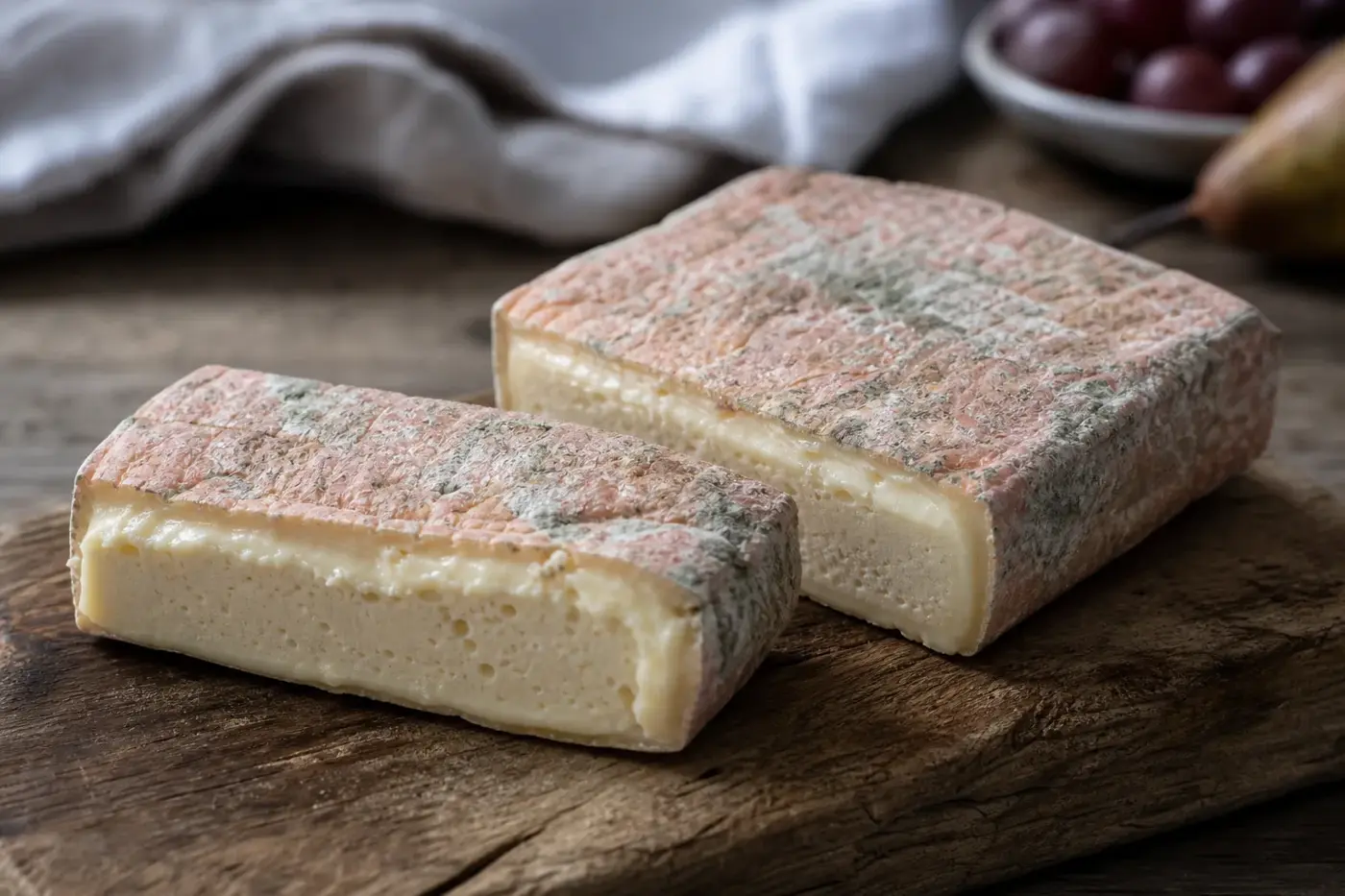
Cut into Taleggio and the rind makes its presence felt first. Pinkish, mottled with grey and pale sage-green moulds, it carries an aroma that grows bolder with age. Inside this square cow’s milk cheese, you find soft, pale paste with a gentler, savoury character. The rind, it seems, has been doing most of the talking.[6][7]
Named after Lombardy’s Val Taleggio, this is a cheese that rewards simple company. Bring bread and pears, or give it hot polenta to melt into. There is no need to turn supper into a production.[6][7]
| Taleggio at a glance | What to know |
|---|---|
| The familiar and registered name | Taleggio.[3][4] |
| Registration authority and register ID | EU: European Commission; register ID: not established here. Great Britain: Defra; separate record identifier: not established here.[3][4] |
| Protection by jurisdiction, November 2026 | EU: current register status not established here. Great Britain: registered PDO, scheme registration dated 31 December 2020. Northern Ireland: EU GI scheme applies; current Taleggio status not established here. Switzerland and the US: status not established here.[3][4][5] |
| Production specification | EU amendment approved by Commission Implementing Regulation (EU) 2022/955.[3] |
| Milk and coagulant | Whole cow’s milk, raw or pasteurised; liquid animal rennet from calves or young cattle.[1] |
| Legal minimum maturation | Not established here.[1][2] |
| Legally defined production and maturation area | Not established here. |
| Shape and size | Square, with faces 18 to 20 cm across and a height of 4 to 7 cm, subject to the specification’s tolerances.[1] |
| Rind and paste | Thin, soft, naturally pinkish rind; white to straw-coloured paste, softer immediately beneath the rind.[2] |
Take your time from rind to centre
Give Taleggio’s aroma a moment before you taste. ONAF, Italy’s national cheese-tasting organisation, describes developing aromas of cooked milk, hay and animal notes. Its account gives younger cheese a slight acidity, with salt becoming more evident as maturation advances.[7]
Now follow your slice from edge to middle. A yielding outer layer surrounds a more substantial centre, which ONAF records can be chalkier in some cheeses. That central area shrinks as ripening progresses. You are looking for contrast, not necessarily softness all the way through.[7]
The PDO specification adds balanced saltiness, lactic notes and a truffle-like finish to the picture.[2] Think of these published descriptions as pointers for your own exploration. They are not fromage.co.uk tasting notes.
Meet the cows and cattle keepers behind the name
Tired cows returning from summer pasture stand at the heart of the regional story of stracchino. Piemonte’s agricultural reference links the name to stracche, meaning tired cows, and places Taleggio within this broader cheesemaking tradition. It also records the historical name stracchino quadro di Milano: square stracchino of Milan.[6]
The valley that gives Taleggio its name lies in the province of Bergamo, in Lombardy. The regional account describes a pastoral economy in which cheesemaking turned milk into something people could mature, exchange and transport. That is the tradition’s regional explanation. Precise medieval origin dates remain less firmly documented.[6]
There are travelling cattle keepers in the story, too. The specification links the spread of production to bergamini, who moved between mountain and plain.[2] So you have a particular valley in the name, but a wider northern Italian cheesemaking tradition on your plate.
Get to know the protected name
Taleggio’s name carries geographical and production requirements, set out in its approved specification.[1][3] PDO means Protected Designation of Origin, expressed as DOP in Italian. It protects a shared cheese name, rather than a single manufacturer.
That distinction is useful when you shop. Different dairies can make cheese under the designation, provided they meet its requirements.[1][3] You are choosing within a shared framework, not looking for just one maker.
The protection itself has geographical boundaries. Defra distinguishes the Great Britain scheme from the EU scheme applying in the EU and Northern Ireland.[5] For a clearer view of how these arrangements work, visit protected names explained.
Watch whole milk take its square shape
Taleggio gets its square outline early. The cheesemaker starts with whole cow’s milk, raw or pasteurised, and a starter culture: bacteria introduced to begin fermentation. The specification permits either a culture prepared naturally at the dairy or one made from selected cultures.[1]
Next comes rennet, the enzyme preparation that turns milk into a gel. Cutting that gel creates curd and releases liquid whey, which drains away. The specification describes successive cuts, with a pause after the first, before the pieces go into square moulds.[1]
Sant’Antonio cooperative describes turning the cheeses during drainage, then moving them through stufatura, a warm, humid stage. This develops acidity and allows more drainage before maturation. Salting can be dry or by immersion in brine.[9]
By the time maturation begins, the outline is unmistakable. The work ahead develops what lies inside it. For a closer look at setting, cutting and draining milk, follow how cheese is made.
Step into the ripening room
Taleggio’s surface needs regular attention. Frequent turning and treatment with water and salt keep it soft and moist during maturation, while removing fungal filaments. Water and salt are the permitted rind treatment described in the specification.[1]
That surface is also home to a mixed community of microorganisms. The specification identifies moulds, yeasts and bacteria, explaining their roles in colour, protein breakdown and fat breakdown. Ripening travels from the outside towards the centre. This creates the softer layer you find immediately beneath the rind.[2]
Look again at the pinkish background, with its grey and pale sage-green moulds, described by Piemonte’s agricultural reference.[6] It is quite different from a continuous white, bloomy coat. What you see reflects repeated attention in the ripening room, and the rind remains an active part of maturation.
Find your kind of Taleggio
Start with milk treatment. The published specification allows both raw and pasteurised milk, so the name alone cannot tell you which you are buying.[1] Look at the individual product; Raw milk, thermised and pasteurised cheese explains the differences.
Then ask about maturity. ONAF describes growing aromatic intensity and a changing balance between the firmer centre and softer outer paste.[7] Tell the cheesemonger whether you would prefer something relatively young or further developed. Describing the texture you enjoy is a useful place to start.
The maker adds another part of the picture. Sant’Antonio says it uses raw milk for its Taleggio and describes its cheese as sweet and rounded in flavour.[10] That tells you something about this producer’s cheese, not every Taleggio you might encounter.
Choose a piece with supper in mind
Begin with the name and the information supplied alongside the cheese. Defra’s Great Britain register lists Taleggio as a PDO. The Italian specification describes identification on both the cheese and its packaging.[2][4]
On a whole cheese, look for an impressed arrangement of four circles, including three letters T and a dairy identification number.[2] If you are buying a cut piece, ask to see the original wrapping or the whole cheese it came from. Retain the product information in case you need its milk treatment details later.
Now think about what you want to eat. A more substantial centre may suit slicing; a softer piece may be just right spooned onto hot polenta. This is supper, not a softness competition.
ONAF’s descriptions make the cut face as useful as the rind when you discuss maturity with a cheesemonger.[7] Ask about condition and explain the texture you like. The right piece is the one that suits your plans.
Give your Taleggio a good home
Follow the cheese’s own storage instructions and date marking. For England, Northern Ireland and Wales, the Food Standards Agency advises a domestic fridge temperature between 0 and 5 °C. It also advises refrigerating dairy products and following packaging instructions.[11]
Keep what remains covered, and retain its label. Buy an amount that fits your plans, especially if you choose a developed piece to eat straight away. A producer’s stated maturation period describes the cheese before sale. Once it is yours, the product’s storage directions are your guide.[10][11]
Keep the cheesemonger’s handling instructions with the original product details, somewhere you can find them easily. That leaves the practical information together when you need it. For help with wrapping and fridge arrangements, turn to how to store cheese at home.
Give everyone a little edge and middle
Cut slices that include both centre and edge. Everyone then gets the textural contrast ONAF describes: the more substantial middle and the softer paste beneath the rind.[7] You have more to explore than a single soft mouthful.
Put out the portion you intend to eat and leave the rest refrigerated. In England, Northern Ireland and Wales, follow current Food Standards Agency guidance on keeping chilled food out of the fridge.[11]
For the rind, ONAF and Piemonte’s agricultural reference recommend lightly scraping it rather than automatically removing it.[6][7] Follow the maker’s instructions for your particular cheese before preparing it. Preparing Taleggio’s characteristic rind is a separate matter from unexpected spoilage, covered in mould on cheese.
Bring bread, pears and something to sip
Plain country bread and pears make a lovely beginning. Sant’Antonio’s published serving suggestions favour these simple companions, alongside fruit with enough character to hold its own beside the cheese.[8] Apart from water, the recommendations below come from that commercial producer.
| What to put alongside | What it brings to your plate |
|---|---|
| Lightly toasted country bread | Crisp crust against soft paste, with the bread keeping quietly in the background.[8] |
| Ripe pear or fresh figs | The sweetness and juicy texture recommended by the maker.[8] |
| Walnuts | Crunch and slight bitterness to contrast with the cheese.[8] |
| A fruit-led red wine | The maker suggests Valcalepio Rosso or Valpolicella Classico, favouring balance over heavy tannin.[8] |
| Still or sparkling water | An alcohol-free editorial choice that keeps your attention on the cheese and fruit. |
Wine suggestions are for adults of legal drinking age, in small servings. People who are pregnant, driving, taking medicines that interact with alcohol, or recovering from alcohol dependence should not drink. Water works equally well when you want to explore the differences between rind, outer paste and middle.
Let Taleggio melt into supper
Hot polenta gives Taleggio’s yielding texture a particularly inviting role. ONAF describes the cheese melting over it, and also lists risotto, savoury tarts, pizza and cooked vegetables among its uses.[7] Your piece need not stay on the cheese board.
Start with one straightforward dish and give Taleggio room, rather than gathering several competing cheeses. Try pieces over polenta, fold a modest amount into risotto, or add a layer to a vegetable tart. These ideas follow the published uses; take quantities and cooking controls from your chosen recipe.[7]
Planning a vegetarian menu? Choose another cheese whose producer confirms a suitable coagulant, because the published Taleggio specification requires animal rennet.[1] Milk treatment is a separate question: consult the product information, follow its label, and use the official guidance relevant to the people eating it.[10][11]
General information only, not medical advice: follow the official guidance where you live.
Questions people ask
What does Taleggio taste like?
The PDO specification describes balanced saltiness, lactic notes and a truffle flavour in the finish. ONAF describes aromas of cooked milk, hay and animal notes, with salt becoming more evident as the cheese matures.
Is Taleggio made with raw or pasteurised milk?
The specification permits whole cow’s milk that is either raw or pasteurised. Check the individual product to find out which was used.
Is Taleggio vegetarian?
The Taleggio specification requires liquid animal rennet from calves or young cattle. For a vegetarian menu, choose another cheese whose producer confirms a suitable coagulant.
Can you eat the rind of Taleggio?
ONAF and Piemonte’s agricultural reference recommend lightly scraping the rind rather than automatically removing it. Check the maker’s instructions for the particular cheese before preparing it.
How should Taleggio be stored?
Follow the cheese’s storage instructions and date marking. For England, Northern Ireland and Wales, the Food Standards Agency advises keeping a domestic fridge between 0 and 5 °C, refrigerating dairy products and following packaging instructions. See the Food Standards Agency’s guidance for details.
Sources
- Italian agriculture ministry, Proposta di modifica del disciplinare della denominazione di origine protetta “Taleggio”, ministry-hosted specification text, associated with the 2022 amendment. Articles 1 to 6.
- Italian agriculture ministry, Modifica del disciplinare di produzione della denominazione “Taleggio”, measure dated 8 July 2022, published in Gazzetta Ufficiale, Serie generale, No. 169, 21 July 2022, pages 21 to 23. Documentary reproduction held by Istituto Zooprofilattico Sperimentale della Lombardia e dell’Emilia Romagna.
- European Commission, Commission Implementing Regulation (EU) 2022/955 of 14 June 2022 approving non-minor amendments to the product specification for a name entered in the register of protected designations of origin and protected geographical indications “Taleggio” (PDO), Official Journal L 165, 21 June 2022.
- Department for Environment, Food & Rural Affairs, Taleggio, Great Britain protected food names register, published 4 January 2021, live record retrieved November 2026.
- Department for Environment, Food & Rural Affairs, Protected geographical food and drink names: UK GI schemes, updated 8 March 2024.
- Regione Piemonte agricultural reference service, Taleggio, undated online entry, retrieved November 2026. Used for its attributed historical account, surface appearance and serving guidance, not its older quantitative specifications.
- Organizzazione Nazionale Assaggiatori di Formaggi, Taleggio, undated technical and sensory sheet, retrieved November 2026. Used for sensory descriptions and culinary uses, not its production limits.
- Cooperativa Agricola Sant’Antonio, Come servire il taleggio: il compagno giusto fa la differenza, undated producer article, retrieved November 2026. Commercial producer source for its own serving and pairing recommendations.
- Cooperativa Agricola Sant’Antonio, Come si fa il Taleggio DOP: il processo artigianale raccontato dai casari della Val Taleggio, undated producer article, retrieved November 2026.
- Cooperativa Agricola Sant’Antonio, Taleggio DOP, undated product declaration, retrieved November 2026. Commercial source for its own milk treatment and tasting description.
- Food Standards Agency, How to chill, freeze and defrost food safely, published 18 December 2017, live guidance retrieved November 2026; applies to England, Northern Ireland and Wales.
Researched through desk research comparing official specification documents, registration evidence, attributed sensory references, producer accounts and national food-handling guidance.
Last checked: November 2026
Last checked November 2026.
The editors suggest you read next
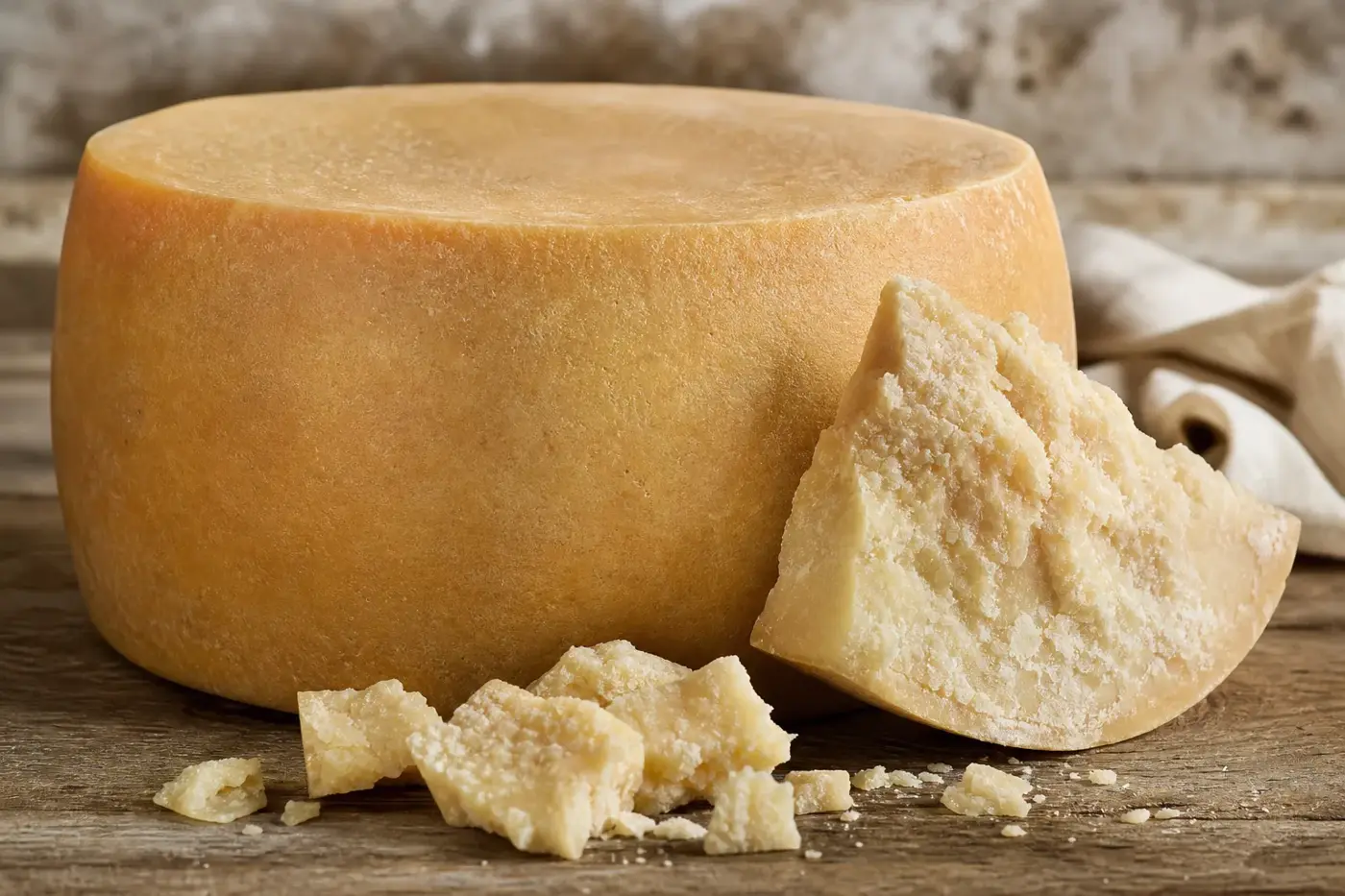
Parmigiano Reggiano
Break into a wheel of Parmigiano Reggiano and flakes fall away, revealing a finely granular cheese, pale straw to straw in colour.