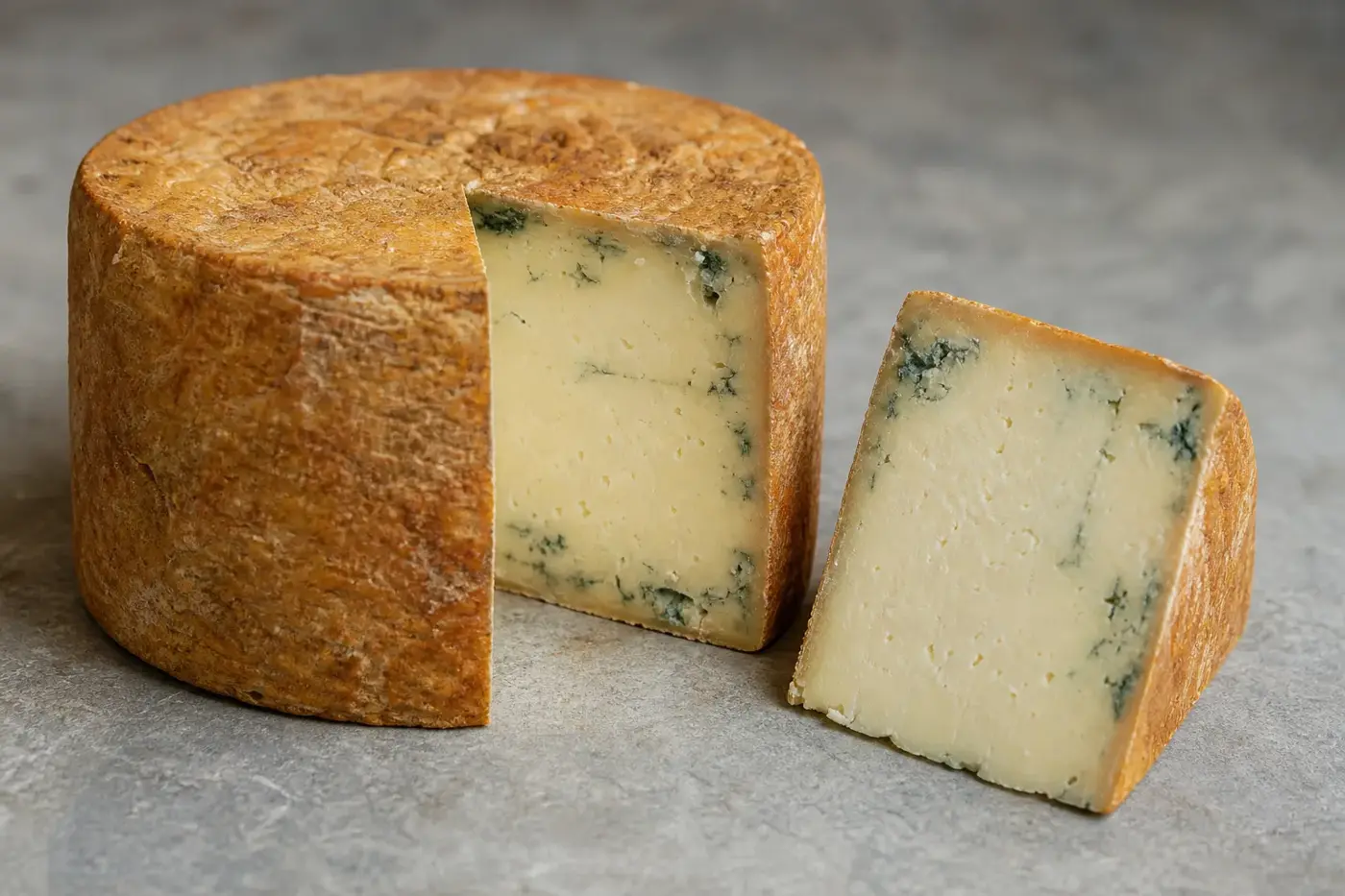
A piece breaks beneath your fingers. There is gentle smoke, a firm crumble and, perhaps, the lingering hazelnut finish described in Gamonéu’s specification. Before this raw milk cheese from Asturias in northern Spain reaches your plate, it is lightly smoked and matured in natural caves. There, fungi and yeasts arrive from its surroundings rather than being added to the milk. [1]
Follow its story and you move between summer’s high mountain pastures and valleys where cheesemaking continues throughout the year. You may know it as Gamonedo; in Great Britain, its registered PDO name is Gamoneu / Gamonedo. [1,4]
| What to look for | The details |
|---|---|
| Names you may recognise | Gamonéu; Gamonedo. [2,3] |
| Registered name in the EU amendment | Gamonéu, replacing Gamoneu / Gamonedo. [2] |
| EU registration authority and register ID | European Commission; register ID: not established here. [2] |
| EU legal instrument | Commission Implementing Regulation (EU) 2024/1227, approving specification amendments. [2] |
| Current EU register status | Not established here |
| Great Britain | Gamoneu / Gamonedo, registered PDO; register entry dated November 2026. [4] |
| Where it is made | Onís and Cangas de Onís, Asturias, Spain. [1,3] |
| Milk permitted | Raw cow’s, sheep’s or goat’s milk, singly or mixed, subject to the Puerto requirements below. [1,3] |
| Minimum ageing in the published specification | Two months; three months above 7 kg, including at least 30 days in caves. [1] |
| Typical ageing | Not established here |
Take the path from high pasture to valley
To get to know Gamonéu del Puerto and Gamonéu del Valle, begin with the landscape. Puerto belongs to the high pastures. Valle comes from the lower settlements, where dairies can make cheese throughout the year. [1]
For del Puerto, the published specification requires milk from at least two species. Cow’s milk, when used, cannot exceed 90%; sheep’s or goat’s milk, when used, must each contribute at least 5%. Production runs from late spring to early autumn, with the weather having its say. [1]
At the counter, venture beyond “Which is stronger?” Ask where the cheese was made, when its milk was collected and how long that wheel has matured. Request both the production date and the selling date: buying a seasonal cheese in a particular month does not mean it was made then.
If you want to explore Puerto beside Valle, choose two examples of similar age. A young cheese beside a substantially older one makes the distinction harder to untangle. Note the maker and milk mixture, then describe each piece without deciding beforehand what it ought to taste like.
Meet the milk behind your piece
Cow, sheep, goat: Gamonéu gives you an unusually broad choice. The earlier EU specification summary explicitly permits their milks singly or in mixtures of two or three. [3]
“Mixed milk” opens a conversation rather than closing it. Which species are present, and in what proportions? Does the blend change between production periods? Ask for the maker’s information, especially if you are hoping to find another piece like one you loved.
Record the blend, but leave room for uncertainty about how changing species proportions affects Gamonéu’s flavour or texture. Your cheesemonger can tell you about the batch in front of you. Separate notes on texture, aroma and finish give you something concrete to return to next time.
Milk species and milk treatment tell you different things. If the terminology starts to tangle, the guide to raw, thermised and pasteurised cheese helps you keep those two pieces of label information apart.
Follow the cheesemaker from milk to wheel
First, the milk sets with animal rennet or other authorised coagulating enzymes. The curd is cut, drained and moulded; light pressing is optional. Salt goes onto the upper and lower faces. [1]
That setting stage is coagulation: milk becomes curd, the solid material from which cheese takes shape. The liquid separated during draining is whey. You can follow the wider sequence in how cheese is made.
The specification lays out the stages; the cheesemaker does the work. Pressing is optional, so it does not belong to every Gamonéu’s story. And one dairy’s equipment tells you about that dairy, not every producer.
You need not collect every technical detail before buying a piece. Start with its milk, production setting and age. If a texture catches your attention, ask how that particular cheese was made, keeping the conversation close to the wheel in front of you.
Follow a little smoke into the cave
Ash, heather, beech and other local non-resinous woods are permitted for smoking. There is no fixed timetable: the duration follows the conditions. In the caves that come next, the characteristic fungi and yeasts arrive from the maturation environment, not additions to the milk. [1]
Smoke and maturation give you two threads to follow. Smell a freshly cut piece before tasting it. Does smoke arrive first, sit quietly behind everything else, or become clearer after you swallow?
Pause before reaching for accompaniments. An unaccompanied first piece gives you a clearer reference for the bread, fruit and drinks that follow. When comparing cheeses, take separate pieces rather than repeatedly adding things to the same mouthful.
Keep your notes close to what happened: what you smelled, how the cheese broke, what lingered. A producer’s website may offer useful prompts. But this is your tasting, not a vocabulary exam with a particularly demanding lunch.
Look at the rind, then explore the crumble
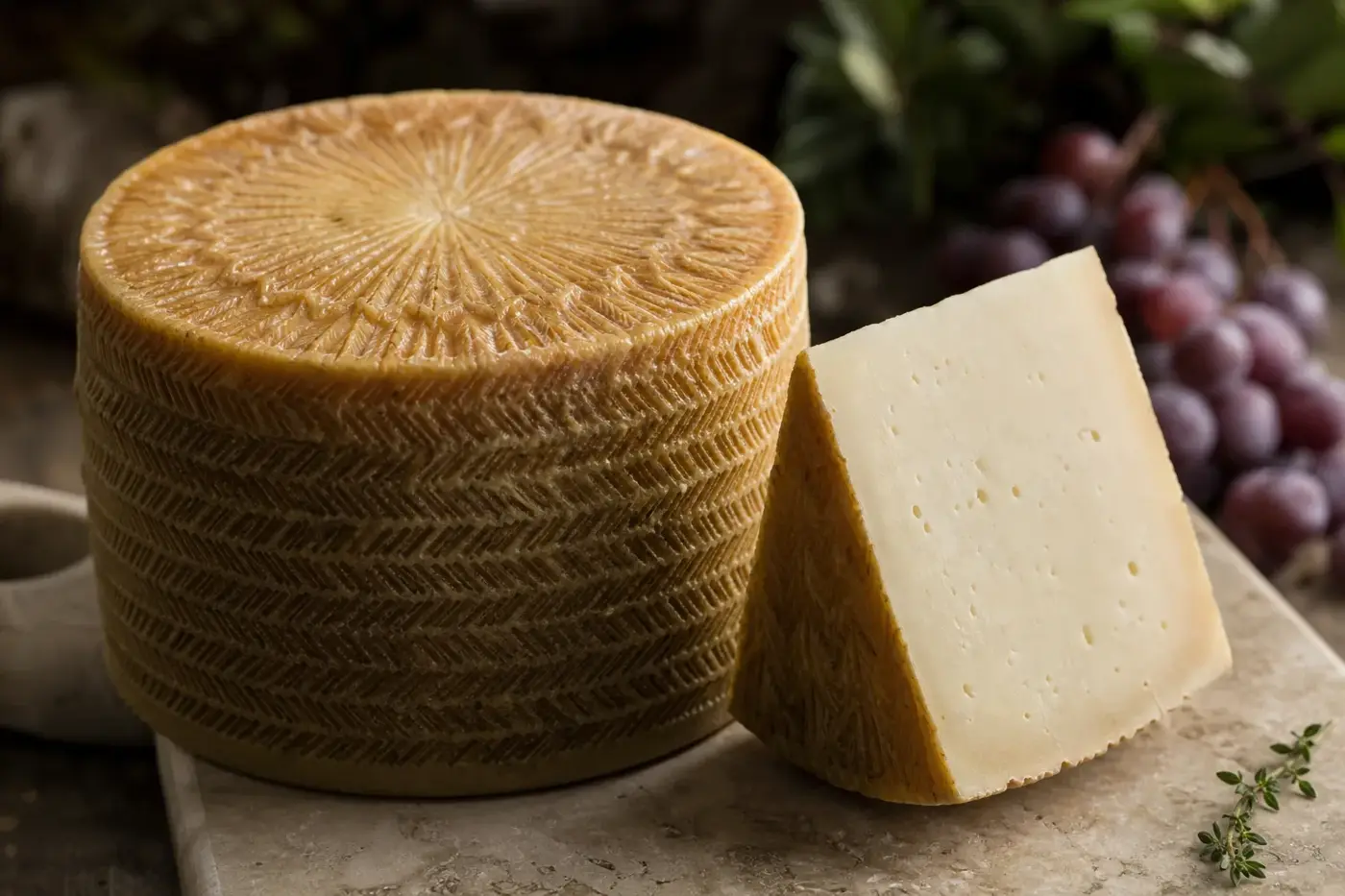
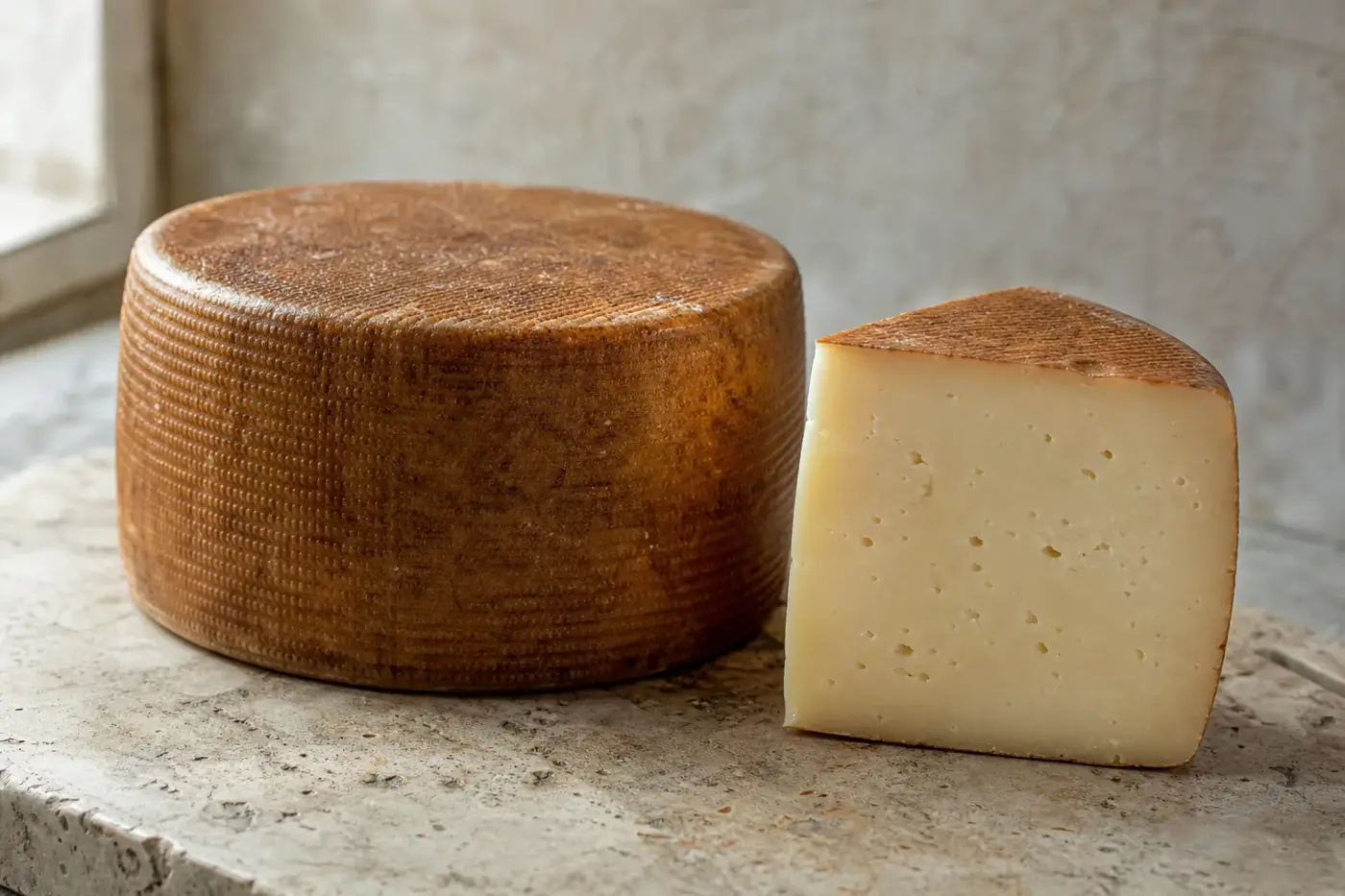
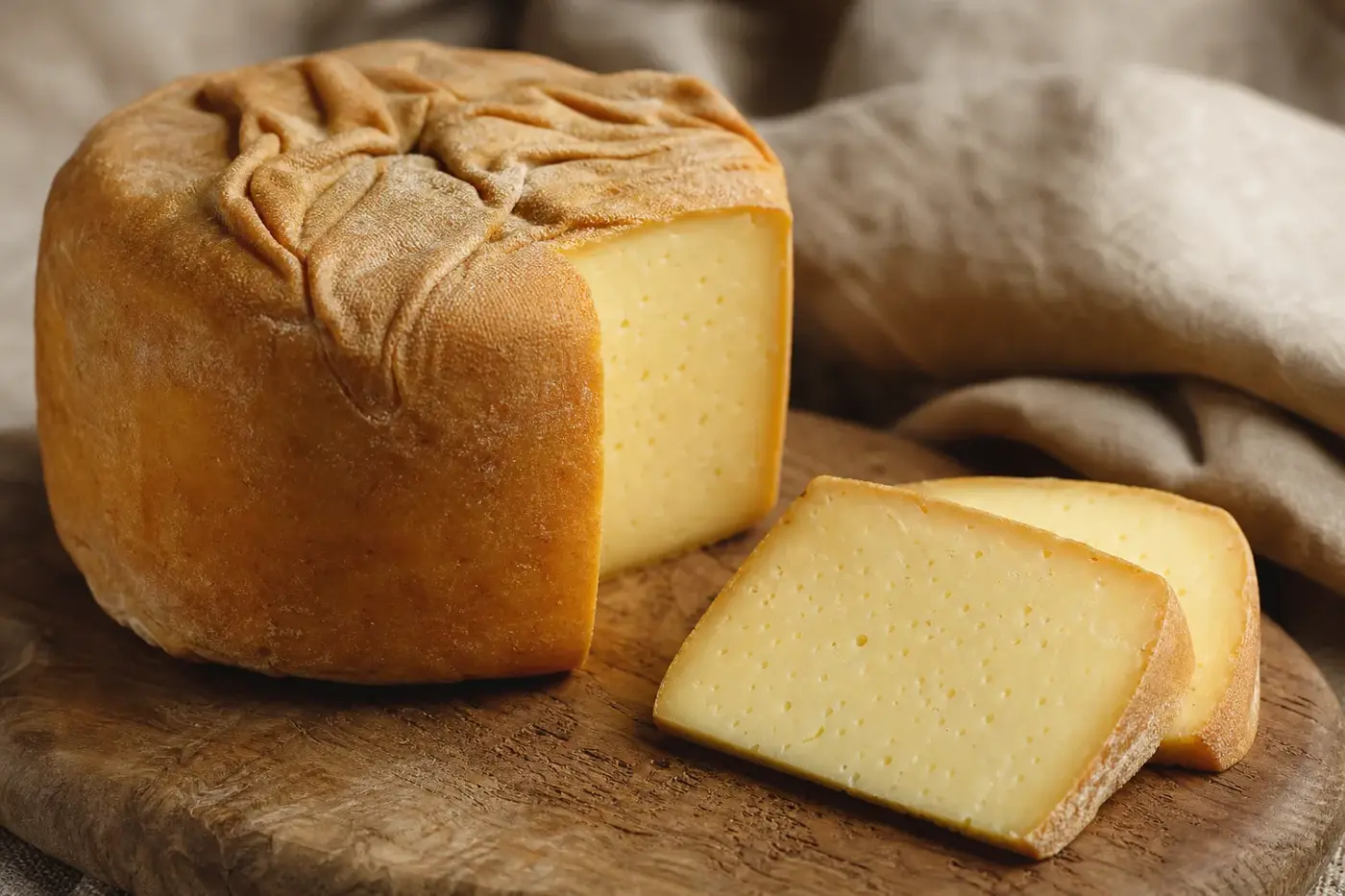
A thin, toasted-sienna rind surrounds pale, firm, friable cheese. The published specification describes cylinders 6 to 18 cm high and 10 to 35 cm across, weighing 0.5 to 10 kg. [1]
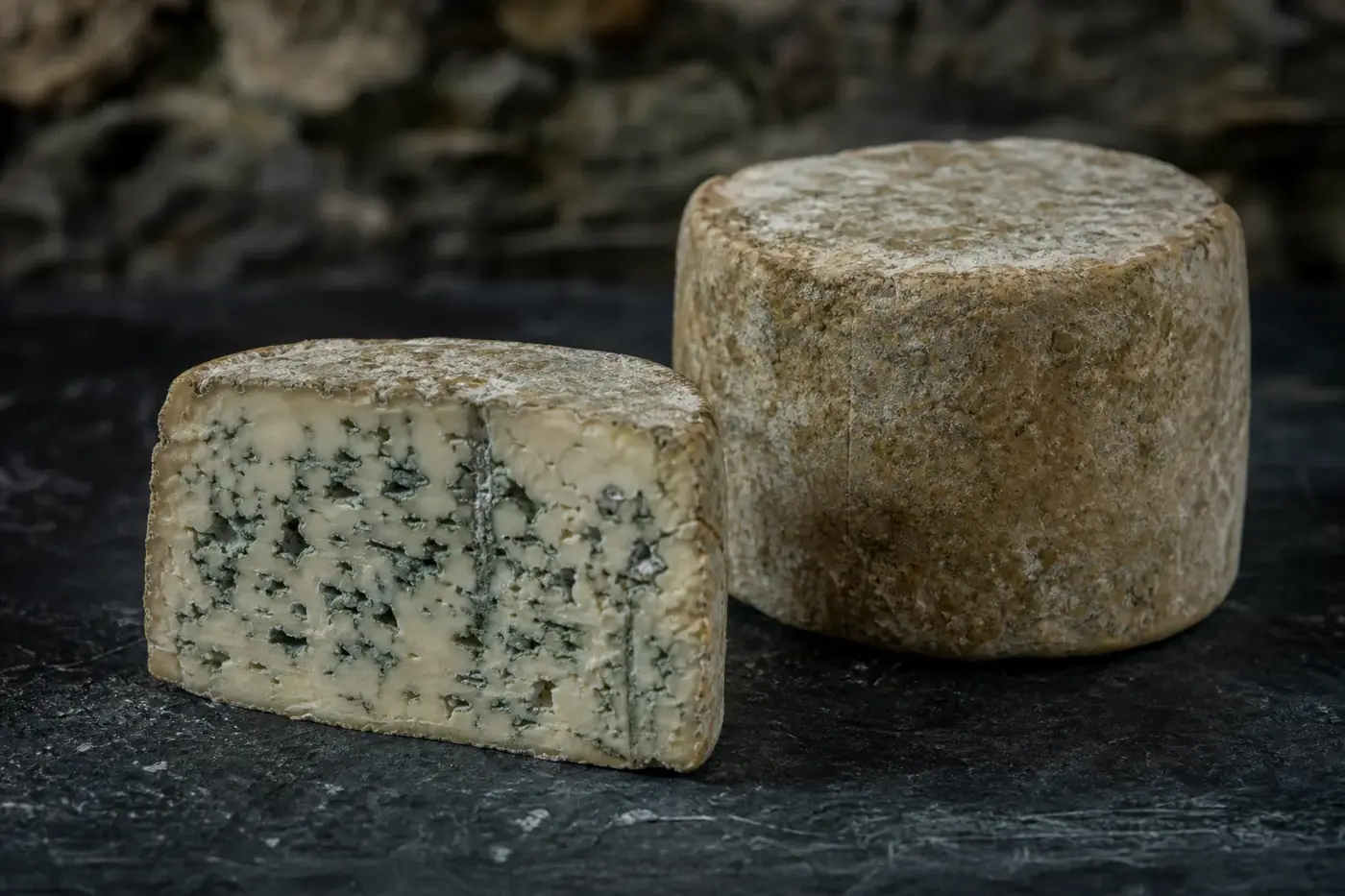
Look towards the edge of your cut piece. That is where to seek the blue green growth described in the cheese’s documentation. [3] Compare it with the centre; if you search only for a sweeping network of blue veins, you can miss that outer zone.
For flavour, the specification offers gentle smoke, slight pungency, a buttery mouthfeel and a persistent hazelnut finish. [1] Treat those as starting words, not a script. The piece on your plate deserves its own description.
Break off a little and notice what happens. Does it fracture cleanly or tumble into smaller crumbs? Follow the texture as you chew, then ask whether the finish feels smoky, pungent or reminiscent of nuts. Write down what lasts longest rather than squeezing every descriptor into one mouthful.
Make room for Cabrales alongside
If you taste Gamonéu beside nearby Cabrales, smoke is a useful place to begin. Cabrales’ specification includes cave maturation without a smoking stage. It describes an unctuous paste, blue green veining and a soft, thin rind, with minimum maturation of two months from curd manufacture. [5]
The map changes too. Cabrales comes from the municipality of Cabrales and specified villages in Peñamellera Alta, rather than Onís and Cangas de Onís. Like Gamonéu, it uses raw cow’s, sheep’s or goat’s milk, singly or in mixtures. [5]
Choose examples whose makers and ages you know, and keep those details beside your notes. Then concentrate on three things you can observe: how each piece breaks, where the blue growth appears and whether you identify smoke.
Give each cheese its own description. There is no need to turn the plate into an intensity contest. If one crumbles more readily and the other spreads more easily, start there. Those observations can also help you decide how to serve each cheese.
Ask for the story behind your wedge
Begin with the wheel’s identity. Ask to see its original information or the packaging associated with your portion, and keep the maker’s name, batch details and dates. If you want Puerto production, ask the seller to confirm it: a mountain illustration is not a birth certificate.
Tell the cheesemonger what you have planned. For a first tasting, request a piece that includes the centre and the area towards the rind. That gives you the cut face to examine as well as the cheese to taste.
If you want to compare purchases over time, photograph the label and keep it with your notes. Ask about this piece’s milk blend, production date, maturation and recommended handling after cutting. An account of the current batch tells you more than a cheerful assurance that it is “strong”.
Packaging can carry several kinds of information at once. For help separating the cheese’s identity from everything else on the wrapper, turn to reading a cheese label.
Keep it well and serve what you need
Follow the storage instructions supplied with your piece. For household refrigeration in England, Wales and Northern Ireland, the Food Standards Agency’s November 2026 guidance recommends a fridge between 0 and 5 °C and following packaging instructions. [6]
In the United States, the FDA’s November 2026 guidance advises a refrigerator at 4 °C (40 °F) or below, with refrigerated food kept covered. [7] If you move your cheese into another container, keep its identifying information available.
Cut only what you intend to serve, leaving the rest refrigerated. In the United States, consult the FDA’s current guidance on how long perishable food may remain unrefrigerated. [7]
For a tasting, arrange separate pieces rather than repeatedly handling a shared wedge. Keep the packaging instructions handy for later servings, so advice for that particular piece stays easy to find. The guide to how to store cheese at home covers the broader practical questions.
Leave a little space on the plate
Start simply, with plain bread and water. They give you a reference before sweetness, acidity or another aroma joins in. The combinations here are suggestions to explore, not results from a recorded tasting.
Next, try a slice of fresh pear or apple. Keep it separate so you can taste each combination deliberately and decide which you prefer. You need not build a crowded plate before getting to know the cheese itself.
For an alcohol-free drink, consider an unsweetened apple drink, an alcohol-free cider with attention to its alcohol declaration, or lightly brewed black tea. Taste the cheese, then the drink, then the two together. Can you still pick out the features that interested you in the cheese alone?
Keep that first plate restrained: one cheese, bread, one fruit and one drink. Add another accompaniment when there is something specific you want to explore. Empty space needs no garnish.
General information only, not medical advice: follow the official guidance where you live.
Questions people ask
Where is Gamonéu made?
Its defined production area is Onís and Cangas de Onís in Asturias, northern Spain. Gamonéu del Puerto is made in the high pastures, while Gamonéu del Valle is made in lower settlements.
What does Gamonéu taste like?
The published specification describes gentle smoke, slight pungency and a buttery mouthfeel. It also describes a persistent hazelnut finish.
What milk is used to make Gamonéu?
Gamonéu is made from raw cow’s, sheep’s or goat’s milk, used singly or in mixtures. Gamonéu del Puerto must contain milk from at least two species.
How is Gamonéu different from Cabrales?
Gamonéu is lightly smoked before cave maturation. The Cabrales specification includes cave maturation without a smoking stage, and the cheeses have different defined production areas.
What can I serve with Gamonéu?
The page suggests starting with plain bread and water, then trying fresh pear or apple. For an alcohol free drink, it suggests unsweetened apple drink, alcohol free cider with its alcohol declaration checked, or lightly brewed black tea.
Sources
- Principado de Asturias. Pliego de condiciones de la Denominación de Origen Protegida “Gamonéu”, revision 14, official PDF hosted in the regional government’s 2020 document collection. Sections B, C, E, F and H consulted. Official specification PDF.
- European Commission. Commission Implementing Regulation (EU) 2024/1227 of 23 April 2024 approving non-minor amendments to the specification for a name entered in the register of protected designations of origin and protected geographical indications (‘Gamoneu / Gamonedo’ (PDO)), published 30 April 2024. Official regulation.
- European Commission. Publication of an application pursuant to Article 6(2) of Council Regulation (EC) No 510/2006, Gamoneu or Gamonedo specification summary, Official Journal C 236, 9 October 2007. Used only for the historical names and descriptive facts corroborated by source 1. Official specification summary.
- Department for Environment, Food & Rural Affairs. Gamoneu / Gamonedo, protected food names register entry, published 4 January 2021, live entry checked November 2026. Great Britain register entry.
- Consejo Regulador de la DOP Cabrales. Expediente de la Denominación de Origen Protegida “Cabrales”, specification PDF retrieved November 2026; revision date not stated in the retrieved document. Sections B, C and E consulted. Published Cabrales specification.
- Food Standards Agency. How to chill, freeze and defrost food safely, published 18 December 2017, live guidance checked November 2026. Applies to England, Northern Ireland and Wales. Official chilling guidance.
- US Food and Drug Administration. Are You Storing Food Safely?, live consumer guidance checked November 2026. Storage basics and refrigeration tips consulted. Official storage guidance.
- Agencia Española de Seguridad Alimentaria y Nutrición. Red de alerta alimentaria, live alerts landing page checked November 2026. Used for the editorial recall check only. Official Spanish alerts.
Researched through official specifications, the EU amendment regulation, the Great Britain register and national food safety guidance; pairing suggestions are editorial proposals, without a site tasting record.
Last checked: November 2026
Last checked November 2026.
The editors suggest you read next