Mahón-Menorca
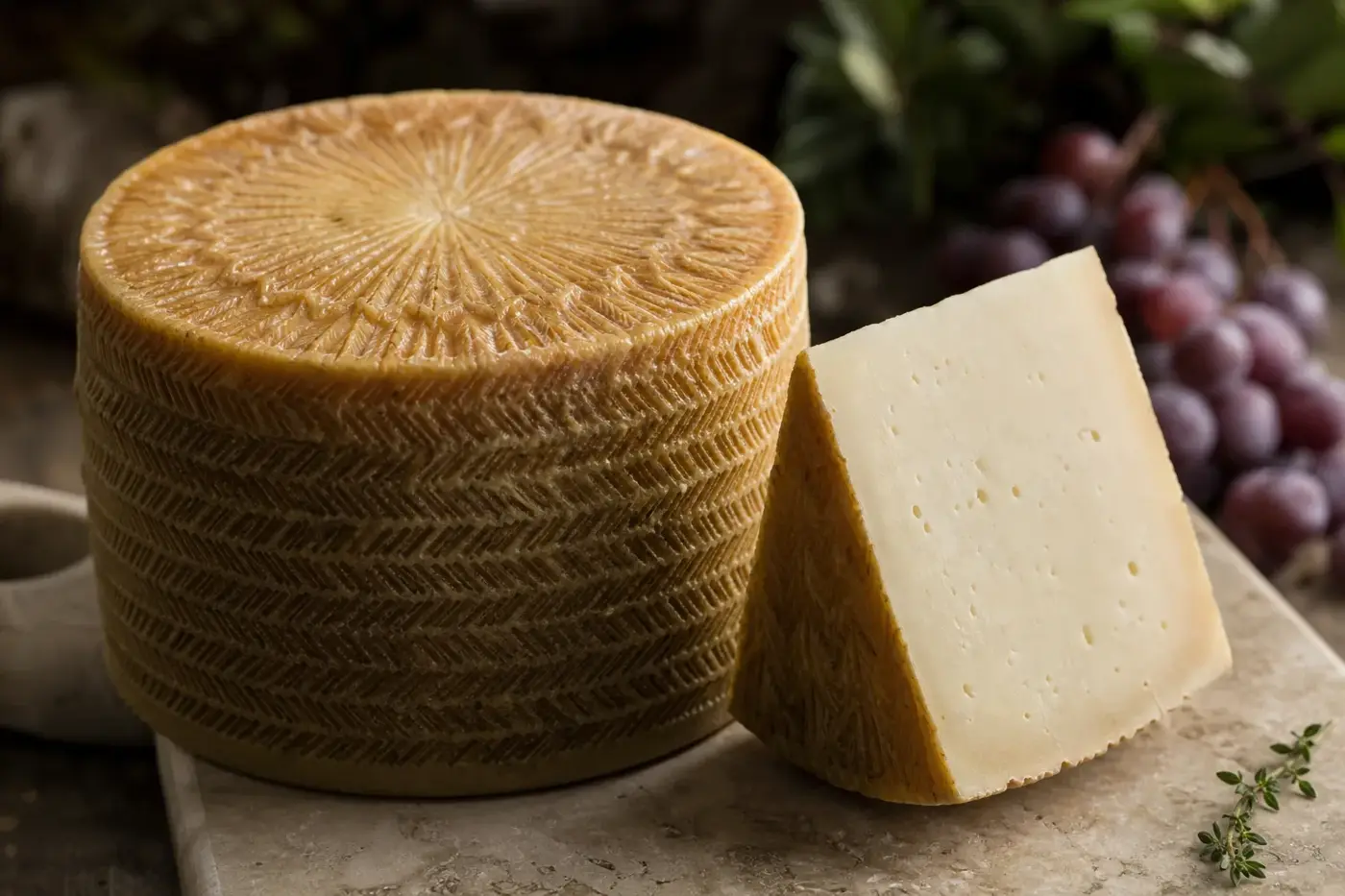
Run your eye over the folds pressed into an artisan Mahón-Menorca.
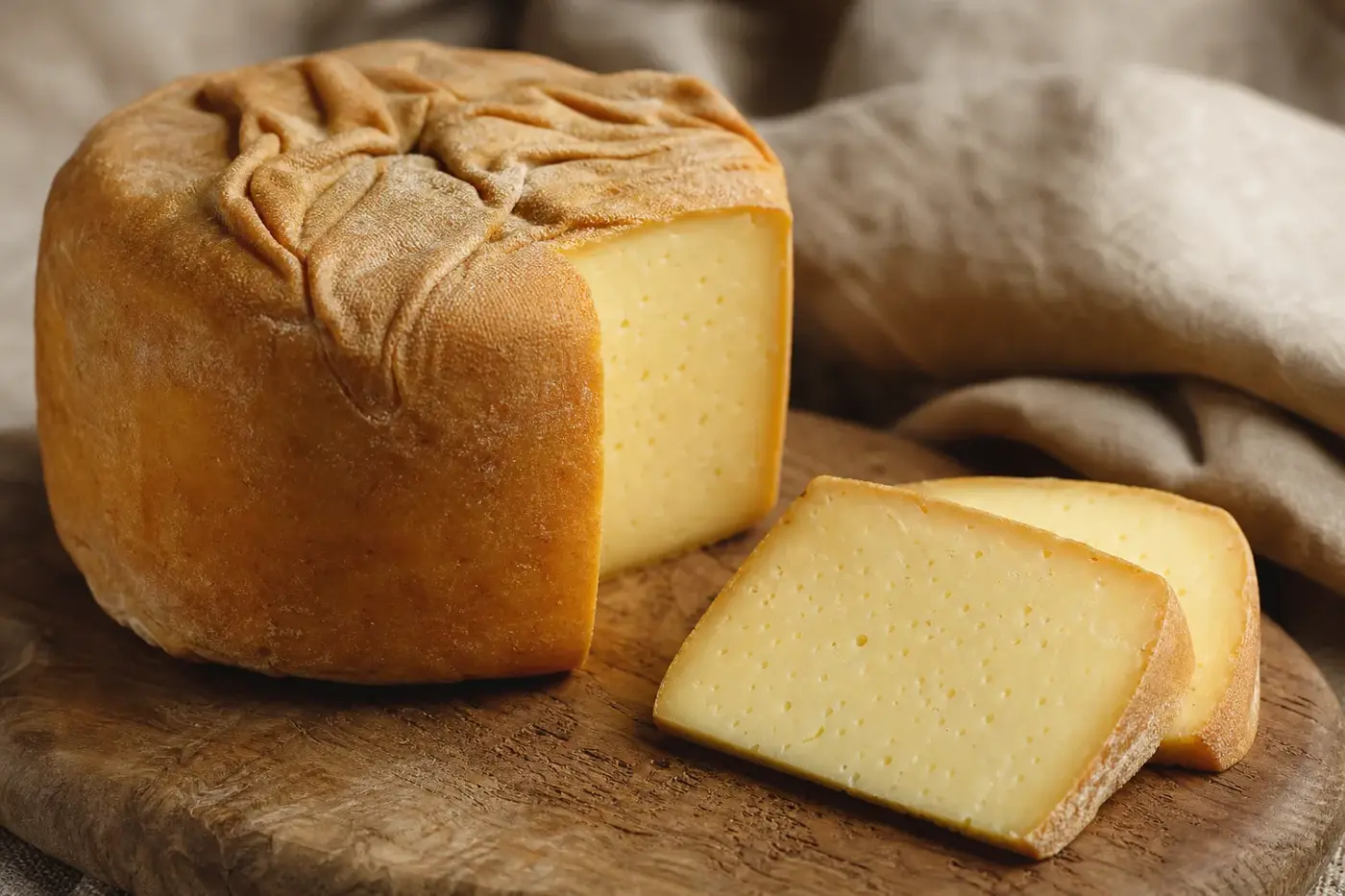
Run your eye over the folds pressed into an artisan Mahón-Menorca. A square cotton cloth left those marks, giving the cheese its rounded corners.[1][5] Cut beneath the rind and you find age at work: yielding and milky becomes firm, sometimes flaking, with a persistent, piquant flavour.[1][2][3]
This is Menorca’s farming tradition in a piece you can take home. Milk production, cheesemaking and maturation all belong within the same protected area.[1] The cloth has left its signature, but there is plenty more to read.
| Your quick guide | What to know |
|---|---|
| Familiar and registered name | Mahón-Menorca.[1][2] |
| EU protection | Current register status and identifier: not stated here. |
| Great Britain protection | Registered PDO; UK scheme registration dated 31 December 2020. November 2026 information.[2] |
| Registration authorities and identifier | European Commission; Defra for Great Britain. Register identifier: not stated here.[2][4] |
| Where it must be made | Menorca, including milk production, cheesemaking and maturation.[1] |
| Milk | Predominantly whole cows’ milk; up to 5% Menorcan sheep’s milk permitted.[3] |
| How the production methods differ | Artesano uses raw milk; other protected production uses milk subjected to a preservation process, which can include pasteurisation.[1][5] |
| Artisan minimum maturation | 60 days. Other production: minimum not specified in the cited specification.[1] |
| Shape and size | Rounded-square base; 0.6 to 4 kg; height 5 to 9 cm.[1] |
| UK pregnancy guidance | NHS guidance distinguishes milk treatment and cheese texture; see the dated sources below.[8][9] |
Get to know those rounded corners
Start with the outline. Mahón-Menorca has a square base with rounded edges and corners, not the sharp geometry of a block cut from a larger cheese. On artisan examples, you can see the shaping cloth’s folds across the upper face.[1]
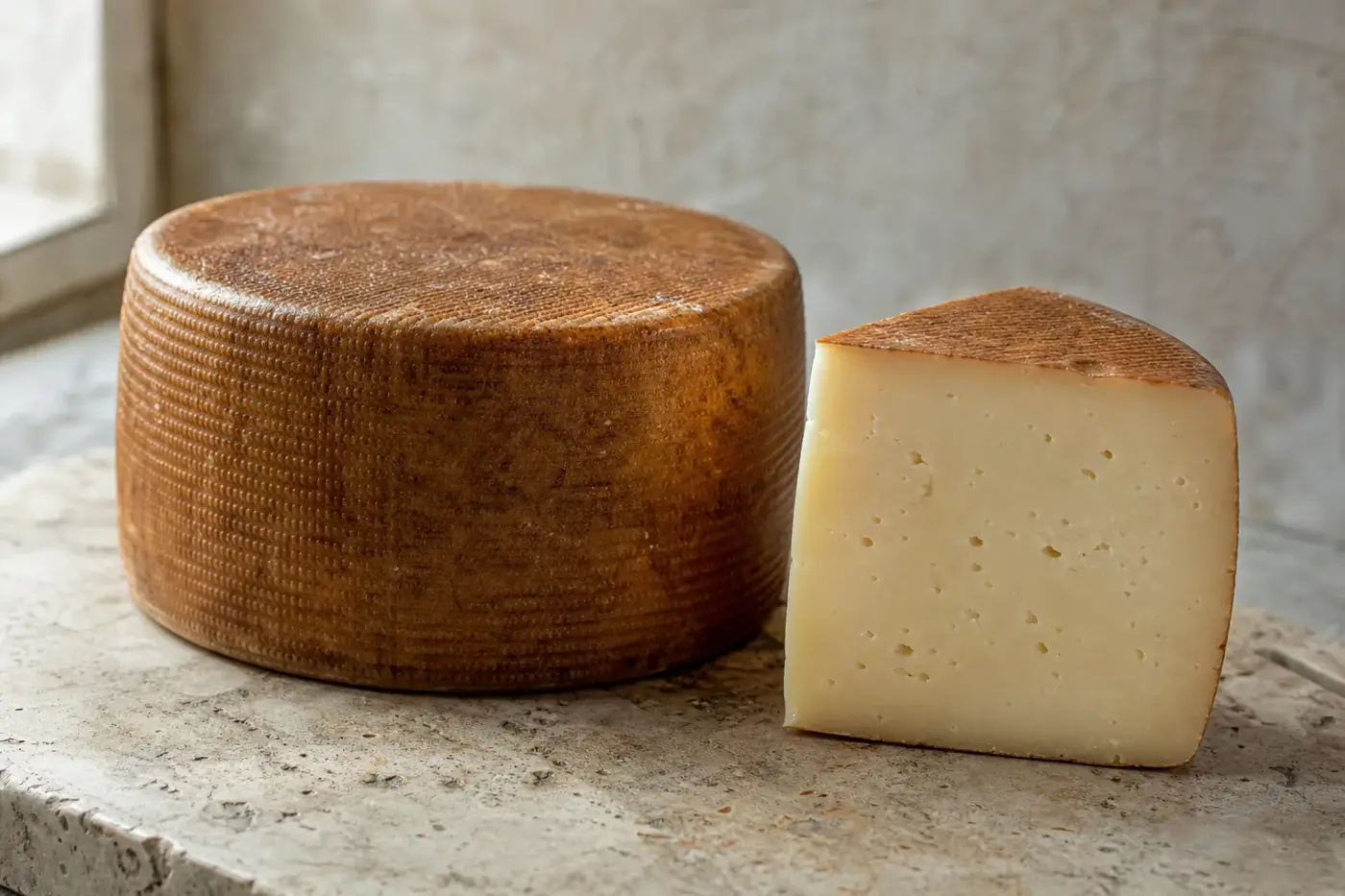
Inside, the paste, or body of the cheese, is ivory-yellow. Small holes called eyes appear here and there, each no larger than a pea.[1] You have plenty to take in before the first bite.
The specification describes a compact, greasy rind, ranging from yellow to brownish-yellow.[1] If you are photographing your cheese, those details are better reference points than an indiscriminately bright orange exterior. Colour gets your attention, but it cannot tell you everything.
The town name needs a little unpacking, too. The protected area covers the whole island, not simply Mahón, and the name belongs to that defined place and its production requirements.[1] For the distinction between a geographical designation and a cheese style, explore protected names explained.
Let artesano guide your first questions
Artesano means raw-milk production, with at least 60 days’ maturation under the specification.[1] The designation’s council adds that artisan cheese uses milk from the farm’s own livestock.[5] That gives you a useful connection to the farm before you choose your piece.
The Balearic Government’s September 2026 amendment lists Friesian, Menorcan, Brown and Jersey cattle, including crosses between those breeds. It also allows the occasional addition of Menorcan sheep’s milk, up to 5%.[3] Predominantly cows’ milk, then, with a small sheep’s milk addition permitted.
Other protected production can use a milk-preservation process such as pasteurisation.[5] Look for the product’s milk declaration rather than making assumptions. The absence of artesano does not tell you one precise treatment.
Keep milk treatment and maturity as separate questions. Ask how the milk was handled, then how long the cheese matured: “artisan” and “mature” are not opposing choices.[1][5] For help with the terminology, turn to raw milk, thermised and pasteurised cheese.
Follow the cloth into the maker’s hands
The artisan shape begins with a fogasser, a square cotton cloth. Into it goes the curd, the coagulated milk solids. The council describes the maker gathering the corners, working out whey by hand and tying the bundle with a cord called a lligam.[5]
Pressing leaves the distinctive folded impression called the mamella.[5] You are looking at a trace of the making, not decoration added afterwards. The cheese comes with its own record of the work.
The prescribed process includes pressing, immersion in brine and drying in ventilated rooms before maturation. As the cheeses develop, they are turned and cleaned.[1] Shaping gives the outline, pressing brings the cheese together, and the care afterwards develops the finished piece.
For artisan rinds, the specification permits cow butter, olive oil, or olive oil mixed with paprika. Repeated applications limit abrupt surface drying and help determine the rind’s appearance.[1] An orange tone can therefore tell you about rind treatment, rather than exact age.
At the counter, ask how the rind was treated, alongside your questions about milk and maturation. The answer will tell you more than colour alone. A handsome rind deserves attention, not guesswork.
Find your favourite bite, from yielding to flaking
Age changes how the cheese cuts, how it feels and what lingers after you swallow. The designation’s council describes young cheese as soft and elastic, progressing towards harder examples that can break into flakes.[5] The descriptions below come from the council, rather than a fromage.co.uk tasting.
| The council’s name | Published maturation guide | What to look forward to |
|---|---|---|
| Tierno, young | From 21 days in the council’s guide; artisan minimum 60 days | Soft and elastic, with a lightly developed rind; milky aromas, a butter-like suggestion and gentle acidity.[1][5] |
| Semicurado, semi-matured | From 60 days | Firm and easy to cut, with small eyes and milky flavour and aroma.[5] |
| Curado, matured | From 150 days | Harder and less elastic; advanced examples can flake, with more intense, persistent aromas and flavour.[5] |
There is a distinction to keep in mind. The legal specification sets different boundaries from the consumer guide: semicurado is below 150 days and curado above 150 days, while artisan cheese still has a 60-day minimum.[1] If that distinction matters to your choice, ask for the actual maturation period.
Choose the bite you want, rather than treating age as a league table. For a yielding slice, explore younger examples; for a clean cut, start with semi-matured. For firmer pieces and a longer finish, ask for matured cheese, following the council’s published descriptions.[5]
You do not need an elaborate tasting vocabulary at the counter. “Which of these is firmer, and which has the sharper finish?” gets straight to the point. There is no entrance exam for buying a good wedge.
Read the island’s year through its forage
From November to May, pasture is generally grazed on Menorca. Spring surplus is conserved as hay or silage for times when grazing is scarce, according to the official single document.[6] The fresh grass may pass, but the farming year carries on.
Cultivated forage includes barley, oats, maize, clover and ryegrass. The same document says that 70% of the forage fed to the livestock is grown on the island.[6] That figure concerns forage, not the entirety of every animal’s diet.
The designation’s published account links pasture resources to rainfall and maritime humidity.[1] You can follow the connection from seasonal grass to conserved fodder, milk and the people turning it into cheese. These are working parts of one island farming system.
That landscape establishes origin, but it cannot choose your wedge for you. Declared milk treatment and maturation offer more direct guidance than whether a cheese tastes “Mediterranean”. Read the environmental story alongside those production details, rather than expecting it to describe every cheese’s flavour.[1][6]
Take the label to the cheese counter
Start with the full name Mahón-Menorca and its designation identification. The specification provides for the PDO logo and a control number after the required checks.[1] If your wedge has been wrapped separately, ask to see its original identification.
Next, look for artesano, the milk declaration and the maturation description. Together, they tell you more than any single term. The designation establishes origin and production requirements; the particular label describes the piece you are choosing.[1][5]
When several cheeses catch your eye, a few simple questions will help. Keep these to hand:
- Is the milk raw or pasteurised?
- What is the actual maturation period?
- Is the texture yielding, sliceable or brittle?
For a shared board, two contrasting maturities can give you a clearer comparison than several near-identical pieces. Keep the labels beside your tasting notes, so each observation stays with the right cheese, milk treatment and age. Otherwise, “the lovely one” becomes a surprisingly unhelpful shopping list.
If the rest of the packaging leaves you puzzling, turn to how to read a cheese label. You can leave the counter with a clearer idea of what you have chosen.
Give your cheese a proper moment at the table
The designation’s council recommends an eating temperature of 18 to 20 °C (64 to 68 °F).[5] Bring out only the amount you intend to serve. Leave the rest refrigerated.
Keep warming time within food-handling limits. FSA guidance for England, Wales and Northern Ireland says chilled food should be out for the shortest possible time, with four hours as its maximum during preparation. Its hot-weather advice says to discard perishables left out for more than two hours.[7][10]
Taste a plain piece first, then bring in bread and fruit. You could try a younger example with plain bread and fresh pear, or a firmer, matured piece with apple or a little dried fig. Keep the accompaniments small enough to judge whether their sweetness and texture suit the cheese.
For an alcohol-free drink, start with water. Then try unsweetened apple juice, diluted to your taste. These are serving experiments, not prescribed Menorcan pairings, so let your own taste guide you.
If you are comparing maturities, serve younger examples before more intensely matured ones. Notice texture first, then aroma, acidity and the length of the finish. Give each piece its own place in the comparison.
Keep the cheese well, and its label close
Follow the cheese’s storage instructions, including any directions after opening. FSA guidance for England, Wales and Northern Ireland recommends a refrigerator between 0 and 5 °C.[7] Cover the cut surface and keep the original label.
A use-by date is a safety instruction. UK guidance says not to eat food after it, even if it looks satisfactory; a best-before date concerns quality.[11] Neither appearance nor smell can replace the date and the cheese’s handling history.
If you are unsure whether mould makes the cheese unsuitable, do not eat it. Consult mould on cheese and the relevant official guidance for its texture. If the named product and batch are recalled, follow the recall instructions.[12]
This page summarises published guidance from the official sources it cites. It is not medical advice. Guidance differs between countries and changes over time, so check the current source for where you live, and ask your doctor, midwife, pharmacist or dietitian about your own circumstances.
Pregnancy and raw milk: know your particular cheese
UK NHS pregnancy guidance lists pasteurised or unpasteurised hard cheeses, and pasteurised semi-hard cheeses, among foods that can be eaten.[8] Apply that guidance to your particular Mahón-Menorca’s texture and milk treatment. The cheese name alone is not enough.
The NHS also identifies pregnancy, older age and weakened immunity as circumstances associated with more serious listeriosis outcomes.[9] If you are in one of these groups, consult the linked official guidance and your healthcare professional about your own circumstances.
Keep the original product information to hand when you seek advice. “Mahón-Menorca artesano, raw milk, with this stated maturation” gives you a clearer starting point than the cheese name by itself.
Questions people ask
Where is Mahón-Menorca made?
The protected production area covers the whole island of Menorca. Milk production, cheesemaking and maturation all take place within that area.
What milk is used in Mahón-Menorca?
It is predominantly made with whole cows’ milk, with up to 5% Menorcan sheep’s milk permitted. Artesano is made with raw milk, while other protected production can use a preservation process such as pasteurisation.
How does Mahón-Menorca change as it matures?
The council describes young cheese as soft and elastic, with milky aromas and gentle acidity. Matured examples are harder and less elastic, and advanced cheeses can break into flakes.
Why can the rind be orange?
The artisan rind can be treated with olive oil mixed with paprika. An orange tone can therefore reflect rind treatment rather than exact age.
Can you eat Mahón-Menorca during pregnancy?
NHS pregnancy guidance lists pasteurised or unpasteurised hard cheeses, and pasteurised cheeses with a semi hard texture, among foods that can be eaten. See NHS pregnancy guidance for the particular cheese’s texture and milk treatment, and consult a healthcare professional about your circumstances.
Sources
- Govern de les Illes Balears, Pliego de condiciones de la Denominación de Origen Protegida “Mahón-Menorca”, current document linked from the regional authority’s page, retrieved November 2026. Sections B to F. Product specification.
- Defra, Mahón-Menorca, protected food names register entry, published 2021, retrieved November 2026. GB register entry.
- Govern de les Illes Balears, Decreto 31/2026, de 4 de septiembre, amendment to the product description, 2026. Published decree.
- European Commission, Commission Implementing Regulation (EU) 2018/1852, adopted 26 November 2018, published 28 November 2018. Official legal text.
- Consejo Regulador DOP Mahón-Menorca, Nuestros quesos, undated, retrieved November 2026. Producer-designation body’s descriptions of production, maturation and consumption. Council account.
- Govern de les Illes Balears, Documento único: Mahón-Menorca, current linked document, retrieved November 2026. Section 3.3, feeding practices. Single document.
- Food Standards Agency, How to chill, freeze and defrost food safely, 2017, current page retrieved November 2026. Official guidance.
- NHS, Foods to avoid in pregnancy, current page retrieved November 2026. UK pregnancy guidance.
- NHS, Listeriosis, reviewed 10 November 2023, retrieved November 2026. Official guidance.
- Food Standards Agency, Food safety in a heatwave, advice for consumers, 27 June 2024. Official hot-weather guidance.
- GOV.UK, Understanding food labelling: Best before and use-by dates, current page retrieved November 2026. Official date guidance.
- Food Standards Agency, Alerts, current service retrieved November 2026. Official alerts.
Researched through official designation documents, published legislation, the designation council’s accounts and UK official food-safety guidance; serving combinations are labelled editorial suggestions.
Last checked: November 2026
Last checked November 2026.
The editors suggest you read next