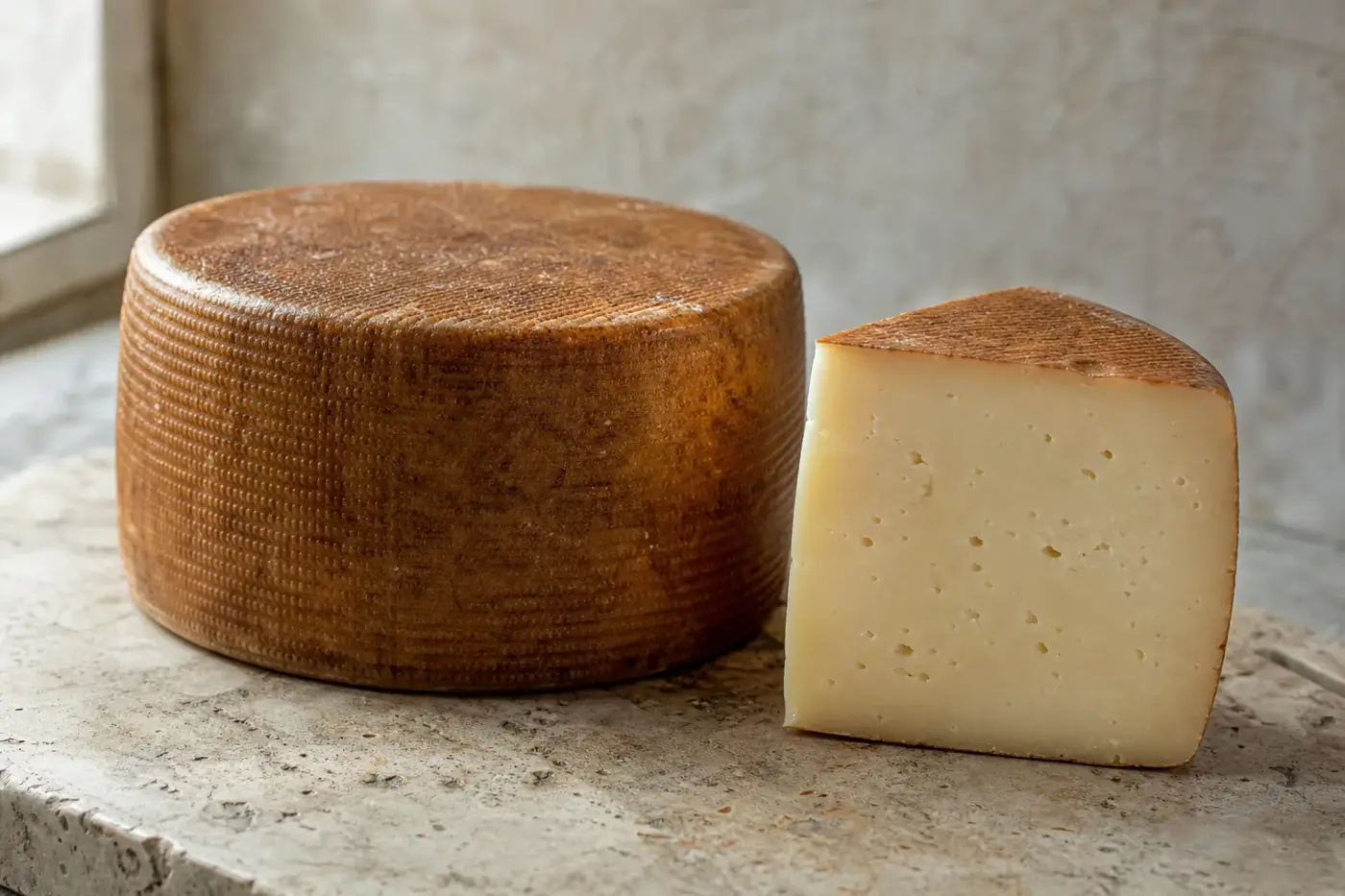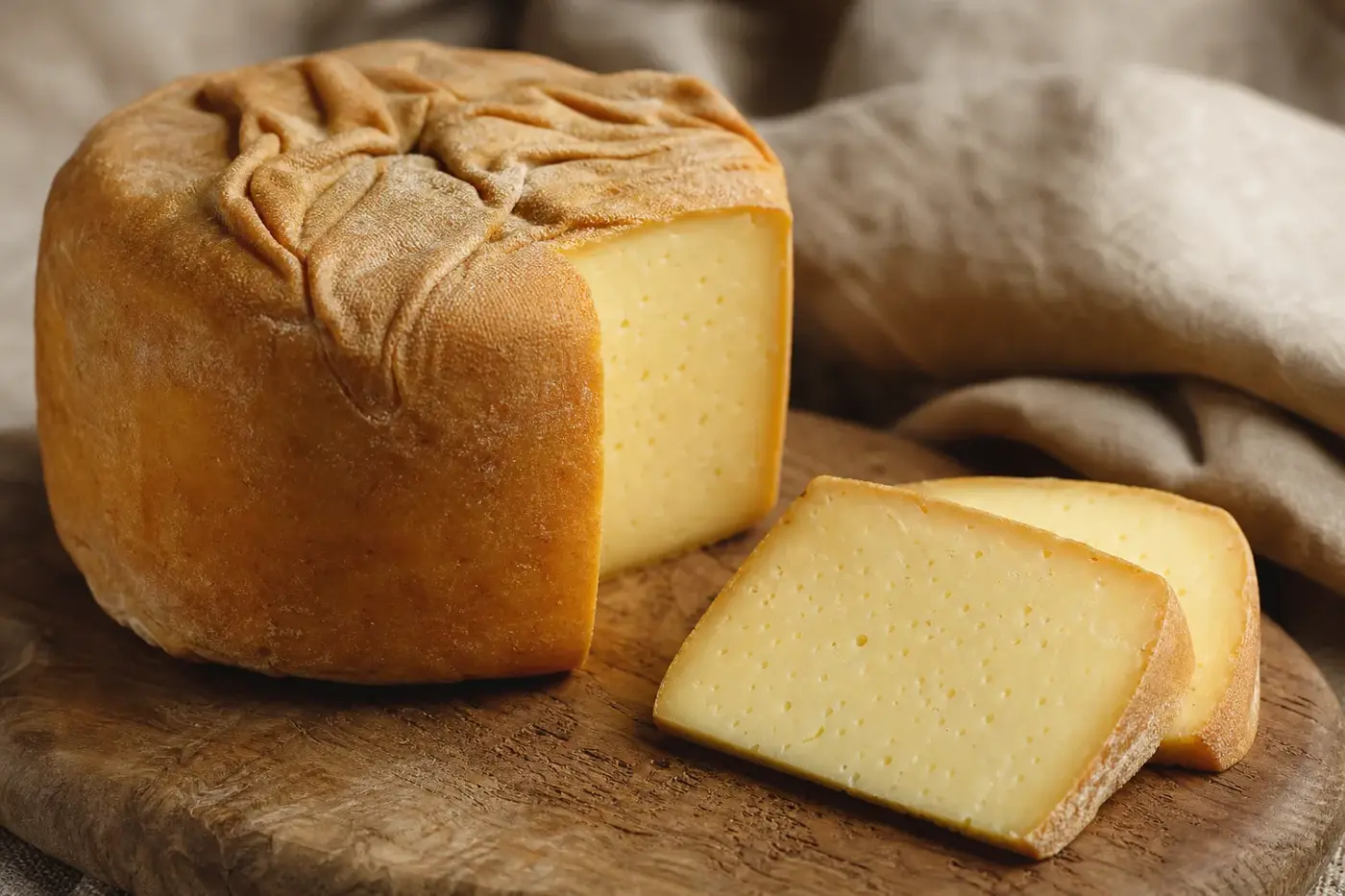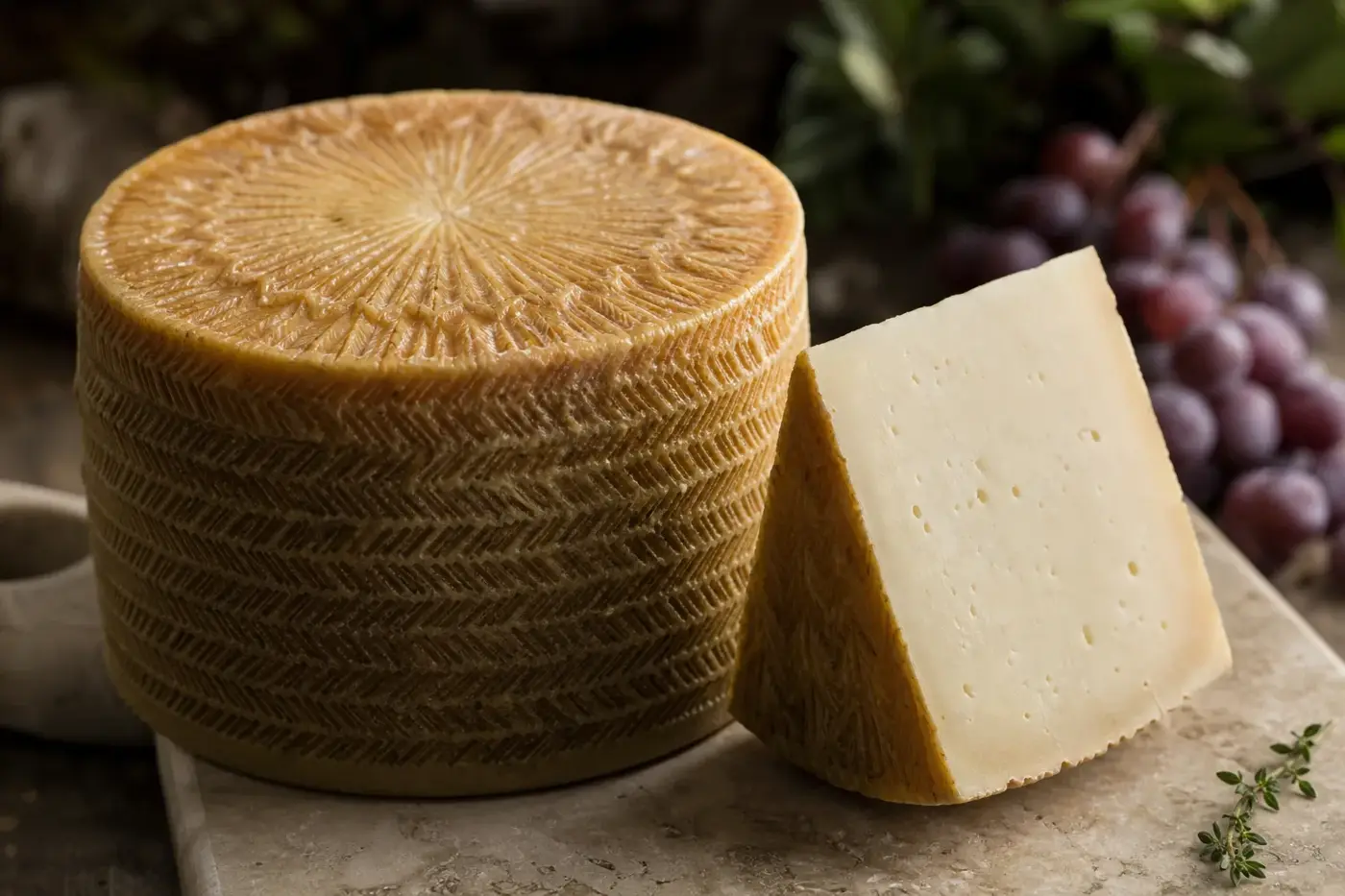
Before you reach for the knife, turn the wheel. A basket-like pattern circles the rind; a flower marks each flat end. Cut inside and you find white to yellowish ivory cheese, firm and compact, with a scattering of small eyes or none at all. It makes quite an entrance without leaving the board. [1, 3, 10]
Behind that distinctive wheel are the Manchega sheep of La Mancha. Protected examples of this pressed cheese use only their milk, from a defined part of central Spain. Give the cheese time and its flavour grows sharper. [1, 3, 10]
Get acquainted with the wheel
| What to know | The detail |
|---|---|
| Registered name | Queso Manchego [1] |
| Cheese style | Pressed sheep’s milk cheese [1] |
| Milk | Exclusively Manchega sheep; raw or pasteurised [1, 10] |
| Where it comes from | Listed municipalities in Albacete, Ciudad Real, Cuenca and Toledo, Spain [1] |
| Wheel weight | 0.4 to 4 kg [1] |
| Minimum maturation | Awaiting clarification of the applicable specification [1, 10] |
| Maximum maturation | 2 years [1] |
| EU registration authority and ID | European Commission; register ID unresolved |
| EU current register status | Unresolved |
| Great Britain protection | Registered PDO; 31 December 2020 [2] |
Meet La Mancha’s sheep and their home ground
Queso Manchego belongs to a landscape with precise boundaries. Its protected area takes in parts of four provinces, not their entire territory. The eligible municipalities listed in the specification include Villarrobledo in Albacete, Valdepeñas in Ciudad Real and Belmonte in Cuenca. Milk production, cheesemaking and maturation must all happen within that area. [1]
The specification describes Manchega sheep as adapted to grazing in dry conditions, with supplementary feed also used. Breed and place are at the heart of this cheese’s agricultural identity. At the counter, that gives you something specific to look for: a Spanish address alone is not enough. The milk must come from the specified sheep and origin. [1]
This page summarises published guidance from the official sources it cites. It is not medical advice. Guidance differs between countries and changes over time, so check the current source for where you live, and ask your doctor, midwife, pharmacist or dietitian about your own circumstances.
Follow the milk into the mould
The cheesemaker can begin with raw or pasteurised milk. Rennet or another legally authorised coagulating enzyme sets it into curd, the milk solids. Cutting, stirring and gentle heating help those solids release whey, the liquid fraction. Then the curd goes into moulds for pressing. [1, 3, 9]
Once out of the moulds, the cheeses receive dry salt, brine or both. Maturation follows, with turning and cleaning along the way. These stages give you the compact paste and patterned exterior you recognise. To follow the process beyond Manchego, explore how cheese is made. [1, 3, 9]
Read the rind before you cut
The familiar Queso Manchego wheel is cylindrical, with flat faces. Its moulds leave the basket-like pleita pattern around the side and the flower pattern on the ends. Inside, the specification describes firm, compact cheese, white to yellowish ivory, with small, unevenly distributed eyes or none at all. [1, 3]
Those details help you recognise the cheese in front of you. Appearance, though, is only the beginning. Next, look for the numbered identification marks that provide traceability when you choose Queso Manchego. [4]
Buying slices or grated cheese? The current Spanish specification permits a bar format for those uses, so protected cheese need not reach you as a wedge from a wheel. On packaged products, follow the protected name and traceability information. Shape cannot tell you the whole story. [1]
The specification allows transparent, authorised surface coatings or olive oil, provided the rind keeps its natural appearance and the identification plate remains readable. When serving, trim away the rind and enjoy the paste. Do not eat any wax or plastic coating, and keep the labelled wrapping for reference. [1, 9]
Discover what time brings to the flavour
Lactic aroma and slight acidity gradually give way to a more pungent, persistent character. The specification describes low elasticity and a buttery, slightly floury mouthfeel, becoming granular in very mature examples. You can feel age in the way Queso Manchego breaks, not just taste it in its intensity. [1, 3]
Let texture guide your choice as much as strength. For neat, yielding slices, ask your cheesemonger for a younger, milder example. For firmer cheese to shave or nibble in small pieces, compare it with a longer-matured one. If samples are offered, taste both plain before inviting bread and accompaniments into the conversation.
Get to know semicurado, curado and beyond
Semicurado, curado, viejo and añejo tell you more than how a producer describes the cheese. They have regulated meanings in Spain. Real Decreto 1113/2006, Annex I, section 2.2.3, sets minimum ages for these optional terms when used instead of madurado, meaning matured. The figures apply when cheese leaves the factory, and the PDO’s own minimum requirements also apply. [5]
| Term on the label | Wheels over 1.5 kg: minimum days | Wheels up to 1.5 kg: minimum days |
|---|---|---|
| Semicurado | 35 | 20 |
| Curado | 105 | 45 |
| Viejo | 180 | 100 |
| Añejo | 270 | 270 |
Source: Spain, Real Decreto 1113/2006, Annex I, section 2.2.3; November 2026. [5]
Treat these terms as a starting point rather than an exact age. Producers can mature cheese longer within their chosen description, so ask for the actual age when comparing examples. The weight categories refer to the original cheese, not the wedge you take home. [5]
A stated number of months gives you a more useful comparison between cheeses. Then choose the eating qualities that suit your plans: longer maturation may suit one plate, while younger cheese works better on another. For your first purchase, tell the seller how you intend to serve it. This is lunch, not a contest to find the oldest wheel.
Follow the marks back to the wheel
PDO means protected designation of origin; DOP is the Spanish abbreviation. The British register records Queso Manchego as a registered PDO in Great Britain, dated 31 December 2020. The specification linked from that register sets out the production conditions attached to the protection. [2, 3]
At the counter, use the PDO body’s identification guide as your checklist. Begin with the name, then follow the numbered marks: [4]
- Read the commercial label for the protected name and designation.
- Look for the numbered counter-label bearing the denomination’s logo.
- On a whole wheel, find the identification plate embedded in the rind.
- On a packaged wedge, look for its own numbered counter-label; the guide identifies wedges with a green band.
- For cheese marketed in the EU, look for the EU PDO symbol on the commercial label.
The guide also distinguishes small cheeses with a blue band. If your wedge is freshly cut, ask to see the original wheel’s labels. Have the cheese’s name and storage advice written on the wrapping, then keep that information until you have finished it. [4]
Wondering where origin protection ends and a brand begins? See protected names explained. With Queso Manchego, make that identification trail part of your choice, particularly when the piece you are buying has already left its wheel.
Ask what artesano says about the milk
Artesano gives you a useful clue: the specification permits the word when Queso Manchego is made with raw milk. Pasteurised-milk examples can also meet the protected production rules. Read the description of your particular cheese, rather than expecting the protected name to supply every detail. [1, 3, 9]
The NHS describes pasteurisation as heat treatment to kill bacteria. Raw milk has not been pasteurised. [8]
Another description worth knowing is queso de granja. The current Spanish specification reserves it for qualifying raw-milk cheese made by a dairy and milk-producing holding under the same ownership, exclusively from that holding’s milk. If that connection to the farm matters to you, ask for the specific description and the producer’s explanation. [1]
Keep your questions about milk treatment and age separate. First ask whether the cheese is raw or pasteurised, then how long that particular cheese has matured. If you are choosing for somebody else, keep the label so they have the details in writing. Explore the distinctions in raw milk, thermised and pasteurised cheese.
Choose the cheese your plate needs
Picture how you want to eat it: slices beside bread, shavings over a finished dish, or cheese on its own. Then ask three questions: what is its actual age, how was the milk treated, and what storage does the seller recommend for this cut piece? Those answers give you more to work with than rind colour alone.
Try comparing two ages from the same producer. Keep the rest of the plate simple and notice whether a slice bends or breaks, how much acidity you perceive, and how long the flavour stays after swallowing. Jot down the producer and stated age alongside your preference. Next time, you will have a useful starting point.
Buy an amount that fits your plans and the seller’s handling instructions. Two small, clearly labelled pieces can teach you more about your preferences than a large selection tasted all at once. Give each cheese room on the plate. Offer accompaniments separately so you can taste the differences clearly.
Bring out the bread, quince and Spanish wine
Start with Queso Manchego, plain bread and a little quince paste, or membrillo. Taste the cheese alone, then add a small piece of quince and adjust the balance to suit you. Keep the sweet accompaniment separate. Not every mouthful needs to be in a committed relationship with quince.
For wine, begin with a Spanish red labelled Tempranillo, or choose a dry Spanish white for a lighter companion. Taste a mouthful of cheese before and after a small sip. If either overwhelms the other, change the pairing. A regional match is a starting point, not an obligation.
Offer water or an alcohol-free drink with every plate. Wine suggestions are for adults of legal drinking age, in small servings. People who are pregnant, driving, taking medicines that interact with alcohol, or recovering from alcohol dependence should not drink. Check the advice of your national health authority.
Give your wedge a good home
Follow the packet or cheesemonger’s written storage instructions for your particular piece. Leave it in its original wrapping if the label says to, and follow any rewrapping directions after opening. Keep the original label. For a freshly cut wedge, ask for a use-by date or other storage information before you leave the shop.
For broader handling advice, turn to how to store cheese at home. The instructions for your own piece remain the practical starting point.
The Food Standards Agency recommends a fridge temperature of 0 to 5 °C (32 to 41 °F) in its guidance for England, Wales and Northern Ireland. It advises refrigerating dairy products and following packaging instructions. During preparation, keep chilled food out for the shortest possible time, with a maximum of four hours. [6]
Take out only the portion you intend to serve. Let it lose its refrigerator chill before tasting, while staying within that FSA limit. Judge the timing by your room and the portion’s size, rather than leaving the whole cheese on display. Keep the remainder refrigerated. [6]
Take extra care when choosing for higher-risk eaters
If you are choosing cheese during pregnancy, UK NHS guidance lists pasteurised or unpasteurised hard cheeses, and pasteurised semi-hard cheeses, among those that can be eaten. It separately advises avoiding unpasteurised milk, cream, yoghurt, butter and ice cream. Match your particular cheese’s milk treatment and description to that guidance. Take particular care with a younger example. [7]
The NHS also identifies infants and young children, people over 65, pregnant women, and people with long-term conditions or weakened immunity as groups needing particular care over certain cheeses. Its dairy guidance specifically discusses mould-ripened soft cheeses, ripened goats’ cheeses and soft blue-veined cheeses. If you belong to one of these groups, consult the linked official guidance for your circumstances. [8]
Before buying for a shared plate, ask guests about dietary requirements and keep all packaging available. Check milk treatment, ingredients and accompaniments separately. If you need advice about pregnancy, allergy or illness, consult your local official source and a doctor, midwife, pharmacist or dietitian.
Find your next label or pairing
- How to Read a Cheese Label: get practical help comparing the information on a packet.
- Cheese and Wine Pairing: The Complete Guide: explore combinations with your own preferences at the centre.
Questions people ask
Where is Queso Manchego made?
Its protected area covers listed municipalities in Albacete, Ciudad Real, Cuenca and Toledo in central Spain. Milk production, cheesemaking and maturation must all take place within that area.
How can I recognise protected Queso Manchego?
Look for the protected name and a numbered counter label bearing the denomination’s logo. The identification guide shows a green band for packaged wedges and a blue band for small cheeses.
Is Queso Manchego made with raw or pasteurised milk?
It can be made with either, using milk exclusively from Manchega sheep. The specification permits the word artesano when it is made with raw milk.
What is the difference between semicurado and curado?
These optional Spanish maturity terms have different minimum ages when cheese leaves the factory. For wheels over 1.5 kg, semicurado means at least 35 days and curado at least 105 days; for wheels up to 1.5 kg, the figures are 20 and 45 days.
Can I eat Queso Manchego during pregnancy?
The NHS lists pasteurised or unpasteurised hard cheeses, and pasteurised semi hard cheeses, among those that can be eaten during pregnancy. See the NHS pregnancy guidance linked on this page and check the particular cheese’s milk treatment and description.
Sources
-
Ministerio de Agricultura, Pesca y Alimentación, Pliego de condiciones “D.O.P. Queso Manchego”, consolidated specification published in the Ministry’s file dated 21 March 2025. Sections B, C, E, F and H. Official specification.
-
Department for Environment, Food & Rural Affairs, Queso Manchego, Great Britain protected food names register, published 4 January 2021, live entry checked November 2026. Register entry.
-
Department for Environment, Food & Rural Affairs, Product specification Queso Manchego, English specification identified in the document as the version of 31 December 2020, retrieved through the GB register. Official specification.
-
Fundación Consejo Regulador de la Denominación de Origen Queso Manchego, Identificación, undated, live guidance checked November 2026. This is the PDO certification body’s identification guidance. Identification guide.
-
Boletín Oficial del Estado, Real Decreto 1113/2006, de 29 de septiembre, por el que se aprueban las normas de calidad para quesos y quesos fundidos, consolidated text, last modification recorded as 12 September 2015. Article único and Annex I, section 2.2.3. Consolidated legislation.
-
Food Standards Agency, How to chill, freeze and defrost food safely, published 18 December 2017, live guidance checked November 2026. Applies to England, Northern Ireland and Wales. Official storage guidance.
-
NHS, Foods to avoid in pregnancy, live guidance checked November 2026, section “Cheese, milk and other dairy”. Official pregnancy guidance.
-
NHS, Dairy and alternatives in your diet, live guidance checked November 2026, sections on cheese, pasteurisation and vulnerable groups. Official dairy guidance.
-
Boletín Oficial del Estado, Orden APA/3273/2007, de 25 de octubre, por la que se publica el pliego de condiciones de la Denominación de Origen Protegida «Queso Manchego», 2007. Historical corroboration of production stages, surface treatments and raw-milk terminology retained in later specifications. Historical specification.
-
Fundación Consejo Regulador de la Denominación de Origen Queso Manchego, Manchego cheese, undated, live English homepage checked November 2026. Milk and minimum maturation summary. PDO body’s summary.
-
Food Standards Agency, Alerts, live official recall and allergy alert index, accessed November 2026. Official alerts.
Researched through official specifications, the GB register, Spanish legislation, the PDO body’s identification material and official UK food guidance; pairing suggestions are editorial recommendations.
Last checked: November 2026
Last checked November 2026.
The editors suggest you read next