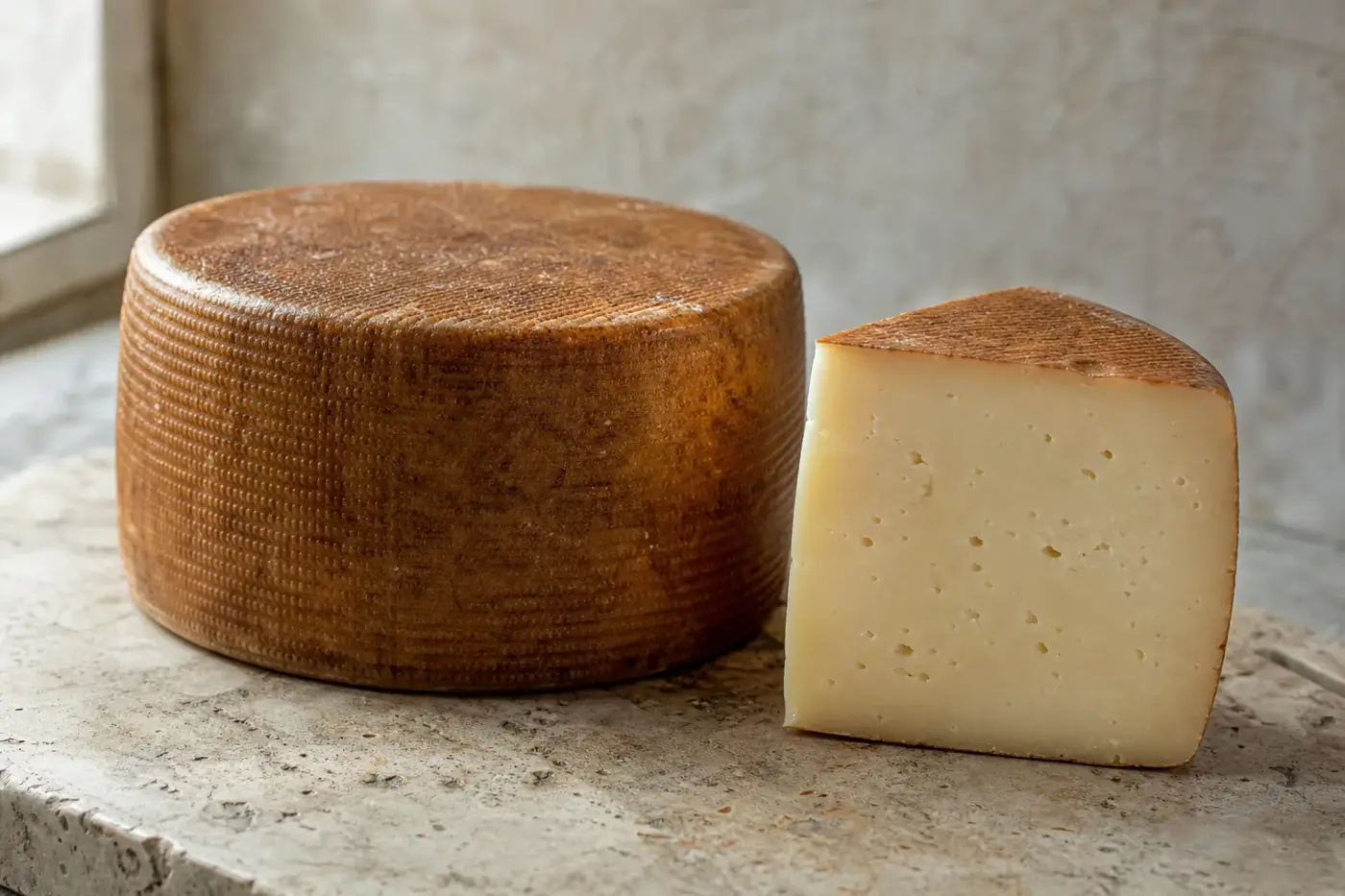
Cut into an Idiazabal and look past the rind. The firm, pressed interior carries the savoury, persistent flavour of local Latxa and Carranzana sheep’s milk. You might find smoke too, but it isn’t compulsory. Unsmoked Idiazabal has every right to a place on your cheeseboard.[1][4][5]
Follow that flavour and you reach the grazing country of the Basque Country and Navarre. Here, sheep and shepherding give the cheese its character. Smoke may catch your attention first, but the flock deserves the introduction.[1][4][5]
| What you might want to know | The detail |
|---|---|
| Familiar and registered name | Idiazabal.[1][2] |
| Registration authorities and identifiers | EU: European Commission; register ID not supplied here. Great Britain: Defra; register entry Idiazabal.[2][11] |
| Protection status | EU: PDO listed by Spain’s agriculture ministry; consult the official register for status and identifier. Great Britain: registered PDO, with a status date of November 2026.[2][11] For Northern Ireland, Switzerland and the United States, consult the relevant jurisdiction’s current records. |
| Where it can be made | Specified breed areas in Álava, Bizkaia, Gipuzkoa and Navarre, excluding the municipalities of the Roncal Valley.[1] |
| Milk and coagulant | Raw sheep’s milk from Latxa and/or Carranzana sheep; animal rennet.[1][3] |
| Minimum maturation | For the current legal minimum and its starting point, consult the operative specification.[11] |
| A little longer in maturation | The designation’s council recommends four to eight months, according to your taste, separately from the legal minimum.[4] |
| Wheel dimensions and weight | For current permitted dimensions and weight, consult the operative specification.[11] |
| Understanding the fat figure | At least 45% fat in dry matter, not 45% of the whole cheese, under the 2022 specification. For the current requirement, consult the operative specification.[1][11] |
| Pregnancy guidance | Dated links to relevant official national advice are required before publication. |
Follow the flocks through the Basque Country and Navarre
Picture a region, not a single village. Idiazabal’s protected area stretches across the three provinces of the Basque Autonomous Community and neighbouring Navarre. Within them, the specification follows the permitted sheep breeds’ natural distribution areas, expressly excluding the municipalities forming the Roncal Valley.[1]
That boundary stays with the cheese throughout its life. Milk production, cheesemaking and maturation must all happen within it. You are buying a geographical commitment, not simply a name on a rind.[1]
The dairies themselves come in different sizes. The council describes family producers making cheese from their own flocks’ milk alongside larger cheesemaking businesses. What connects them is the regional relationship between milk and method, rather than the size of the premises.[4]
Then look towards the mountains. The specification describes flocks moving from lower wintering grounds to summer grazing in ranges including Aralar, Urbía and Urbasa. That seasonal movement helped establish the cheese’s foundations, although today’s producers need not all follow the same annual routine.[3]
Get to know the sheep behind your wedge
Before you reach the dairy, Idiazabal’s rules take you to the flock. Participating holdings must use Latxa or Carranzana dairy sheep, the two local breeds named in the specification. Their milk stays raw, with its natural composition neither standardised nor otherwise altered.[1]
There is no compulsory blend for you to remember. The council’s certification procedure allows Latxa milk alone, Carranzana milk alone, or both together. Neither breed has to supply a fixed percentage.[12]
Behind the rules lies a history of communal upland grazing, seasonal flocks and cheese made around shepherds’ shelters. The specification records how those connections helped turn local milk into durable food. A wheel beside a mountain hut belongs to that history, but it doesn’t describe every producer today.[3]
At the counter, ask who supplied the milk. A producer using its own flock’s milk and a dairy buying from registered milk suppliers can both belong to the designation’s documented production system. The answer gives you a useful first acquaintance with the cheese in front of you.[1][4]
This page summarises published guidance from the official sources it cites. It is not medical advice. Guidance differs between countries and changes over time, so check the current source for where you live, and ask your doctor, midwife, pharmacist or dietitian about your own circumstances.
Step inside the dairy, from milk to mould
Animal rennet begins the transformation. It turns the milk into a gel, which is cut into curds to release whey, the liquid drained away during cheesemaking. The specification requires animal rennet, while the council describes suckling-lamb rennet as customary.[3][4]
The published method starts with milk brought to a gentle setting temperature. Once it sets, the curd is cut into small grains, stirred and reheated to encourage whey drainage. Those grains go into cylindrical moulds for pressing, with common salt added either dry or in brine.[3]
You feel the effects of draining and pressing when you take a bite. The council identifies the moisture left in the curd, drainage and maturation time as major influences on firmness and elasticity. Small decisions in the dairy leave their mark on the finished texture.[6]
For the broader journey from milk to wheel, see how cheese is made. To explore the difference between Idiazabal’s required coagulant and other cheesemaking options, turn to rennet explained.
Give your freshly cut wedge a closer look
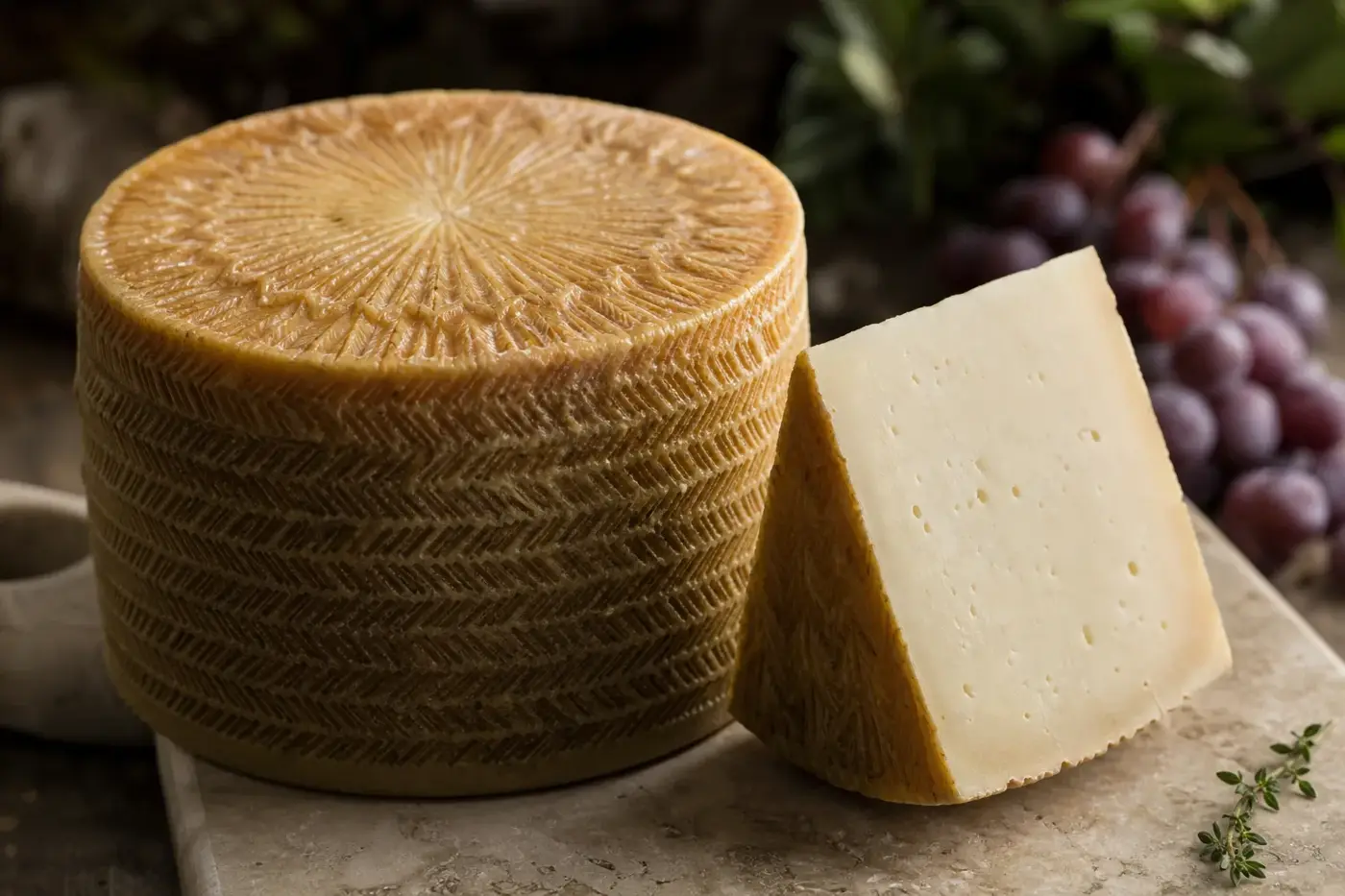
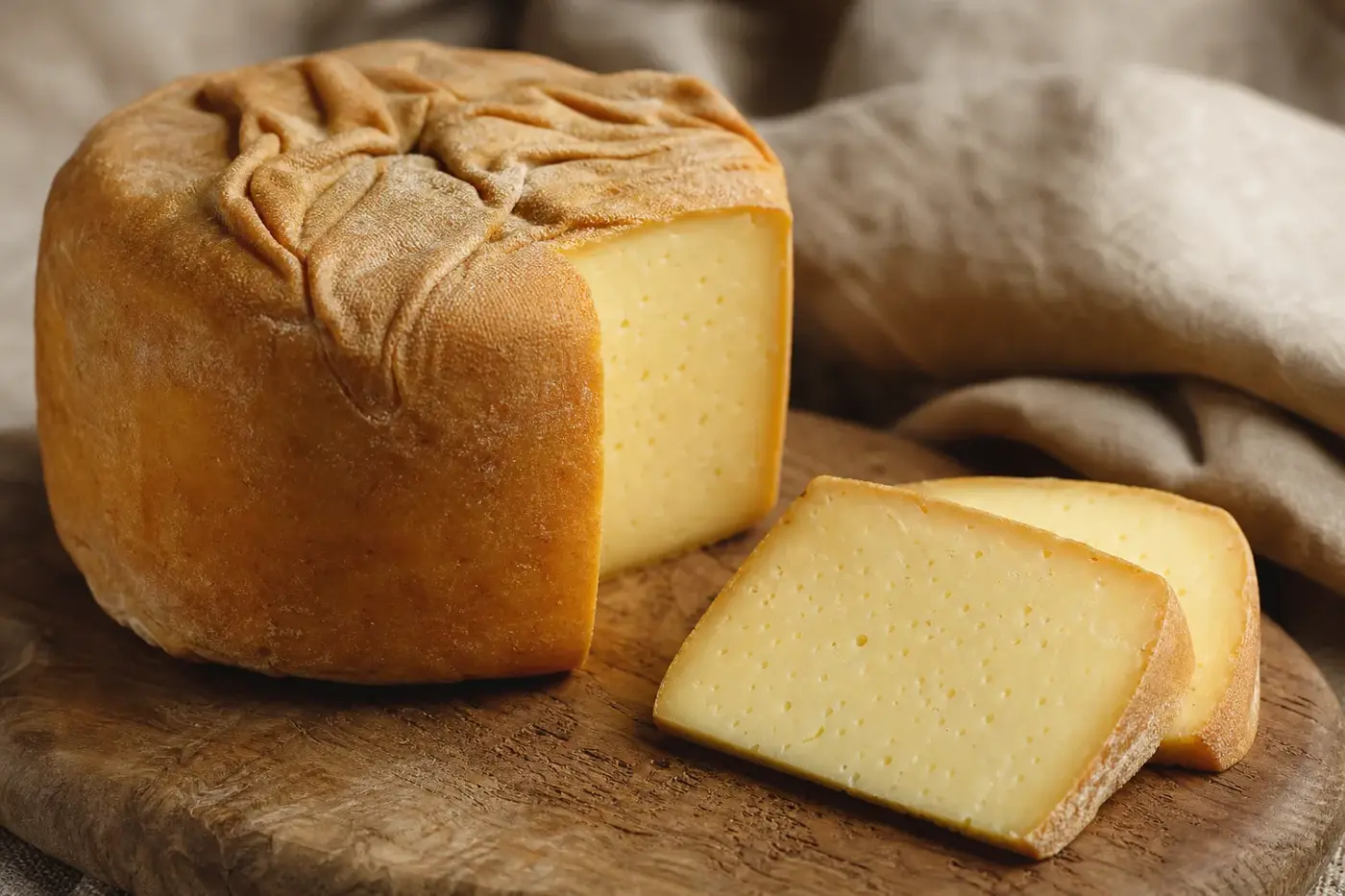
Before you taste, spend a moment with the cut face. Idiazabal’s interior is compact, with relatively few small holes, and the official tourism description gives its colour as white or ivory through to yellowish ivory. The whole wheel is cylindrical, with broadly flat faces and slightly convex sides.[8]
Look at the hard rind and you may spot faint impressions from the cloth used during production. Inside, the specification describes mostly irregular holes, scattered randomly and smaller than a short grain of rice. These are small details, quite unlike the large, regular eyes of some other cheese styles.[1][8]
Smoke leaves its most obvious visual mark outside. Unsmoked wheels tend towards pale yellow, while smoked examples can develop a dark brown rind. Underneath, both retain the compact interior character of the same sheep’s milk cheese.[8]
So give the cut face as much attention as the rind when you choose. Look for the paste’s colour and closeness, and an impression of its firmness. It is your most useful starting point for examining the cheese itself.[6][8]
Taste the sheep’s milk before the smoke
Matured sheep’s milk is at the heart of Idiazabal’s flavour. The council describes an intense, balanced cheese, with a contribution from natural rennet, medium saltiness, modest sharpness or piquancy, and variable acidity. “Savoury” points you in the right direction; the pleasure is in how those elements come together.[5]
Give the finish time to make itself known. Persistence after swallowing is a defining feature in the council’s account, rather than a flavour that disappears with the bite. As you chew, expect a compact, fairly firm texture with limited elasticity and some perceptible graininess.[6][7]
In smoked Idiazabal, smoke should accompany that character, not take charge. The council warns that too much can obscure the cheese’s characteristic flavour, as can excessive salt, acidity or piquancy. Smoke is a guest here, not the person rearranging all the furniture.[5]
Begin an unsmoked tasting with a plain piece, before bread or fruit. Notice the sheep’s milk character, the balance of salt and acidity, and how long the flavour stays with you. These simple observations follow the council’s tasting criteria and give you a useful basis for comparing wedges.[5][7]
Discover what a little more age brings
For the current legal minimum maturation period and its starting point, consult the operative specification. Keep those legal details separate from advice about the age you might most enjoy.[11]
The council recommends four to eight months as a period in which the cheese can express its qualities, with your preference guiding the choice. That recommendation goes beyond the minimum. It is neither a compulsory age nor a reason to pass over a younger qualifying cheese.[4]
Maturation makes itself felt in the bite. As moisture is lost, the paste becomes harder, more brittle and less elastic, according to the council’s texture guidance. Its flavour guidance also names insufficient maturation as one possible cause of weak characteristic flavour.[5][6]
Ask your cheesemonger for the actual age rather than a maturity adjective. For a clearer comparison, choose cheeses from the same producer with the same smoking treatment. You can then focus more closely on what maturation brings to each one.
Know which marks to look for on the rind
A picture of a sheep is not the same as origin protection. PDO means protected designation of origin, and Idiazabal’s published requirements connect its defined milk source and production area with its making method, maturation and finished characteristics. Registered operators must keep records so the cheese can be traced through production.[1]
The council identifies three visible marks for you to look for. These are a numbered holographic counter-label, a registered casein plate integrated into the rind, and the designation’s numbered logo label. They connect the wheel to its documented control system; pictures of sheep or mountains serve a different purpose.[4]
If you are buying a cut portion, ask to see the identification on the original wheel. With a packaged wedge, keep the label after opening. That way, you still have the producer and batch information to hand.
In Great Britain, Defra lists Idiazabal as a registered PDO, with UK-scheme registration dated 31 December 2020. That is a separate jurisdictional record from its EU registration.[2] For the wider distinction between origin protection and a brand, see protected names explained.
Bring home a wedge that suits your taste
Start with three questions: who made it, how old is it, and is it smoked? Those answers tell you more about the likely eating experience than rind colour alone. The council’s descriptions identify age, production technique and smoking as meaningful sources of difference between cheeses.[4][5][6]
For your first comparison, choose smoked and unsmoked wedges of similar age. Taste the unsmoked cheese first, then return to it after the smoked one. You can explore what smoke adds without losing track of the underlying milk and maturation character.
For storage, follow the cheese’s own labelled refrigeration and after-opening instructions, and keep its packaging information. The Food Standards Agency’s guidance for England, Wales and Northern Ireland explains that chilling helps prevent harmful bacteria from growing.[9] Find detailed household handling advice in how to store cheese at home.
At the table, cut manageable slices or small wedges. Taste the cheese alone first, then introduce accompaniments one at a time. Keeping the cheese as your reference point makes each addition’s effect easier to notice.
Make room for bread, fruit and kitchen exploring
Begin with plain bread, crisp apple or pear, or a little quince paste. Try each separately rather than piling everything onto one bite. Fruit contrasts with the saltiness and persistent flavour described by the council; plain bread leaves you more room to concentrate on the cheese itself.[5][7]
Water is the simplest drink when you are comparing smoked and unsmoked examples. Unsweetened tea is another alcohol-free option, particularly if you want to keep sweetness in the accompaniment low. Neither requires you to turn a cheese tasting into a drinks project.
In the kitchen, start with small additions. Try fine shavings over warm vegetables, grated cheese stirred into a finished potato dish, or a little inside an omelette. These are serving suggestions, not independently tested recipes.
Choose unsmoked Idiazabal when you want the sheep’s milk character to lead. Reach for smoked cheese when smoke belongs in the dish you have in mind.[5]
Curious about tasting Roncal alongside it? The Roncal Valley has a distinct geographical boundary: it is excluded from the area described in the Idiazabal specification.[1] For a comparison of the two cheeses’ current production requirements, consult their operative specifications.
Questions people ask
Where is Idiazabal made?
Its defined production area covers specified breed areas in Álava, Bizkaia, Gipuzkoa and Navarre, excluding the municipalities of the Roncal Valley. Milk production, cheesemaking and maturation share that boundary.
Is all Idiazabal smoked?
No. Both smoked and unsmoked Idiazabal belong to the designation. Unsmoked wheels tend towards pale yellow, while smoked examples can have a dark brown rind.
What milk and rennet are used in Idiazabal?
Idiazabal is made from raw milk from Latxa sheep, Carranzana sheep, or both. The specification requires animal rennet.
How long is Idiazabal matured?
The current legal minimum maturation period has not been verified. The designation’s council recommends four to eight months, according to personal taste.
How can I identify a protected Idiazabal cheese?
The council identifies a numbered holographic counter label, a registered casein plate integrated into the rind, and the designation’s numbered logo label. If buying a cut portion, ask to see the identification on the original wheel.
Sources
[1] Consejo Regulador de la DOP Idiazabal. Pliego de condiciones, version published 27 July 2022, sections B to F. Retrieved specification.
[2] Department for Environment, Food & Rural Affairs. Idiazabal, GB protected food name register, published 4 January 2021, live entry checked November 2026. Register entry.
[3] Ministerio de Agricultura, Alimentación y Medio Ambiente. Pliego de condiciones Idiazabal, document incorporating modifications dated 6 May 2014. Historical specification used for its production description and historical account, not as proof of the current maturation starting point. Retrieved document.
[4] Consejo Regulador de la DOP Idiazabal. Queso Idiazabal: descripción, elaboración e identificación, undated, checked November 2026. Industry designation body’s account. Description and identification.
[5] Consejo Regulador de la DOP Idiazabal. Características sensoriales: sabor, undated, checked November 2026. Flavour criteria.
[6] Consejo Regulador de la DOP Idiazabal. Características sensoriales: textura, undated, checked November 2026. Texture criteria.
[7] Consejo Regulador de la DOP Idiazabal. Características sensoriales: regusto, undated, checked November 2026. Finish criteria.
[8] Idiazabal Turismo. Queso Idiazabal, undated, checked November 2026. Used for appearance, not its simplified dimensions or breed description. Cheese description.
[9] Food Standards Agency. How to chill, freeze and defrost food safely, published 18 December 2017, landing page checked November 2026. Applies to England, Northern Ireland and Wales. Official guidance.
[10] Agencia Española de Seguridad Alimentaria y Nutrición. Red de alerta alimentaria and Buscador de alertas alimentarias, live notices checked November 2026. Official alert network.
[11] Ministerio de Agricultura, Pesca y Alimentación. DOP/IGP: Idiazabal, live designation entry checked November 2026. The retrieved search record identifies a specification effective from 14 March 2026; the full page and linked specification could not be opened. Ministry entry.
[12] Consejo Regulador de la DOP Idiazabal. Procedimientos normalizados de trabajo para la inscripción y certificación de queserías, PNT-01, edition 6, 15 July 2016, table 1. Certification procedure.
This desk-researched draft compares retrieved specifications with the designation council’s production and sensory accounts, the GB register and official consumer guidance.
Last checked: November 2026
Last checked November 2026.
The editors suggest you read next