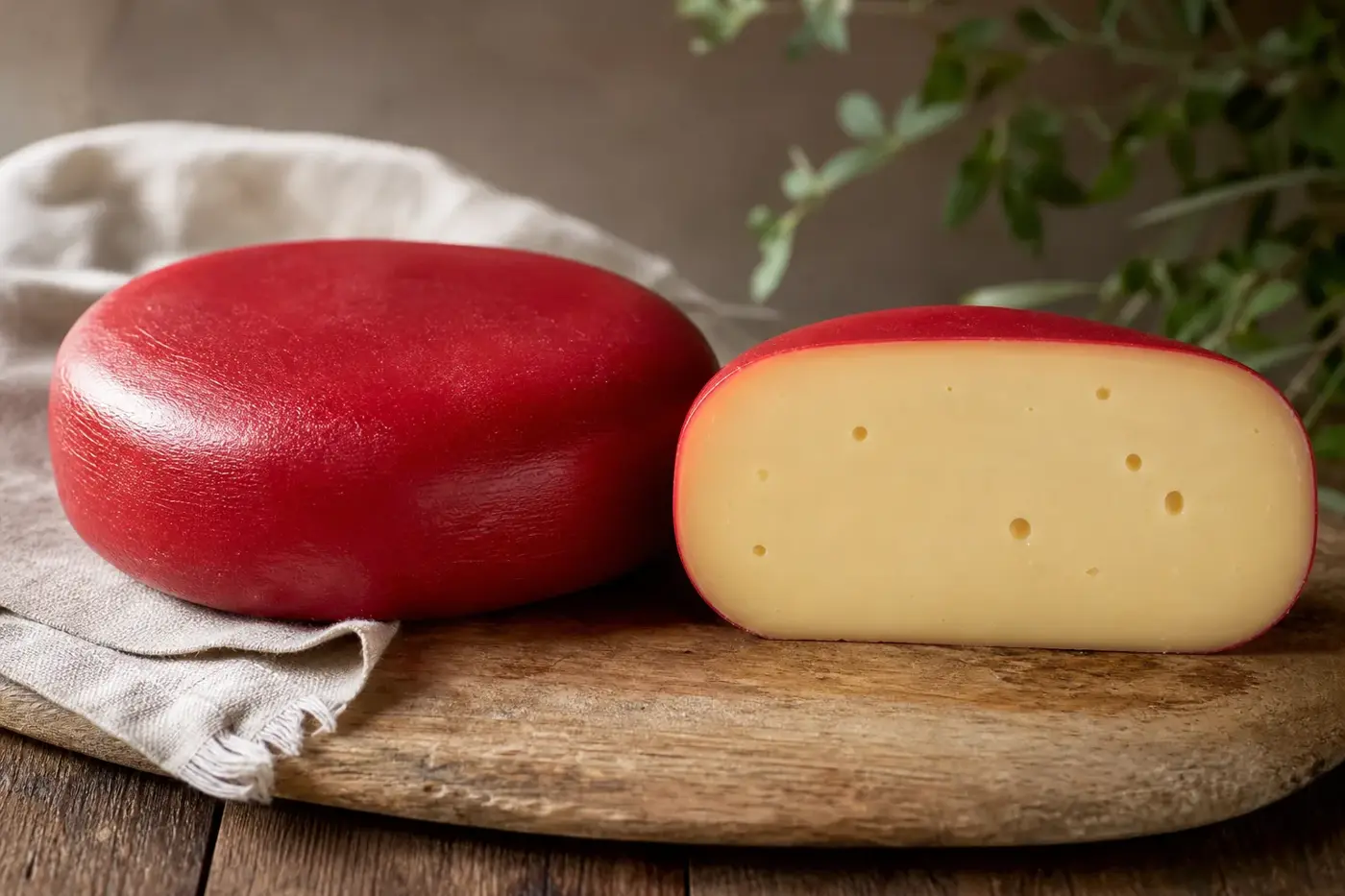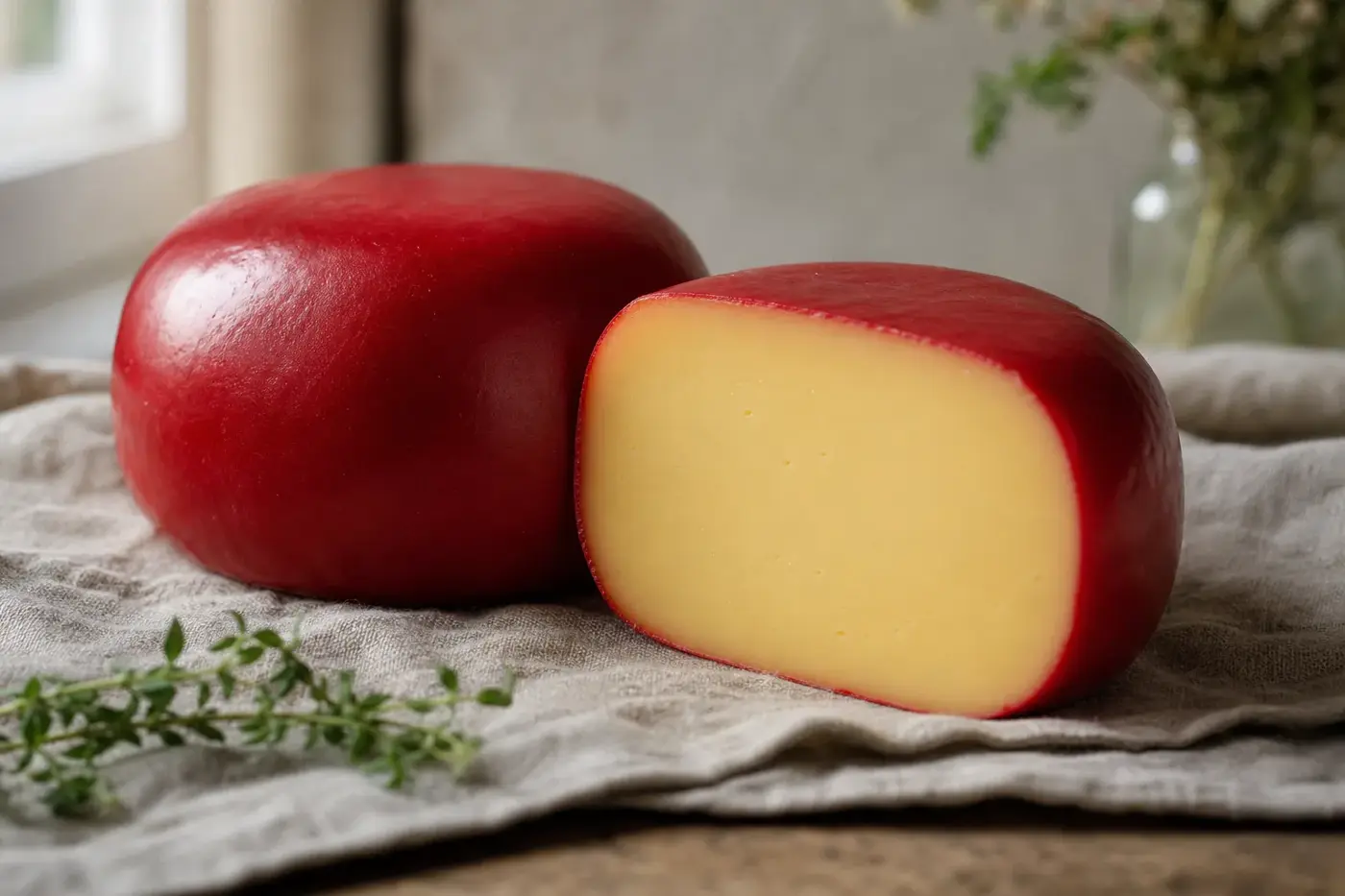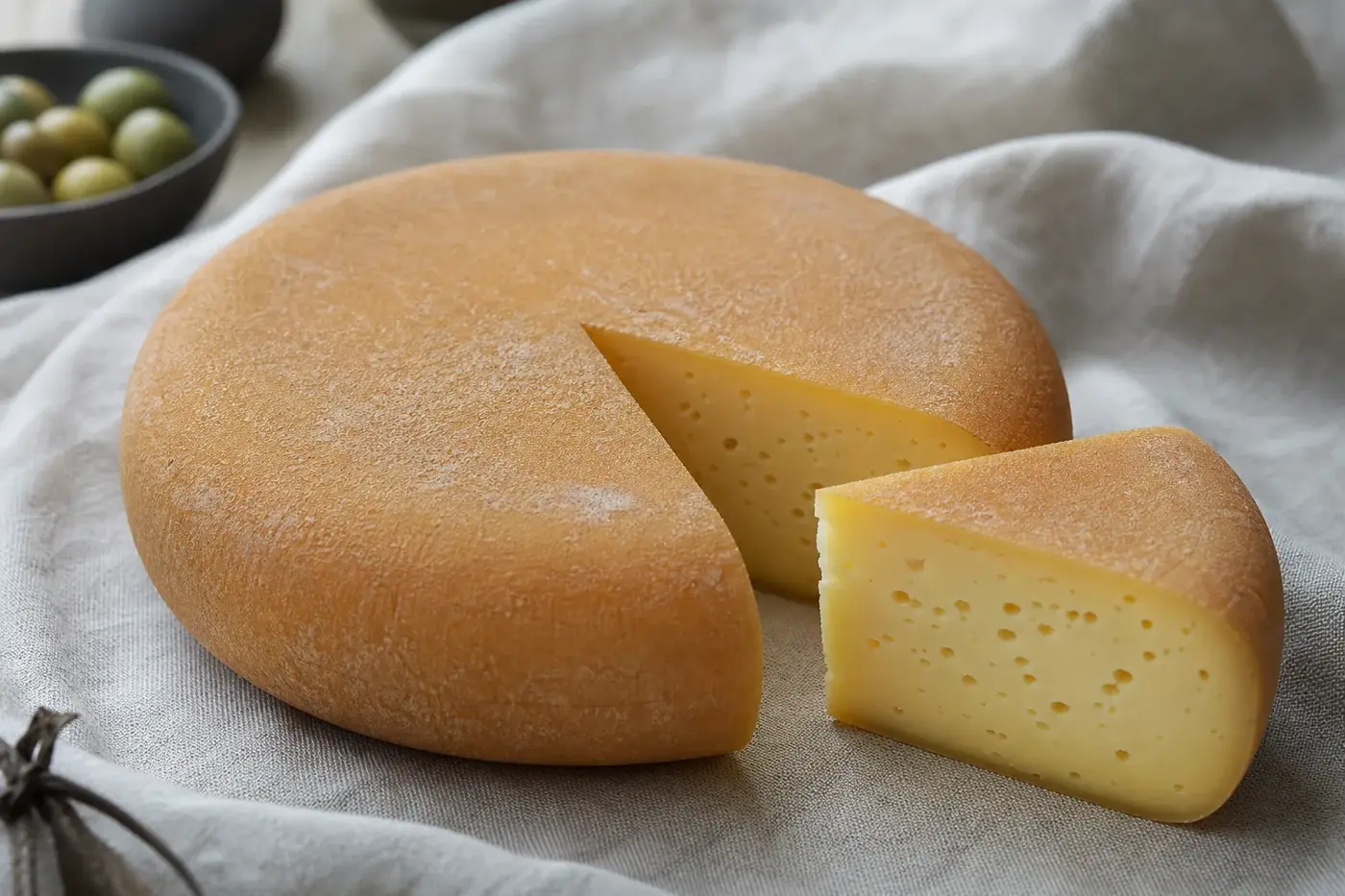
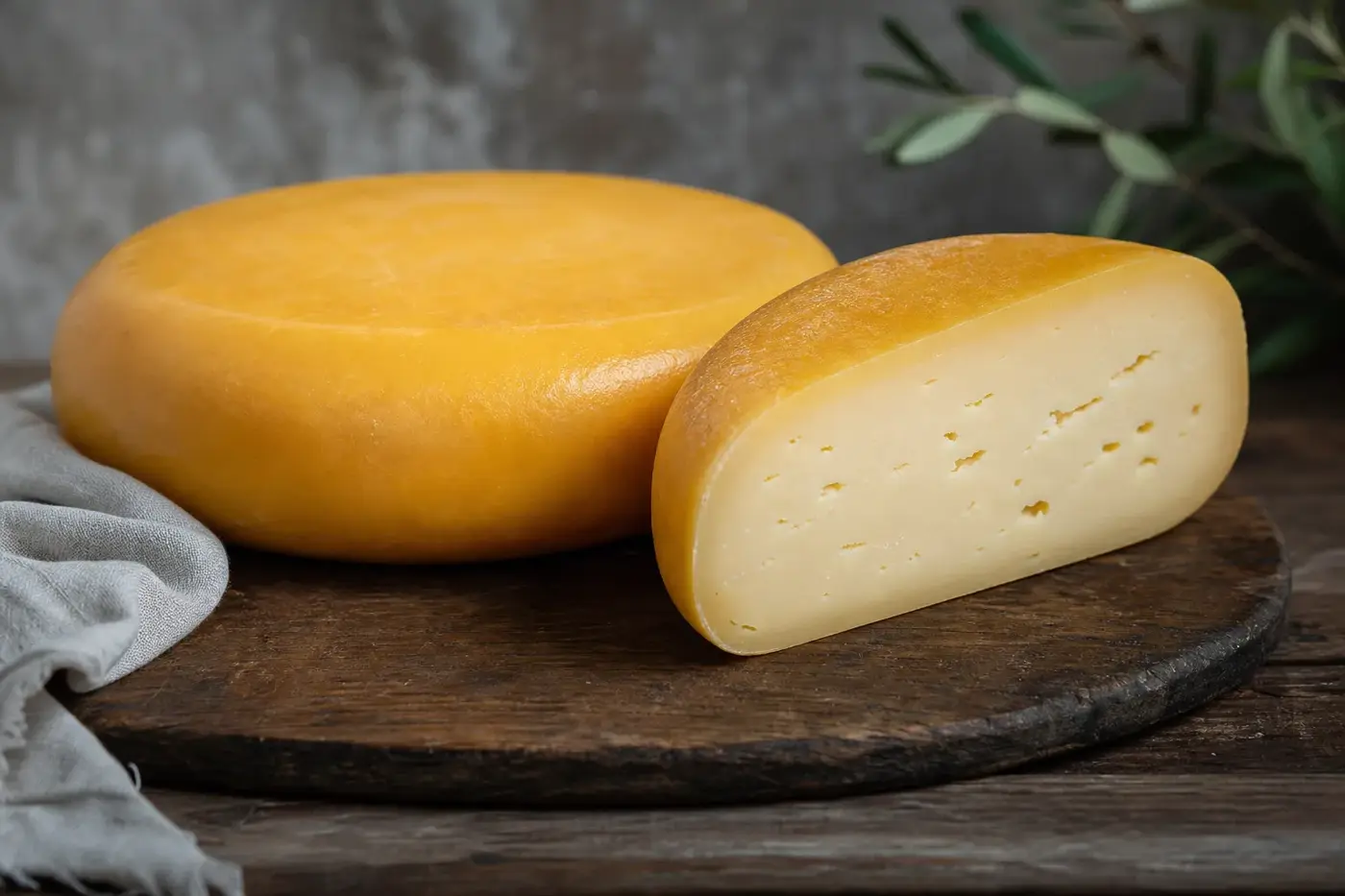
Take a slice of Gouda Holland at four weeks. It is ivory to yellow, dotted with visible openings, with a slightly soft to supple bite. Leave it longer and the body firms, the texture becomes shorter, and the flavour grows more pronounced.[3] Patience has its rewards, assuming you can leave the cheese alone.
That is the appeal of Gouda, a firm to semi-hard cheese style whose name travelled far beyond the Dutch city where it was traded. But before you choose, look closely at the name. Gouda Holland and Noord-Hollandse Gouda have geographical protection in the EU; Boerenkaas protects a separate farmhouse production tradition that reaches beyond Gouda.[1][2][5][6][7]
Get to know the cheese on your plate
| What you want to know | Your guide |
|---|---|
| Familiar name | Gouda, a cheese style. The EU registration of Gouda Holland expressly leaves “Gouda” available for continued use.[2] |
| International reference | Codex Standard for Gouda, CXS 266-1966: an international reference standard, not a worldwide law.[1] |
| Typical character | Codex describes a firm, sliceable body, near-white to yellow, with small, approximately round openings.[1] |
| Milk | Gouda Holland and Noord-Hollandse Gouda require cow's milk. Boerenkaas permits raw milk from cattle, goats, sheep or buffalo.[3][4][5] |
| Registered names to recognise | Gouda Holland, PGI-NL-0328; Noord-Hollandse Gouda, PDO-NL-0314; Boerenkaas, TSG-NL-0023.[3][4][5] |
| Milk treatment | Gouda Holland: pasteurised. Boerenkaas: raw milk, not heated above 40 °C. Generic Gouda: treatment depends on the applicable standard and product.[3][5] |
| Minimum ageing | Gouda Holland: at least 28 days. Other Gouda products follow their applicable rules.[3] |
Ordering aloud? The UK pronunciation is /ˈɡaʊ.də/, approximately GOW duh. In the US, it is /ˈɡuː.də/, approximately GOO duh.[18]
Follow Gouda from mild to mature
Age gives you quite a choice. The Gouda Holland dossier follows the cheese from slightly soft to supple at four weeks towards a firmer, shorter texture with further ripening. Inside, it is ivory to yellow, with visible openings; the flavour moves from mild to pronounced.[3]
The broader Codex description allows room for variation. It describes normal ripening from three weeks at 10 to 17 °C, but permits alternative conditions that deliver comparable physical, biochemical and sensory characteristics. These are technical ripening conditions, not instructions for keeping your cheese at home.[1]
At the counter, take the label one detail at a time. The complete cheese name, stated origin, milk treatment and age each tell you something different. “Gouda” alone gives you less to go on than the longer registered names below.[1][2][3][4][5]
Gouda Holland: look for the full Dutch name
Gouda Holland is a Protected Geographical Indication, or PGI, and its EU registration protects the complete name. Article 1 of Regulation (EU) No 1122/2010 expressly allows “Gouda” to continue to be used within the EU, subject to the applicable rules. Published on 3 December 2010, the regulation specifies entry into force on the twentieth day after publication.[2]
Despite “Holland” in the name, the defined production area covers the European Netherlands. Gouda Holland must use cows’ milk from Dutch dairy farms, and must be made and matured to a consumer-ready product in the Netherlands. Dutch milk, Dutch cheesemaking, Dutch maturation: each is part of the promise.[2][3]
The dossier specifies 48 to 52% fat in dry matter. That means the proportion of fat once you exclude the cheese’s water. Maturation must last at least 28 days, and ripening in foil is prohibited. Shapes can be flattened cylinders, blocks or loaves, weighing 2.5 to 20 kg.[3]
Behind the familiar texture is washed curd. Rennet, the enzyme preparation that coagulates milk, creates curd: the solid portion separated from the liquid whey. The curd is washed, pressed and brined. Air ripening then develops a dry rind.[2]
Your cue at the cheese counter is the full name Gouda Holland. The dossier requires prominent wording on the label or band, with distinguishing identification on prepacked cheese. Cutting and prepacking can happen outside the Netherlands under the specified traceability arrangements.[3]
Three names, three different promises
Gouda Holland and Noord-Hollandse Gouda protect geographical origins. Boerenkaas protects a tradition instead: it is a Traditional Speciality Guaranteed, or TSG. Its registration concerns a traditional product and production method, rather than a geographically exclusive production area.[5][9]
For November 2026, this comparison covers the Dutch production specifications and EU schemes. You can also find each name’s separate record in the site’s Protected Cheese Directory.
| Name and directory record | EU scheme | What sets it apart |
|---|---|---|
| Gouda Holland, D0080 | PGI | Dutch cows’ milk; manufacture and maturation in the Netherlands; pasteurisation and natural ripening.[2][3] |
| Noord-Hollandse Gouda, D0129 | PDO | Cow's milk from North Holland; pasteurisation, washed curd and natural ripening for at least four weeks.[4] |
| Boerenkaas, D0019 | TSG, separate from geographical indications | Farm manufacture using raw milk, with at least half from the farm’s own herd.[5] |
Noord-Hollandse Gouda: the story starts in North Holland
With Noord-Hollandse Gouda, you are choosing a PDO made from cow's milk produced in the Dutch province of North Holland. The milk is pasteurised, the curd washed, and the cheese naturally ripened for at least four weeks.[4]
Milk production and the initial manufacturing stages must happen within North Holland. Later ageing, cutting and packing may take place elsewhere under the specification’s traceability requirements. Its EU registration dates from 21 June 1996.[4][6]
Boerenkaas: a farmhouse tradition beyond Gouda
Boerenkaas means cheese made by farmers on the farm. Its amended EU specification requires raw milk to be processed within 40 hours of milking, with at least half coming from the farm’s own herd. Here, you are choosing a particular way of making cheese, rather than the geographical origins protected by the two Gouda indications.[5]
The farmhouse story does not stop at cows’ milk Gouda. The specification permits milk from cattle, goats, sheep or buffalo. Examples include Goudse Boerenkaas, Edammer Boerenkaas, Leidse Boerenkaas and cheeses made from goat’s or sheep’s milk. Boerenkaas embraces a broader farmhouse cheesemaking tradition than Gouda alone.[5]
Let age lead you to your next slice
You will often see jong, belegen and oud, common Dutch cheese descriptions that move from young towards older cheese. The Gouda Holland dossier discusses young, matured and old forms. Consumption ages range from the required 28 days to more than a year.[3]
For a useful comparison, separate the specification’s minimum maturation from the age of the cheese in front of you. Kaas.nl, for example, describes its jong belegen Noord-Hollandse Gouda as approximately six weeks ripened. That tells you about its cheese, not every product bearing the term.[15]
Choosing between two cheeses? Ask for the actual maturation period. A four-week cheese and a wheel matured beyond a year occupy very different points in the Gouda Holland dossier’s description, even though both can carry the same geographical name.[3] It is a perfectly respectable reason to ask for two tastes.
How far do those protected names travel?
A protected name means something within a particular jurisdiction. For November 2026, the table below separates scheme or agreement entries from other rights. Unresolved entries are marked “Unconfirmed”.
| Where you are | Gouda and the two geographical names | Boerenkaas |
|---|---|---|
| Netherlands and EU | Gouda remains available for use under EU rules; Gouda Holland is PGI and Noord-Hollandse Gouda is PDO.[2][4][6][8] | Registered TSG.[5][7] |
| Great Britain | Gouda Holland PGI and Noord-Hollandse Gouda PDO are registered under the UK scheme from 31 December 2020.[6][8] | Registered TSG from 31 December 2020.[7] |
| Northern Ireland | EU geographical indication schemes apply.[9] | EU TSG scheme applies.[9] |
| Switzerland | Gouda Holland and Noord-Hollandse Gouda appear in the EU list under Appendix 1 to Annex 12 of the bilateral agricultural agreement.[10] | Not listed in that appendix.[10] |
| United States | Gouda has a federal standard for composition and manufacture; it does not establish Dutch geographical protection for the longer names.[11] | A separate European traditional-speciality designation, not a US cheese category. |
The US standard makes the distinction between composition and origin particularly clear. Under 21 CFR 133.142, Gouda follows the Edam standard with specified differences: at least 46% milkfat by weight of the solids and no more than 45% moisture in the whole cheese. Those figures tell you about composition, not Dutch geographical origin.[11]
Before you bite, look beneath the coating
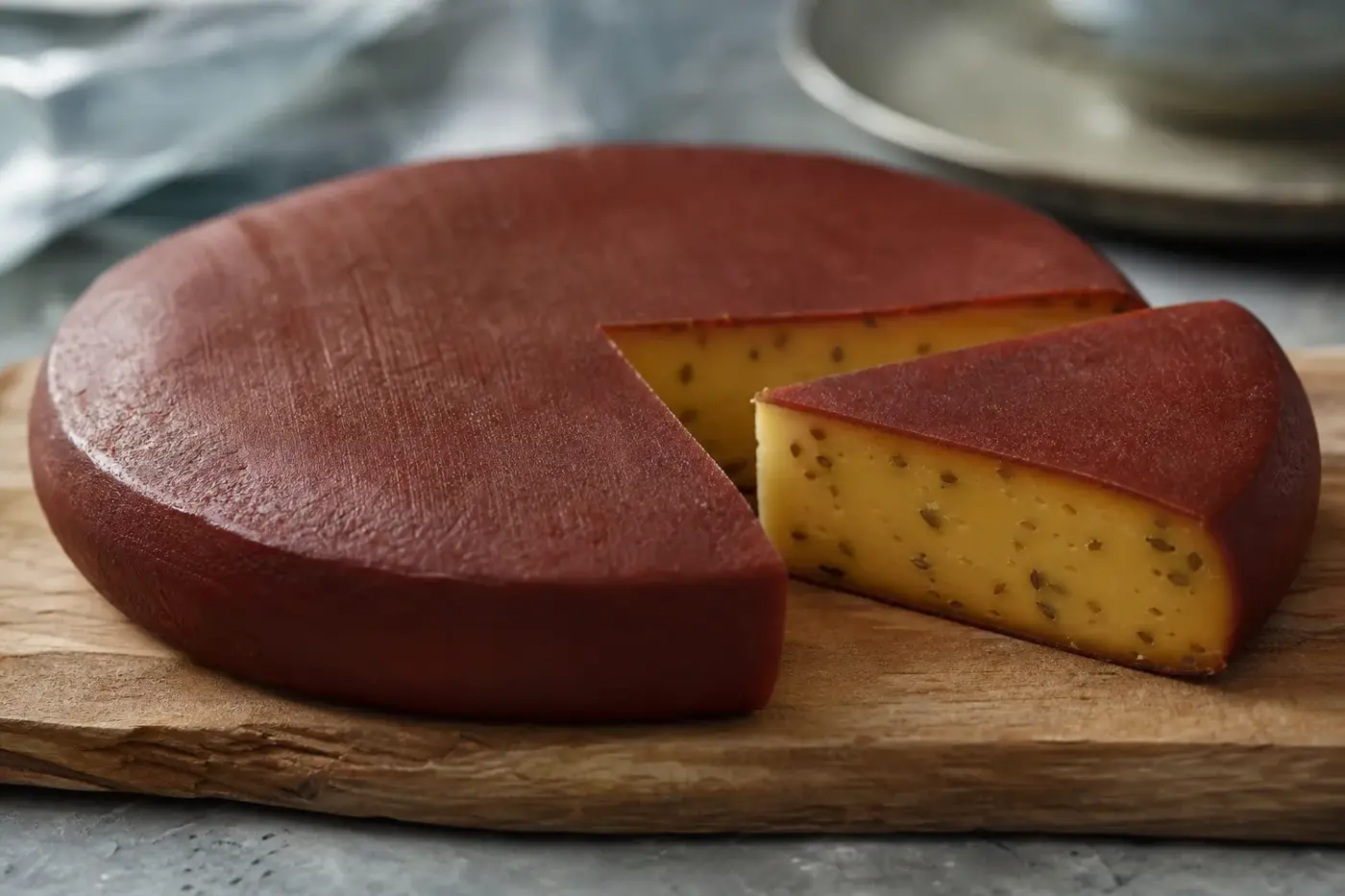
Give that coloured covering a moment of your attention before serving. Codex distinguishes the rind itself from protective coatings, and the Gouda Holland dossier permits a semi-water-vapour-permeable rind covering during natural maturation. A coated wheel can still develop its rind through air ripening.[1][3]
Foil ripening is a separate matter, and Gouda Holland excludes it. A coating alone therefore cannot tell you how the cheese was matured.[3]
Remove wax and plastic coatings before eating; they are packaging materials, not food. For any remaining rind treatment, follow the product’s instructions. Trust the label and your cheesemonger’s identification of the covering rather than its colour.[1]
Back to Gouda, where the cheese came to market
Behind the name is a trading city and its market square. The local historical association Die Goude dates the formation of the present square to about 1368, and says cheese trading began concentrating in Gouda around 1500. Its account connects the market’s development with space for trading and access to weighing facilities.[14]
| When | The market’s story |
|---|---|
| About 1368 | The market square took shape, according to Die Goude.[14] |
| Around 1500 | Cheese trading increasingly concentrated in Gouda.[14] |
| Eighteenth century | Cheese traded in the city acquired the designation Gouda cheese, according to the Gouda Holland dossier.[3] |
The dossier first associates the name with flattened cylindrical cheeses from the Zuid-Holland and Utrecht pasture regions, before describing its wider trading use. You can carry that history straight to the cheese counter. Gouda names a broad style; the complete registered names tell you more precisely where or how your cheese must be made.[2][3]
Questions people ask
How is Gouda pronounced in the UK?
The UK pronunciation is approximately GOW duh. In the US, it is approximately GOO duh.
Does Gouda have to come from the Netherlands?
Gouda is a cheese style, and the name remains available for use under EU rules. Gouda Holland is a protected name that requires Dutch cows’ milk and manufacture and maturation in the Netherlands.
How does Gouda change as it ages?
At four weeks, Gouda Holland has a slightly soft to supple texture and a mild flavour. With further ripening, it becomes firmer and its flavour more pronounced.
Can you eat the rind on Gouda?
Remove wax and plastic coatings before eating, as they are packaging materials rather than food. Follow the product’s instructions for any remaining rind treatment.
Is Boerenkaas the same as Gouda?
Boerenkaas is a broader name for a farmhouse cheesemaking tradition that includes Goudse Boerenkaas and other cheeses. Its specification permits raw milk from cattle, goats, sheep or buffalo.
Sources
[1] FAO and WHO, Standard for Gouda, CXS 266-1966, amended 2022. Current standard.
[2] European Commission, Commission Regulation (EU) No 1122/2010, 2 December 2010, Article 1, Article 3 and Annex II. Official text.
[4] Netherlands Enterprise Agency, Productdossier BOB Noord-Hollandse Gouda, February 2024 file. Product dossier. EU register entry.
[5] European Commission, Publication of the amended product specification following the approval of a minor amendment, Boerenkaas, 2022/C 136/04, 28 March 2022. Amended specification. EU register entry.
[6] Defra, Noord-Hollandse Gouda, GB protected food names register, live entry, November 2026. Register entry.
[7] Defra, Boerenkaas, GB protected food names register, live entry, November 2026. Register entry.
[8] Defra, Gouda Holland, GB protected food names register, live entry, November 2026. Register entry.
[9] Defra, Protected geographical food and drink names: UK GI schemes, live guidance, November 2026. Official guidance.
[10] EU-Switzerland Joint Committee on Agriculture, Decision No 2/2022, Appendix 1 to Annex 12, published 9 December 2022. Official text.
[11] US Food and Drug Administration, 21 CFR 133.142: Gouda cheese, eCFR, displayed as current to 29 October 2026. Standard of identity.
[12] Global Affairs Canada, Comprehensive Economic and Trade Agreement, Annex 20-A, official treaty text, retrieved November 2026. Treaty annex.
[17] Canadian Intellectual Property Office, List of geographical indications, undated. Register.
[18] Cambridge Dictionary, gouda, online edition. Pronunciation.
[13] Australian Department of Foreign Affairs and Trade, Dairy geographical indications, live negotiating and agreement information, November 2026. Official information.
[14] Historische Vereniging Die Goude, Het ontstaan van de Goudse kaasmarkt, undated historical account, retrieved November 2026. Historical account.
[15] kaas.nl, Noord-Hollandse Gouda Jong Belegen, undated cheese description, retrieved November 2026. Published description.
[16] European Commission, Publication of an approved standard amendment, Noord-Hollandse Gouda, C/2024/3414, 31 May 2024. Official amendment publication.
Last checked: November 2026
Last checked November 2026.
The editors suggest you read next
Noord-Hollandse Gouda
An ivory to yellow cut face, a smooth yellow rind, and a decision to make at the counter.