Noord-Hollandse Edammer
Bend a slice of Noord-Hollandse Edammer and watch it yield.
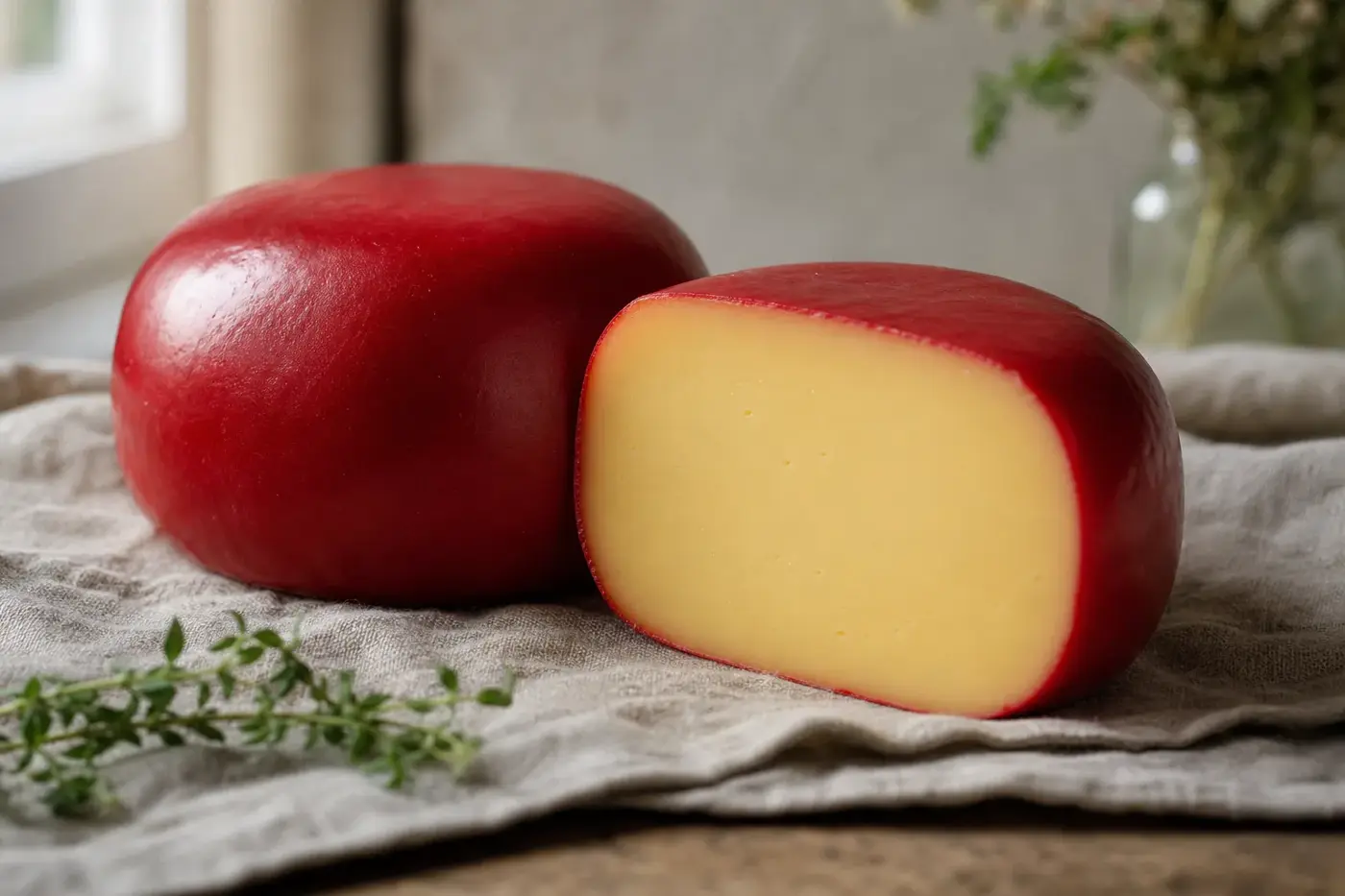
Bend a slice of Noord-Hollandse Edammer and watch it yield. That suppleness carries a little of North Holland to your plate: the designation dossier connects it to sea-clay pasture, local milk and relatively soft milk fat.[1] Small and rounded, this member of the Edam family has a defined origin and composition. Its name is registered as a protected designation of origin in Great Britain.[1][2]
| What you might want to know | The detail |
|---|---|
| Name to look for | Noord-Hollandse Edammer.[1][2] |
| Registration authority | European Commission, original EU registration; Defra, Great Britain register.[2] |
| EU register ID and current status | Not specified here |
| Northern Ireland status | Not specified here |
| Switzerland status | Not specified here |
| United States status | Not specified here |
| Great Britain status | Registered PDO; UK scheme registration dated 31 December 2020, at 23:00.[2] |
| Original EU registration date | 21 June 1996, as recorded by Defra.[2] |
| Where it comes from | Province of Noord-Holland, Netherlands.[1] |
| Milk | Partially skimmed, pasteurised cows’ milk.[1] |
| Shape and whole-cheese weight | Flattened sphere weighing 1.7 to 1.9 kg.[1] |
| Fat | 40 to 44% fat in dry matter.[1] |
| Salt | Maximum 3.9% in dry matter.[1] |
| Legal minimum ripening | Not specified here |
| Typical age when sold | Not specified here |
| Specific permitted rind coatings | Not specified here |
| Current producers | Not specified here |
Find the pasture in a yielding slice
Look across North Holland’s old polders and you see working farmland shaped by the management of land and water. Open views, watercourses and field patterns are among the qualities the provincial government identifies in its protected landscapes.[3]
The cheese dossier brings that landscape closer. Sea-clay pasture produces local milk whose relatively soft fat contributes to the cheese’s suppleness.[1] Give texture as much attention as flavour. Notice how your slice bends, how readily it yields and how that shapes each mouthful.
The geographical name points to a province, not simply the town associated with Edammer. At the counter, ask your cheesemonger to show you the complete product name on the original label or accompanying documentation.
Let your first mouthful be plain. Bread, fruit and mustard can wait a moment. They will cope while the cheese makes its introduction.
Travel from medieval ports to factory dairies
This little cheese belongs to a long history of making and trading. The regional dossier traces medieval production, exports through Edam and other Zuiderzee ports, and the shift from farms towards factories from the late nineteenth century.[1]
The official Edam Holland documentation tells a related story on a broader scale. Farm cheesemaking grew into local factory production, then into a nationally produced cheese with an international reputation. National rules for Edam cheese followed in the early twentieth century.[5]
That history helps you untangle the familiar names gathered at the cheese counter. Edam can mean a town or a broad cheese tradition. The regional designation and the national geographical indication identify more specific products.
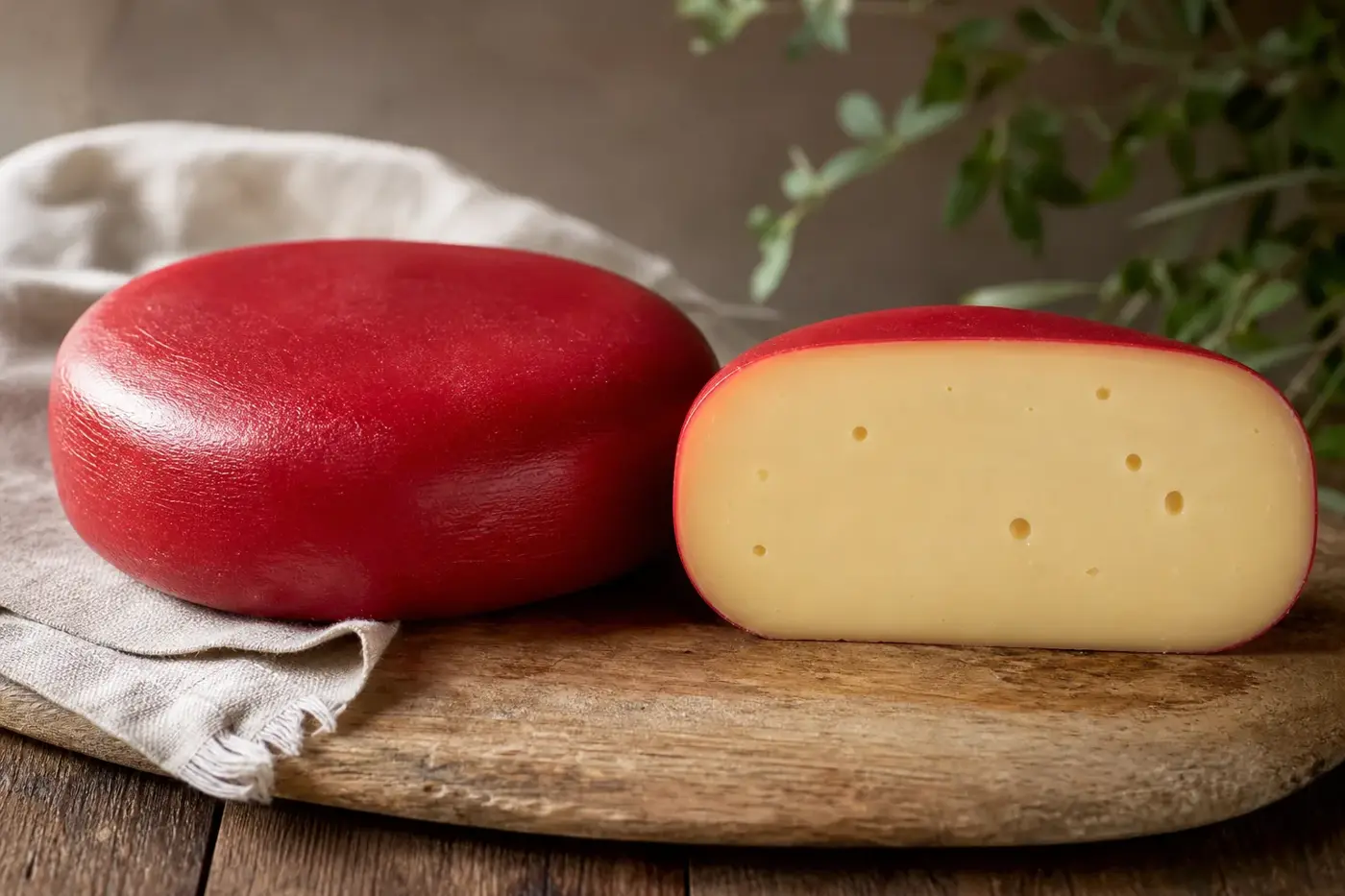
Start with the exact name when you ask about origin. A familiar red-covered ball introduces the style, but the label or accompanying documentation tells you which named cheese you are buying. Appearance starts the conversation; the complete name supplies the identity.
Let the protected name guide you
Those three letters, PDO, mean protected designation of origin. RVO, the Netherlands Enterprise Agency, explains that the designation connects a product’s characteristics with a defined geographical area and a verifiable production method. Unlike a privately owned brand, it is available to eligible operators who follow the specification.[4]
For you, the central questions are where the cheese comes from and whether it meets that specification. Who made it, how it matured and what this particular cheese tastes like are separate conversations. They are equally worth having.
Ask separately about organic certification, animal welfare statements and vegetarian suitability. Request the relevant product information for each. The geographical designation has a particular job; it does not answer every question on your shopping list.
Great Britain’s official register lists Noord-Hollandse Edammer as a registered PDO. It records the original EU registration date and the later UK scheme registration date.[2] These mark distinct events in its protection history, not competing accounts of when the cheese began.
Want to understand how the schemes differ? Turn to protected names explained.
Follow the milk to the press and wooden boards
Several hours in the press. Several days in brine. Then time on wooden boards: the dossier describes the sequence that gives Noord-Hollandse Edammer its finished form.[1]
First, the milk is partially skimmed and pasteurised. Naturally obtained animal rennet, lactic cultures and colouring follow. The curd is worked, cut into blocks, moulded and pressed. After brining, the cheeses ripen under controlled humidity and temperature.[1]
If you have ever wondered where curd ends and cheese begins, here is the useful distinction. Curd is the coagulated material; whey is the liquid separated from it. Here, the curd comes together into a coherent cheese before salting and maturation develop it further.
No single ingredient does all the work. Milk preparation establishes the starting material, moulding gives the cheese its format, and the handling that follows develops what you eventually find at the counter.
You can follow the stages more fully in how cheese is made. Read that general account alongside the regional dossier. Together, they help you distinguish Noord-Hollandse Edammer’s requirements from practices used for other cheeses.
Look beyond the familiar rounded shape
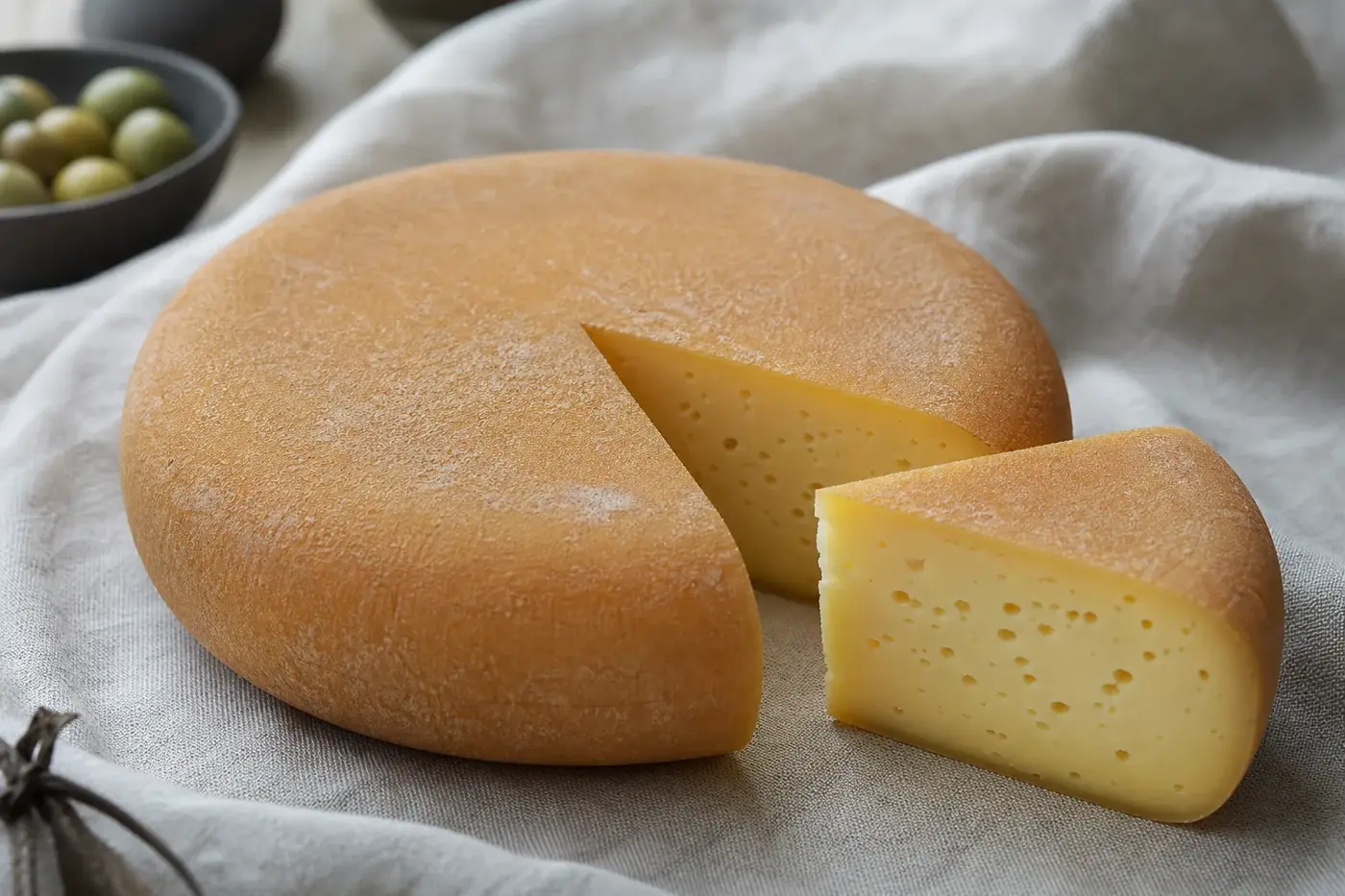
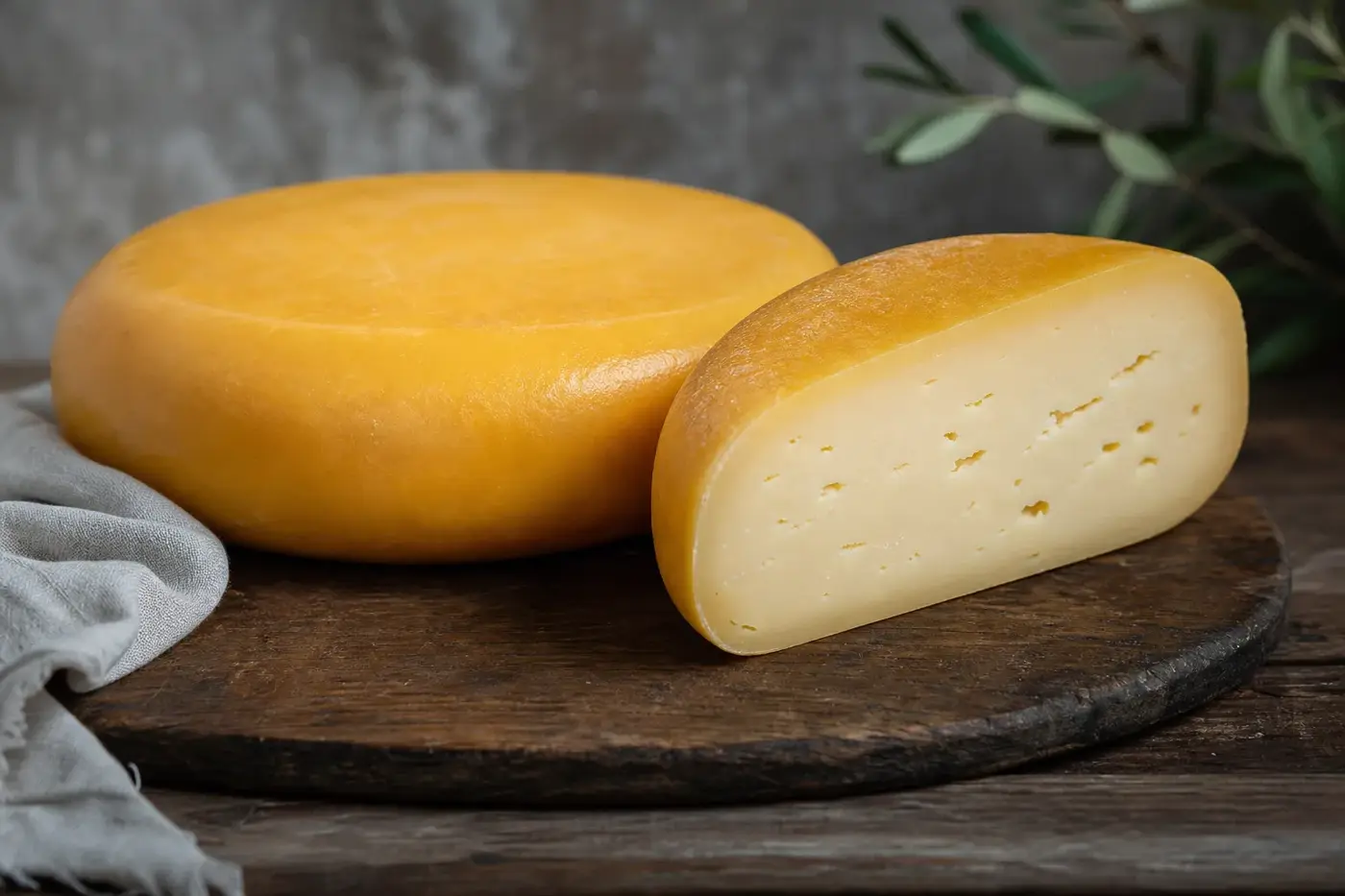
A whole Noord-Hollandse Edammer is compact and rounded, with flattened upper and lower faces.[1] You see less of that distinctive shape in a wedge or a few counter-cut slices. Keep the label with your portion so its identity stays with it after unwrapping.
For a broader family portrait, the Codex Edam standard describes a firm or semi-hard cheese. Its body runs from near-white or ivory to light yellow, with relatively few rounded openings. The standard describes a dry rind that may be coated. It also recognises rindless blocks and loaves within the wider style.[7]
That international reference is useful company for the regional PDO dossier, not a replacement for it. Codex helps explain Edam’s structure and appearance. The regional specification determines which formats belong to Noord-Hollandse Edammer.
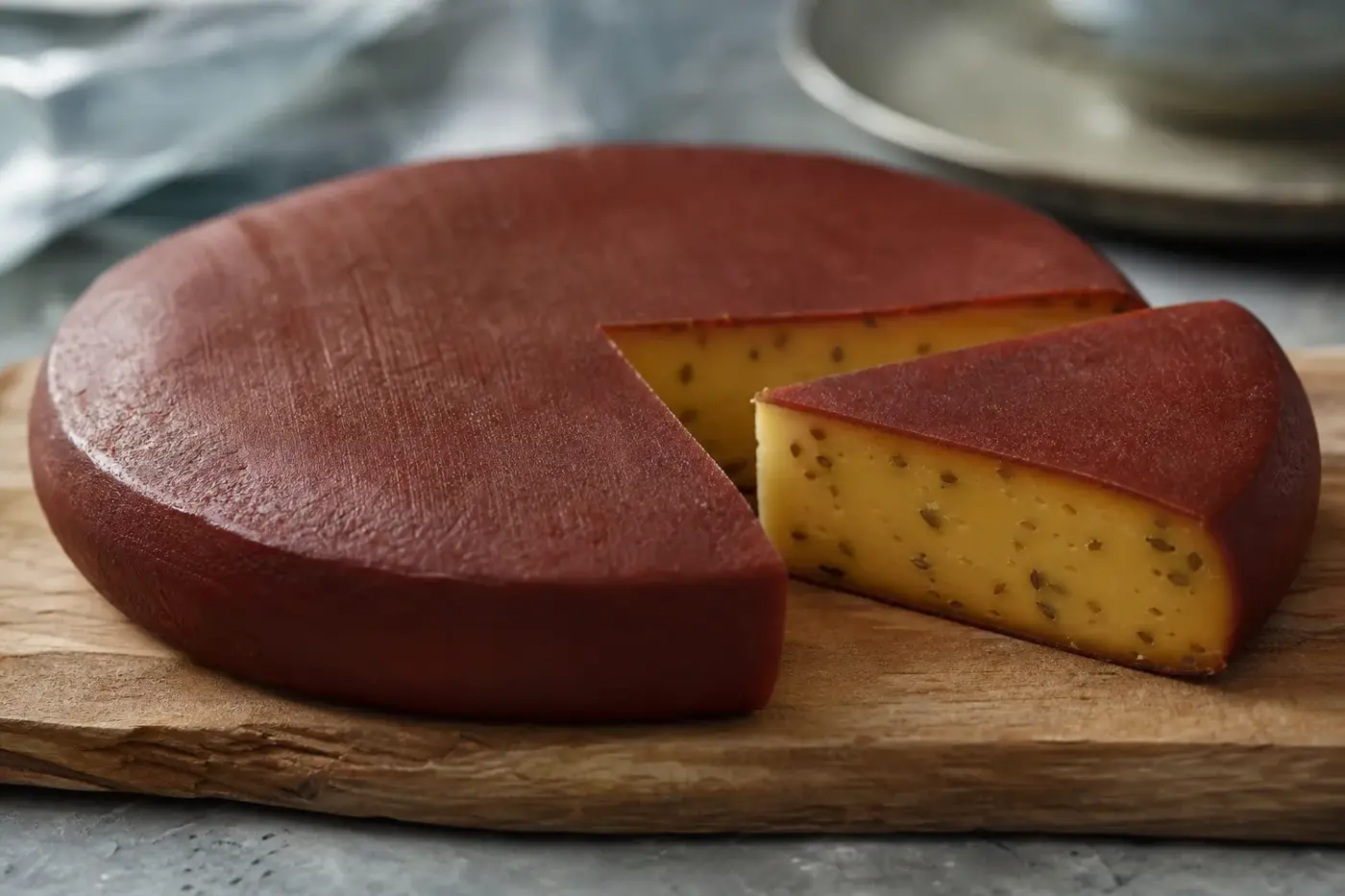
Ask your seller what covers this particular cheese and how you should remove it. The product name, coating information and appearance work best together. Colour cannot do all that paperwork by itself.
Start with texture and get curious about age
Suppleness is the defining textural quality emphasised in the regional dossier.[1] A characteristic flavour description and changes with maturity remain unspecified here for Noord-Hollandse Edammer.
For comparison, the official Edam Holland description gives a flavour range from mild to piquant, depending on age and type. It also describes a structure that becomes firmer and tighter as maturation progresses.[5]
Use that comparison to begin a more revealing conversation at the counter. How does this regional Edammer differ from the younger or older cheese beside it? Ask for its age in weeks or months, then ask your seller to describe the particular batch.
Keep the producer and age with your tasting notes. Those details help you compare your next purchase, whether you loved the yielding slice or the flavour of that particular cheese. They also keep each impression attached to the cheese you actually tasted.
Meet the neighbours in the Edam family
Edam Holland has its own EU PGI documentation. It specifies Dutch milk and maturation in the Netherlands, while allowing several formats, including balls, loaves and blocks.[5]
Noord-Hollandse Gouda has a separate regional dossier. Its milk shares Edammer’s provincial origin, but its specified fat range is higher and its formats differ.[6] The same provincial landscape, then, does not mean the same cheese.
| Cheese or reference | Where it belongs | How you can tell it apart |
|---|---|---|
| Edam, Codex reference | International style reference | Broad description covering several formats.[7] |
| Edam Holland | Netherlands, EU PGI documentation | Dutch milk, Dutch maturation, several formats.[5] |
| Noord-Hollandse Edammer | North Holland regional dossier | Compact rounded format; composition listed above.[1] |
| Noord-Hollandse Gouda | North Holland regional dossier | Cylindrical or block-shaped; 48 to 52% fat in dry matter.[6] |
If you fancy comparing them, choose similarly aged portions where available. Taste each on its own before deciding which you prefer in sandwiches, on a cheese plate or in cooking. Keeping the ages close gives your conversation with the seller a clearer focus, too.
Ready to explore the neighbouring family? The broader Gouda guide is your next stop.
Make the cheese-counter conversation count
Begin with the complete name. If the counter ticket shortens it, ask to see the original label before getting into the cheese’s character.
Next, establish three things: who made it, how long it has matured, and what treatment or covering is on the rind. Keep those details with your purchase. They are especially useful when you take home a cut portion rather than a whole cheese.
You will learn more from questions about texture and flavour than from “Is it strong?” Ask whether the slice is yielding or firm, and whether its flavour is gentle or pronounced. Then ask which age the seller recommends for your serving plans.
COKZ, the Dutch dairy control body, explains that checks on protected cheeses can cover origin, production location, recipe and maturation. Assessments can take place at different points in the chain.[9] Those checks underpin the designation. At the counter, bring the conversation back to the complete name, recorded age and actual cheese in front of you.
Need help separating identity from the other details on a packet? See how to read a cheese label.
Keep it well and make room at the table
Keep the cheese’s storage instructions with it. For households in England, Wales and Northern Ireland, the Food Standards Agency advises a home fridge temperature of 5 °C or below. It also advises keeping chilled food out for the shortest possible time during preparation; the guidance date for this page is November 2026.[8]
For your first serving, take a small portion from the fridge and leave the rest refrigerated. Taste a plain slice while you assemble the plate, rather than putting the whole cheese out well ahead of the meal. You will find broader guidance in how to store cheese at home.
Keep the accompaniments restrained: plain bread, crisp apple or pear, and a little mustard offered separately. Try each after the cheese alone so you can notice the difference. Water or unsweetened tea keeps things simple.
Slip thin slices into a bread roll, put small pieces beside cooked potatoes, or add cubes to a salad. These are serving suggestions, not a fixed traditional formula. Choose whichever format suits your meal.
If you want to cook with it, begin with an open sandwich, a vegetable filling or a small topping on hot potatoes. Use a modest amount, then adjust the quantity and seasoning to the cheese you bought. Set aside a plain piece too. Tasting the same purchase cooked and as it comes is a useful way to discover which you prefer.
General information only, not medical advice: follow the official guidance where you live.
Questions people ask
Where does Noord-Hollandse Edammer come from?
It comes from the province of Noord-Holland in the Netherlands. The geographical name identifies the province, not simply the town associated with Edammer.
How is Noord-Hollandse Edammer different from Edam Holland?
Noord-Hollandse Edammer has a North Holland regional designation and a compact rounded format. Edam Holland has its own EU geographical indication, specifies Dutch milk and maturation in the Netherlands, and includes balls, loaves and blocks.
What milk and rennet are used to make it?
It is made from partially skimmed, pasteurised cows’ milk. The dossier specifies naturally obtained animal rennet, alongside lactic cultures and colouring.
What does Noord-Hollandse Edammer taste like?
The regional dossier emphasises its supple texture. A characteristic flavour description and changes with maturity have not been verified for this cheese, so ask the seller about the particular batch.
How should I store Noord-Hollandse Edammer?
Keep the cheese’s storage instructions with it. For households in England, Wales and Northern Ireland, the Food Standards Agency advises a home fridge temperature of 5 °C or below and keeping chilled food out for the shortest possible time during preparation. Check the Food Standards Agency’s current guidance.
Sources
[1] Netherlands Enterprise Agency, Noord-Hollandse Edammer: registration dossier under Regulation (EEC) No 2081/92, national dossier 003/94. Undated historical application summary, hosted by RVO. Sections 5(b) to 5(i). Product dossier.
[2] Department for Environment, Food & Rural Affairs, Noord-Hollandse Edammer, protected food and drink names register, published 4 January 2021; live entry retrieved November 2026. Great Britain register entry.
[3] Province of Noord-Holland, Beschermd landschap, live provincial information page, retrieved November 2026. Provincial landscape account.
[4] Netherlands Enterprise Agency, Wat zijn Europese kwaliteitsaanduidingen?, live guidance, retrieved November 2026. Sections on PDOs and use of registered names.
[5] European Commission, Commission Regulation (EU) No 1121/2010, 2 December 2010, Annex II, Edam Holland specification summary. Historical legal publication, used for its documented description and history. Official text.
[6] Netherlands Enterprise Agency, Beschermde Oorsprongsbenaming (BOB) Noord-Hollandse Gouda: Productdossier, undated version retrieved November 2026. Product dossier.
[7] FAO and WHO, Milk and Milk Products, second edition, 2011, Codex Standard for Edam, CODEX STAN 265-1966, section 2. Historical edition used as an international descriptive reference. Official compilation.
[8] Food Standards Agency, How to chill, freeze and defrost food safely, published 18 December 2017, live guidance retrieved November 2026. Applies to England, Northern Ireland and Wales. Official guidance.
[9] COKZ, Jaarverslag 2025, published 2026, section 2.1.2, pages 22 to 23. Annual report.
This desk-researched draft compares official regional dossiers, register information, international descriptive standards and national household guidance.
Last checked: November 2026
Last checked November 2026.
The editors suggest you read next