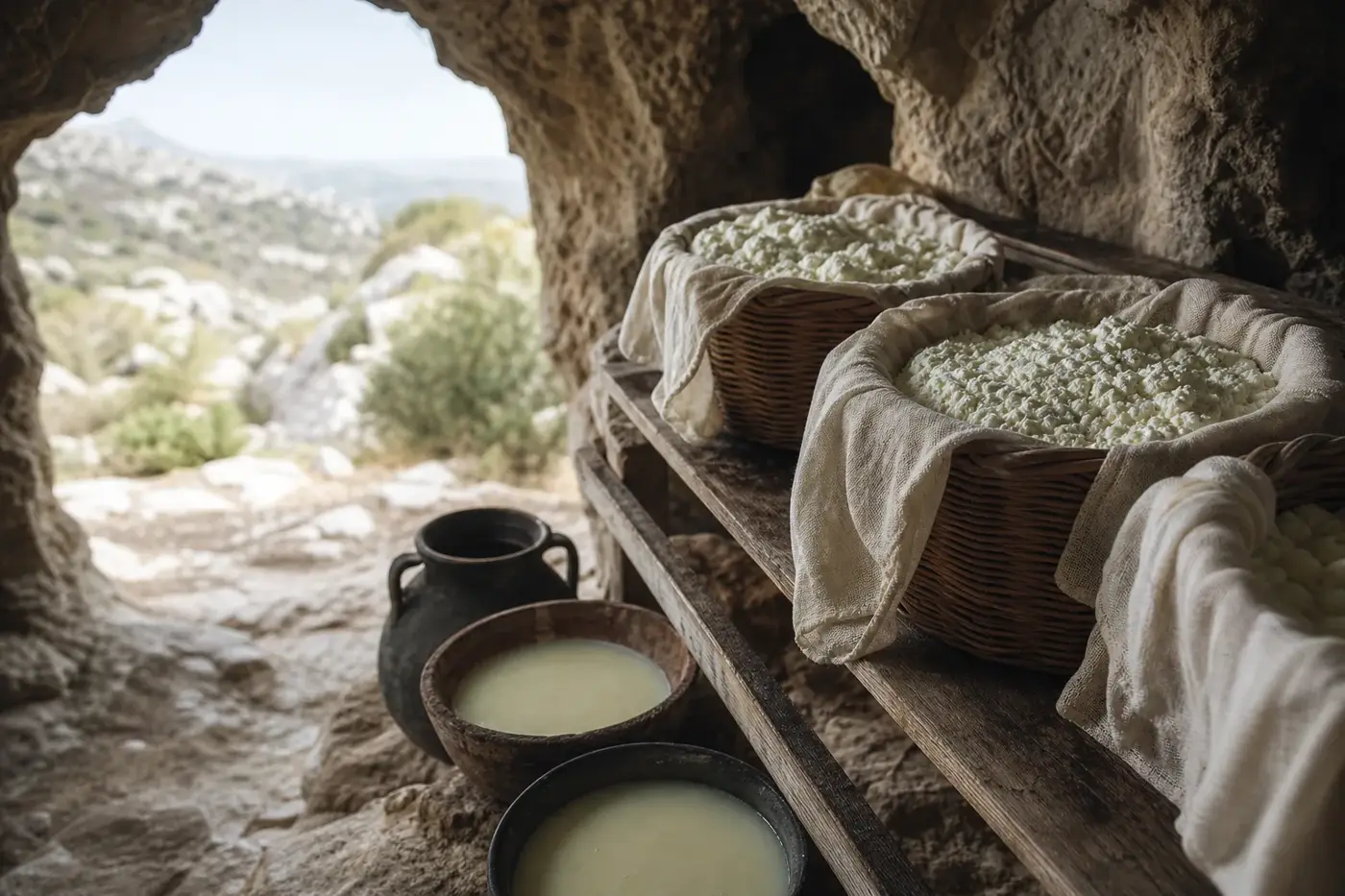
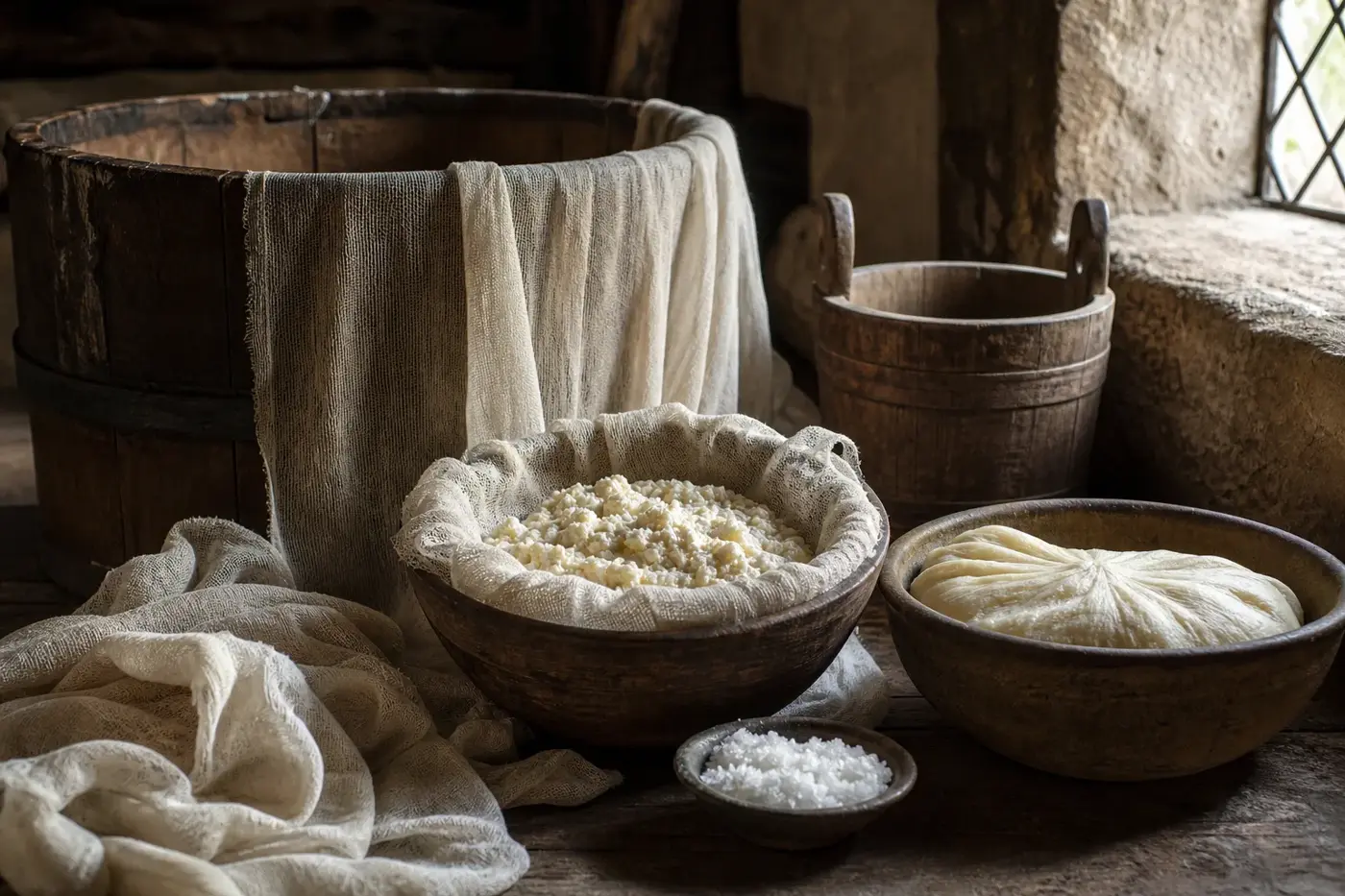
How Cheese Spread Around the World
Whey trickles through holes in a pottery vessel.
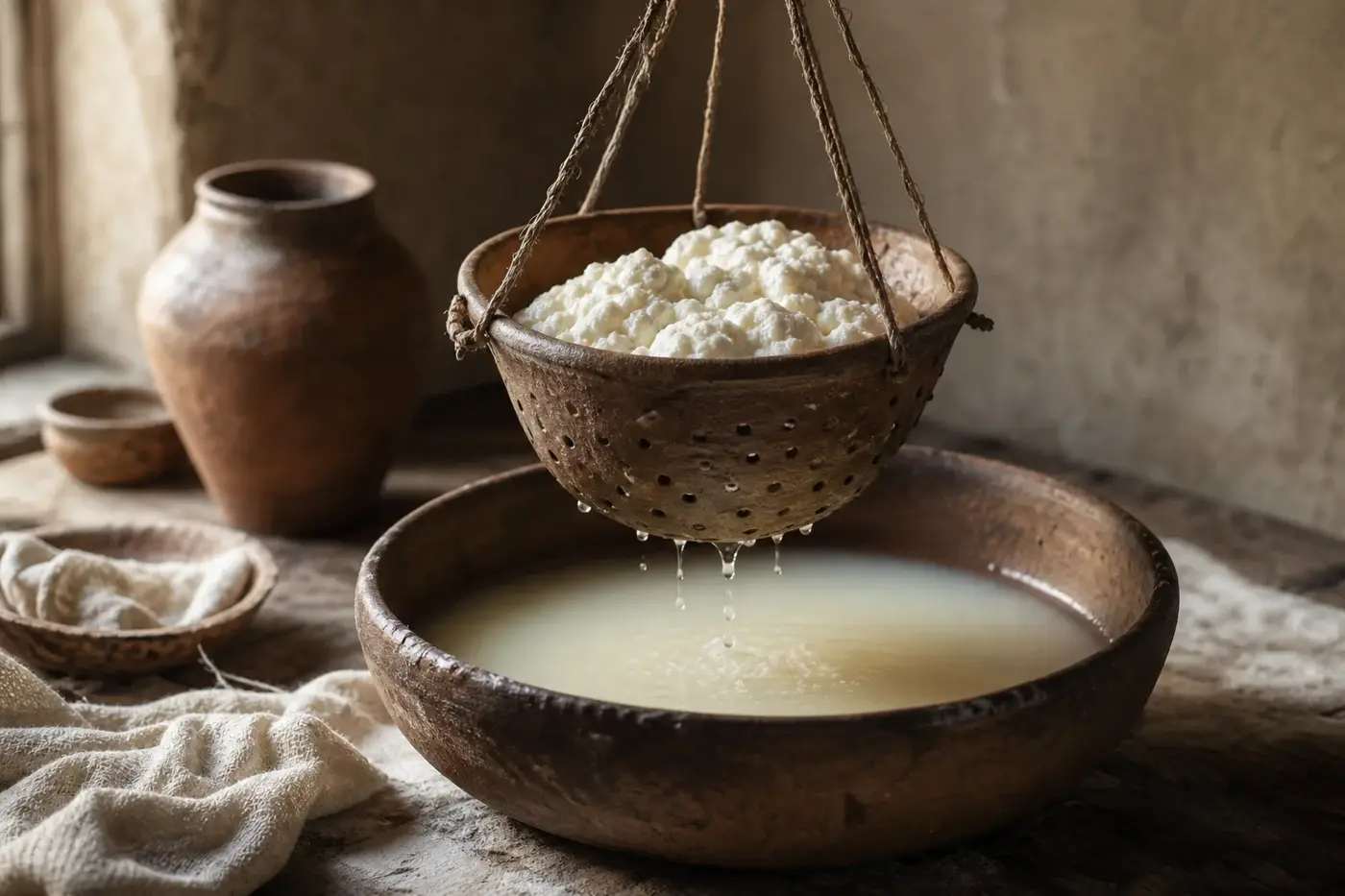
Whey trickles through holes in a pottery vessel. The curds stay behind. In sixth-millennium BCE Kuyavia, in present-day Poland, that simple separation turned milk into another food. Milk fat surviving in those vessels gives you a glimpse of early cheesemaking.[2]
The knowledge travelled with herders, migrants, merchants and settlers. What they made changed with the animals, landscapes and food cultures they encountered. Follow archaeological residues, Mediterranean accounts of traded cheeses and colonial dairy histories, and you find connected journeys. This is not a single march outwards from a proven birthplace.[1][2][4][5][11]
Follow the milk to the early makers
The trail begins before those strainers. Milk was being used in the seventh millennium BCE, with particularly strong evidence from north-western Anatolia. A 2008 study examined more than 2,200 pottery vessels from the Near East and south-eastern Europe. Carbon isotope measurements of fatty acids distinguished milk fats from other animal fats.[1]
But milk in a pot does not automatically mean cheese. Farmers could heat, ferment or otherwise process it, and surviving fat may not distinguish those activities. Later finds from northern Europe and the Adriatic include vessels associated with separating curds from whey. Curds are the solid part of coagulated milk; whey is its liquid portion.[1][2][3]
Together, these discoveries give you a geographically varied early history, allowing for exchanged techniques and separate local developments. They do not establish how many times cheesemaking was invented. Dating a practice at one site is one thing. Finding its first appearance everywhere demands a different order of evidence.[1][2][3]
The holes that help tell the story
Sometimes, the pot tells you as much as its contents. In Kuyavia, researchers found milk fat inside perforated pottery from the sixth millennium BCE. The holes let liquid drain while retaining curds, making a stronger case for cheesemaking than the same residue in an ordinary cooking pot. The study appeared online in December 2012 and in a 2013 journal volume.[2]
On Croatia's Dalmatian coast, a 2018 investigation examined 47 potsherds from Pokrovnik and Danilo Bitinj using molecular and carbon isotope analysis. Researchers identified milk use around 5700 BCE. They interpreted residues in distinctive vessels and sieves from around 5200 BCE as evidence of cheese or other fermented dairy processing.[3]
Keep that distinction handy when you meet a claim about the “oldest cheese”. An animal bone, a dairy fat residue and a strainer containing milk fat answer different questions. The method matters because it determines what the evidence can establish.[1][2][3]
Pack cheese with the Greeks, shop with the Romans
Even a poem can carry cheese. Earlier Greek writing preserved by Athenaeus in Book XIV of the Deipnosophistae mentions Sicilian cheese and goat's milk cheese from Tromilea in Achaia. One cited poem describes bringing the latter along: a food known by its origin, travelling beyond the place where it was made. Packing cheese for a journey clearly has a respectable pedigree.[4]
The collection also mentions cheesecakes associated with Syracuse and other Greek communities. You can glimpse regional foods in these references. They cannot, however, establish the routes by which cheesemaking itself spread.[4]
For a clearer picture of trade, turn to Pliny's Natural History. His account names cheeses reaching Rome from Gaul, the Alps, Dalmatia and the Apennines, as well as Bithynia across the sea. He distinguishes cheeses enjoyed fresh from others with different keeping qualities. He also describes smoked goat's milk cheese made in Rome itself.[5]
Rome's appetite reached both nearby producers and distant suppliers. Its imperial market brought their cheeses together without turning every supplying region into a maker of one Roman cheese.[5]
West and Central Asia: saving the spring's milk
In the Syrian account of FAO's 1990 field survey, spring surplus milk became cheese. Milk from dairying regions and the steppe went into several cheeses, whose names could describe their place of origin or physical form. Here, you can follow the pastoral calendar into the marketplace. Cheesemaking carried the season's milk into regional markets.[6][8]
Pull up a chair for Ethiopian ayib
Ethiopian ayib begins with milk that has already been busy. FAO's Ethiopian account describes heating sour milk or buttermilk, separating the whey and collecting the curd. Cheesemaking belongs to a household sequence of fermentation and butter production. It draws further food from milk after another product has been taken.[6]
FAO describes ayib as crumbly and records it alongside injera and chicken sauce, as well as in other preparations. Its place at the table tells you something essential about its identity. A fresh curd can be central to a cuisine without ever becoming a large, aged wheel.[6]
Household work matters as much to this story as ships and armies. Even within eastern Africa, dairy habits differ between pastoral and farming communities, and between households with different access to livestock. FAO's regional dietary study records marked differences within individual countries. Ethiopia's example has its own food history, alongside the continent's many other dairy cultures.[15]
Asian cheeses: a shared beginning, different destinations
Separate curd from whey, and you have a shared beginning, not a predetermined cheese. What happens next produces very different foods. To follow the processes behind those differences, explore how cheese is made.[14]
The Americas: new livestock, distinctly local cheeses
The colonial story involves people as well as livestock. English settlement, Indigenous societies and the arrival of Africans in 1619 all form part of the history described in the National Park Service's account of Jamestown.[10]
In FAO's Latin American survey, you meet fresh and semi-hard farm cheeses, including Brazilian Minas and Chilean chanco and quesillo. Their different regional names and methods show introduced dairying taking root in local food cultures. This was not simply a matter of reproducing one imported tradition.[6][7][9]
Australasia: cattle cross the water
In 1814, Shorthorn cattle reached New Zealand's Bay of Islands from the New South Wales Crown herd, destined for mission stations. Te Ara, New Zealand's national encyclopedia, records that livestock journey from Australia. It also describes the domestic dairying that followed.[11]
Small herds supplied household milk, butter and cheese, with women and children commonly doing the milking. Pasture was established on land cleared from native bush. Look beyond finished cheeses arriving at a port, and you find animals, practical knowledge, family labour and changes to the environment.[11]
The Australian connection also shows you how colonial food routes formed networks. Livestock moved between colonies as well as from Europe. Dairy traditions could take shape through several stages of settlement and adaptation.[11]
Taste the place, see the practicalities
A strainer separated curds from whey; cloth, moulds and presses changed their shape and drainage. Drying produced a different food from a moist curd collected for local cooking. Milk supply set the possibilities. Equipment and the need to preserve food helped decide what emerged.[2][7][14]
Climate made itself felt in the daily work. FAO's Latin American account describes production varying with environmental temperatures, milk quality and the cheesemaker's skill. Without tightly controlled conditions, those factors could influence successive batches. Industrial equipment later gave makers ways to manage some of that variation.[6]
Then there was the meal itself. Dairy's role varied with local diets and whether households kept livestock. The same milk supply could serve different priorities: butter, fresh curd, a cooking ingredient or food stored for another season.[9][15]
Factories, cold ships and a wider world
New Zealand's dairy factories expanded during the 1880s. At first, they used farmhouse methods; larger, steam-driven equipment became established later. Milk from several farms could now enter a common manufacturing system. Work shifted from individual households into organised processing.[12]
Refrigeration brought distant consumers within reach of that production. Te Ara dates the expansion of refrigerated dairy exports to the early 1880s. Its transport history shows you what a ship needed behind it. Rail connections, refrigerated wagons and storage linked factories with ports and overseas markets.[12][13]
Making cheese and eating it could now happen far apart. A distant market could shape a dairy region's everyday planning, while central processing and transport supported a more organised supply. The route from farm to table depended on infrastructure earlier household producers had never needed.[12][13]
Regional farm traditions continued alongside other influences, too. FAO's Latin American account records cheeses related to Italian forms in Argentina, Brazil and Uruguay.[6]
Why cheese became an everyday guest at some tables
Having cheese available has never guaranteed it a daily place on your plate. FAO's regional dietary account describes differences between pastoral and non-pastoral populations. It also distinguishes rural households using their own milk from urban households obtaining dairy products through markets. Access to animals and distribution mattered alongside cultural preference.[15]
Lactose digestion belongs in this story, too. The archaeological studies discuss cheesemaking among early farming populations as a way to separate curds from lactose-containing whey. Processing created a different food from fresh milk. The persistence of lactose digestion into adulthood followed its own complex history.[1][2][3]
But biology alone cannot explain a food culture. These examples include populations with longstanding practices of fermenting, draining or drying milk, alongside others for whom dairy occupied a smaller place in the diet. To understand adoption, look at the particular product. Then consider its place in a meal and the practical means of supplying it.[7][15]
For more on that distinction, read lactose in cheese. If you want to explore the diversity it helped produce, how to tell cheese styles apart gives you a practical vocabulary for comparing milks, textures, rinds and methods.
Where will your cheese curiosity take you next?
- Cheese: The Complete Guide: get to know the main families, ingredients and uses.
- How Cheese Is Made: From Milk to Cheese: follow the transformations behind these historical examples.
Questions people ask
Where was cheese first invented?
The evidence does not establish a single birthplace or show how many times cheesemaking was invented. Discoveries point to a geographically varied early history, with both exchanged techniques and possible separate local developments.
What is the earliest evidence of cheesemaking?
Perforated pottery containing milk fat from sixth millennium BCE Kuyavia provides evidence of cheesemaking because the holes could drain whey while retaining curds. In Croatia, researchers interpreted residues in vessels and sieves from around 5200 BCE as evidence of cheese or other fermented dairy processing.
How is Ethiopian ayib made?
FAO describes ayib as a crumbly cheese made by heating sour milk or buttermilk, separating the whey and collecting the curd. It records ayib alongside injera and chicken sauce, as well as in other preparations.
How did cheese develop in Latin America?
FAO records fresh and semi hard farm cheeses including Brazilian Minas and Chilean chanco and quesillo. Their regional names and methods show introduced dairying taking root in local food cultures.
How did New Zealand cheese reach distant markets?
New Zealand's dairy factories expanded during the 1880s, and refrigerated dairy exports expanded in the early 1880s. Ships relied on rail connections, refrigerated wagons and storage to link factories with ports and overseas markets.
Sources
- Nature, “Earliest date for milk use in the Near East and southeastern Europe linked to cattle herding”, volume 455, 2008. Original pottery-residue investigation. Retrieved article.
- Nature, “Earliest evidence for cheese making in the sixth millennium bc in northern Europe”, volume 493, 2013; published online 12 December 2012. Original investigation of milk fats in perforated pottery. Retrieved article.
- PLOS ONE, “Fatty acid specific δ13C values reveal earliest Mediterranean cheese production 7,200 years ago”, 2018. Original investigation of Dalmatian pottery residues. Full text.
- Perseus Digital Library, Tufts University, Athenaeus, Deipnosophistae, Book XIV, English translation, digital edition. Ancient literary evidence for regional cheeses and preparations. Retrieved text.
- University of Chicago, Pliny, Natural History, Book XI, chapter XLII in the 1601 English translation, digital edition. Ancient account of cheeses reaching Rome. Retrieved text.
- Food and Agriculture Organization of the United Nations, The technology of traditional milk products in developing countries, Animal Production and Health Paper 85, 1990, Part A, “Cheese and cheese products”. Retrieved chapter.
- Food and Agriculture Organization of the United Nations, the same publication, 1990, Part B, cheese catalogue covering Asian and Latin American products. Retrieved catalogue. Entry-level verification remains outstanding, as recorded below.
- Food and Agriculture Organization of the United Nations, the same publication, 1990, Part B, Near Eastern cheese catalogue. Retrieved catalogue. Entry-level verification remains outstanding, as recorded below.
- Food and Agriculture Organization of the United Nations, the same publication, 1990, Part A, “Milk as a raw material”. Retrieved chapter. Passage-level verification remains outstanding, as recorded below.
- US National Park Service, “History & Culture”, Historic Jamestowne, updated 1 November 2021. Official interpretation of colonial settlement and forced migration, rather than a dairy-specific historical record. Retrieved page.
- Manatū Taonga, Ministry for Culture and Heritage, Te Ara, “Dairying and dairy products: Beginnings of New Zealand’s dairy industry”, 2009. Retrieved page.
- Manatū Taonga, Ministry for Culture and Heritage, Te Ara, “Dairying and dairy products: Expansion of dairying”, 2009. Retrieved page.
- Manatū Taonga, Ministry for Culture and Heritage, Te Ara, “Dairying and dairy products: Cooperatives and centralisation”, 2009. Retrieved page.
- John Wiley & Sons, “History of Whey Production and Whey Protein Manufacturing”, in Whey Protein Production, Chemistry, Functionality, and Applications, first edition, 2019. Retrieved publisher excerpt.
- Food and Agriculture Organization of the United Nations, The technology of traditional milk products in developing countries, Animal Production and Health Paper 85, 1990, Part A, “Nutritional importance of traditional milk products in the national diet”. Used for historical dietary context, not medical advice. Retrieved chapter.
This desk-researched draft combines original archaeological studies, ancient texts, regional dairy surveys and official historical accounts; the evidence log identifies the research still required before publication.
Last checked: November 2026
Last checked November 2026.
The editors suggest you read next
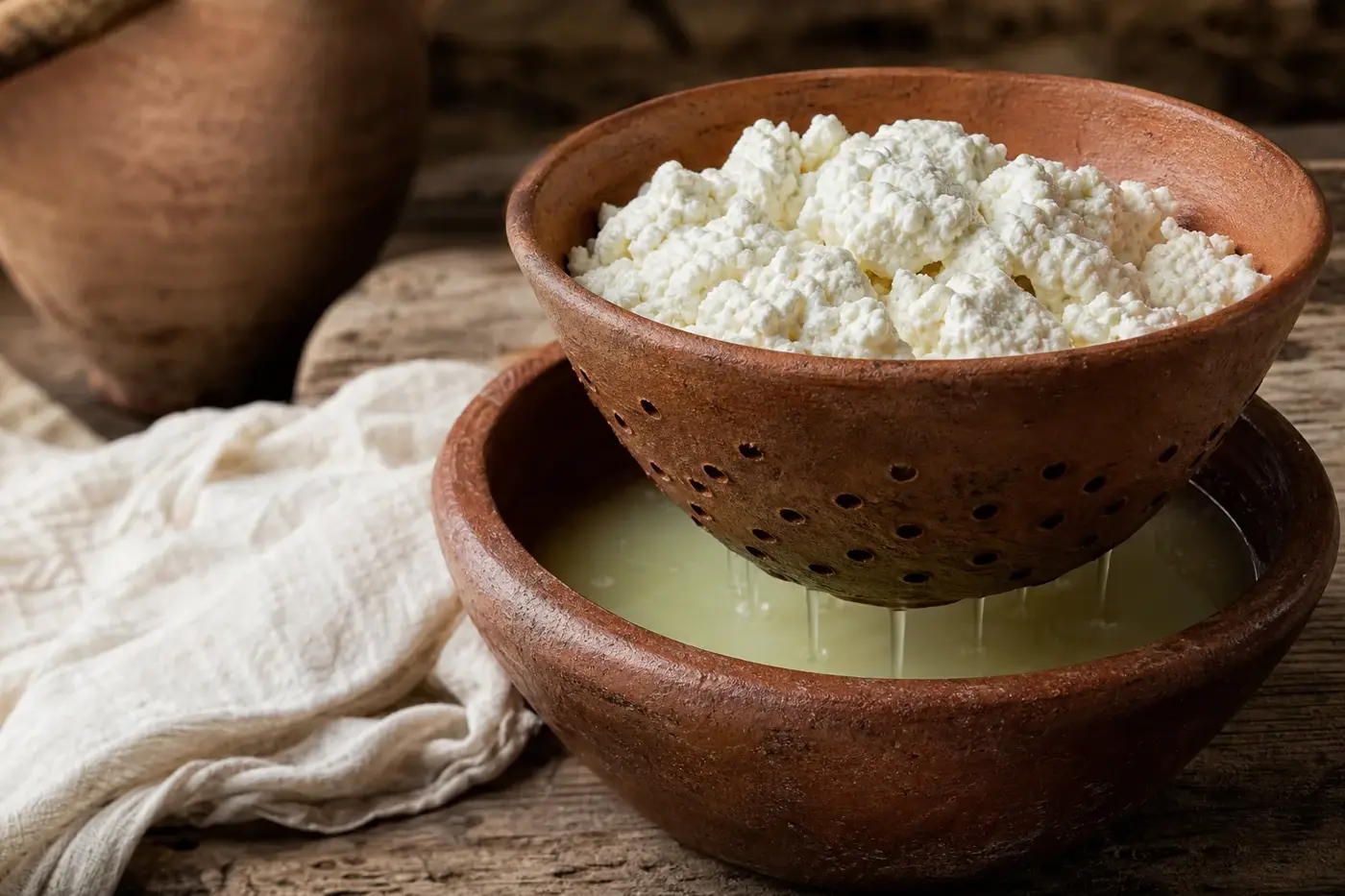
A History of Cheese: From the First Curds to Global Food
Picture cheese lying beside Bronze Age burials in China's Tarim Basin, surviving for approximately 3,500 years.