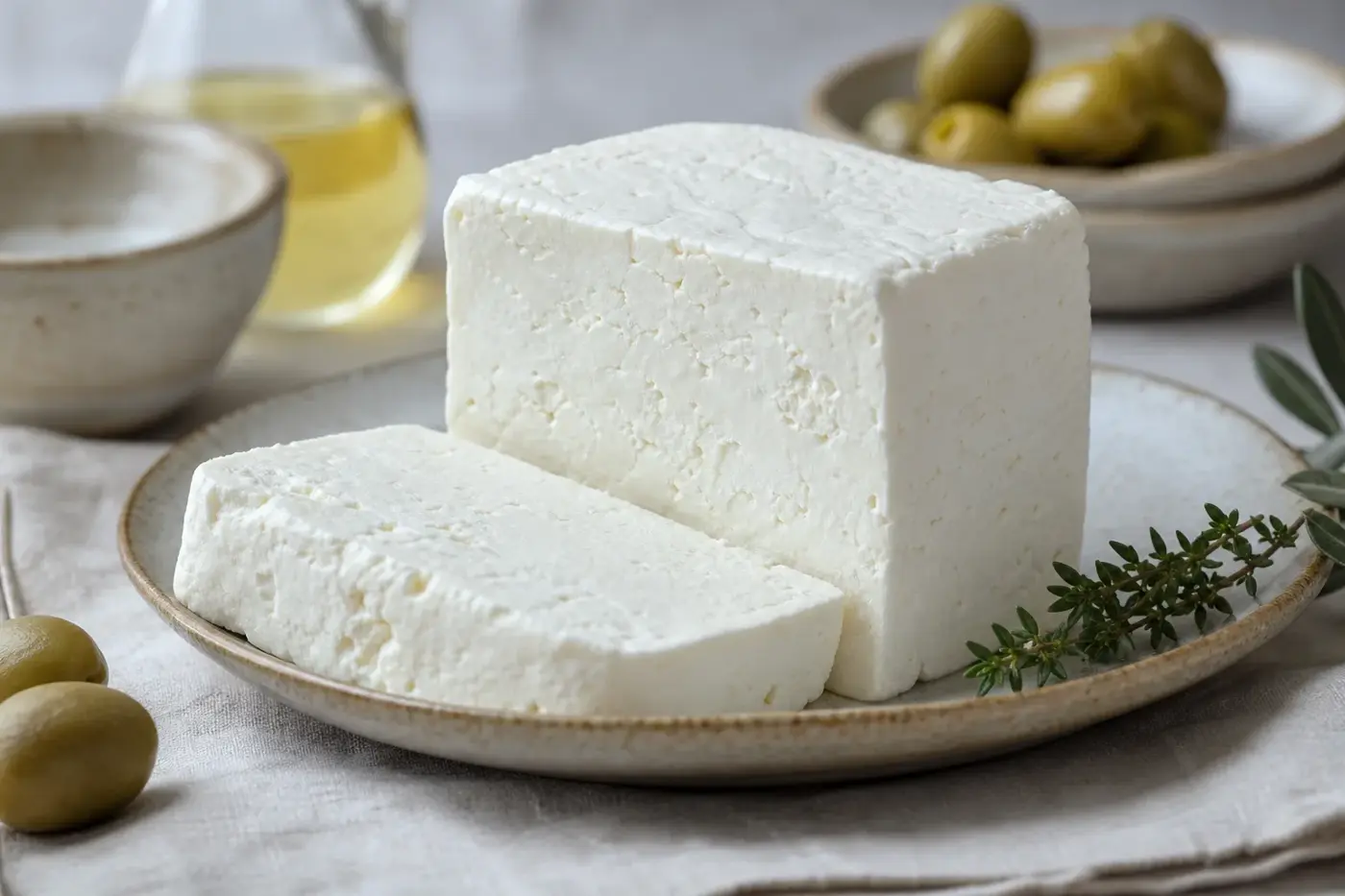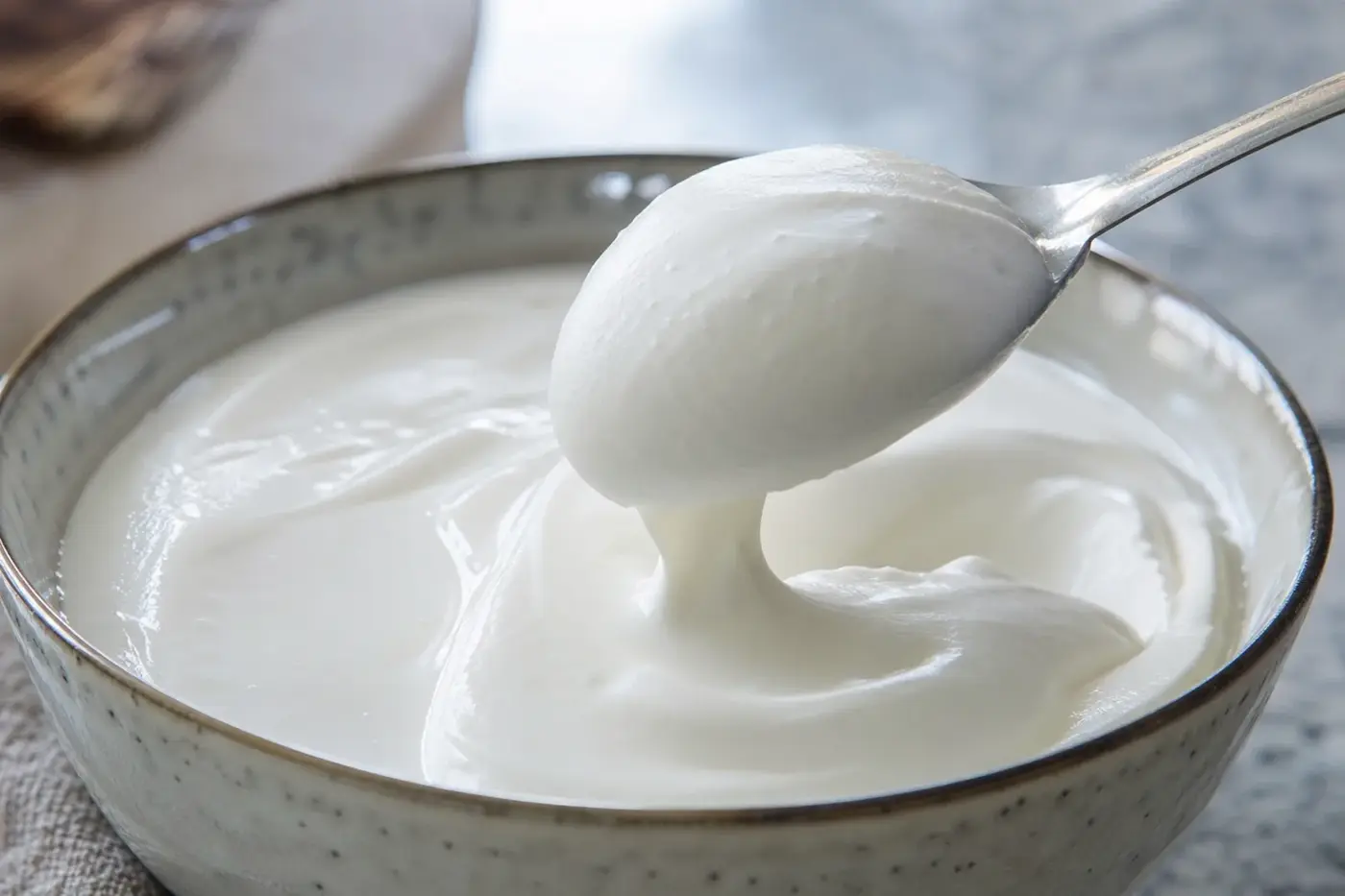
Your spoon slips into a tub of pure white Katiki Domokou. Forget the neat slice: this rindless fresh cheese from Domokos in central Greece has other plans for your cutlery. Local goat's milk, alone or mixed with sheep's milk, becomes curd, drains in cloth bags and is mixed until spreadable. The promised flavour is slightly acidic and refreshing. [1,2]
Follow your spoon back to Domokos
Behind that white spoonful is Domokos, an area of mainland central Greece associated with Mount Othrys. Both the milk and the cheesemaking must belong here. The specification names locally adapted sheep and goat breeds, fed on the area's vegetation, whose milk must come from within the defined production zone. [2]
That gives the name its substance: farms, local milk and a particular way of making cheese. When you choose a tub, begin with that sense of place. Then let the individual producer's label tell you about the milk mixture and how to handle the finished cheese.
A Greek name with a home of its own
PDO means protected designation of origin, and the place matters as much as the method. Katiki Domokou's milk production and cheesemaking must happen within the Domokos zone defined in the Greek specification. The administrative boundaries and annex referenced there set the limits; milk from elsewhere, or cheese made outside that area, does not qualify. [2]
The European registration appears in Commission Regulation (EC) No 1107/96, published on 21 June 1996. The Greek agriculture ministry's June 2026 list continues to include Katiki Domokou among PDO cheeses. Great Britain records its separate UK scheme registration from 31 December 2020 at 23:00. [1,3,4]
Those systems protect the name in different territories: the UK scheme in Great Britain, and the EU scheme in the EU and Northern Ireland. A geographical indication belongs to the qualifying product and its verified producers, rather than a single brand. You can explore how origin protection differs from a trade mark in protected names explained. [5]
Goat's milk takes the lead
Goat's milk is essential to Katiki Domokou; sheep's milk may join it. The specification allows goat's milk alone or mixed with sheep's milk, without prescribing a percentage for either species in the mixture. Cow's milk falls outside the definition, so your tub's ingredients list is the place to find its particular combination. [2]
That declaration gives you a useful starting point when comparing producers. It tells you whether sheep's milk contributes, while draining and mixing also help shape the finished texture. Read the milk species alongside the consistency and the maker's description: a shared name need not mean an identical mouthful.
Inside the cloth bags
There is no wheel, but there is a carefully described method behind that softness. The milk is heated to approximately 75 °C for 30 seconds, then cooled to 27 to 28 °C. It is left to form curd, the soft mass that separates from liquid whey, with or without rennet, an enzyme preparation that helps milk coagulate. [2]
Acidification is central to this family of fresh, spreadable cheeses. Salt has a particular place in the proceedings, too. The EU's comparison of Greek spreadable cheeses singles out Katiki's timing: salt goes in after the whey has drained, rather than earlier in production. [6]
The curd is broken down and placed in cloth bags to drain. Once drained, it is salted, mixed into a homogeneous mass and packed in containers. You get no wheel to cut and no rind to develop, just the cheese in its spreadable form. [2]
Keep two details in mind when you read a label or talk to a maker. Incoming milk may be raw or pasteurised, although the stated method includes the heating stage above. Rennet is optional, so if the coagulant affects your choice, ask what that particular producer uses. [2]
Give the first spoonful a moment
Pure white, pleasantly aromatic and gently tangy: the specification paints a picture of freshness. You should expect no rind, a spreadable consistency and a slightly acidic, refreshing flavour. The interest is in the fresh cheese itself, rather than the developed rind aromas of a ripened wheel. [2]
Give it room on your plate. Spread it generously over bread as the main topping, or tuck smaller spoonfuls among vegetables so each mouthful gets a little cheese. When comparing producers, taste your first serving plain; the herbs and oil can wait their turn.
A little reading before the first mouthful
Start with the full name, Katiki Domokou or Κατίκι Δομοκού, the PDO designation and a clearly identified producer or packer. The specification requires packaging to carry the name, designation, producer or packer details, contents weight, production date and control information. For once, reading the small print is part of looking forward to lunch. [2]
Next come the details you need in your kitchen: milk declaration, storage temperature, date marking and instructions after opening. Buy an amount you can finish within those instructions. If your portion comes from a larger container, ask the seller for the relevant label information, especially storage and use guidance, rather than leaving it with the original pack.
Bring bread, vegetables and herbs to the table
Set out bread, a small bowl of cheese and vegetables separately, and you have a simple starting point. Try cucumber, tomatoes or roasted peppers, with chopped dill, mint or oregano alongside. These are serving suggestions, not a prescribed traditional local recipe: you are giving the cheese space and everyone a choice of accompaniments.
For something more substantial, spoon Katiki Domokou beside roasted courgettes or aubergines. Or spread it inside bread before adding vegetables. Taste the assembled dish before reaching for lemon, oil or extra salt, keeping those additions separate at first so you can adjust each serving without overwhelming the cheese or seasoning the whole dish alike.
Let softness do the cooking work
Think soft fillings and generous toppings: a vegetable tart, baked potatoes or a cooked vegetable dish finished with a spoonful of cheese. For a tart, choose an established recipe written for a fresh spreadable cheese and follow its quantities and cooking instructions. Check the filling's consistency before assembly, remembering that a substitution changes the recipe.
Katiki Domokou suits those jobs better than a recipe that needs tidy cubes to hold their shape. Your simplest first experiment is a baked potato. Add a spoonful at serving and discover how it works as a topping, without having to rethink an entire recipe around it.
Find your favourite among Katiki, Feta, Galotyri and Kopanisti
Reach for Feta when you want to crumble, and Katiki Domokou when you want to spread or spoon. That everyday distinction can tell you more than their shared appearance as white Greek cheeses. Begin with what your dish needs, rather than assuming one can always stand in for another.
Galotyri is closer in texture: the EU's published comparison groups it with Katiki by consistency, but separates them by salting method. Galotyri's salt goes into the milk after acidification begins; Katiki's goes in after draining. Kopanisti offers another direction, with a specification describing a spreadable cheese whose notably pungent, peppery character develops through ripening. Choose for strength as well as consistency. [6,7]
Make room in the fridge
Keep your fridge at 0 to 5 °C and follow the pack's storage instructions, advises the FSA in England, Northern Ireland and Wales. If the cheese's label gives a lower temperature, use that. During preparation, keep chilled food out of the fridge for the shortest possible time; the FSA states a maximum of four hours. [8]
Once opened, the tub's stated use period matters alongside its printed date. UK government guidance distinguishes use-by dates, which concern safety, from best before dates, which concern quality. Incorrect storage can make food unsafe before its use-by date. For the rest of your kitchen routine, see how to store cheese at home. [9]
This page summarises published guidance from the official sources it cites. It is not medical advice. Guidance differs between countries and changes over time, so check the current source for where you live, and ask your doctor, midwife, pharmacist or dietitian about your own circumstances.
Milk allergy and pregnancy: know the guidance
Katiki Domokou contains milk, one of the regulated allergens identified by the FSA. Read the label or ask the food business about ingredients relevant to your allergy, including those in the accompaniments. Discuss your own suitability with your clinician. [11]
For pregnancy, the NHS says you can eat pasteurised soft cheeses, including goats' cheese without a white coating on the outside. Its advice distinguishes other cheeses by type, milk treatment and cooking. The UK guidance here is dated November 2026; consult the current advice and ask your midwife about your circumstances. [10]
If you live outside the UK, remember that the November 2026 guidance here concerns NHS advice. Use your own national agency's pregnancy guidance instead. Take the product label with you when asking a health professional about a particular cheese. [10]
Questions people ask
Where does Katiki Domokou come from?
It comes from the defined Domokos area of central Greece, associated with Mount Othrys. Both the milk production and cheesemaking must take place within that area.
What milk is used in Katiki Domokou?
It is made from goat's milk alone or mixed with sheep's milk. The specification does not prescribe proportions for a mixture, and cow's milk is outside the definition.
Is Katiki Domokou made with rennet?
Rennet is optional in the specified method. If the coagulant affects your choice, ask the producer what is used in the particular product.
Can I eat Katiki Domokou during pregnancy?
The NHS says pasteurised soft cheeses, including goats' cheese without a white coating on the outside, can be eaten. Consult the current NHS advice at https://www.nhs.uk/pregnancy/keeping-well/foods-to-avoid/ and ask your midwife about your circumstances.
How should I store Katiki Domokou?
The FSA advises keeping the fridge at 0 to 5 °C and following the pack's storage instructions. Once opened, observe the stated use period as well as the printed date.
Sources
-
Greek Ministry of Rural Development and Food. Τυριά [Cheeses], official list of registered Greek names dated 8 June 2026, entry 8, Κατίκι Δομοκού. Official ministry list.
-
Hellenic Republic, Ministry of Agriculture. Ministerial Decision 313048/14.01.1994, recognition of Katiki Domokou as a protected designation of origin. Government Gazette, Series B, No 16, 1994, Articles 1 to 5. Official gazette text.
-
Department for Environment, Food & Rural Affairs. Κατίκι Δομοκού / Katiki Domokou, protected food name register entry, published 4 January 2021. Great Britain register entry.
-
European Commission. Commission Regulation (EC) No 1107/96, adopted 12 June 1996, published in Official Journal L 148, 21 June 1996, Annex, Greek cheeses. Official Journal copy hosted by the Greek ministry.
-
Department for Environment, Food & Rural Affairs. Protected geographical food and drink names: UK GI schemes, updated 8 March 2024. Official scheme guidance.
-
European Commission. Publication of an application pursuant to Article 6(2) of Council Regulation (EC) No 510/2006, Xygalo Siteias / Xigalo Siteias, Official Journal C 312, 17 November 2010, section 5.2, comparison with other spreadable cheeses. Official published document. )
-
Greek Ministry of Rural Development and Food. Κοπανιστή: Προστατευόμενη ονομασία προέλευσης, προδιαγραφές [Kopanisti PDO specification], undated document linked from the ministry's current cheese list, sections 2 and 5. Official specification.
-
Food Standards Agency. How to chill, freeze and defrost food safely, published 18 December 2017, current online text retrieved November 2026, section 1. Applies to England, Northern Ireland and Wales. Official chilling guidance.
-
UK Government. Understanding food labelling: Best before and use-by dates, current online edition retrieved November 2026. Official date-marking guidance.
-
NHS. Foods to avoid in pregnancy, current online edition retrieved November 2026, “Cheese, milk and other dairy”. UK pregnancy guidance.
-
Food Standards Agency. Food allergy and intolerance advice for consumers, updated 7 August 2026, sections on regulated allergens and consumer information. Applies to England, Northern Ireland and Wales. Official allergen guidance.
-
Food Standards Agency, Alerts, current listing; Hellenic Food Authority, Ανακλήσεις [Recalls], current listing. Retrieved November 2026 for editorial screening. FSA alerts; Greek recall notices.
-
Municipality of Domokos. Κατίκι Δομοκού, undated municipal account, retrieved search extract, November 2026. Municipal cheese account.
Research used official Greek production rules, published European documents, the Great Britain register and national consumer guidance, with serving suggestions identified as editorial recommendations.
Last checked: November 2026
Last checked November 2026.
The editors suggest you read next