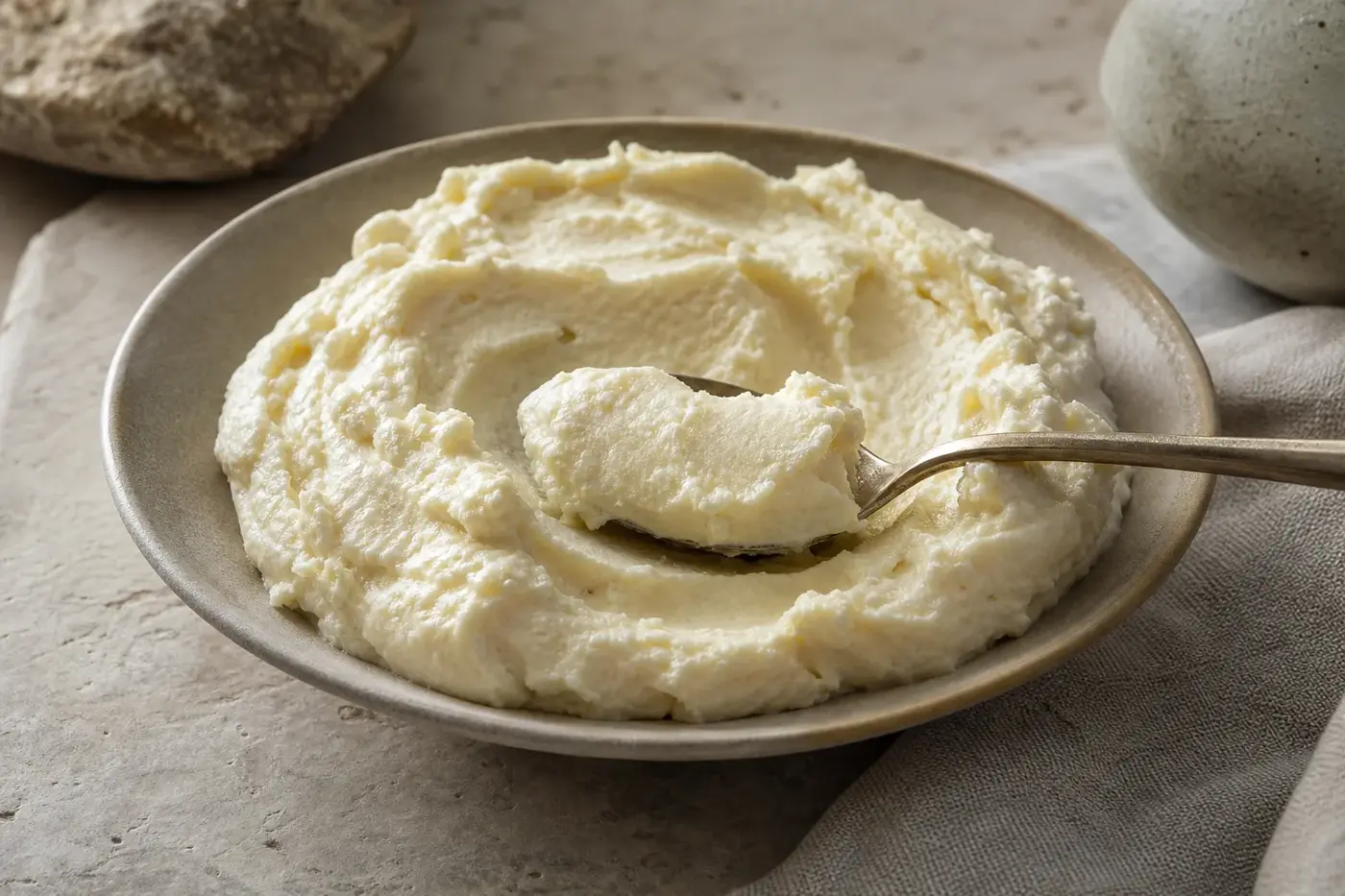
Knead the curd. Let it ripen. Then knead it again. Kopanisti’s peppery force takes repeated work, but not a dose of chilli.
Scoop a little and you meet a soft, spreadable, pungent cheese from Greece’s Cycladic islands. Its heat develops through microbial maturation, as proteins and fats break down. The maker works that transformation through the whole cheese, not just its surface. Your spoonful has had quite a workout. [1,3,4]
| What you want to know | The detail |
|---|---|
| Name you’ll recognise | Kopanisti [1] |
| Registered name | Κοπανιστή (Kopanisti) [2] |
| EU registration record | Commission Regulation (EC) No 1107/96; specification amendment approved by Regulation (EU) No 433/2013 [2] |
| Legally defined home | Cyclades, Greece [1] |
| Milk used | Cow, sheep or goat, separately or mixed [1] |
| Texture and rind | Soft, spreadable; rindless [1] |
| Published composition limits | Maximum whole-cheese moisture 56%; minimum fat in dry matter 43% [1] |
| UK pregnancy guidance | NHS, November 2026 [6] |
Follow Kopanisti beyond Mykonos
Mykonos is part of Kopanisti’s story, but it does not have the stage to itself. This cheese belongs to the Cyclades, the Aegean island group that includes Mykonos. Greece’s 1994 recognition decision drew the boundary precisely: milk exclusively from the Cyclades, with production and maturation there too. For today’s requirements, turn to the current specification. [1]
The EU’s 2013 amendment regulation identifies Κοπανιστή (Kopanisti) as a PDO, a protected designation of origin, registered under Regulation (EC) No 1107/96. When you compare jars, ask which island and dairy produced each one. Those details bring the cheese’s home into focus, rather than casting every Kopanisti as the product of a single island. [2]
Meet the milk in your spoonful
Cow’s, sheep’s and goat’s milk all have a place in the Greek recognition text, alone or mixed. Its sourcing provisions connect the animals to locally adapted breeds, traditional rearing and the area’s vegetation. A jar made entirely from cow’s milk and one made from a blend can both belong to Kopanisti’s documented tradition. [1]
Ask which milks went into the cheese in front of you. Do their proportions change with the season, and how does the maker describe the texture? Start with that particular batch. The milk mixture alone cannot tell you exactly how your cheese will feel or taste.
Cloth bags, salt and the maker’s hands
Before the kneading comes the curd. Coagulation sets the milk, separating solid curd from liquid whey. The Greek production text then describes draining in cloth bags, dry salting and transfer to a broad container. During ripening, the maker repeatedly mixes the microbial growth from the surface through the paste. [1]
Here, the outer layer does not ripen quietly on its own. The cheesemaker redistributes that ripening community, bringing the whole mass into the transformation. The original Greek text describes several repetitions over 30 to 40 days. Kneading is central to the work, not a finishing flourish. [1]
Some traditional makers also add mature Kopanisti, known as mana, to a fresh batch. Mana carries ripening organisms from an established cheese into another batch; it is not an added spice. A published experimental study investigated this practice alongside selected bacterial cultures. For the bigger journey from milk to finished cheese, see how cheese is made. [3]
Where that peppery heat begins
That peppery sensation starts with changes in proteins and fats. Proteolysis means the breakdown of proteins; lipolysis means the breakdown of fats. The abstract of a 1990 study reports extensive changes in both as Kopanisti matured. Researchers observed its characteristic peppery taste developing alongside a strong release of free fatty acids. [4]
A later study compared four experimental cheeses made with pasteurised cow’s milk and different culture combinations, including one containing mana. Microbial sequencing, chemical measurements and sensory assessment showed that the inoculation scheme influenced their development. Bacteria and yeasts formed changing communities, rather than one organism doing every flavour job. The experimental batches were assessed through day 35. [3]
Keep that changing picture in mind when you taste. Notice the saltiness, the way the texture coats your mouth, the aroma and the lingering pungent finish separately. Ask your monger how this batch compares with the maker’s usual cheese. Two pots can both be peppery without giving you exactly the same experience. [3,4]
Put down the knife and reach for a spoon
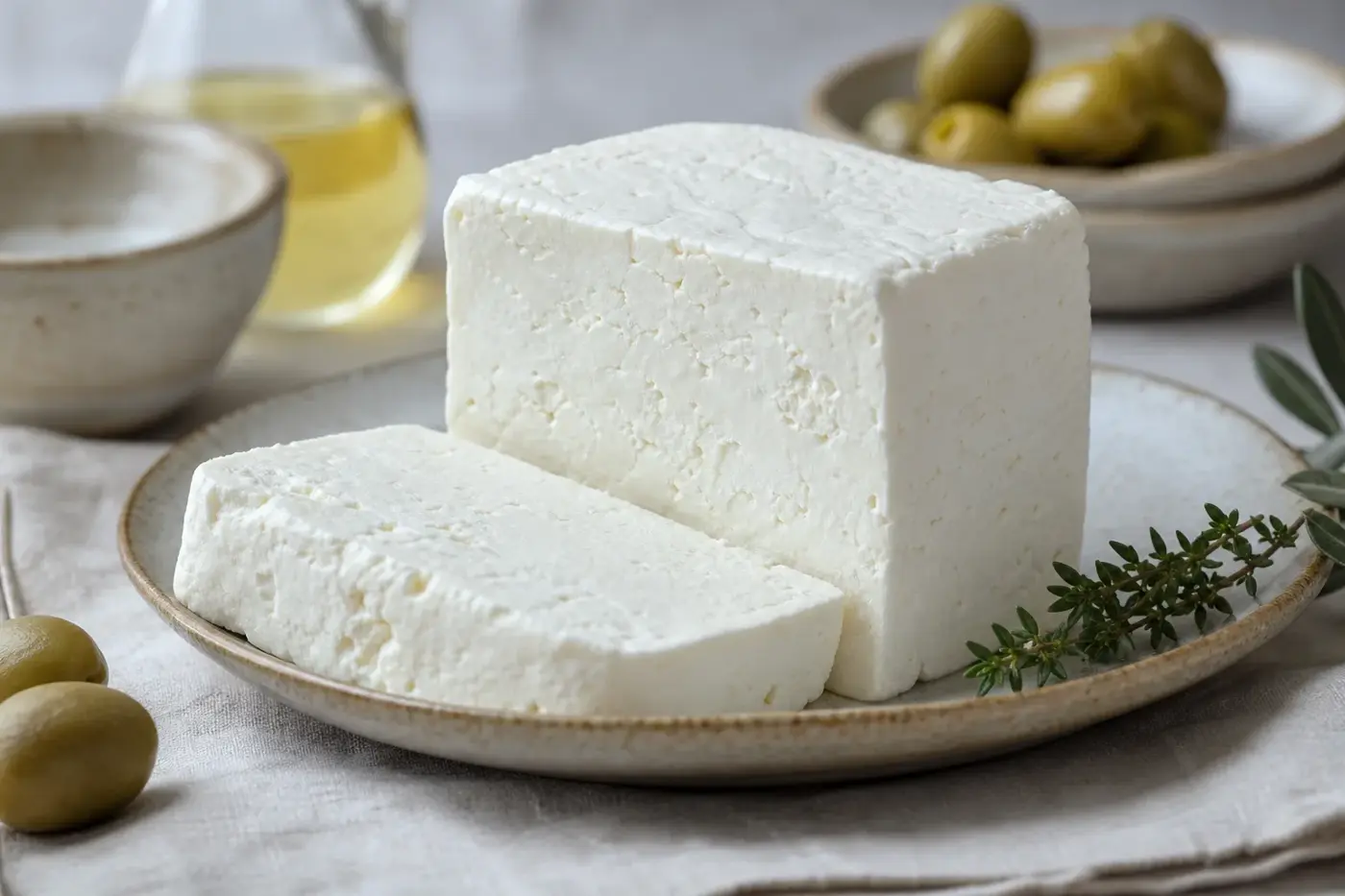
Forget neat wedges for a moment. The Greek recognition text describes Kopanisti as soft, spreadable and rindless, with colour ranging from pale yellow towards greyish tones. Its taste is distinctly salty and pungent. Modern experimental research also identifies good spreadability as part of its expected character: this is cheese for scooping and spreading. [1,3]
“Peppery” describes the sensation, not a requirement for pepper or chilli. The ripening study demonstrates that this character develops as the cheese matures. If you are buying a prepared cheese spread, read the ingredients: chilli, peppers and other additions belong to that spread’s recipe. For Kopanisti itself, look first to maturation to understand the flavour. [4]
Get to know the jar before you buy
Start with Κοπανιστή or Kopanisti, the producer’s identity and a clear PDO description. Buying a portion from a larger container? Ask to see the original label. A name, maker and batch tell you more than a handwritten “spicy Greek cheese”; the historical Greek labelling provisions specifically identify the cheese and its producer-packer. [1]
Keep your questions direct. Which island made it, and which milk or blend went into this batch? What milk treatment does the producer declare, and when was it packed? Ask for storage and after-opening instructions too; milk treatments explained and how to read a cheese label can help you interpret the answers.
Bread, tomato and a seat at the Mykonos table
Bread or a rusk, ripe tomato and olive oil give Kopanisti a simple setting. Start with a restrained layer of cheese. You want the bread and tomato to have their say. Kopanisti is not a shy dinner guest.
Spread a little cheese on the bread or rusk, add chopped ripe tomato and finish with olive oil. Taste before you add salt. Put extra cheese alongside so each person can choose the strength of their next mouthful.
For a gentler balance, leave cucumber, plain bread and additional tomato on the plate. You need not make the serving more complicated. Just change the amount of Kopanisti to suit your taste.
Find good company for that pungency
Try cool water alongside your first taste. Unsweetened iced tea or sparkling water with lemon are other suggestions. Give yourself a moment to consider the cheese before deciding what should accompany it.
Build your plate around contrast: a little sweet fruit, something fresh and watery, and a plain starch to carry the cheese. Try ripe pear or grapes beside tomato and cucumber. Keep strongly seasoned chutneys separate at first, then adjust the proportions after tasting. Start with the cheese rather than committing the whole plate to one combination; for broader principles, see cheese and wine pairing.
Keep the pot cold and serve a little at a time
Follow the product’s storage instructions and keep Kopanisti refrigerated. For England, Wales and Northern Ireland, the Food Standards Agency advises a home fridge temperature between 0 and 5 °C (32 to 41 °F). It also advises keeping chilled food out for the shortest possible time during preparation, with a maximum of four hours. That is the agency’s preparation limit. [5]
Take out a small serving and leave the main container chilled. Replenish only as needed, within the producer’s instructions. Use a clean utensil, then close the container after taking your portion. Observe the labelled use-by date and any shorter after-opening instruction; for loose cheese, get those details from the seller when you buy it. [5]
Have your bread and tomato ready before spooning out a small portion straight from the fridge. Keep its journey to the table brief, and take only what you intend to eat rather than repeatedly warming the whole pot. This keeps the serving manageable and the remainder properly chilled. For packaging and fridge organisation, see how to store cheese at home. [5]
This page summarises published guidance from the official sources it cites. It is not medical advice. Guidance differs between countries and changes over time, so check the current source for where you live, and ask your doctor, midwife, pharmacist or dietitian about your own circumstances.
Pregnant? Let the product details guide your questions
For pregnancy advice in the UK, start with the NHS guidance on cheese, milk and other dairy products. It distinguishes cheeses by type and milk treatment. The details of the actual product therefore matter, not just the name on the pot. [6]
Ask the seller for those details, then consult the current NHS pregnancy guidance for the UK or the official agency where you live. Talk to your midwife or doctor about your circumstances, especially if the milk treatment or ripening category is unclear. The product information helps make that conversation specific. [6]
Questions people ask
Where does Kopanisti come from?
Kopanisti comes from the Cyclades, the Greek island group that includes Mykonos. Its documented origin covers the islands, not just Mykonos.
What milk is Kopanisti made from?
The Greek recognition text lists cow’s, sheep’s and goat’s milk, used separately or mixed. Ask the producer which milk or blend is in the batch you are buying.
Does Kopanisti contain chilli?
Kopanisti’s peppery character develops as it matures and does not require chilli. A prepared cheese spread may have chilli or peppers added, so check its ingredients.
How do you serve Kopanisti?
Spread a little on bread or a rusk, add chopped ripe tomato and finish with olive oil. Extra cheese can be served alongside so each person can adjust the strength.
Can you eat Kopanisti during pregnancy?
The NHS distinguishes cheeses by type and milk treatment in its pregnancy guidance. Check the product details and consult the current NHS guidance at https://www.nhs.uk/pregnancy/keeping-well/foods-to-avoid/ or the official agency where you live. Ask your midwife or doctor about your circumstances, especially if the milk treatment or ripening category is unclear.
Sources
- Greek Ministry of Agriculture, Ministerial Decision No. 313046, Recognition of Protected Designation of Origin (P.D.O.) for the Cheese “KOPANISTI”, 1994. Greek Government Gazette, issue 16, 14 January 1994, reproduced in WIPO Lex. Historical recognition text, including Articles 1 to 5.
- European Commission, Commission Implementing Regulation (EU) No 433/2013 of 7 May 2013 approving non-minor amendments to the specification for a name entered in the register of protected designations of origin and protected geographical indications (Κοπανιστή (Kopanisti) (PDO)), 2013. Official Journal text.
- Agricultural University of Athens research team, The Impact of Different Inoculation Schemes on the Microbiota, Physicochemical and Sensory Characteristics of Greek Kopanisti Cheese throughout Production and Ripening, Microorganisms, volume 11, article 66, published 26 December 2022, January 2023 issue. Open-access research article.
- Agricultural University of Athens and University of Thessaloniki research team, Ripening changes in Kopanisti cheese, Journal of Dairy Research, volume 57, issue 2, pages 271 to 279, May 1990. Publisher’s abstract and bibliographic record.
- Food Standards Agency, How to chill, freeze and defrost food safely, published 18 December 2017, live guidance retrieved November 2026. Applies to England, Northern Ireland and Wales. Official guidance.
- NHS, Foods to avoid in pregnancy, live guidance retrieved November 2026, section “Cheese, milk and other dairy”. Official guidance.
- Cyclades.travel, Best Cheese Tasting and Making Experiences in Mykonos, 2026, retrieved search excerpt describing mostra. Published travel account. Full-page and local primary-source confirmation remain editorial checks.
Researched through historical official recognition and amendment records, original cheese-ripening research, current UK agency guidance and a published account of Mykonos serving customs.
Last checked: November 2026
Last checked November 2026.
The editors suggest you read next