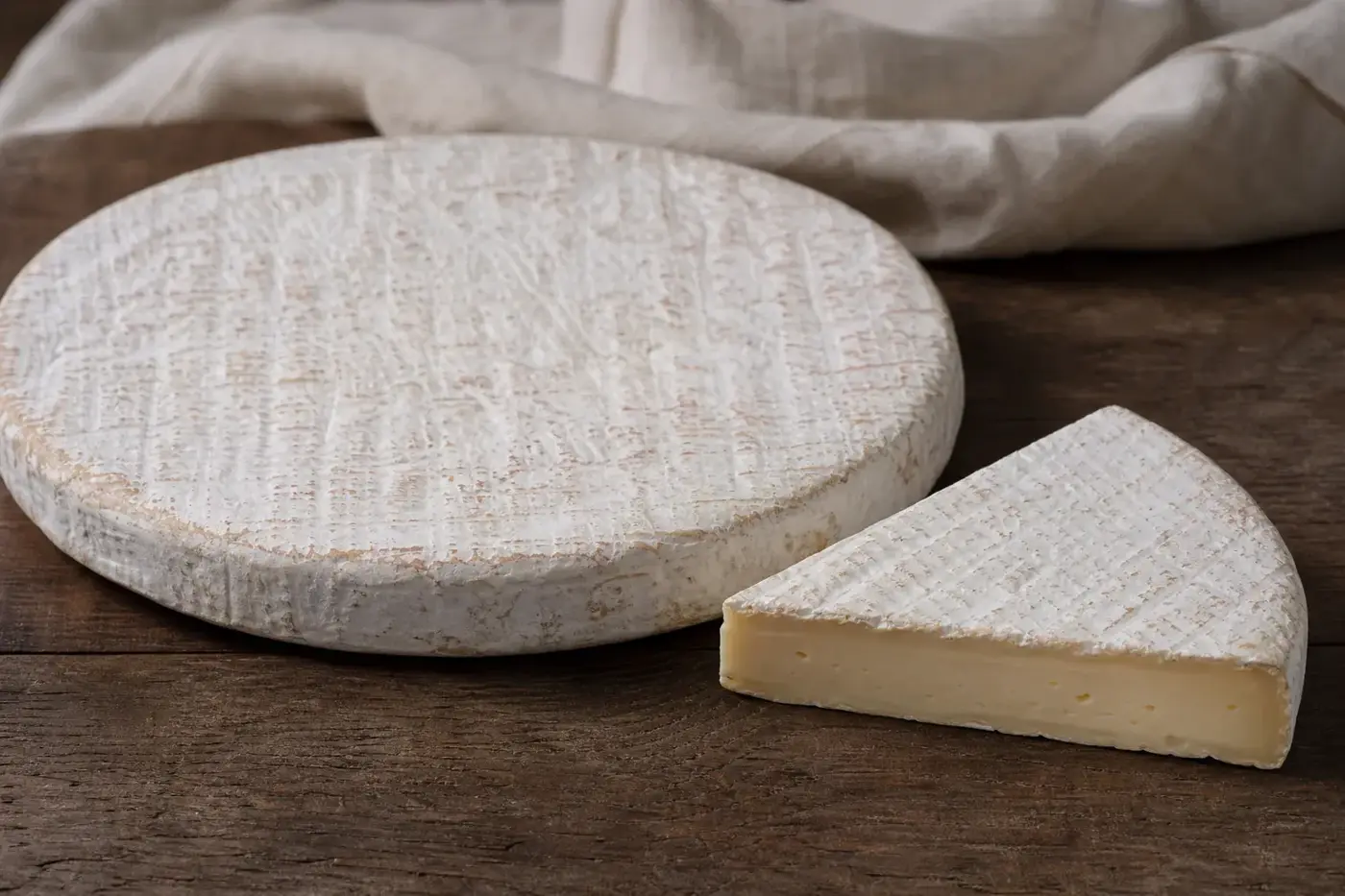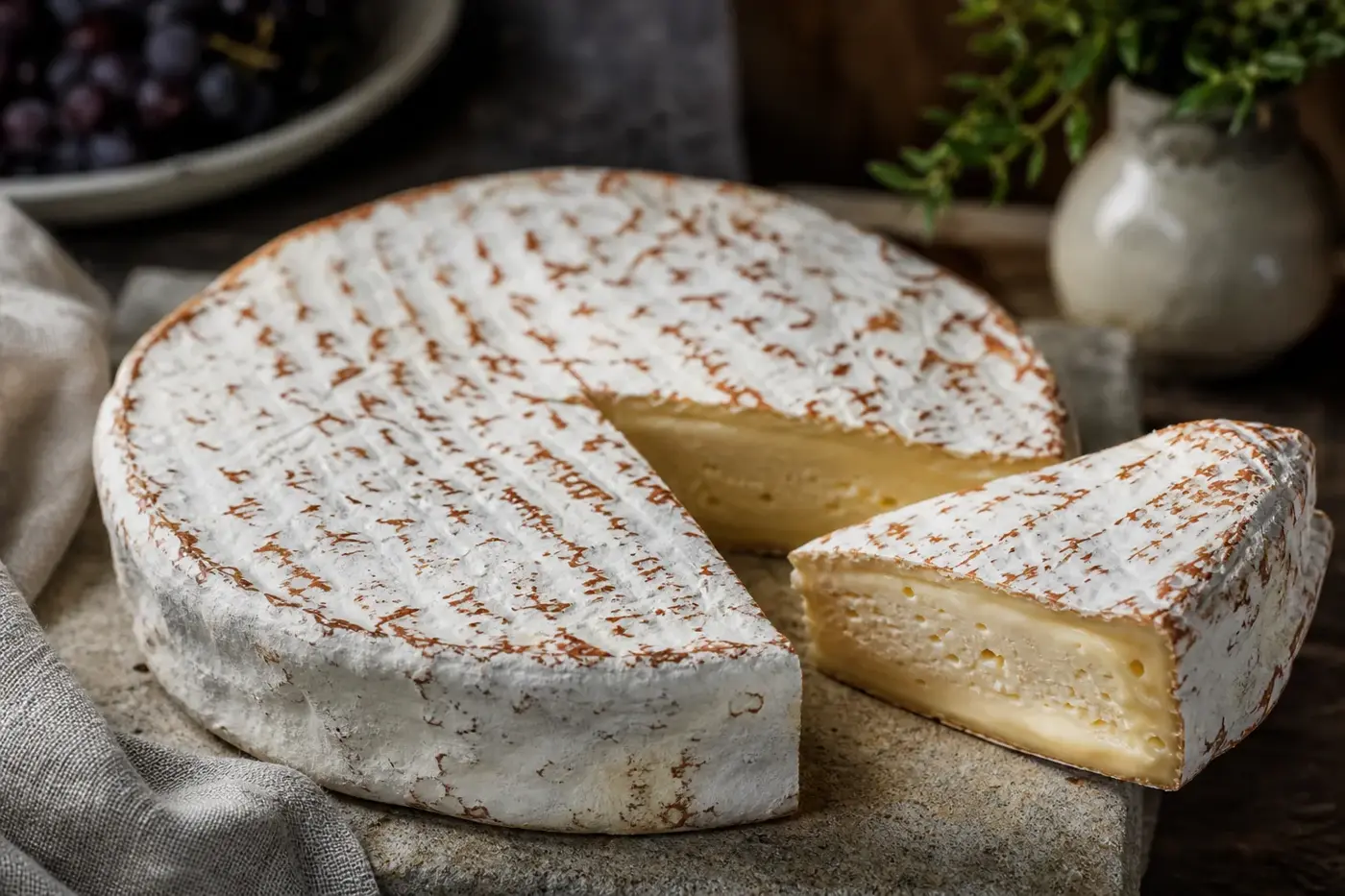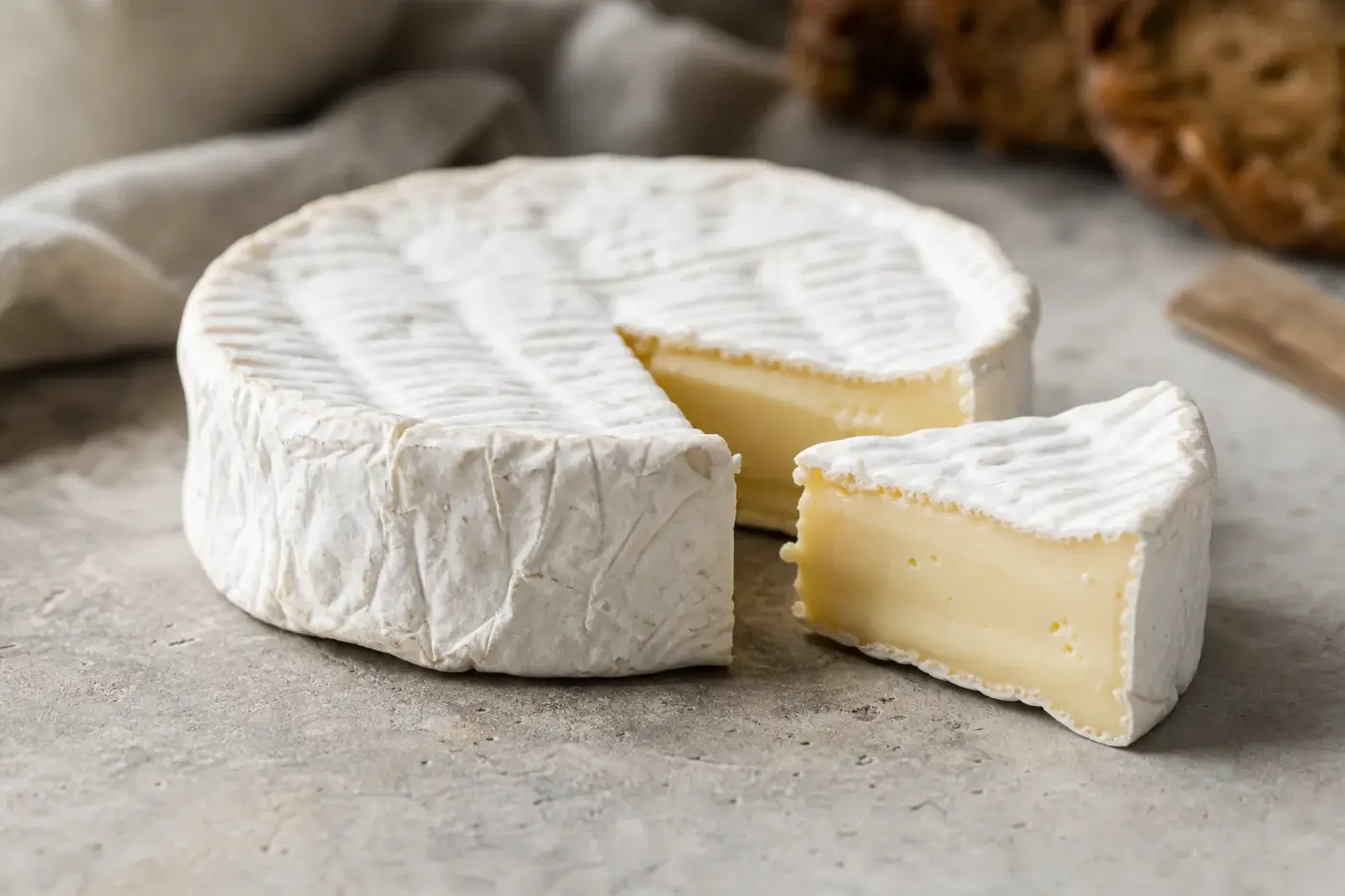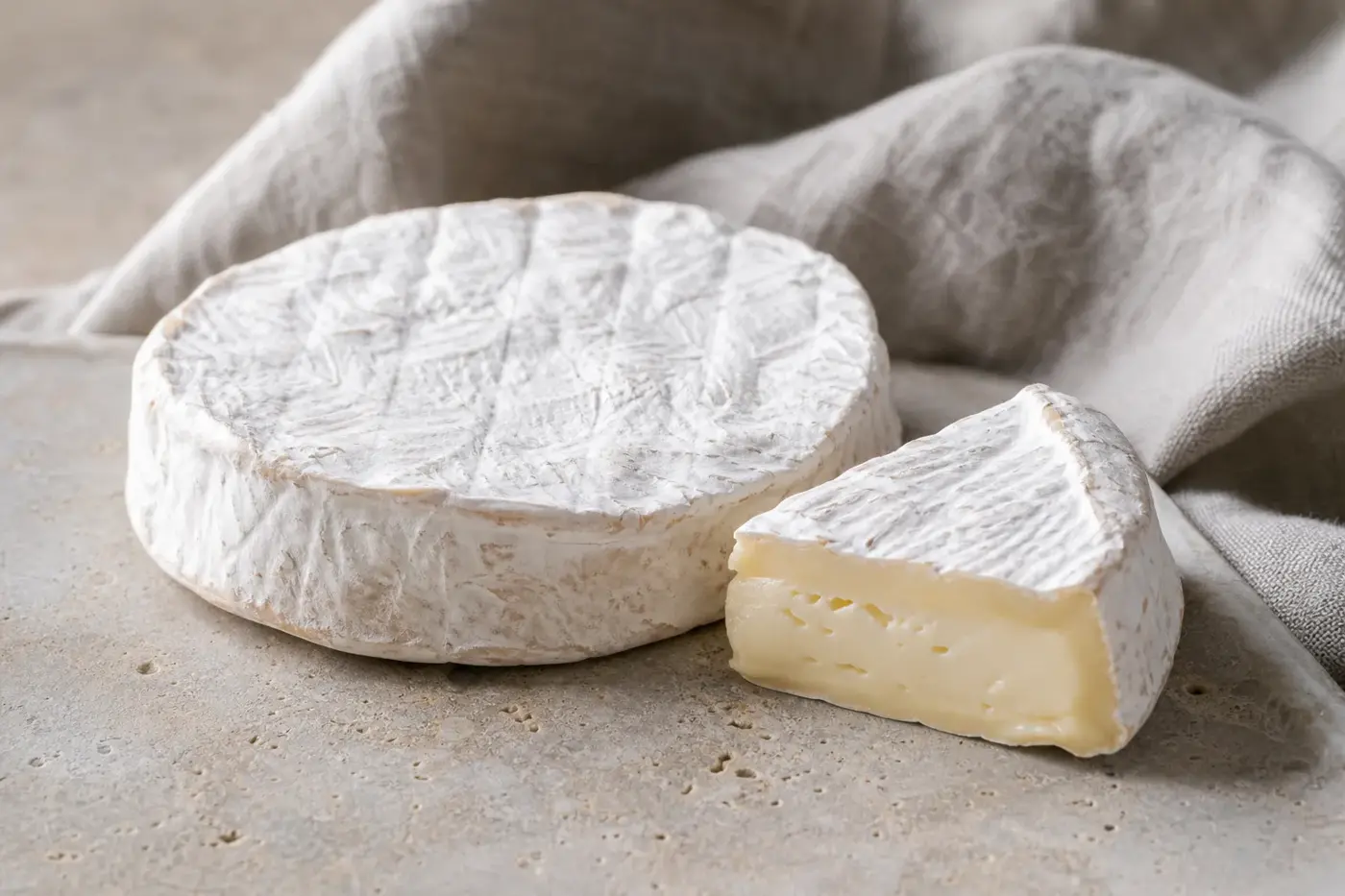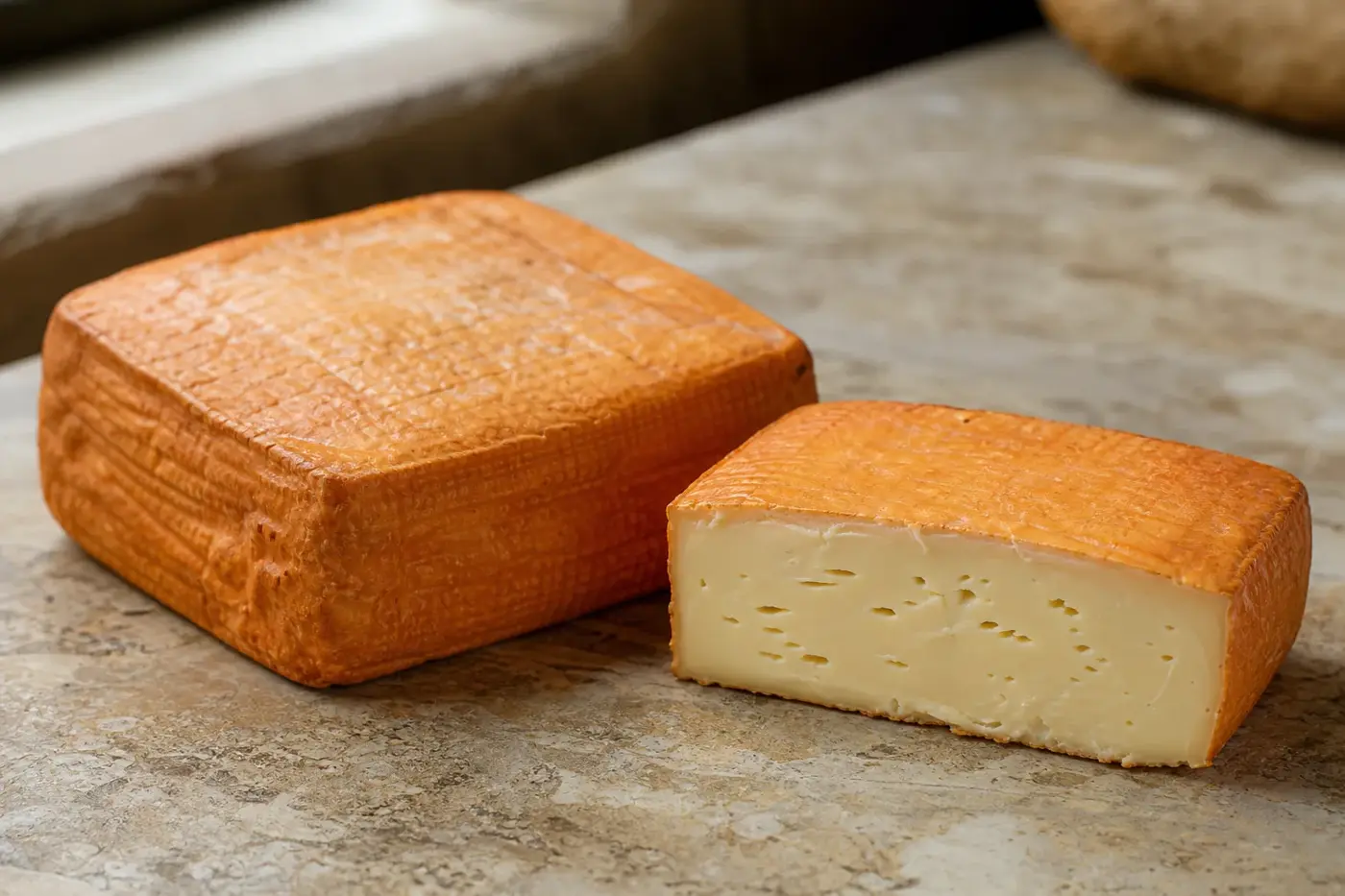
First, you see the orange-red rind. Then the smell arrives, rather ahead of introductions. Cut into this square cow’s milk cheese and you find a gentler character: a pale, supple centre, milky, lightly salted and savoury. Its home is Thiérache in northern France, where hedged dairy pastures and humid ripening cellars help shape those contrasts.[1,2]
Get acquainted with Maroilles
| What to know | The details |
|---|---|
| Name | Maroilles, registered as Maroilles ou Marolles.[1] |
| Cheese style | Soft cow’s milk cheese with a washed rind.[2] |
| Home | Defined communes in Nord and Aisne, France.[1] |
| Milk treatments | Raw, thermised or pasteurised.[3] |
| What sets the milk | Calf rennet.[3] |
| EU status | PDO, identified as AOP by INAO; original registration 21 June 1996.[2,5] |
| GB status | Registered PDO; scheme registration 31 December 2020, 23:00.[5] |
| Register identifiers | EU: Not verified; GB entry: maroilles-slash-marolles.[5] |
| Minimum ripening | 21 to 35 days, depending on format; see table below.[1,7] |
| Allergen | Milk.[1] |
| Status checked | November 2026.[2,5] |
Follow that bold rind to a gentler heart
Look closely and you may spot the ripening racks’ impressions on the square’s faces. The specification describes a uniformly orange-red washed rind, sometimes moist. Beneath it, the paste is white to cream with small openings. Its firmer centre softens as maturation continues.[1]
Your nose and palate may seem to have met two different cheeses. INAO highlights the pronounced smell alongside the mild, milky, lightly salted paste. At minimum maturity, you may find a chalky heart; with further ageing, that centre becomes less apparent and the aromas grow more assertive. Young and longer-ripened Maroilles have distinctly different characters.[2]
For your first piece, ask for some firmness at the centre. Already fond of pronounced washed-rind cheeses? Ask your cheesemonger for a more advanced maturity: a firmer heart and a softer, more mature paste are different pleasures, not different rungs on a quality ladder.[2]
Walk into Thiérache’s hedged pastures
Maroilles belongs to a defined part of Thiérache, crossing Nord and Aisne around southern Avesnes and northern Vervins. INAO places milk production, cheesemaking and ripening inside that area. You are looking at specified communes, not the whole of northern France.[1,2]
This is bocage country: grassland divided by hedges, with woodland and damp, clay-rich ground. The specification connects abundant rainfall and moisture-retaining soils with grass growing and dairy farming. It also requires at least 170 days of grazing annually, alongside rules for hedges, grassland and where forage comes from.[3]
The protected name takes you beyond the finished square, back to the milk supply and farming system. Within those requirements, different dairies and maturities still have room to express themselves. At the counter, two questions bring you closer to your cheese: who made it, and how has it been matured?[1,3]
Meet the monks behind the tradition
The abbey at Maroilles sits at the heart of the cheese’s origin tradition, which dates its creation by monks to 960. A report preserved by France’s Ministry of Culture records a village monument commemorating that story. It also records a twentieth-century celebration of the supposed millennium.[4]
An abbey’s recorded role in regional cheese production is one thing; a precise invention date for today’s cheese is another. The current specification cites medieval obligations to deliver cheeses and a commercial dictionary of 1723 identifying Marolles. Those documentary milestones sit alongside the enduring monastic tradition.[1]
The protected name has its own chronology. The GB register records the original EU registration on 21 June 1996, while the EU approved a substantial specification amendment in October 2016. These dates mark recognition and revision, not the beginning of cheesemaking in Thiérache.[5,6]
Read the promise behind the name
Maroilles means more than a place on a map. Its specification binds the name to a defined area, permitted ingredients, production requirements and the finished cheese’s characteristics. AOP is short for appellation d’origine protégée, the French for protected designation of origin, PDO.[1,3]
Great Britain has a separate registered PDO entry, dating from 31 December 2020 at 23:00. You can untangle the schemes with protected names explained. At the counter, look at the maker details and milk treatment too. The specification permits more than one milk treatment, so the designation alone cannot tell you which was used.[3,5]
Follow the milk into the cellar
Your Maroilles may begin with raw, thermised or pasteurised cow’s milk. Thermisation is a heat treatment distinct from pasteurisation; milk treatments explains the differences. Calf rennet sets the milk into curd, a process called coagulation. Its use means this cheese does not suit a vegetarian diet.[1,3]
After starter cultures acidify the milk, the set curd is cut into cubes, partly drained and put into square moulds. The cheeses are turned while drainage continues. Dry salt, brine or both may be used for salting. Drying and yeast development follow before the cheeses reach the ripening cellar.[1,3]
Brushing or washing with a salted solution develops that distinctive rind. The solution may contain surface cultures, with Brevibacterium linens named in the specification as the predominant organism. No orange dye is doing the decorative work: added colourings are prohibited. The exterior gets its colour from ripening.[1,3]
Find your square among four formats
Maroilles comes in four legal formats, each with its own dimensions and minimum ripening period. The specification gives mould dimensions and minimum dry matter weight, not a fixed weight for the cheese you buy. Dry matter means what remains after water is removed. The ripening clock starts at renneting, when the coagulant goes in.[1,7]
| Format | Mould side | Minimum dry matter weight | Minimum ripening |
|---|---|---|---|
| Maroilles | 12.5 to 13 cm | 360 g | 35 days |
| Sorbais | 12 to 12.5 cm | 270 g | 28 days |
| Mignon | 11 to 11.5 cm | 180 g | 28 days |
| Quart | 8 to 8.5 cm | 90 g | 21 days |
France and EU product specification; mould dimensions allow a tolerance of plus or minus 0.3 cm.[1,7]
Size only tells you so much. Milk treatment, salting method and ripening care can all vary within the specification, so ask about the actual cheese’s age and character. A small Quart and a large Maroilles have different legal minimum ripening periods. Neither name gives you the whole flavour story.[1,3]
Choose for supper, then keep it chilled
Tell your cheesemonger what you have planned. Tonight’s bread and cheese calls for a different conversation from a baked tart, so ask about the centre, maturity and milk treatment. Read the label’s storage instructions and date; reading cheese labels helps you make sense of those details.
At home, follow the Food Standards Agency’s guidance for England, Wales and Northern Ireland. Keep dairy foods refrigerated, with your fridge between 0 and 5 °C (32 to 41 °F), and follow the packaging instructions. Use any instructions for after opening rather than assuming every Maroilles has the same shelf life.[8]
Taking it out of the fridge? Follow the FSA’s current advice on chilled food, together with any instructions on the packaging.[8]
Make room for bread, beer and flamiche
Start with plain country bread and a modest piece of Maroilles. Taste the paste before reaching for anything sweet or sharp, and give that savoury character a moment of your attention. The accompaniments can wait their turn.
If you are an adult of legal drinking age choosing beer, try a small serving of amber bière de garde with your bread. An alcohol-free amber beer takes you in a similar direction, while water lets you concentrate on the cheese. Apple slices or a few pickled vegetables offer contrast. These are suggestions, so find the balance you enjoy.
You can take Maroilles into the kitchen, too. Consider flamiche au Maroilles, the northern French cheese tart, with savoury cheese, bread-like dough and a browned top. A simple salad makes a useful companion. For more cooking ideas, the producers publish recipes through the Syndicat du Maroilles.[9]
This page summarises published guidance from the official sources it cites. It is not medical advice. Guidance differs between countries and changes over time, so check the current source for where you live, and ask your doctor, midwife, pharmacist or dietitian about your own circumstances.
Before you tuck in: rind and safety
For the rind, follow the maker’s guidance for your particular cheese. Remove the wrapping before serving.
If you are pregnant, consult the current UK NHS guidance on soft cheeses and cooking. Ask your midwife about your circumstances.[10]
The NHS identifies pregnant people, newborn babies, people with weakened immunity and older people as groups at greater risk of serious listeriosis. If you are in one of those groups, consult its current guidance and your healthcare professional. You can find broader background in Listeria and cheese safety.[11]
Maroilles is made from cow’s milk, so if you manage a milk allergy, read the particular product’s allergen information and follow your clinician’s advice. For a recall, match the maker, batch and date against the official notice, then follow its instructions. That strong smell tells you nothing about whether a batch is affected.[1,12]
Questions people ask
What does Maroilles taste like?
Despite its pronounced smell, Maroilles has a mild, milky and lightly salted paste. A younger cheese can have a chalky centre, which softens as it matures.
Is Maroilles made with pasteurised milk?
Maroilles can be made with raw, thermised or pasteurised cow’s milk. The protected name alone does not tell you which milk treatment has been used, so check the maker details and milk treatment.
Is Maroilles vegetarian?
No. Maroilles is made using calf rennet, so it does not suit a vegetarian diet.
Can I eat Maroilles during pregnancy?
The NHS has current guidance on soft cheeses and cooking during pregnancy. Check that guidance and ask your midwife about your circumstances.
How should I store Maroilles?
The Food Standards Agency advises keeping dairy foods refrigerated at between 0 and 5 °C and following the packaging instructions. If the pack gives instructions for after opening, follow those.
Sources
- French Ministry of Agriculture, Cahier des charges de l’appellation d’origine « Maroilles » ou « Marolles », associated with Commission Implementing Regulation (EU) 2016/1874, Bulletin officiel no. 44, 27 October 2016. Product description, formats, geographical area, production and historical account.
- Institut national de l’origine et de la qualité, Maroilles ou Marolles, undated current product page, checked November 2026. Official description of appearance, maturity, sensory character and territory.
- French Ministry of Agriculture, Cahier des charges de l’appellation d’origine « Maroilles » ou « Marolles », approved by Décret no. 2015-1032 of 19 August 2015, Bulletin officiel no. 37, 10 September 2015. Read alongside the subsequently approved 2016 specification.
- French Ministry of Culture, archival research file Ethno_Streith_1989_307c.pdf, 1989, printed page 93, notes 3 to 5. Records the commemorative monument and the twentieth-century millennium tradition.
- Department for Environment, Food & Rural Affairs, Maroilles / Marolles, protected food names register, published 4 January 2021, current entry checked November 2026.
- European Commission, Commission Implementing Regulation (EU) 2016/1874 of 19 October 2016, Official Journal L 288, 22 October 2016. Approval of a non-minor specification amendment.
- European Commission, Publication d’une demande de modification en application de l’article 50, paragraphe 2, point a), du règlement (UE) no 1151/2012, Maroilles/Marolles, Official Journal C 176, 18 May 2016. Amendment application, subsequently approved by source 6.
- Food Standards Agency, How to chill, freeze and defrost food safely, current online guidance, checked November 2026. Applies to England, Northern Ireland and Wales.
- Syndicat du Maroilles, Coin des recettes, undated recipe index, checked November 2026. An industry source promoting use of its members’ cheese.
- NHS, Foods to avoid in pregnancy, current online guidance, checked November 2026.
- NHS, Listeriosis, current online guidance, checked November 2026.
- French government, Rappel Conso, Maroilles search results, checked November 2026. Includes batch-specific Maroilles notices dated 27 March 2026.
Researched from official specifications, INAO and Defra records, an archived cultural research report and official food safety guidance, with serving suggestions identified as editorial choices.
Last checked: November 2026
Last checked November 2026.
The editors suggest you read next