Montgomery's Cheddar
First comes the dry, crystalline bite.
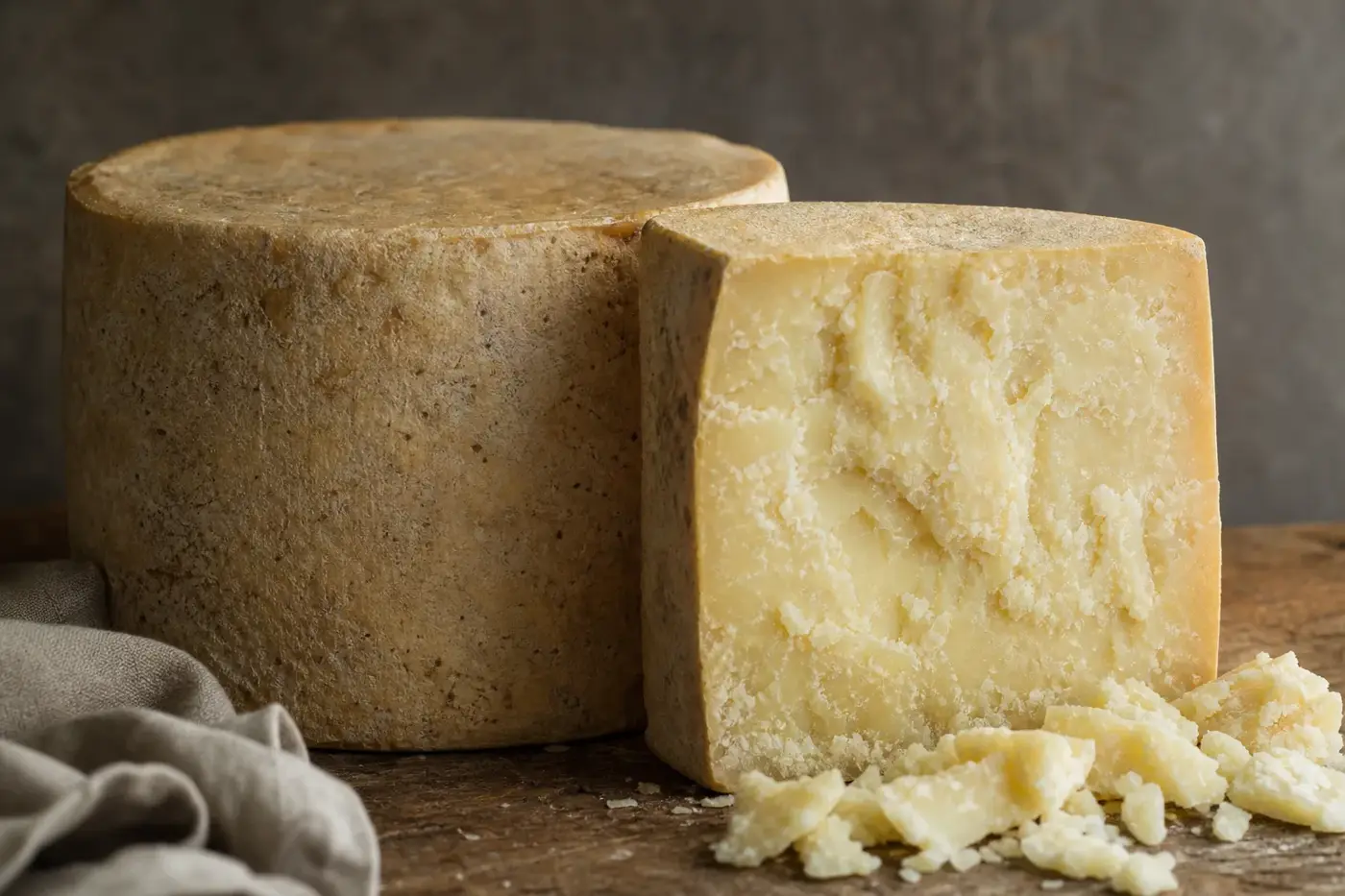
First comes the dry, crystalline bite. Then a deeply savoury flavour, the kind that makes you pause before reaching for another piece. Follow the qualities Neal's Yard Dairy describes back to Manor Farm in North Cadbury, Somerset, and you find Friesian cows, curd stacked by hand and a slow peg mill preparing it for salt. [1,2]
Clothbound maturation follows, but these wheels do not leave the farm as interchangeable batches. Neal's Yard Dairy's buyers choose them individually for their character. With Montgomery's, you are choosing a wheel, not just a familiar name. [1,2]
Your first look at Montgomery's
| What to know | The details |
|---|---|
| Home farm | Manor Farm, North Cadbury, Somerset. [1] |
| Milk | Own-herd Friesian cows' milk; raw-milk cheese documented, with pasteurised stock also listed by Neal's Yard Dairy. [1,2] |
| Rennet | Animal rennet. [1,2] |
| Wheel's wrapping | Muslin cloth with lard. [1,2] |
| Shape and size | Cylindrical wheel; average 23 kg in the merchant's 2026 sheet. [2] |
| Time to mature | Farm maturation: 12 to 24 months; current Neal's Yard Dairy selection averages 24 months. [1,2] |
| Allergen | Milk. [2] |
| Related registered name | West Country Farmhouse Cheddar Cheese, GB PDO; Montgomery's current certification: Not verified. [4] |
| Register identifier | EU file PDO-GB-0279; GB identifier: Not verified. [4,5] |
| Status checked | November 2026. [1,2,4,5] |
Meet the family behind Manor Farm
The family story begins in 1911, when Archibald Langman bought Manor Farm and began making cheese. Local seller North Cadbury Village Stores traces the business through his daughter Elizabeth Montgomery to her son Jamie. He is the third generation in that succession. [3]
Today, Neal's Yard Dairy names Jamie Montgomery, Steve Bridges and Tim Griffey as the makers on its product page. Its 2026 technical sheet gives the shorter credit, Jamie Montgomery and team. Those are the people behind the name you meet at the cheese counter. [1,2]
Start with the farm's own Friesians
You can trace the milk straight to Manor Farm's own Friesian cows, according to the merchant. Herd and dairy belong to the same farm. Here, the story of the milk begins somewhere more specific than a regional name. [1,2]
Do check the milk treatment on the portion you buy. Neal's Yard Dairy's current listing offers raw and pasteurised versions, while its linked 2026 sheet specifies raw milk. The Montgomery's name alone cannot tell you which you have, so read the label or ask your cheesemonger. [1,2]
Follow the milk into the vat
Liquid “pint” starter cultures and animal rennet begin the transformation at Montgomery's, according to Neal's Yard Dairy. The starter develops acidity. Rennet sets the milk into a gel, allowing the solid curd to be separated from the liquid whey. [1,2,6]
Then come cutting, warming and stirring the curds, followed by draining the whey, as the West Country farmhouse Cheddar specification describes. Each step plays its part in the wider farmhouse process. You can follow the sequence in how cheese is made. [6]
See why the curd needs stacking
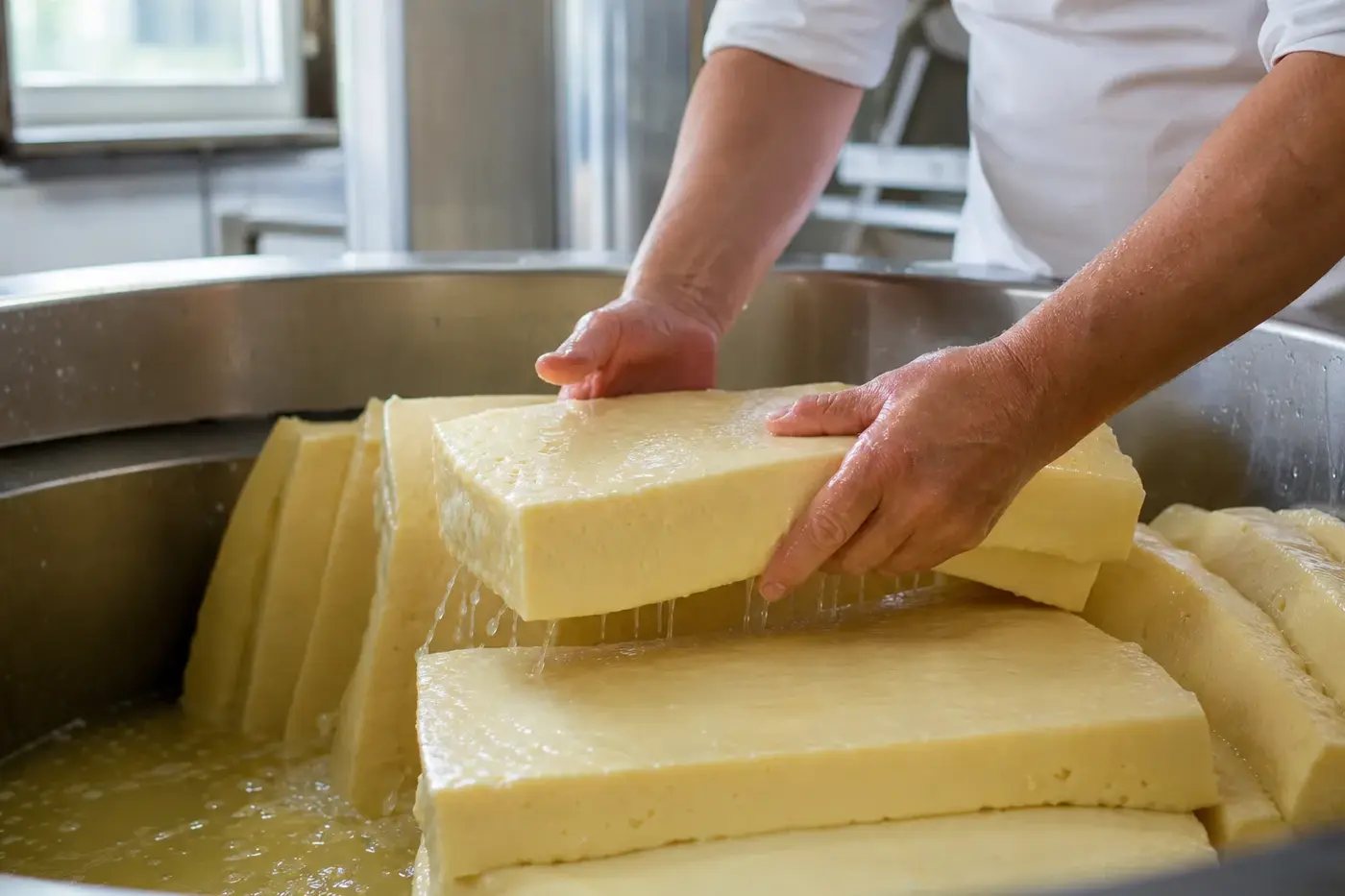
Cheddaring is hands-on work with slabs of drained curd. The slabs are cut, turned and stacked, their own weight helping to push out whey as acidity develops. Milling breaks them into smaller pieces, ready for salting, mixing and moulds for pressing. [6]
Neal's Yard Dairy singles out Montgomery's slow peg mill as a feature retained in production. It is not there to look picturesque. Cheddaring handles the big slabs; the mill breaks them down before the salt goes in. [1,6]
Settle in for clothbound maturation
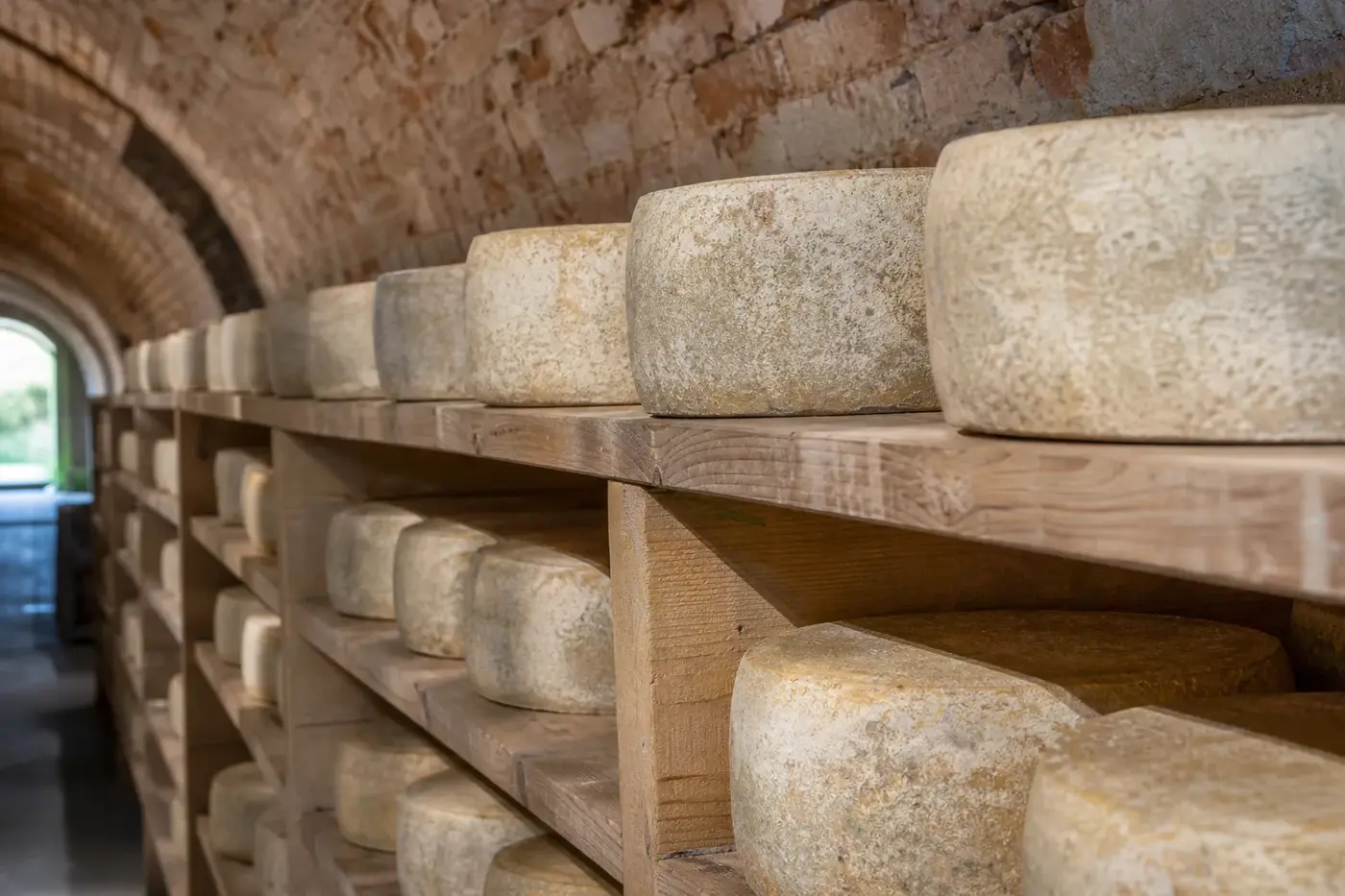
The wheels wear muslin cloth and lard while they mature on wooden shelves, with regular turning along the way. The merchant's 2026 sheet gives a farm maturation range of 12 to 24 months and an average wheel weight of 23 kg. Neal's Yard Dairy's current retail selection averages 24 months. [1,2,3]
As those clothbound cylinders mature, they lose moisture and develop a hard rind, the specification explains. The muslin remains part of the wrapping. Before you serve a cut piece, remove any fabric still attached. [6]
Join the search for the right wheel
Neal's Yard Dairy selects Montgomery's at Manor Farm, tasting alongside Jamie Montgomery. Its buyers say they visit every other month and reserve wheels. Those wheels stay at the farm until mature enough for sale, before the merchant sells its selection through its own business. [1,2]
So age is only your opening question at the counter. Ask what makes the wheel being cut distinctive. One batch may taste different from another bearing the same farm name, which gives you good reason to pay attention to the individual wheel.
Taste past the word “strong”
Horseradish warmth. Roasted vegetables. Chicken stock and beef dripping. All appear in Neal's Yard Dairy's 2026 tasting notes for Montgomery's, giving you rather more to explore than a single strength rating. [2]
The merchant describes a dry, crystalline texture and a selection that is drier and more layered than many other Cheddars it sells. Its notes capture variation between batches. You are not being promised an identical mouthful every time. [1,2]
Try a small piece on its own, before bread or anything alongside. Does it separate into flakes, and how quickly does it break down? Notice the finish, too: stock, vegetables or sharpness might come to mind. That tells you far more about your piece than “strong” ever could.
Get to know the protected farmhouse name
West Country Farmhouse Cheddar Cheese has a registered protected designation of origin, or PDO. The GB register records entry into the Great Britain scheme on 31 December 2020 and original EU registration on 21 June 1996. GIview gives the EU file number PDO-GB-0279. [4,5]
The published specification requires production on farms within Somerset, Dorset, Devon and Cornwall, followed by at least nine months' maturation. It permits raw or pasteurised cows' milk. Animal and vegetable rennet are both allowed. [6]
This page summarises published guidance from the official sources it cites. It is not medical advice. Guidance differs between countries and changes over time, so check the current source for where you live, and ask your doctor, midwife, pharmacist or dietitian about your own circumstances.
Choose with pregnancy and dietary needs in mind
If you are pregnant, consult the current NHS guidance on foods to avoid and its separate guidance on listeriosis. Then ask your midwife about your own circumstances. [7,8]
The NHS identifies pregnancy, newborn babies, weakened immunity and older age as factors increasing the risk of serious listeriosis. Separately, the FSA advises vulnerable groups in England, Wales and Northern Ireland against raw drinking milk and cream. Those groups include people aged 65 or over, infants and small children, pregnant women and people with compromised immunity. That particular advice concerns drinking milk and cream. [8,9]
US guidance differs: the CDC recommends pasteurised dairy products for everyone. Its higher-risk guidance tells pregnant people, adults aged 65 or over and people with weakened immunity to avoid unheated cheese made with raw milk. Its alternatives include raw-milk cheese heated to 74 °C (165 °F), or until steaming hot. [10,11]
Montgomery's declared animal rennet and lard make it unsuitable for a vegetarian diet. Milk is the listed allergen. Ask for your portion's actual label and any additional allergen information, rather than relying on a general description of the style. [1,2]
Bring a good piece home
Take three questions to the counter: which milk treatment is on the label, how old is the wheel, and what does this batch taste like? If you are offered a taste, try it plain before deciding how to serve it. Choose a piece you can finish within the seller's labelled instructions.
At home, follow the packaging's storage and date instructions. FSA guidance for England, Wales and Northern Ireland advises a fridge temperature between 0 and 5 °C (32 to 41 °F). Keep dairy refrigerated, and protect ready-to-eat cheese from raw meat and its juices. [12]
Take out only what you plan to serve; leave the rest in the fridge. The same FSA guidance says chilled food should spend the shortest possible time out, with a maximum of four hours. Follow any stricter instructions supplied with your cheese. For cut portions, see how to store cheese at home. [12]
For your board, cut a few small pieces rather than reducing the whole wedge to uniform cubes. Leave enough of the cut face visible to show its structure. Keep accompaniments separate so everyone can start with cheese alone, and use a clean board and utensils.
Keep the wrapper, or photograph the label, until you have finished the cheese. You will have the milk-treatment statement, batch details and storage instructions handy if you need to ask the seller something. If you give someone a portion, pass those details on too. That matters especially when a larger piece is shared between several households.
Give Montgomery's the centre of the plate
Neal's Yard Dairy suggests buttered sourdough or a jacket potato with the cheese grated over it. Both ideas come from the merchant. Neither asks the cheese to disappear into the background, which seems only fair after all that time on the shelf. [2]
For another simple starting point, try plain bread and a crisp apple, with water or alcohol free cider alongside. Take one bite without an accompaniment, then another with one. You can decide which combination you prefer, with the cheese still firmly at the centre.
Keep exploring the world of Cheddar
- Cheddar: get to know the broader family alongside one farm's approach.
- How Cheese Is Made: From Milk to Cheese: follow the farmhouse sequence in its wider production context.
Questions people ask
Is Montgomery's Cheddar made with raw milk?
Neal's Yard Dairy lists both raw and pasteurised versions, although its 2026 technical sheet specifies raw milk. Check the label or ask the cheesemonger which version you have.
Is Montgomery's Cheddar vegetarian?
No. It is made with animal rennet and wrapped in muslin cloth with lard.
How long is Montgomery's Cheddar aged?
The farm maturation range is 12 to 24 months. Neal's Yard Dairy's current selection averages 24 months.
Can I eat Montgomery's Cheddar during pregnancy?
Consult the NHS guidance on foods to avoid in pregnancy and its separate guidance on listeriosis. Check both sources in their current form and ask your midwife about your circumstances.
Is Montgomery's Cheddar a protected cheese?
West Country Farmhouse Cheddar Cheese is a registered protected designation of origin, or PDO. Montgomery's current certification was not verified on the page.
Sources
- Neal's Yard Dairy. Montgomery's Cheddar (24 months). Undated live product page, retrieved November 2026. Product information, named makers, background and selection account. Commercial source, cited for its own products and practices.
- Neal's Yard Dairy. Montgomery's Cheddar crib sheet. 2026 edition; filename identifies April 2026. Product fields, production summary, tasting notes, pairing suggestions and selection account. Commercial source; sensory descriptions are attributed to the merchant.
- North Cadbury Village Stores. The famous Montgomery cheeses. Undated live page, retrieved November 2026. Retailer's account of the family succession and maturation. This is a seller's account, not a retrieved farm archive or producer statement.
- Department for Environment, Food & Rural Affairs. West Country Farmhouse Cheddar Cheese. GB protected food name register entry, published 4 January 2021; current page retrieved November 2026.
- European Union Intellectual Property Office, GIview. West Country farmhouse Cheddar cheese. Record EUGI00000013113, file PDO-GB-0279; retrieved November 2026.
- Department for Environment, Food & Rural Affairs. Product specification: West Country Farmhouse Cheddar. Version linked from the GB register in November 2026; document revision date not stated. Sections 4.2, 4.3 and 4.5.
- NHS. Foods to avoid in pregnancy. Live edition retrieved November 2026, “Cheese, milk and other dairy”.
- NHS. Listeriosis. Page last reviewed 10 November 2023; live edition retrieved November 2026. “Risks of listeriosis” and “Foods to avoid if you're at risk”.
- Food Standards Agency. Raw drinking milk. Published 9 January 2018; live edition retrieved November 2026. Applies to England, Northern Ireland and Wales.
- US Centers for Disease Control and Prevention. How Listeria Spread: Soft Cheeses and Raw Milk. 16 January 2025; retrieved November 2026.
- US Centers for Disease Control and Prevention. Preventing Listeria Infection. 31 January 2025; retrieved November 2026. Higher-risk groups and cheese advice.
- Food Standards Agency. How to chill, freeze and defrost food safely. Published 18 December 2017; live edition retrieved November 2026. Applies to England, Northern Ireland and Wales.
Researched through retrieved merchant records, the GB register and specification, GIview, and official UK and US food safety guidance; no site tasting or farm visit was undertaken.
Last checked: November 2026
Last checked November 2026.
The editors suggest you read next
Farmhouse, Artisan and Industrial Cheesemakers Explained
Slabs of curd are turned and stacked by hand.