Organic and Biodynamic Cheese
Picture cow horns filled with manure, rather than a wheel waiting to be cut.
Picture cow horns filled with manure, rather than a wheel waiting to be cut. Not quite the cheese-counter scene you had in mind. Yet on 13 June 1924, Rudolf Steiner lectured on treating manure in cow horns and adding specially prepared materials to it. His ideas helped shape biodynamic farming, whose underlying beliefs need separating from measurable farming outcomes.[6][7]
Organic certification follows a different thread. It tracks how land, animals, milk and finished cheese are managed, not how a cheese tastes or how far it has travelled. Biodynamics adds requirements rooted in Steiner’s thinking.[1][6][7]
Follow the organic trail from field to wheel
An organic cheese has a paper trail stretching back beyond the vat. Certification follows the land and animals, the milk supply and the cheesemaking business. Buying certified organic milk is not enough: the dairy must also meet the relevant processing and certification requirements before calling its finished cheese organic.[1][4]
At the counter, read organic certification alongside origin information. One identifies a production system; the other tells you where the agricultural ingredients were farmed. Organic systems can include bought-in feed and milk travelling between businesses, so “organic”, “local” and “entirely pasture-fed” answer different questions.[1][5]
Out in the fields, organic does not mean leaving everything to its own devices. Great Britain’s government guidance requires farmers to maintain soil fertility through rotations and other organic methods. Fertilisers and crop-protection materials are restricted to permitted inputs. Farmers actively manage fertility, weeds and disease, using authorised treatments where needed.[4]
Read the label, then look a little closer
“Organic” is more than an appealing word on a wrapper. It is a legally governed description, with operators inspected and certified by approved control bodies. Government approves those bodies; any extra private standards set by a certification organisation sit alongside the underlying legal requirements.[1][2]
| Where the cheese is labelled | Rules behind the certification | What to look for on labels, November 2026 |
|---|---|---|
| Great Britain | Assimilated Regulation (EC) No 834/2007 sets the organic framework, with implementing requirements including Regulation (EC) No 889/2008.[3][4] | Look for the relevant control-body code. Businesses labelling in Great Britain use GB-ORG-XX.[1] |
| Northern Ireland | Regulation (EU) 2018/848 and associated legislation govern organic production and labelling.[5] | Businesses labelling in Northern Ireland use XI-ORG-XX. Prepacked organic food produced there must carry the EU organic logo.[1] |
That code gives you a useful starting point. It identifies the body certifying the labelling operator: find it on the government’s approved list, then look at the operator’s certificate and its scope. A familiar logo helps you recognise the scheme. The certificate establishes which activities and products it actually covers.[1][2]
Beyond milking time: feed, pasture and patience
The organic story carries on long after the milking is done. Northern Ireland’s applicable regulation requires organic or authorised in-conversion feed, subject to specified exceptions. Cattle, sheep and goats must have access to grazing whenever conditions allow.[5]
There are rules for the daily ration, too. Roughage, fresh or dried fodder, or silage must provide at least 60% of daily ration dry matter. A limited reduction is permitted in early lactation.[5]
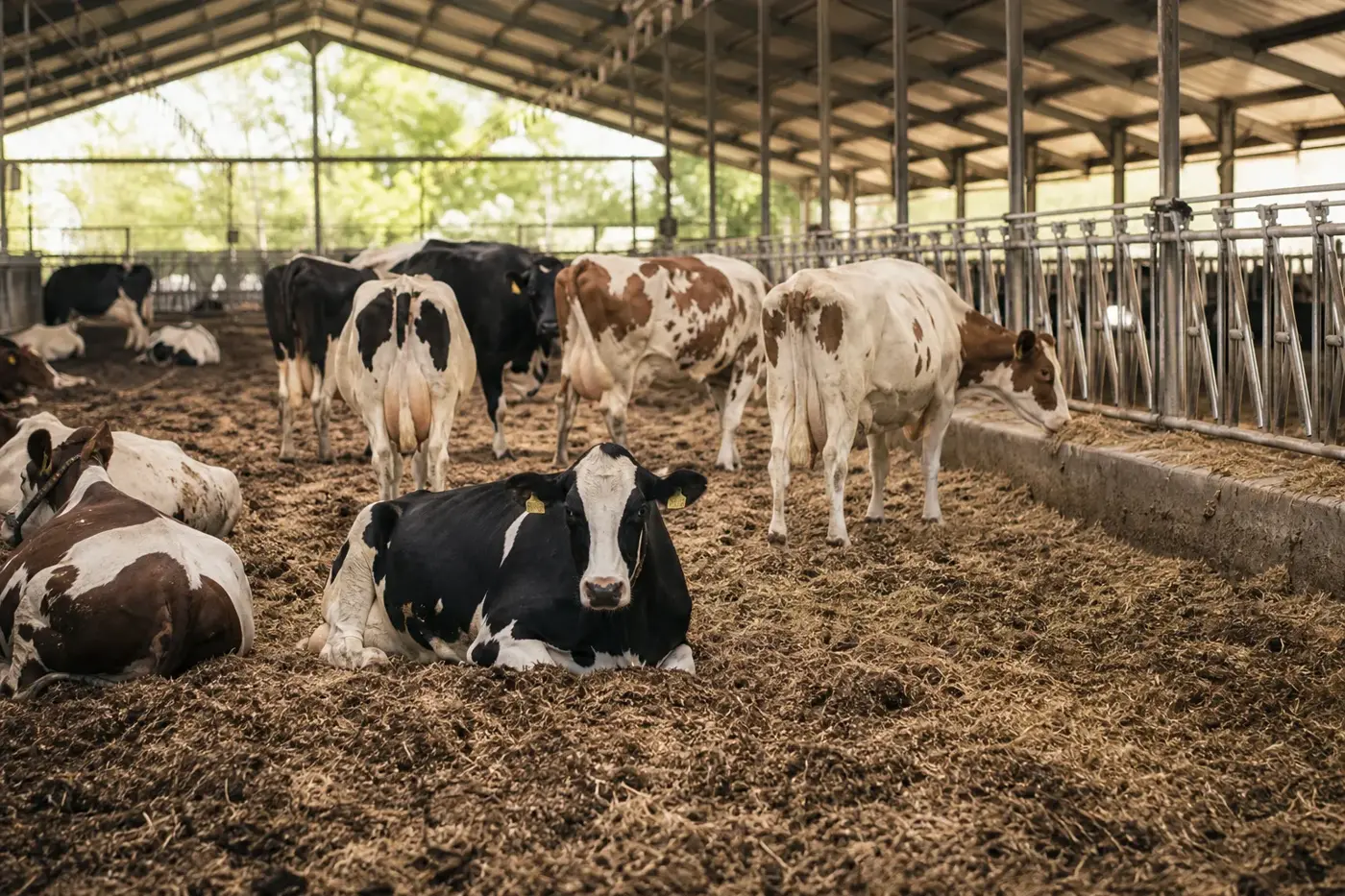
Life indoors matters as much as life outdoors. Housing must meet animals’ physiological and behavioural needs, including movement, ventilation and resting space. Organic certification does not require animals to remain outside all year: grazing and housing belong within the same system.[5]
Conversion takes patience, not just a change of label. Great Britain’s government guidance says land normally takes two years to convert, with different periods for certain uses. Northern Ireland sets separate periods for land and animals, including six months for animals producing milk. A farm’s conversion plan must account for both.[4][5]
When an animal is ill, care comes first
Sick or injured organic livestock must receive treatment. Northern Ireland’s rules prohibit preventive use of chemically synthesised allopathic medicines, including antibiotics, but require immediate treatment when animals become ill or injured. Treatment also brings additional withdrawal and certification conditions.[5]
Ask your cheesemaker how the supplying farms prevent illness, and what happens when an animal falls ill. Veterinary oversight, treatment records and the handling of milk during withdrawal periods are useful details. “No antibiotics” needs an explanation of how sick animals receive appropriate care.
Into the vat: meet the other ingredients
Milk is only part of the ingredients story. In Great Britain and Northern Ireland, using “organic” in a processed food’s name generally requires at least 95% of its agricultural ingredients to be organic. That means agricultural ingredients, not simply the finished cheese’s total weight. Other ingredients, additives and processing aids must also meet the applicable rules.[1]
Starter cultures drive fermentation, while rennet turns milk into curd. Both must comply with organic processing requirements, as must herbs, spices and other additions. Organic cheese need not contain only milk and salt. Nor does certification tell you which coagulant the maker uses.[1][5]
You can follow that transformation in how cheese is made, then explore the different coagulants in rennet explained. If vegetarian suitability or a particular ingredient matters to you, ask the maker about the actual recipe.
Meet biodynamics, from Steiner’s lectures to Demeter
Biodynamics grew from Rudolf Steiner’s agricultural lectures of 1924. In the lecture of 13 June, he described treating manure in cow horns and adding specially prepared materials to manure. He explained these practices through life forces and relationships between soil, plants and animals.[7]
Those lectures give you a record of what Steiner taught. His proposed mechanisms remain historical beliefs, distinct from experimentally demonstrated explanations.
Today, Demeter is a private biodynamic certification system with an international standard and national certification organisations. Its standards page describes annual Demeter inspections alongside organic inspection, and says national organisations may add requirements. Cheese marketed as organic in Great Britain or Northern Ireland must still meet the applicable organic certification obligations.[1][6]
Horns, herbs and a look at the calendar
The horns return in two distinctive biodynamic inputs: horn manure and horn silica. Demeter’s explanatory booklet describes cow manure for the first and ground quartz for the second, with materials placed in horns and buried. Other preparations use plants, including yarrow, camomile and nettle.[8][9]
The 2026 international standard requires preparation use and addresses farm biodiversity. Its biodiversity provisions include a reserve benchmark of 10% of farm area, or an approved plan towards it, with implementation qualifications.[9]
Then there is the farm calendar. A grower may follow lunar or planetary timings, but the international standard does not prescribe one universal planting calendar. Ask which practices the individual farm follows.
To assess preparations scientifically, comparisons need to hold manure, rotation and other management constant. Comparing whole farming systems cannot, by itself, tell you what the preparations do.
Animal welfare starts beyond the logo
Demeter adds conditions to organic husbandry requirements. Its international standard prohibits dehorning and keeping dehorned animals, while allowing justified exemptions subject to annual review. It also restricts the use of genetically hornless dairy cattle.[5][9]
These are substantive differences, but you still need to ask about daily life on the particular farm. Start with lameness, udder health, injuries, comfortable resting areas and access to pasture. Then ask how problems are recorded and corrected. A standard sets required practices, rather than describing every animal’s condition every day.
Neither label supplies those answers on its own. Equally, an uncertified farm deserves assessment on the evidence of its practices, not dismissal because it lacks a logo.
This page summarises published guidance from the official sources it cites. It is not medical advice. Guidance differs between countries and changes over time, so check the current source for where you live, and ask your doctor, midwife, pharmacist or dietitian about your own circumstances.
Healthy soil and more species: show the results
Spreading compost is an action; a change in soil carbon or soil organisms is a measured result. Organic requirements encourage fertility management through rotations and permitted nutrient inputs. To judge what happens in the soil, you need sampling.[4]
For biodiversity, comparative research tells you more than a label alone. A hierarchical meta-analysis published in the Journal of Applied Ecology drew on 184 observations from 94 studies and found approximately 30% greater species richness under organic farming on average. Effects varied between organisms and crops. The evidence was concentrated in northern and western Europe and North America.[10]
That gives you a broad biodiversity tendency, not a portrait of every dairy farm. To understand one particular farm, you need local evidence about habitats, management and the species being monitored.
With biodynamics, keep habitat measures separate from preparation claims. You can study the organisms supported by a flowering field margin without accepting Steiner’s explanation of forces.
Emissions and land: choose your measuring stick
A hectare and a kilogram answer different environmental questions. Impacts per hectare describe pressure across an area; impacts per kilogram describe the burden of producing a quantity of food. Produce less from the same area, and the comparison can change.
A 2026 systematic review of European dairy life-cycle assessments reports lower energy use per hectare in organic systems. It also reports examples of greater land requirements for organic milk. Environmental assessment needs several measures, not a single verdict delivered by a label.[14]
For cheese, ask where the assessment stops. At the farm gate, or after cheesemaking, maturation, refrigeration and distribution? How are impacts allocated between milk and other farm products, and between cheese and whey?
Those choices shape how you interpret the findings. They are not interchangeable scoring systems. A claim about soil, biodiversity or energy should retain its own measurement basis when presented beside a climate claim.
What organic can tell you about nutrition
Organic and conventional milk can differ in composition. A 2016 systematic review and meta-analysis examined 170 studies comparing organic and conventional cow’s milk. Organic milk had higher concentrations of several polyunsaturated fatty acids and lower iodine and selenium concentrations. Total saturated fatty acid concentrations did not differ significantly.[11]
Feeding systems helped explain those differences. But the research measured milk composition, not health outcomes from eating organic cheese. You cannot translate a relative difference in one milk constituent directly into a benefit from a serving of cheese.[11]
For the cheese in your hand, turn to its nutrition information. The cited milk analysis provides no basis for choosing biodynamic cheese as a treatment or preventive food.
Raw or pasteurised? Read that separately
Organic and Demeter cheeses can be made with raw or pasteurised milk. Certification tells you about one set of production questions; heat treatment answers another. Demeter’s dairy standard explicitly permits pasteurisation.[5][9]
UK pregnancy guidance from the NHS, November 2026, permits pasteurised or unpasteurised hard cheeses. Mould-ripened soft cheeses with a white rind and soft blue-veined cheeses must be thoroughly cooked, whether made with pasteurised milk or not. The guidance permits any cheese cooked until steaming hot.[12]
The NHS also identifies older people and people with weakened immunity as groups at greater risk of serious listeriosis. Follow its current guidance for your circumstances, even when the packaging carries certification marks.[13] For fuller explanations, read milk treatments and cheese food safety.
Take these five questions to the cheese counter
Start with the certification code and agricultural-origin statement. Then get curious about the things a label cannot tell you.[1][2] Cheese lovers rarely need encouragement to linger at a counter; now you have an agenda.
- Certification: Which body certifies this cheese, and does the current certificate cover cheesemaking?
- Milk: Which farms supply it, and is the milk raw or pasteurised?
- Feed and pasture: What do the animals eat during grazing and housing periods?
- Animal care: How are illness, lameness and udder health monitored and treated?
- Environmental evidence: What has been measured, over what period, and per hectare or per kilogram?
For the packaging details, turn to how to read a cheese label. If you want deeper comparisons of emissions, welfare, biodiversity and related questions, explore the Sustainability and Animal Welfare hub’s specialist guides.
Questions people ask
Does organic milk automatically make cheese organic?
No. The cheesemaking business must also meet the relevant processing and certification requirements before calling its cheese organic. Generally, at least 95% of a processed food’s agricultural ingredients must be organic for its name to use the word organic.
What is the difference between organic and biodynamic cheese?
Organic certification covers how land, animals, milk and finished cheese are managed. Biodynamics adds requirements rooted in Rudolf Steiner’s ideas, and Demeter is a private biodynamic certification system.
Is organic cheese vegetarian?
Organic certification does not tell you which coagulant a cheesemaker uses. If vegetarian suitability matters, ask the maker about the actual recipe.
Can organic dairy animals be treated with antibiotics?
In Northern Ireland, preventive use of chemically synthesised allopathic medicines, including antibiotics, is prohibited. Animals that become ill or injured must receive immediate treatment, with additional withdrawal and certification conditions.
Can I eat organic cheese during pregnancy?
The NHS permits pasteurised or unpasteurised hard cheeses during pregnancy. It says mould-ripened soft cheeses with a white rind and soft blue-veined cheeses must be thoroughly cooked, whether made with pasteurised milk or not. Check the current NHS pregnancy guidance for your circumstances.
Sources
[1] Department for Environment, Food & Rural Affairs. Organic food: labelling and advertising rules. Updated 20 August 2025.
[2] Department for Environment, Food & Rural Affairs. Organic products: approved UK control bodies. Live government listing, retrieved November 2026.
[3] UK legislation publisher. Council Regulation (EC) No 834/2007 of 28 June 2007 on organic production and labelling of organic products and repealing Regulation (EEC) No 2092/91. Title III, revised legislation record.
[4] Department for Environment, Food & Rural Affairs. Organic farming: how to get certification and funding in Great Britain. Updated 13 July 2023.
[5] European Union. Regulation (EU) 2018/848 on organic production and labelling of organic products. Consolidated text dated 25 March 2025, particularly Articles 9, 30 and 32, and Annex II, Parts II and IV.
[6] Biodynamic Federation Demeter International. The Demeter Standard. Standards landing page identifying the English 2026 edition and inspection arrangements.
[7] Rudolf Steiner Archive. The Agricultural Course, GA 327, fifth lecture, Koberwitz, 13 June 1924. English translation published by Steiner Online Library. Primary historical text.
[8] Biodynamic Federation Demeter International and collaborating biodynamic organisations. Biodynamic agriculture explanatory booklet, English edition hosted May 2024, particularly “Biodynamic preparations”. A publication by organisations promoting biodynamics.
[9] Biodynamic Federation Demeter International. International Demeter Biodynamic Standard. English 2026 edition, particularly sections 2.5.1, 6.1.9.3, 6.2, 6.3.5.1 and 7.7.
[10] Journal of Applied Ecology. “Land-use intensity and the effects of organic farming on biodiversity: a hierarchical meta-analysis”. Volume 51, 2014, pages 746 to 755; first published online 30 December 2013.
[11] British Journal of Nutrition. “Higher PUFA and n-3 PUFA, conjugated linoleic acid, α-tocopherol and iron, but lower iodine and selenium concentrations in organic milk: a systematic literature review and meta- and redundancy analyses”. 2016.
[12] NHS. Foods to avoid in pregnancy. Live guidance, “Cheese, milk and other dairy”, retrieved November 2026.
[13] NHS. Listeriosis. Live guidance, particularly “Risks of listeriosis”, retrieved November 2026.
[14] Sustainability. “Organic and Conventional Dairy Farming in Europe: A Cross-Study Systematic Review of Life Cycle Assessment Outcomes”. Volume 18, 2026, article 4903. Retrieved publisher-indexed extract.
This desk-researched article compares government guidance, organic legislation, Demeter’s published requirements, primary historical material and research syntheses, keeping certification requirements separate from measured outcomes.
Last checked: November 2026
Last checked November 2026.
The editors suggest you read next
Sustainability in Cheese: The Complete Guide
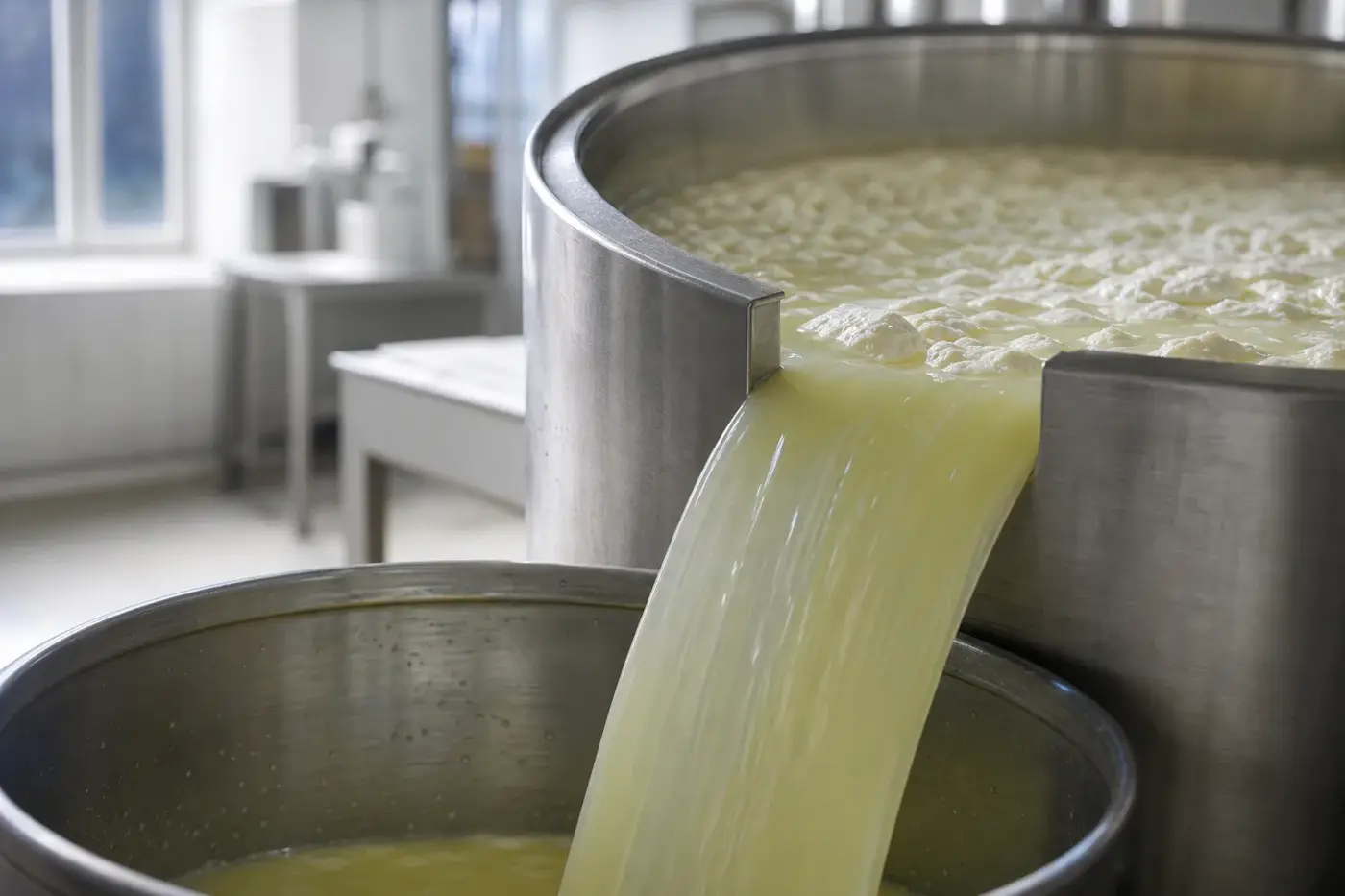
At the cheese vat, curd parts company with liquid whey.