Ornua and Kerrygold
Peel back that familiar gold wrapper and you’re opening a little of Ireland’s export story.
Peel back that familiar gold wrapper and you’re opening a little of Ireland’s export story. Kerrygold began in Britain in 1962, an Irish dairy brand created for a market abroad.[5] Behind it sits Ornua, a much larger cooperative linking farmers, milk-processing businesses and an international sales network. What reaches your basket under the Kerrygold name depends on where you shop.[1][2]
| At a glance | The details |
|---|---|
| Legal entity | Ornua Co-operative Limited, registered in Ireland as an industrial and provident society, number 3221R.[1] |
| Headquarters | Dublin, Ireland.[1] |
| Ownership | A dairy cooperative whose members are processors.[1] |
| Where Kerrygold fits | Ornua names Kerrygold as its brand; the UK site names Ornua Co operative Limited as trade mark owner.[2][3] |
| Other consumer brands | Dubliner, Pilgrims Choice, Forto and BEO.[1] |
| Ownership information | November 2026, from Ornua's published company information.[1][2] |
An Irish name makes its British entrance
The story begins with An Bord Bainne, the Irish Dairy Board. Ornua’s historical account dates its establishment to 17 May 1961.[5]
Kerrygold arrived the following year, its name chosen from a shortlist of six proposals. It launched in Britain in 1962, not Ireland. Export was part of the plan from the beginning, rather than a later adventure once the brand had settled in at home.[5]
In 2015, the Irish Dairy Board became Ornua. In 2016, Kerrygold Park opened in Mitchelstown, County Cork, bringing butter production and packing into a named Irish facility. Look beyond the brand’s farm imagery and you find another setting for its story: butter being made, packed and prepared for its onward journey.[5]
Follow the milk, meet the owners
Ornua’s members are Ireland’s dairy processors. It describes itself as working for those members and, through them, for Irish farmers. Farmers supply the processing businesses; those businesses hold Ornua membership. Calling Kerrygold simply farmer-owned folds two distinct relationships into one.[6]
The member directory gives that network names and places. You’ll find Aurivo in County Roscommon, Carbery in west Cork and Dairygold in Mitchelstown, substantial processors with different milk catchments and manufacturing roles. Carbery’s profile emphasises cheese production; Dairygold’s describes dairy ingredients. This is a broad processing network, not the output of a single farm.[7]
Follow the money and the same structure comes into view. Ornua reports purchases from member cooperatives, plus an additional Ornua Value Payment for products supplied. Those transactions are with processors, whose relationships with milk suppliers form the next stage. A payment to an Ornua member is not the same as a payment to an individual farm.[2]
There’s more beyond your butter dish
Ornua supplies supermarket shelves and businesses making other foods. Its Foods division handles consumer brands, while Ingredients procures Irish and non-Irish dairy products for food manufacturers and foodservice customers. The gold wrapper gets the recognition; the less visible side of the business goes into other companies’ products.[1]
Britain offers a useful glimpse of those different jobs. Ornua Foods UK says it markets cheese, butter and butter spreads under Kerrygold and Pilgrims Choice. At Leek in Staffordshire, its site packs hard cheese for retail and other customers. Selling, cutting and packing cheese are not the same as making it, so read a British business address alongside the product’s origin statement.[8]
The export traffic travels far beyond Britain. For the year ending 27 December 2025, Ornua reported shipping more than 14,000 containers of Irish dairy globally. Its results also describe customised cheese products for food manufacturing and quick-service restaurant customers in the US, Europe and Middle East. Your supermarket favourites and the ingredients behind other foods belong to the same international business.[2]
A familiar logo, a different shopping basket
You may recognise the logo, but the range does not travel unchanged. The UK catalogue in November 2026 lists salted and unsalted butter, spreadable blends, and natural and garlic-and-herb cream cheese. The spreadable combines Irish butter with rapeseed oil, so it has a different formulation from block butter.[9][10]
For cheese, the US Kerrygold Aged Cheddar product sheet describes a firm, smooth body and a milder flavour within its range. Those are the brand’s tasting descriptions: the character it intends for that cheese. Canada’s official Kerrygold site lists Reserve Cheddar separately. The market and exact product name tell you more than the familiar logo alone.[11][12]
| Where you’re shopping | Product | What the details tell you |
|---|---|---|
| UK | Pure Irish Salted Butter, 200 g | Gold-wrapped salted butter; the front of the pack states milk from Irish grass-fed cows.[3] |
| UK | Spreadable, 400 g | Butter blended with rapeseed oil.[10] |
| UK | Cheddar range currently sold | No current range specified here |
| US | Aged Cheddar | The product sheet gives a 1 oz (28 g) serving and lists sodium.[11] |
| Canada | Reserve Cheddar | Listed separately on the Canadian brand site.[12] |
Treat these as snapshots of each named market’s published information. Compare them with the pack in your hand, right down to its exact product name. If you fancy exploring the cheese style beyond one brand, head to the guide to Cheddar.
What does the grass-fed story tell you?
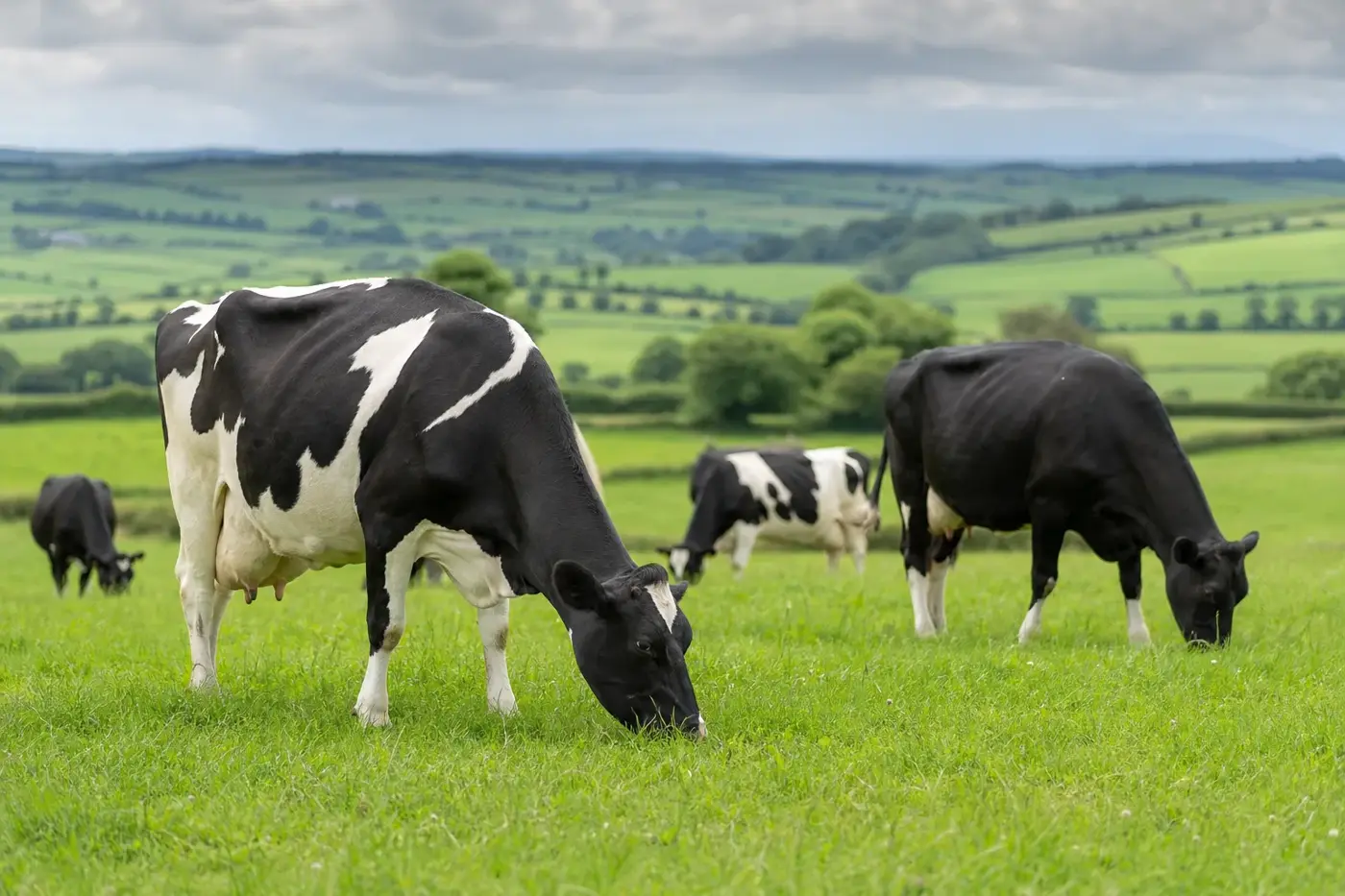
Kerrygold says its products use milk from cows registered on farms on the island of Ireland. It connects that supply with a temperate climate, rainfall and cows grazing outdoors for much of the year. Notice the geographical wording: the island of Ireland, not a particular farm or county.[6]
Bord Bia’s Winter 2025 explanation sets out the thresholds for its dairy grass fed scheme. Individual herds must achieve at least 90% grass in the diet over three years; the combined milk pool must reach a weighted average of at least 94.5%. The fresh-weight calculation includes grass forage.[13] These thresholds are not a rule for every Irish farm, nor do they alone establish certification for a particular Kerrygold product.
Grass-fed does not mean exclusively fresh-grass-fed. The standard allows some other feed, and grass forage includes material conserved for feeding later. For certified herds during 2022 to 2024, Bord Bia reports an annual average of 253 grazing days. That is a measured average across those herds, not a fixed number of outdoor days for every cow.[13]
Three label clues worth keeping apart
Kerrygold is the brand, Cheddar is the cheese style, and an Irish origin statement is the supplier’s declaration of provenance. Give each its own job and the label becomes easier to read. Kerrygold’s UK website identifies Kerrygold and its associated logos as trade marks owned by Ornua Co-operative Limited.[3][11]
Neither a brand name nor an Irish origin statement establishes a protected geographical designation by itself. For that, you need the exact designation and the official register in the jurisdiction concerned. The guide to protected names explains PDO and PGI terminology, helping you distinguish those protections from other wording on a pack.
Put butter and cheese on equal terms
Butter and cheese have different nutritional profiles. Their published serving sizes can make comparisons harder, too. UK Kerrygold Pure Irish Salted Butter lists 80 g fat and 0.6 g protein per 100 g, including 53 g saturated fat. The US Aged Cheddar sheet lists 10 g fat and 6 g saturated fat per 1 oz (28 g) serving.[11][14]
Bring the butter closer to that serving weight and 30 g calculates to 24 g fat and 15.9 g saturated fat. That puts the cheese serving in perspective without confusing a tablespoon-sized spread with a piece of cheese. For everyday comparisons, match the weights first, then look at fat, saturated fat, protein and salt. The farming story and the nutrition panel answer different questions.[11][14]
Look beyond exports to the environmental picture
For Ornua’s processors, the commercial benefit is a shared route to consumers beyond their own locality. Reported member purchases, working-capital support and the Value Payment show how the export organisation connects that activity with its suppliers. Working together opens markets beyond the member businesses’ individual reach.[2]
The environmental picture needs a different set of measures. Ireland’s EPA reports that agriculture accounted for 37.9% of national greenhouse gas emissions in 2024, principally methane from livestock and nitrous oxide associated with fertiliser and manure. Its final inventory summary, updated in April 2026, records a 31.9% rise in dairy cow numbers and a 49% rise in milk production between 2014 and 2024.[15]
Water brings another pressure into view. The EPA identifies excess nitrogen and phosphorus, mainly from agriculture and urban wastewater, among the causes of poor water quality. In its assessment for 2019 to 2024, 52% of surface waters were in good or high ecological status. The remaining 48% were in unsatisfactory condition.[16]
Bord Bia’s buyer guide promotes Irish grass-fed dairy through a comparison of greenhouse gas footprints within the EU. Read that industry framing alongside the EPA’s national emissions and water-quality monitoring. Impact per unit of product and the consequences of the total volume produced tell you different things about environmental performance.[17][15][16]
Turn the pack over for five useful checks
The small print has plenty to tell you, even if it rarely gets top billing. UK butter information declares Irish origin while giving both a Staffordshire business address and an Irish cooperative address.[14] Those details do different jobs, so give each its turn.
- Start with the food’s name. Salted butter, a butter-and-oil spread and Cheddar are different products. The UK spreadable description specifically names rapeseed oil. Read the formulation rather than expecting the shared gold packaging to explain everything inside.[3][10]
- Look closely at the origin words. A statement about Irish milk is different from one about where the finished food was made. Kerrygold’s milk explanation covers farms across the island of Ireland; the UK butter’s product information separately declares Ireland as its country of origin.[6][14]
- Read ingredients and nutrition together. Look for added oils, salt and additional flavourings. Compare equivalent weights, then notice whether the panel reports salt or sodium. The UK butter transcription and US Cheddar sheet use different conventions.[11][14]
- Find the responsible business and any named producer. A distributor, packer or brand owner can appear without identifying the cheesemaking dairy. Ornua Foods UK’s account of its Leek packing operation shows why it pays to keep those roles separate.[8]
- Find the storage and date instructions. Note the exact product, pack size and directions after opening. Keep the batch information if you contact the supplier with a question. Follow that pack’s instructions, rather than borrowing them from another Kerrygold product.
For more help with the information surrounding the logo, see how to read a cheese label. Once your shopping is home, follow the country-specific sources in how to store cheese at home.
Questions people ask
Who owns Kerrygold?
Kerrygold is a brand owned by Ornua Co operative Limited. Ornua’s members are Irish dairy processors, which receive milk from farmers.
Where does Kerrygold milk come from?
Kerrygold says its milk comes from cows registered on farms across the island of Ireland. The claim does not identify a particular farm or county.
Does grass fed mean Kerrygold cows eat only fresh grass?
Grass fed does not mean exclusively fresh grass fed. Bord Bia’s dairy scheme allows a proportion of other feed and includes grass forage, but certification of a particular Kerrygold product has not been verified.
What is the difference between Kerrygold butter and its spreadable product?
The UK spreadable product combines Irish butter with rapeseed oil. It therefore has a different formulation from block butter.
Why does a Kerrygold pack have a Staffordshire address if the butter is Irish?
The UK butter information declares Irish origin while giving both a Staffordshire business address and an Irish cooperative address. Ornua Foods UK also says its Leek site in Staffordshire packs hard cheese, a role separate from making it.
Sources
- Ornua, Our Co-Operative, undated live company account, retrieved November 2026. Includes its legal identity, registration number, headquarters and divisional responsibilities.
- Ornua, Ornua publishes Full-Year Results for 2025, 15 April 2026, reporting the year ending 27 December 2025. Company statement.
- Kerrygold UK, Kerrygold Pure Irish Salted Butter 200g, undated live product page and published front-pack image, retrieved November 2026. Includes the site's trade mark ownership statement.
- Irish Statute Book, Dairy Produce Marketing Act, 1961, Number 1 of 1961, as enacted, sections 3 to 5. Official text retrieved through search; direct opening was subsequently blocked.
- Ornua, History, undated corporate historical account, retrieved November 2026, entries for 1961, 1962, 2015 and 2016.
- Kerrygold UK, Milk from Irish Grass-Fed Cows, undated live explanation, retrieved November 2026. Brand statements about milk sourcing and the processor relationship.
- Ornua, Member Co-Operatives, undated live directory, retrieved November 2026, Aurivo, Carbery and Dairygold profiles.
- Ornua, Ornua Foods UK, undated live business profile, retrieved November 2026.
- Kerrygold UK, Products, live UK catalogue and published pack descriptions, retrieved November 2026.
- Kerrygold UK, Kerrygold Spreadable 400g, undated live product page and pack description, retrieved November 2026.
- Kerrygold product information distributed through Syndigo, 136885: Aged Cheddar Cuts, product sheet, revision date not verified. Retrieved product text includes tasting descriptions, serving size and nutrition declarations.
- Kerrygold Canada, Kerrygold Reserve Cheddar Cheese, undated official product listing, retrieved through search in November 2026.
- Bord Bia, Farmer Newsletter, Winter 2025, grass-fed dairy section. Official scheme explanation, including feed thresholds and grazing statistics.
- BB Foodservice, Kerrygold Pure Irish Butter 200g, undated product-label transcription, retrieved November 2026. Retail EAN 5011038138882. Used specifically for declared nutrition, ingredients, origin and business addresses.
- Environmental Protection Agency, Ireland, Agriculture, final 1990 to 2024 inventory data, updated April 2026.
- Environmental Protection Agency, Ireland, Water quality and agriculture, live explanation incorporating the 2019 to 2024 assessment, retrieved November 2026.
- Bord Bia, Buyer Guide: Grass Fed Dairy from Ireland, undated promotional guide containing 2021 export data, retrieved November 2026. Used as evidence of Bord Bia's promotional framing, rather than independent validation of its comparative environmental claim.
Researched through company records, historical legislation, published product information, Bord Bia scheme explanations and EPA environmental assessments, with company claims distinguished from independent official monitoring.
Last checked: November 2026
Last checked November 2026.
The editors suggest you read next
Who Makes the World's Cheese? The Big Dairy Groups
You pick up Galbani at the cheese counter, then pause over Kerrygold.