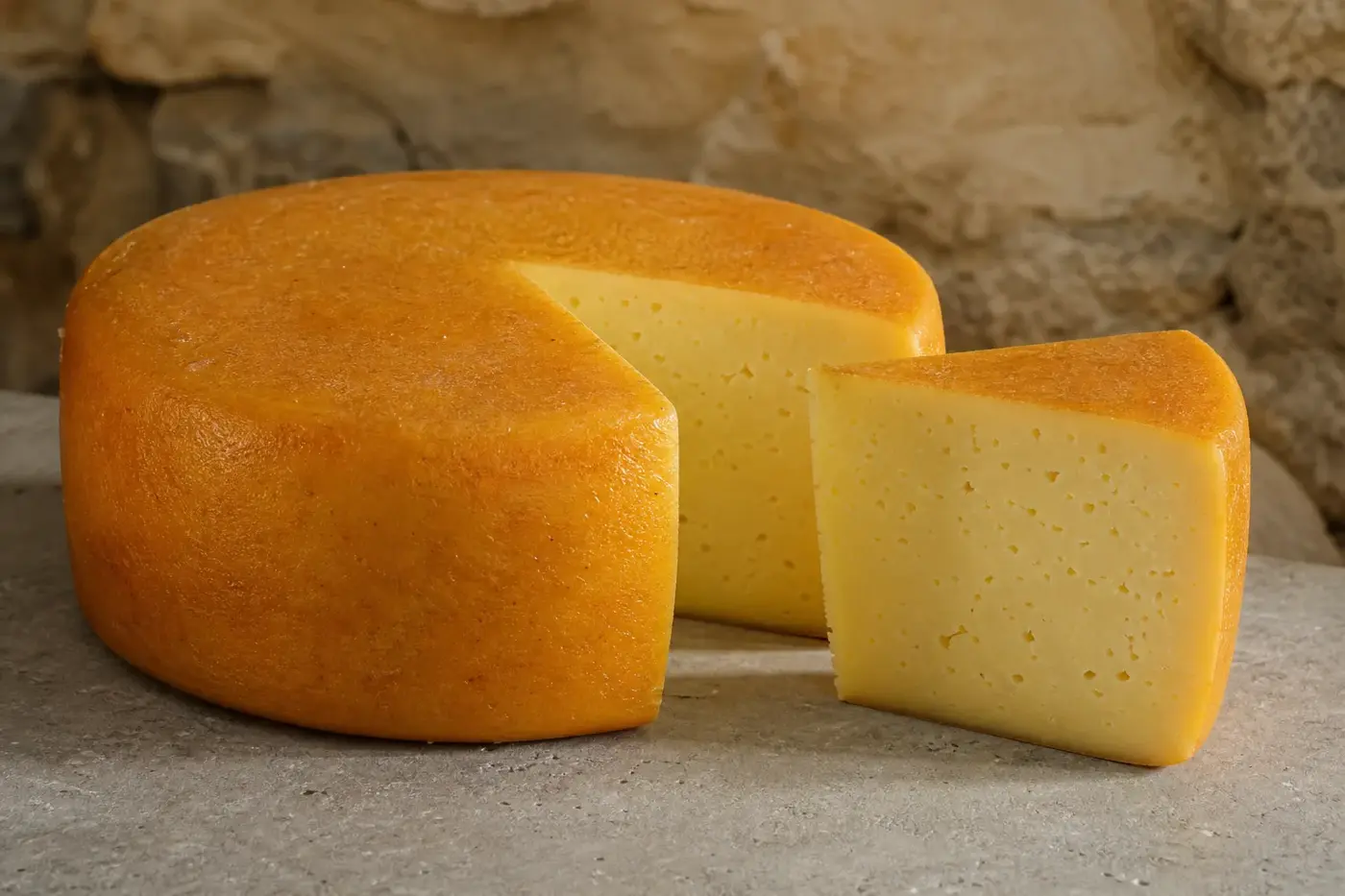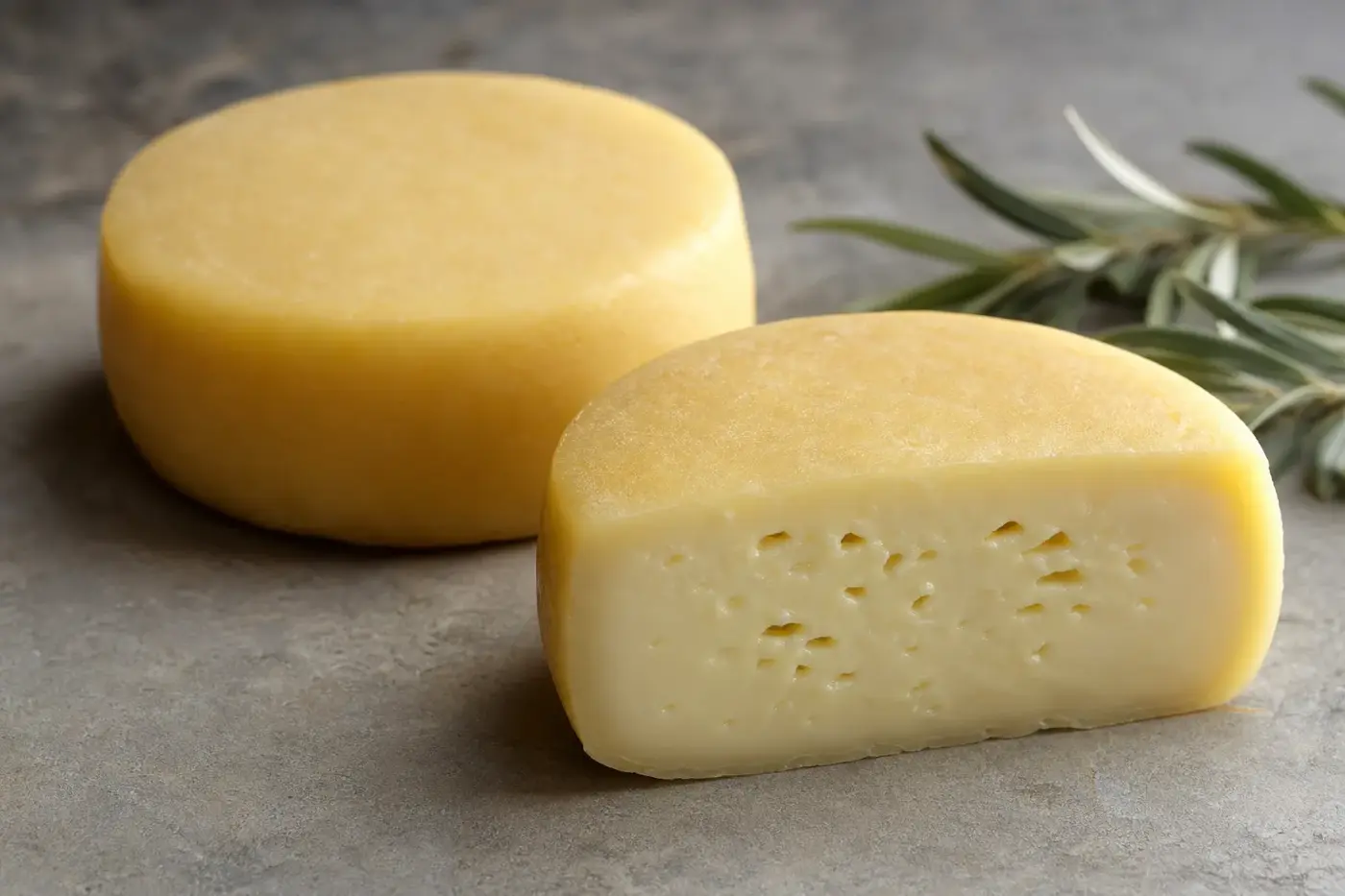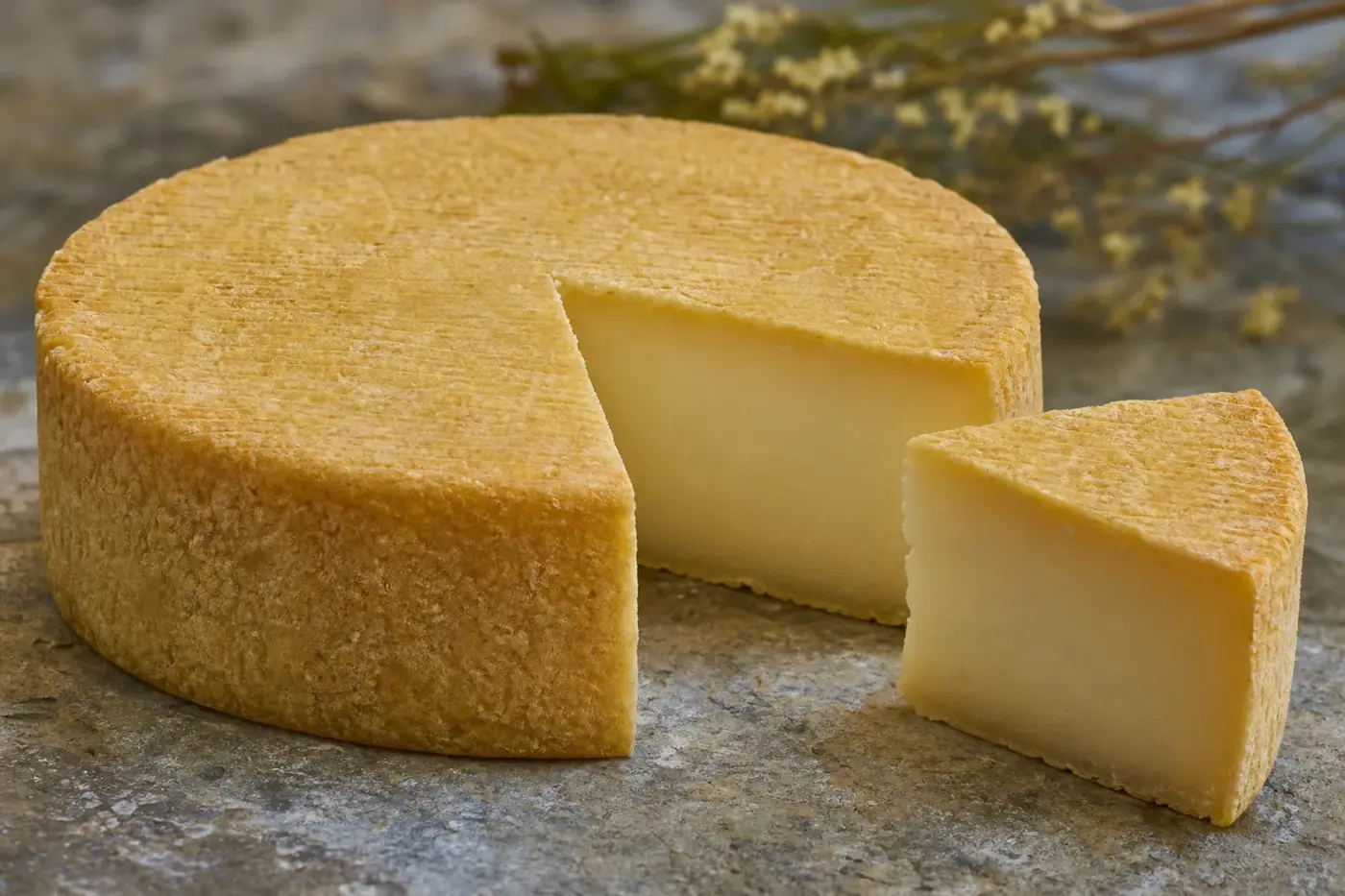
First, a white slice with a close texture. Then a little peppery warmth arrives at the finish. Kiwa’s description of Queijo de Cabra Transmontano invites you into the uplands of Trás-os-Montes, home to this matured goat’s cheese.[2][4] Serrana goats supply the milk; patience takes it from there.
This Portuguese cheese holds PDO registration in Great Britain as of November 2026.[3][4] Before you follow the goats into the landscape behind the name, here are the details worth taking to the cheese counter.
| What you might want to know | The detail |
|---|---|
| Familiar name | Queijo de Cabra Transmontano |
| Registered name | Queijo de Cabra Transmontano / Queijo de Cabra Transmontano Velho.[3] |
| EU register identifier | EUGI00000013236, linked by Portugal’s agriculture authority.[1] |
| EU protection | PDO in official Portuguese records; current live register status unconfirmed.[1] |
| Great Britain protection | Registered PDO; UK scheme registration dated 31 December 2020; November 2026 record.[3] |
| Where it comes from | Delimited production area in north-eastern Portugal.[2] |
| Milk and coagulant | Raw milk exclusively from Serrana goats; animal rennet.[4] |
| Minimum time maturing | 60 days; 90 days for Velho.[2][4] |
| Allergen | Milk.[4] |
Take the goats’ route through Trás-os-Montes
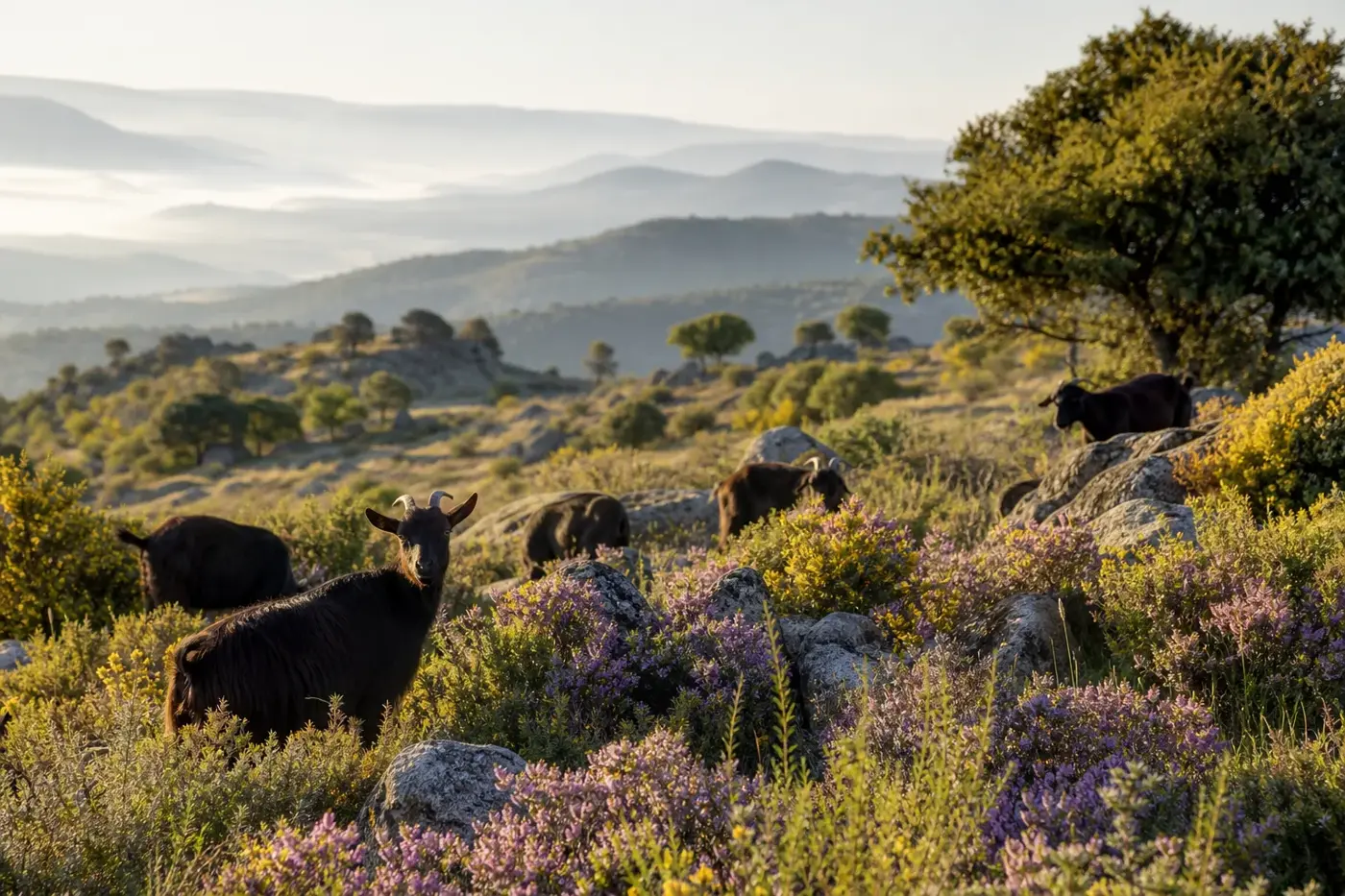
Trees, scrub, pasture: the goats’ daily grazing routes take in all three. In the historical production specification, those routes change with the season, the animals’ needs and the vegetation available. You are looking at extensive husbandry across a working landscape, rather than goats confined to the picture of one open field.[5]
Trás-os-Montes lies in north-eastern Portugal, among plateaux, mountain barriers and deeply cut valleys. The specification describes country shaped by the Douro river system, with soils principally derived from granite, schist and greywacke. Mountain ranges hold back maritime influence; towards the Douro, conditions become more Mediterranean.[5]
The boundaries deserve a careful look. The 2012 EU document uses “Miranda”, while the certification body lists “Mirandela”. The sources also differ on the area covered.[1][2][4][5]
At the cheese counter, keep the delimited production area separate from the broader regional name. “From Trás-os-Montes” tells you something, but not as much as the complete cheese designation.
Meet the Serrana goats with a varied menu
Serrana is not merely a pleasing detail on the label. It is the breed required by the published PDO document, and the goats must live within the defined geographical area. Milk production, cheesemaking and maturation must happen there too.[4]
Their menu has more variety than “mountain milk” might suggest. The document describes browsing spontaneous vegetation on pasture, common land, uncultivated ground and fallow fields. Tree shoots and leaves join shrubs including broom and heather.[4]
Portugal’s agriculture authority attributes the cheese’s distinctive character to its milk and its established production method.[1] Breed and grazing provide the starting material. Draining, salting and ripening then shape the cheese you take home.
That gives you a useful starting point when buying. This is a matured goat’s cheese to cut, rather than a fresh one to spread. “Goat’s cheese” alone is a rather brief introduction.
Give the protected name a closer look
The protected designation ties this cheese to a place and a method. PDO means protected designation of origin; the Portuguese DOP stands for Denominação de Origem Protegida. Here, the published requirements cover the geographical boundary, milk source, animal rennet, production stages and finished characteristics.[2][4]
Both Queijo de Cabra Transmontano and Queijo de Cabra Transmontano Velho appear in the registered wording. Look for “Velho” if you want the documented, longer-matured form. It brings requirements of its own, rather than simply a longer name.[3][4]
The product document requires the designation, certification mark and EU PDO symbol on the cheese or its packaged portions.[4] If you are buying a cut piece, ask to see its original identification. That gives you more to go on than a handwritten counter description.
You can explore how origin protection differs from other quality schemes in protected cheese names. Jurisdiction matters too: the Great Britain register separately records this name as a registered PDO.[3]
This page summarises published guidance from the official sources it cites. It is not medical advice. Guidance differs between countries and changes over time, so check the current source for where you live, and ask your doctor, midwife, pharmacist or dietitian about your own circumstances.
Step into the dairy, from milk to mould
Filtering comes first, followed by temperature adjustment and animal rennet. The historical specification then takes you through coagulation, moulding, pressing, salting, drying and maturation. Salt goes on after the cheeses leave their moulds; turning and washing follow during ripening.[5]
Coagulation means the milk sets into curd. As the curd drains, liquid whey escapes, and pressing helps squeeze more out while building that compact structure. For the wider story, follow how cheese is made.
The published dairy accounts differ in their details. Portugal’s agriculture authority describes preparation at about 35 °C, while a commercial technical sheet gives approximately 30 °C.[1][6] Treat those temperatures as part of their individual accounts, not interchangeable instructions. The sequence is your more useful guide.
Animal rennet is an explicit part of the documented identity.[4] If the coagulant matters to your choice, ask directly. Portuguese origin does not automatically mean a plant-derived coagulant.
Let Velho take its time
Velho keeps you waiting longer, with a firmer cheese at the end. The published single document sets minimum maturation at 60 days for Queijo de Cabra Transmontano and 90 days for Queijo de Cabra Transmontano Velho. Ripening takes place at 5 to 12 °C and 70 to 85% relative humidity.[4]
Those figures belong in the cheesemaking room. They are not instructions for storing your wedge at home.
At the table, texture helps you understand the difference. The younger form is described as semi-hard; Velho is hard to extra-hard. The document also gives Velho a lower moisture range and smaller finished weight ranges, pointing towards a firmer cheese to appreciate in smaller bites.[4]
If you prefer easy slicing, ask for a less mature example. If a more resistant texture appeals, enquire about Velho. Age tells you about the experience, not which cheese deserves first prize.
Find the white paste and peppery finish
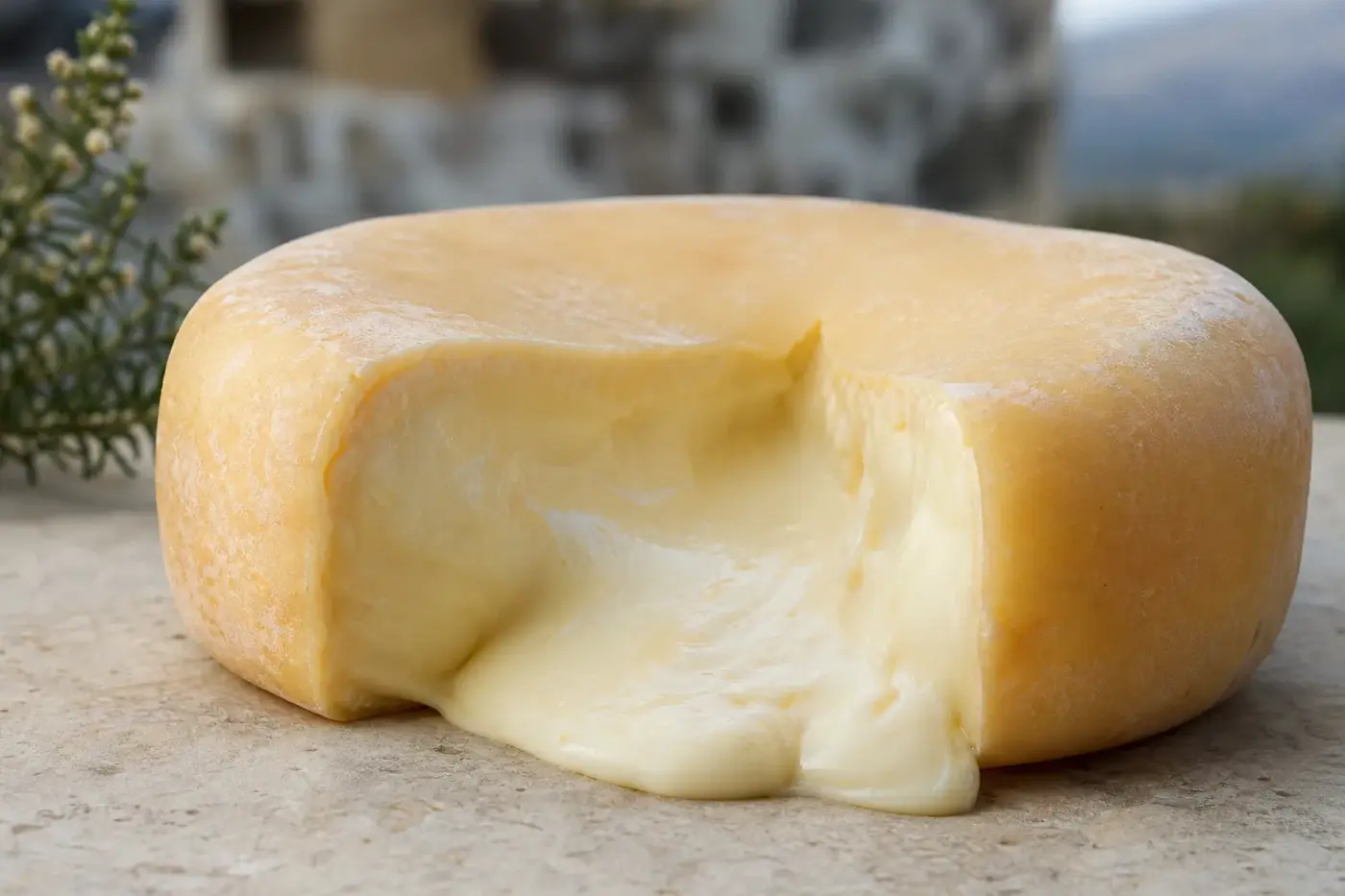
Look at the cut face for uniformly white paste, a close texture, some small openings and little surface oiliness. The published shape is a low cylinder with a regular outline. Its two permitted diameter bands are 6 to 12 cm and 12 to 19 cm, with a height of 3 to 6 cm.[4]
The younger cheese has a smooth, white, semi-hard rind. Velho’s exterior is harder and can be white or reddish. That reddish colour comes from an authorised treatment of olive oil and paprika.[4]
Kiwa, the certification body, describes an intense, pleasant aroma and a clean flavour, usually followed by a slight peppery aftertaste.[2] Think of that as the published sensory portrait, rather than a fromage.co.uk tasting account. It gives you something to look for when choosing your piece.
Take three good questions to the counter
Is this the PDO cheese? Which form is it, and how mature is this particular wheel? Ask to see the label and cut face together, so you can match the cheese to your preferences while allowing for differences between wheels.
A smaller format lets you explore without committing to a larger wheel. Packaged portions also come within the product document’s traceability provisions.[4] Keep their identification and storage instructions with them.
At home, follow that product’s refrigeration and after-opening directions. Proper chilling helps prevent harmful bacteria from growing, as the Food Standards Agency explains in its consumer guidance linked below.[7] For wrapping and fridge organisation, turn to storing cheese at home.
Ask the seller about the rind and any surface treatment. You can trim a hard exterior away if you prefer to focus on the paste. Keep two questions separate, though: how the rind feels, and whether it is edible.
Give the first bite the plate to itself
Cut manageable wedges or slender slices, leaving enough room on the plate to appreciate the white paste. Try your first piece alone, before bread or anything sweet. Give yourself a moment to notice the cheese on its own terms.
Coalho, a commercial cheese supplier, recommends wedge-shaped pieces as a starter or at the end of a meal, alongside rye bread and red wine.[8] That is a straightforward place to begin. Serving cheese need not become an evening examination.
Keep accompaniments separate for your first comparison. Taste one bite plain, another with bread and another with your chosen drink. You will soon find the combinations you want to return to.
Start your plate with rye bread
Rye bread is the clearest accompaniment supported by the sources.[8] You could build a restrained Portuguese-style plate around it, with a little quince paste, a few walnuts or sliced pear. Leave enough space for the cheese to remain the point.
Start with bread as a neutral companion. Then try a small amount of quince paste for sweetness, or pear for a fresher bite. These are serving suggestions, not prescribed regional combinations.
For adults of legal drinking age who choose alcohol, Coalho’s red-wine recommendation offers a starting point.[8] Try a Portuguese red with a small piece of cheese before choosing that pairing for the whole table.
Make room for alcohol-free choices too. Water gives you an uncluttered comparison; unsweetened tea is another suggested alternative. Serve alcoholic drinks in small amounts, and choose an alcohol-free accompaniment whenever alcohol is unsuitable.
Taste goat’s milk alongside Terrincho’s sheep’s milk
If you are comparing Portuguese cheeses, begin with the milk. Queijo de Cabra Transmontano belongs to the goat’s-milk tradition described here. Coalho lists Queijo Terrincho and Queijo Terrincho Velho among its sheep’s cheeses.[8]
These make interesting tasting companions, but their names are not interchangeable. If both are available, ask for pieces of comparable maturity. Taste them separately before adding accompaniments, comparing aroma, firmness and finish without a large age gap dominating the experience.
Take the same useful questions to other Portuguese cheeses: which milk, which coagulant, which origin and which maturation? A shared nationality leaves plenty of room for distinct production traditions. A few thoughtful pieces on your plate can make those differences wonderfully clear.
Raw milk and pregnancy: understand the UK guidance
Queijo de Cabra Transmontano is documented as a raw-milk cheese.[4] If you would like help with the processing terms, see raw, thermised and pasteurised cheese. The distinction matters, but so does the category of cheese.
In its November 2026 guidance, the UK NHS lists pasteurised or unpasteurised hard cheeses among foods that can be eaten during pregnancy. It separately says mould-ripened soft cheeses and soft blue cheeses must be thoroughly cooked until steaming hot.[9]
The NHS groups this advice by product category, not by this Portuguese name. Compare the particular cheese’s description with current advice, and ask your midwife or another appropriate healthcare professional about your circumstances. If you live elsewhere, consult your own country’s official guidance.
Questions people ask
Where does Queijo de Cabra Transmontano come from?
It comes from a delimited production area in north eastern Portugal. It is made exclusively with raw milk from Serrana goats.
What is the difference between Queijo de Cabra Transmontano and Velho?
The standard cheese must mature for at least 60 days, while Velho must mature for at least 90 days. The standard cheese is described as semi hard, whereas Velho is hard to extra hard.
Is Queijo de Cabra Transmontano vegetarian?
The published product document specifies animal rennet. Check the coagulant directly if it matters to your choice.
Can I eat Queijo de Cabra Transmontano during pregnancy?
The NHS lists pasteurised or unpasteurised hard cheeses among foods that can be eaten during pregnancy. It separately advises that mould ripened soft cheeses and soft blue cheeses must be thoroughly cooked until steaming hot. Check the particular cheese against current NHS pregnancy guidance and ask your midwife or another appropriate healthcare professional about your circumstances.
What can I serve with Queijo de Cabra Transmontano?
Cheese supplier Coalho recommends serving wedges with rye bread and red wine. The page also suggests quince paste, walnuts or sliced pear.
Sources
- Direção-Geral de Agricultura e Desenvolvimento Rural, Queijo de Cabra Transmontano PDO, undated official product overview, retrieved November 2026. Includes the official link to eAmbrosia record EUGI00000013236.
- Kiwa, Queijos e Produtos à base de Leite com Certificação DOP, undated certification information, Queijo de Cabra Transmontano section, retrieved November 2026. Kiwa is a certification body, not the registration authority.
- Department for Environment, Food & Rural Affairs, Queijo de Cabra Transmontano / Queijo de Cabra Transmontano Velho, Great Britain protected food names register, published 4 January 2021, retrieved November 2026.
- European Commission, Publicação de um pedido de alteração em conformidade com o artigo 6.o, n.o 2, do Regulamento (CE) n.o 510/2006, including the single document for Queijo de Cabra Transmontano / Queijo de Cabra Transmontano Velho, Official Journal C 163, 9 June 2012, pages 5 to 10. Amendment approval is identified as Commission Implementing Regulation (EU) No 436/2013 in Official Journal L 129, 14 May 2013. Current consolidated specification requires editorial confirmation.
- Portuguese Ministry of Agriculture, Normas de produção do Queijo de Cabra Serrano Transmontano, historical specification hosted by DGADR, undated scanned compilation, retrieved November 2026. Used for landscape, husbandry and the historical production sequence, not current legal limits.
- Sabores das Nossas Raças, Ficha técnica de produto: Queijo de Cabra Transmontano DOP, document MOD.15/00, undated, retrieved November 2026. Commercial technical account, used only for its reported milk-preparation temperature.
- Food Standards Agency, How to chill, freeze and defrost food safely, published 18 December 2017, retrieved November 2026. Publication states that it applies to England, Northern Ireland and Wales.
- Coalho, Queijo de Cabra Transmontano (DOP), undated commercial product page, retrieved November 2026. Used for attributed serving suggestions and its classification of Terrincho among sheep’s cheeses.
- NHS, Foods to avoid in pregnancy, current online guidance retrieved November 2026, cheese and dairy section.
Researched from official product documents, registration and certification records, published commercial accounts and UK public food guidance, with historical specifications distinguished from later documents.
Last checked: November 2026
Last checked November 2026.
The editors suggest you read next
Queijo Serra da Estrela
Cut into Queijo Serra da Estrela and watch its pale interior gently abandon its shape.