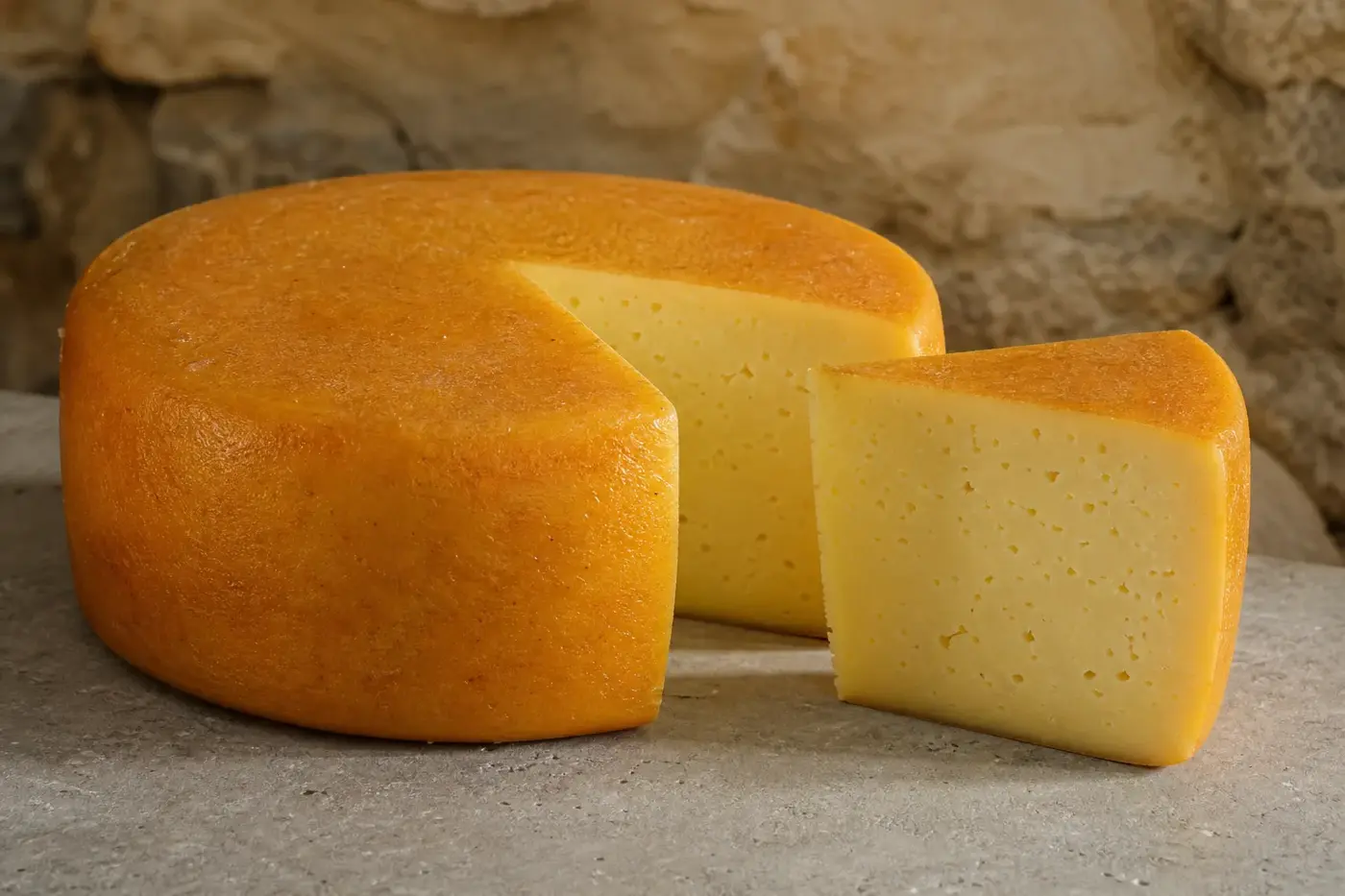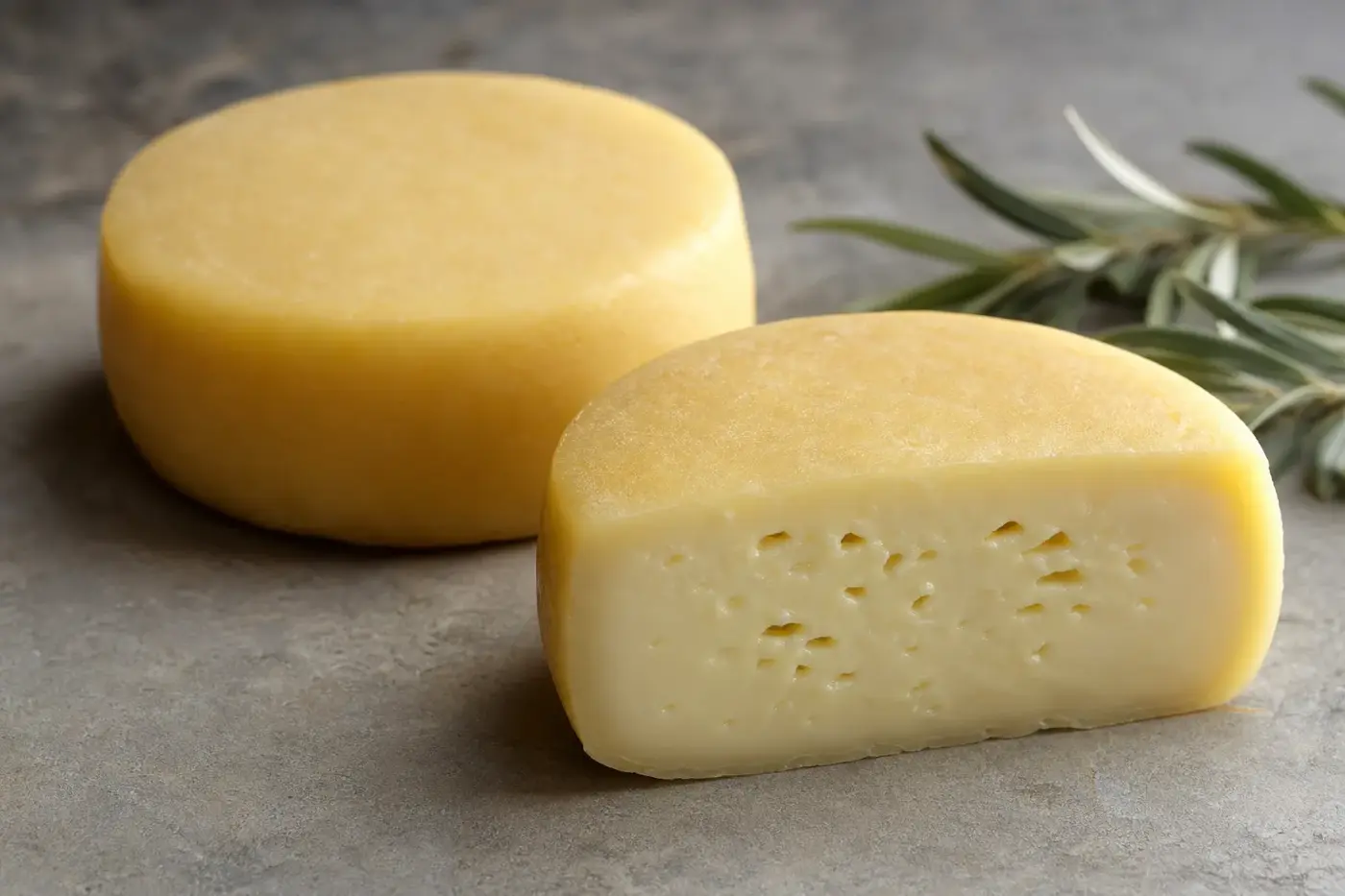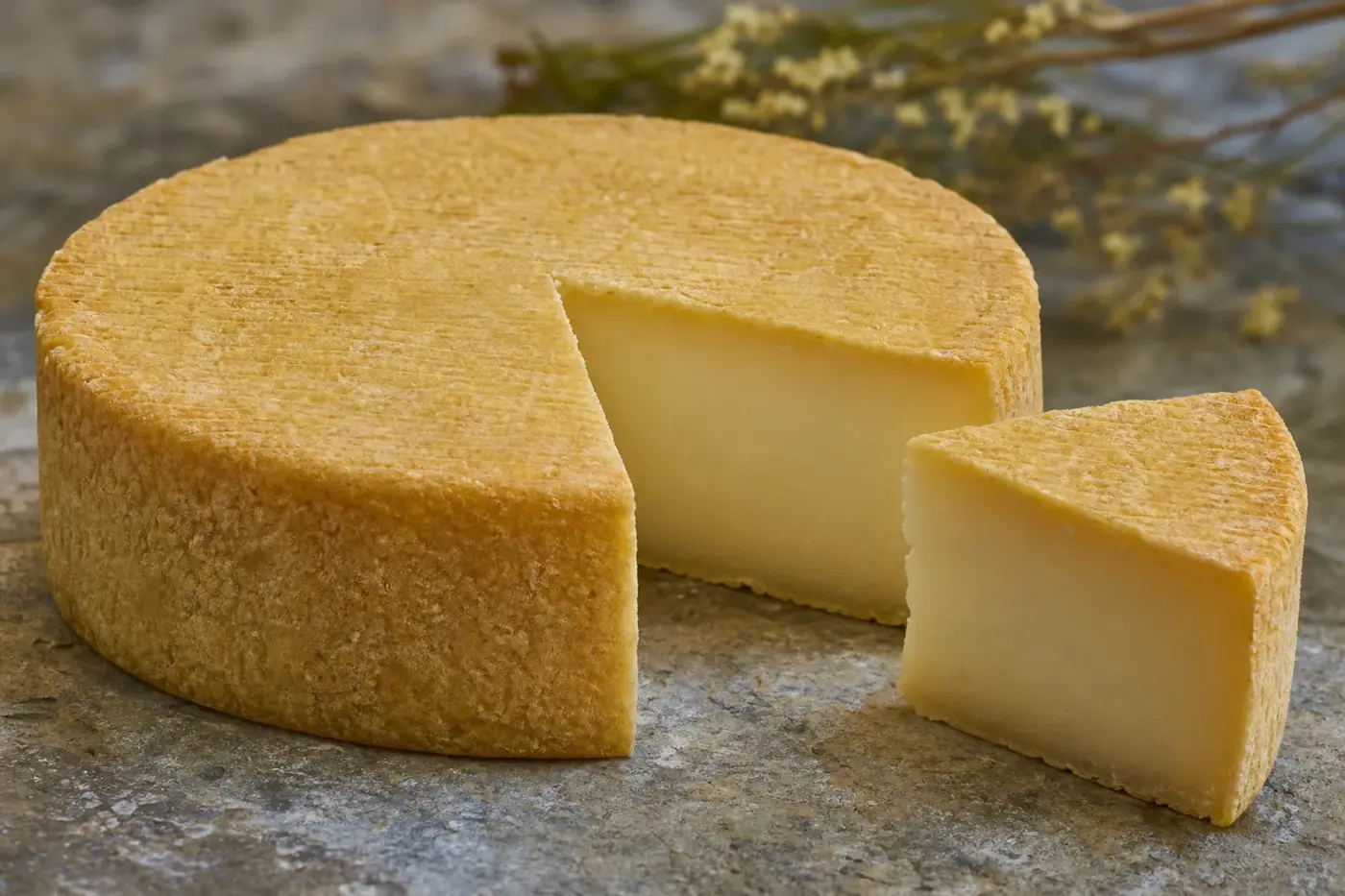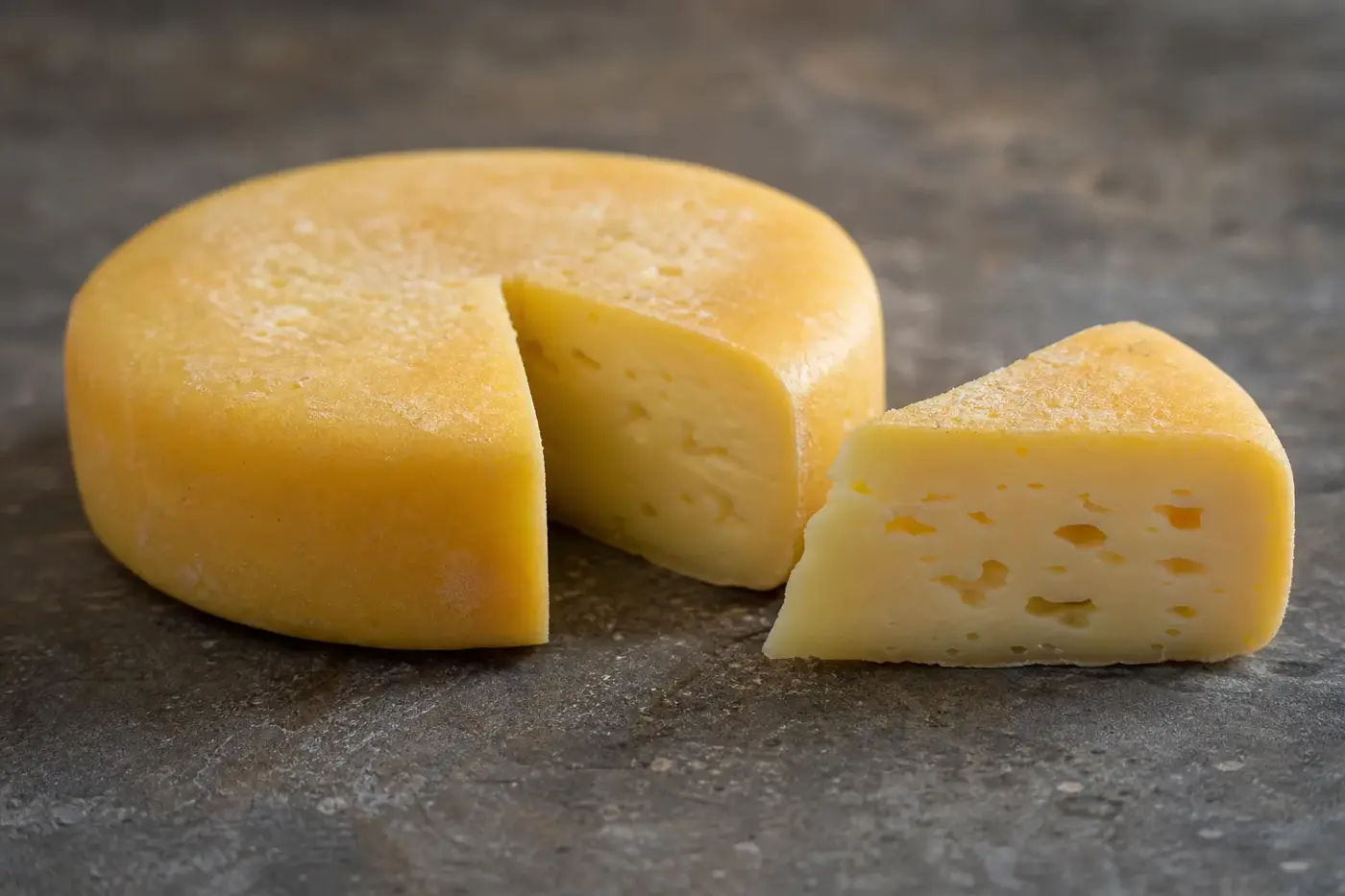
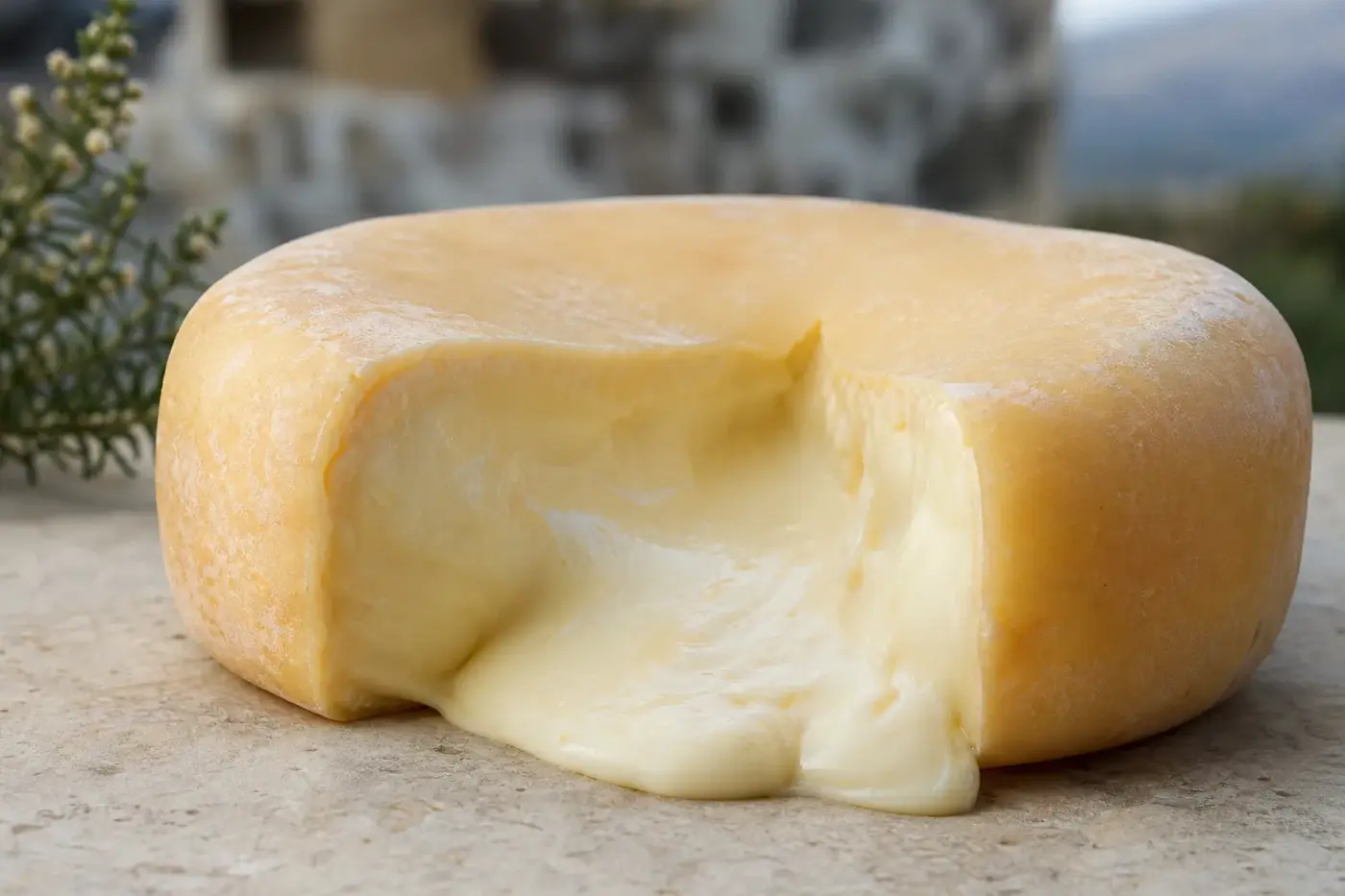
Cut a narrow wedge. There is the yellow rind, then a pale, yielding heart and an intense aroma. Just 2 to 3 cm high, Queijo do Pico takes up little vertical space and rather more of your attention. This small, soft cow's milk cheese comes from Pico, in Portugal's Azores; the Azorean agricultural authority describes irregular openings and a pronounced, salty flavour. [1][2]
| What you might want to know | The details |
|---|---|
| Familiar and registered name | Queijo do Pico. [3] |
| Where it comes from | Pico island, Azores, Portugal. [1][2] |
| EU register reference and current status | Unspecified. [4] |
| Great Britain protection | Registered PDO; UK scheme registration dated 31 December 2020 at 23:00. Status information: November 2026. [3] |
| Original EU registration date | 19 June 1998, recorded by Defra. [3] |
| Milk and coagulant | Raw cow's milk; animal rennet. [2] |
| Shape and size | Low, rounded cylinder, 16 to 17 cm across and 2 to 3 cm high. [2] |
| Specified wheel weight | Unspecified |
| Rind and interior | Yellow rind; yellowish-white, soft, pasty interior with irregular openings. [2] |
| Legal minimum maturation | Unspecified |
| Allergen | Milk. [2] |
| Pregnancy guidance | UK NHS guidance, November 2026: see source [7]. |
Begin in Pico's pastures
This is one island's cheese, not a cheese of the Azores as a whole. Portugal's agricultural authority, DGADR, identifies Pico as its geographical production area. It connects Queijo do Pico with extensively managed dairy cattle and their access to pasture plants, including ryegrasses and trefoil. The story begins with farming, before you reach the cheesemaking. [1]
The island supplies the setting, grazing and accumulated working knowledge. On your plate, the authorities describe something more specific: soft paste and pronounced saltiness. Pico's landscape gives the cheese its context, but you need not search your mouthful for a literal taste of volcanic rock. [1][2]
For your first encounter, pause before reaching for anything else. Look at the shallow wheel and its cut surface, then taste a small piece alone. Bread and a drink can join you afterwards, once you have an impression of that particular cheese.
A shallow wheel with a generous character
Think plate rather than tall drum. The Azorean Institute for Food and Agricultural Markets, IAMA, describes a rounded, plate-like cylinder. Cut a narrow wedge and those shallow proportions show you rind and interior together, with very little ceremony. [2]
Under the rind, the paste, or body of the cheese, is soft, pasty and unctuous. Irregular openings break up its relatively loose interior. You are looking for a yielding cheese, rather than a dense block or a smooth paste without openings. [2]
IAMA describes an intense, characteristic aroma and an active, salty flavour. Those words are useful starting points when you talk to a cheesemonger. Ask how they would describe the wheel in front of you. [2]
Ask about maturation and condition, too, because individual wheels can vary. Cut a thin wedge, then decide whether you prefer it alone or spread across bread. If you keep notes, choose words that will help next time: “yielding” or “resistant”, “restrained” or “pronounced”. “Strong” is doing an awful lot of work on many a cheese lover's notepad.
This page summarises published guidance from the official sources it cites. It is not medical advice. Guidance differs between countries and changes over time, so check the current source for where you live, and ask your doctor, midwife, pharmacist or dietitian about your own circumstances.
Raw milk, patient hands and a shallow mould
Raw cow's milk and animal rennet begin the documented making process. Rennet is the coagulant that turns liquid milk into curd, the solid portion that becomes cheese. Whey is the liquid drained away from it. [2][5]
A University of the Azores dissertation follows the traditional sequence from milk filtration through rennet addition, coagulation, cutting and whey removal. Moulding, hand pressing, salting and maturation follow. Cheesemakers fill the moulds manually, using cloth to hold the curd while the whey escapes. [5]
Each stage calls for practical judgement. Curds need handling, moulds need filling evenly and the shallow wheels need shaping. Salt goes onto the faces of each cheese before the tending work of maturation begins. Here, “traditional” means particular jobs done by hand, not simply an appealing word on a label. [5]
During ripening, the dissertation records turning the cheeses and attending to their edges. The finished shape owes much to this handling after coagulation, not just the moment milk becomes curd. This describes an established production sequence, rather than a method for making the cheese at home. [5]
If you would like the wider picture, how cheese is made takes you through coagulation, draining and ripening. The guide to milk treatments explains the differences between raw, thermised and pasteurised milk.
At the counter, ask for Pico by name
DOP stands for Denominação de Origem Protegida, the Portuguese equivalent of PDO in English. Defra records the registered name as Queijo do Pico. The Portuguese authorities identify its production area as Pico island. [1][3]
A place name and a protected designation are not the same thing. Ask specifically for Queijo do Pico DOP, then look at the designation and traceability information on the product. The original label gives you more to go on than an island name in a shop description.
Great Britain's official register lists Queijo do Pico as a registered PDO. Its UK scheme registration is dated 31 December 2020 at 23:00. The original EU registration date, recorded separately, is 19 June 1998. These mark different registration events. [3]
The guide to protected cheese names explains how a geographical designation differs from a style or brand. Keep the registered name in view as you choose. Look for a clear designation supported by the original packaging, rather than relying on a familiar island reference.
Meet the work behind each wheel
Manual mould filling, pressing, salting and repeated attention during ripening put cheesemakers at the heart of Queijo do Pico. The University of the Azores account places tradition firmly in daily work. These are the tasks that give each wheel its form and carry it through maturation. [5]
The cheese's history has two distinct strands. DGADR reports island residents' accounts placing production in the late eighteenth century, alongside official references from 1867 and 1877. One strand preserves recollections of its beginnings; the other provides dated documentary references to its existence. [1]
The Portuguese authorities name the Associação de Produtores de Queijo do Pico as the producer group associated with the designation. That gives the cheese a collective identity beyond any single dairy or retail label. There are people behind the place name. [1][2]
Ask your seller who made the cheese, not only where it comes from. Keep the maker's name with your tasting notes. Over time, that small habit helps you distinguish wheels and makers, without expecting every cheese carrying the same regional name to eat identically.
Give Pico and Queijo S. Jorge room of their own
If Queijo do Pico and Queijo S. Jorge share your Azorean cheese selection, give each separate attention. For Pico, begin with the described characteristics: a shallow wheel, soft paste and irregular openings. Let those details guide your first look and taste. [2]
Ask the seller to describe each cheese's milk treatment, maturation and texture separately. The characteristics of Queijo S. Jorge remain unspecified in this comparison. A shared Azorean origin is not, by itself, a guide to how the cheeses will eat.
Choose according to the part you want each cheese to play. For a side-by-side tasting, keep the accompaniments simple and note each maker and stated age before adding your impressions. Separate notes will make the comparison more useful when you return to either cheese.
Bread first, then follow your appetite
Start with a small wedge and plain bread, but taste the cheese before the bread. That gives you a chance to judge how much accompaniment suits it. You may prefer one mouthful alone and the next spread across bread.
Fresh pear or apple can sit alongside rather than piled over the cheese. Try a little fruit after your first mouthful. Then decide whether you enjoy the combination or would rather return to the cheese alone.
Sparkling water gives you an alcohol-free drink alongside. If something sweeter appeals, serve apple juice separately. You need not pledge allegiance to one combination for the whole plate.
These are serving suggestions, with room for the character and condition of your particular wheel. Keep cheese, bread and fruit separate at first, so you can adjust as you go. For England, Wales and Northern Ireland, consult the FSA's Listeria guidance for advice on keeping food out of refrigeration. [6]
Bring the right Pico home in the UK
Give a Portuguese food specialist or cheesemonger the exact name: Queijo do Pico DOP. Ask to see the original label. This matters especially if you are choosing a cut portion rather than a whole cheese.
Before choosing, look for the maker, batch information, milk treatment, storage instructions and date marking. If you are ordering remotely, request a photograph of the actual product label. Ask how chilled delivery is handled, too.
Keep the label after opening. It leaves the handling instructions and batch details close to hand, rather than separating your cheese from information you may need later. The guide to reading a cheese label helps you distinguish the food's name, origin information and handling instructions.
Keep it chilled and follow the raw milk advice
For household storage in England, Wales and Northern Ireland, the FSA recommends a refrigerator temperature between 0 and 5 °C. Refrigerate dairy products and follow the packaging's storage instructions. That includes any directions for use after opening. [8]
Protect ready-to-eat cheese from raw meat and its juices, and use clean utensils. Keep the product's instructions; where none are provided, the FSA advises using opened ready-to-eat foods within two days. Appearance, smell and taste cannot reliably reveal harmful bacteria. [6]
Before serving anyone at higher risk, consult the official advice. The FSA identifies pregnancy, weakened immunity and older age as factors associated with increased listeriosis risk. It also lists products made from raw milk among foods in which Listeria can occur. [6]
For UK pregnancy guidance on cheese and unpasteurised milk, go directly to the NHS advice. A midwife or another appropriate healthcare professional can advise on your personal circumstances. [7]
For help with everyday handling, see storing cheese at home.
Questions people ask
Where does Queijo do Pico come from?
Queijo do Pico comes from Pico island in Portugal's Azores. Portugal's agricultural authority identifies Pico as its geographical production area.
What does Queijo do Pico taste like?
The Azorean Institute for Food and Agricultural Markets describes its flavour as active and salty, with an intense aroma. It has a soft, pasty interior with irregular openings.
What milk and rennet are used in Queijo do Pico?
Queijo do Pico is made with raw cow's milk and animal rennet. Rennet turns the liquid milk into curd.
Is Queijo do Pico a protected cheese?
Great Britain's official register lists Queijo do Pico as a registered PDO. Defra records 19 June 1998 as its original EU registration date and 31 December 2020 at 23:00 as its UK scheme registration date.
Can I eat Queijo do Pico during pregnancy?
For UK guidance on cheese and unpasteurised milk during pregnancy, consult the NHS advice directly. A midwife or another appropriate healthcare professional can advise on your circumstances.
Sources
[1] Direção-Geral de Agricultura e Desenvolvimento Rural, Produtos Tradicionais Portugueses: Queijo do Pico DOP, undated online entry, retrieved November 2026. The retrieved text covers production area, extensive farming, pasture plants, producer group and historical references. Official entry.
[2] Instituto de Alimentação e Mercados Agrícolas, Azorean Regional Government, Queijo do Pico, DOP, undated online entry, retrieved November 2026. The retrieved text covers ingredients, dimensions, appearance, texture, sensory description and associated organisations. Official entry.
[3] Department for Environment, Food & Rural Affairs, Queijo do Pico, published 4 January 2021, register entry checked November 2026. Great Britain register entry.
[4] European Commission, eAmbrosia: Queijo do Pico, record EUGI00000013436, accessed November 2026. The application returned no readable record fields. Register record.
[5] University of the Azores, Estudo do Potencial Bioactivo e Tecnológico de Bactérias do Ácido Láctico Isoladas de Queijo do Pico Artesanal, master's dissertation, 2012, sections 2.5.2 and 2.5.3 and Figure 1. Used for its documented production account, not as the binding product specification. Repository document.
[6] Food Standards Agency, Listeria, published 8 January 2018, current online guidance checked November 2026, sections 3 to 5. Applies to England, Wales and Northern Ireland. Official guidance.
[7] NHS, Foods to avoid in pregnancy, current online guidance checked November 2026, section “Cheese, milk and other dairy”. Official guidance.
[8] Food Standards Agency, How to chill, freeze and defrost food safely, published 18 December 2017, current online guidance checked November 2026, section 1. Applies to England, Wales and Northern Ireland. Official guidance.
This desk-researched draft draws on official register material, Portuguese agricultural descriptions, a university production account and UK consumer safety guidance; serving combinations are labelled editorial suggestions.
Last checked: November 2026
Last checked November 2026.
The editors suggest you read next
Queijo Serra da Estrela
Cut into Queijo Serra da Estrela and watch its pale interior gently abandon its shape.