Roncal
Your knife meets a thick, rough rind, then the pale cheese beneath it breaks short.
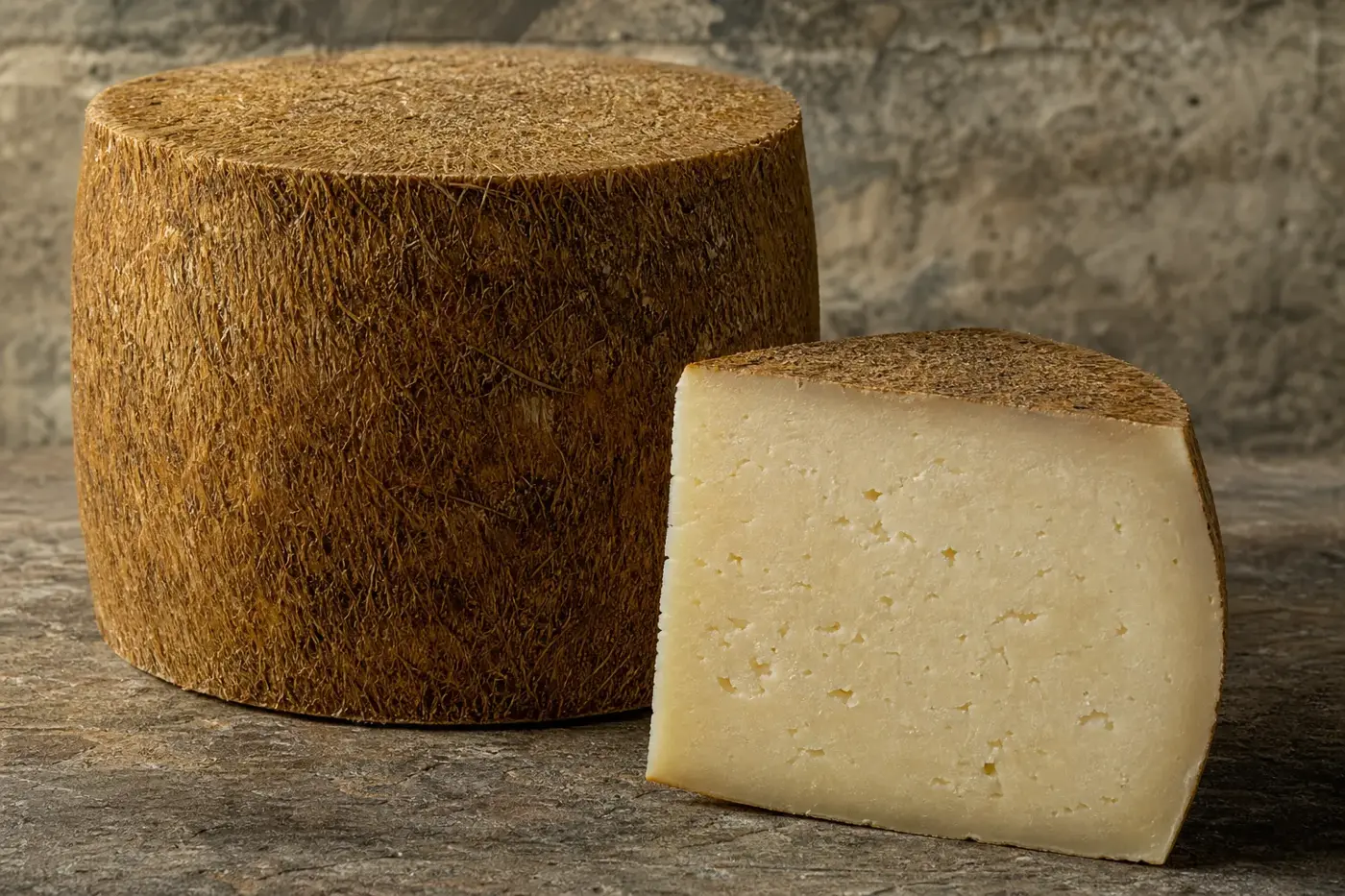
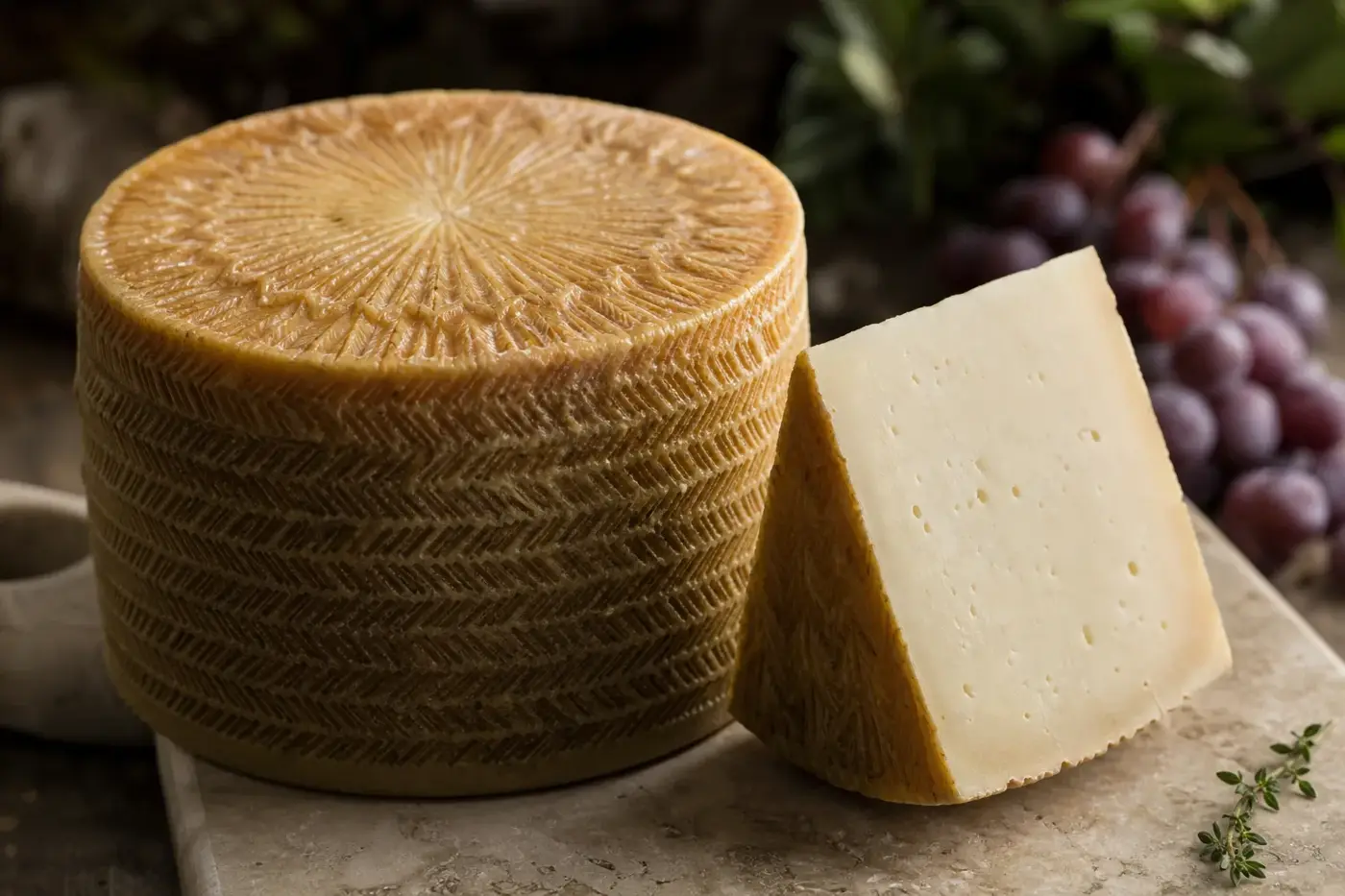
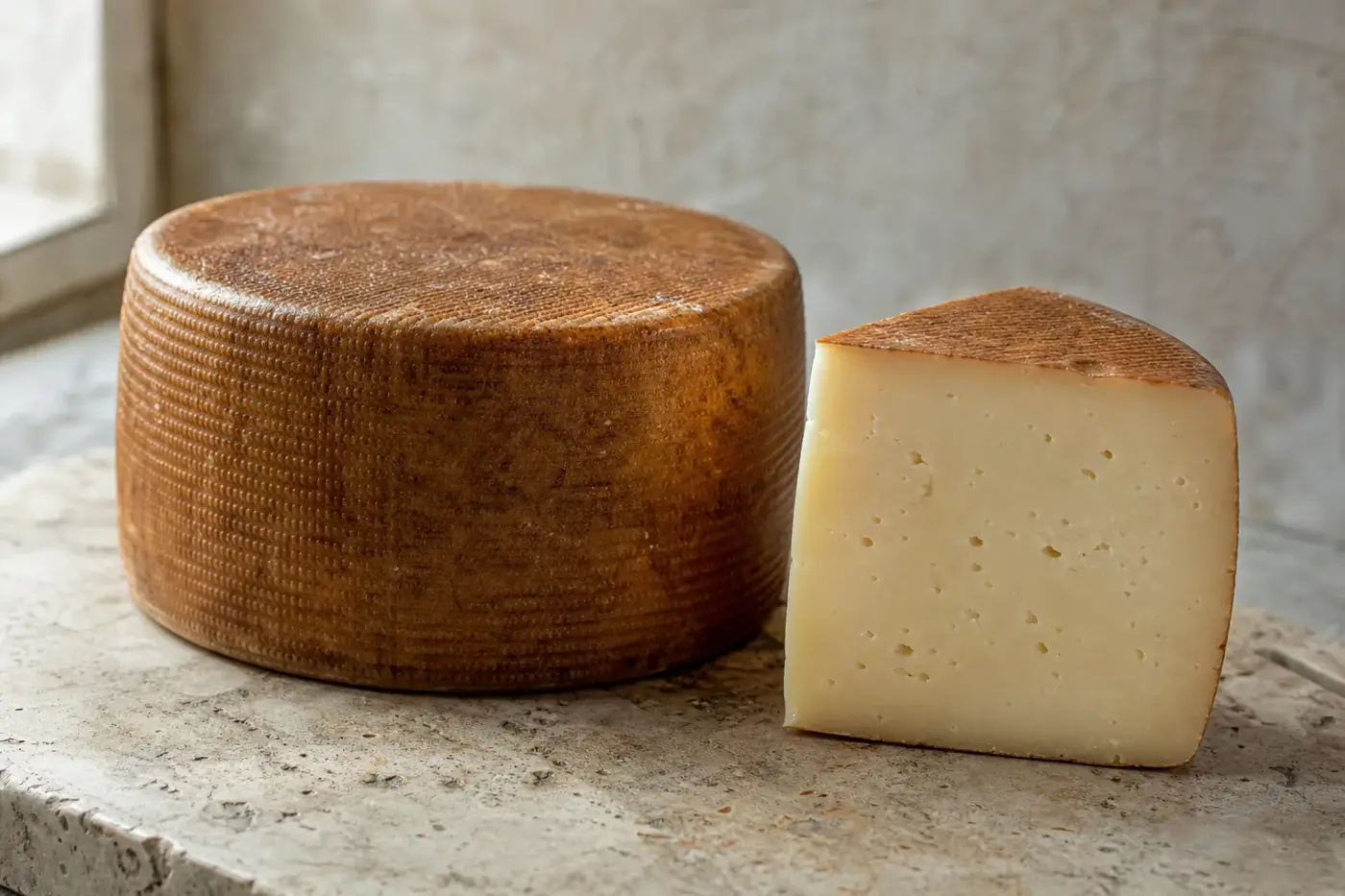
Your knife meets a thick, rough rind, then the pale cheese beneath it breaks short. Roncal’s brownish or straw-coloured shell holds a compact interior with pronounced flavour, gentle piquancy and what Reyno Gourmet calls a buttery impression. This raw sheep’s milk cheese takes its name from a valley of seven communities in the Navarrese Pyrenees, where sheep farming and cheesemaking have long belonged together.[1][3]
Meet Roncal before you choose a wedge
- Roncal’s Spanish ministerial order approving the designation’s regulation was dated 2 March 1981 and published on 9 April 1981.[4]
- At the counter, look for the numbered counter-label and designation logo described by Reyno Gourmet.[1]
- At home in England, Wales and Northern Ireland, the Food Standards Agency recommends a domestic fridge temperature between 0 and 5 °C.[8]
| What you might ask | Your guide to Roncal |
|---|---|
| Familiar and registered name | Roncal.[2] |
| Who registers it? | Great Britain: Department for Environment, Food & Rural Affairs.[2] |
| Protection in Great Britain | Registered PDO; UK scheme registration dated 31 December 2020, 23:00. Record information dated November 2026.[2] |
| EU registration history | The GB register records original EU registration on 21 June 1996. Current EU register entry: unconfirmed.[2] |
| Making and maturation area in the 1991 regulation | Uztárroz, Isaba, Urzainqui, Roncal, Garde, Vidángoz and Burgui, in Navarra. Current specification: unconfirmed.[3] |
| Milk | Raw sheep’s milk; Reyno Gourmet describes the supplying sheep as principally Latxa.[1] |
| Published maturation range | Reyno Gourmet describes at least four months, extending to nine or ten months and beyond.[1] |
| Rind and interior | Natural rind; firm, compact, ivory to pale yellow interior with small openings in the published product description.[1][3] |
Follow Roncal through its seven communities
Roncal belongs to a whole valley, not only the village that shares its name. Follow its documented making area and you encounter Uztárroz, Isaba, Urzainqui, Roncal, Garde, Vidángoz and Burgui. The 1991 regulation places both cheesemaking and maturation within those seven municipalities in Navarra, giving the name a precise place on the map.[3]
The sheep matter just as much as the map, and the flocks have changed over time. A Government of Navarra research report published in 2006 describes an earlier reliance on Rasa sheep, followed by Latxa milk and subsequently an authorised first-generation cross. You’re looking at a cheesemaking tradition that has adapted through its animals, rather than remaining fixed at one historical moment.[5]
There is a useful distinction to carry with you: the territory supplying milk and the places making and maturing cheese are separate questions in the designation’s documentary record. A mountain setting does not mean every litre came from sheep grazing beside the dairy. The landscape matters, but the details matter too.[3][5]
Get to know the promise behind the name
Those three letters, PDO, connect a food’s name to its geographical origin and production requirements. They stand for protected designation of origin, called denominación de origen protegida, or DOP, in Spanish. As the European Commission explains, each product’s specification sets out the detailed conditions for that named food.[10]
For Roncal, you’re looking at much more than a dairy’s address. The documentary record covers milk, authorised animals, cheesemaking, maturation and the finished cheese’s characteristics. Reyno Gourmet describes certification checks across registered farms, dairies and maturation premises, as well as the finished product.[1][3]
The Spanish designation reached its defining historical milestone in 1981. The ministerial order approving its regulation was dated 2 March 1981 and published on 9 April 1981. Approval and publication were separate events, both before the later EU registration date recorded by the GB register.[2][4]
Where you are matters, too, because protection depends on jurisdiction. The live GB record identifies Roncal as a registered PDO in Great Britain. For how these schemes work and where protection applies, turn to protected names explained.[2]
Meet the milk and the flocks behind it
Raw sheep’s milk sits at the heart of Roncal’s published identity. Reyno Gourmet describes the supplying sheep as principally Latxa, fed on pasture and forage. Raw milk has not been pasteurised, although legal definitions vary by jurisdiction; you can explore the treatments in raw, thermised and pasteurised cheese.[1]
Follow the breed history and that single name opens into a more varied story. The 1991 regulation names Rasa and Lacha, the latter a Spanish spelling associated with Latxa. The Government of Navarra’s 2006 research report records the later admission of an F1 Latxa × Milchschaf cross in the 2001 revision.[3][5]
Those dated changes help explain why older descriptions give different breed lists. When you choose a wedge, ask what the maker declares about its own milk. That tells you about the cheese in front of you; the designation’s permitted breeds concern certified production as a whole.
Watch milk become a firm, compact cheese
Pressing helps give Roncal its firm, joined interior. It belongs to the pressed-curd tradition, where curd, the coagulated part of milk, is separated from liquid whey. The Spanish agriculture ministry identifies coagulation and whey separation as cheesemaking’s two fundamental transformations, followed by maturation for ripened cheeses.[6]
First comes curdling, which creates the milk’s gel structure. Rennet is a preparation containing milk-coagulating enzymes that help form that gel. The Roncal regulation published in 1991 describes natural rennet or other authorised coagulating enzymes; that historical provision is not an ingredient declaration for any particular maker.[3]
Next, cutting divides the gel so whey can escape. Moulding gathers the curd into Roncal’s cylindrical shape, while pressing consolidates it. Together, moisture removal and consolidation turn those loose curds into the coherent interior you see when a wheel is cut.[3][6]
Salting plays its part, too, and salt appears in Reyno Gourmet’s published ingredient description. Keep the essential sequence in mind: milk becomes curd, curd loses whey, and the consolidated cheese develops through maturation. Each stage contributes to the wedge you eventually bring to your table.[1][6]
If you’d like to follow the broader process, explore how cheese is made. The applicable specification and the dairy’s controlled process govern the individual production settings.
Ask how long your wheel has waited
“Aged” is a useful beginning, but ask how old the wheel actually is. Reyno Gourmet describes Roncal from four months’ maturation through to nine or ten months and beyond. That range gives you your bearings; the age of the cheese being cut gives you something more useful at the counter.[1]
Maturation is busy work, not simply a wait for moisture to evaporate. Enzymes, including those of microbial origin, drive biochemical transformations in the cheese’s components. Texture and aroma develop together, which is why an age statement helps without telling you everything about the finished cheese.[6]
The documented wheel is cylindrical, with a natural rind and pale interior. The 1991 regulation describes a hard, thick, rough rind, brownish or straw-coloured, around a hard interior. Reyno Gourmet adds a compact texture, small openings and that short, fragile break beneath your knife.[1][3]
Take a close look at your wedge. Notice the cut face and the substantial rind around the pale paste, the cheesemaking term for the interior. If you’re buying freshly cut cheese, ask to see the wheel or its identification as well as the portion being wrapped.
Take your time with butteriness and gentle piquancy
Reyno Gourmet describes Roncal’s flavour as pronounced, clearly defined and slightly piquant, with a buttery impression on the palate. You also get that compact texture and short, fragile break. Cut yourself a manageable piece and take your time; this is not a cheese auditioning to be spread on toast.[1]
“Savoury” is a useful everyday word for its assertive character. Notice the gentle piquancy beside the flavour derived from the milk, without expecting chilli heat. Rather than looking for a characteristic nutty note, start with a plain piece before bringing in anything sweet, acidic or strongly flavoured.
Give texture and flavour separate attention in your tasting notes. Does your piece break cleanly or crumble, how pronounced is the piquancy, and how long does the flavour remain? Record the maker and stated age, too, so your next wedge offers a useful comparison rather than a test of cheese-related memory.
Give Roncal, Manchego and Idiazabal room to shine
Roncal, Manchego and Idiazabal deserve separate attention. Whether you’re choosing a wedge or arranging a tasting, ask about each cheese’s origin, milk, maturation and production method. A familiar Spanish name alone cannot tell you the whole experience waiting on your plate.
Idiazabal offers a particularly clear geographical comparison. Reyno Gourmet states that its milk production and cheesemaking area covers the Basque Country and Navarra except the municipalities of the Roncal valley. It identifies raw milk from Latxa and Carranzana sheep, and describes both smoked and unsmoked forms.[7]
That boundary shows you how neighbouring traditions can share sheep breeds while keeping distinct geographical identities. It also makes smoke a poor shortcut for recognising Idiazabal. Smoking is not universal within its published description.[7]
For your Manchego comparison, keep the tasting focused on the individual cheeses rather than assuming their specifications match. Note each cheese’s maker and age, then serve separate pieces. Give each its own consideration instead of treating the three names as interchangeable.
Choose at the counter, care for it at home
Start with identity before you reach for a wedge. Reyno Gourmet describes Roncal carrying a numbered counter-label and the designation’s logo. If a freshly wrapped portion lacks details, ask for the maker, maturation and original identification: your wedge should be traceable to the cheese it came from.[1]
Once home, follow the cheese’s storage instructions. For England, Wales and Northern Ireland, the Food Standards Agency recommends a domestic fridge temperature between 0 and 5 °C. Its guidance also says to follow packaging instructions, including date information.[8]
Keep the main piece refrigerated and take out only what you intend to serve. In England, Wales and Northern Ireland, follow the Food Standards Agency’s current guidance on keeping chilled food out of the fridge.[8]
If you’re pregnant in the UK, consult the NHS guidance on foods to avoid in pregnancy for its current advice on cheese.[9] For more detailed handling advice, turn to how to store cheese at home.
Set a simple table and let Roncal speak
Begin with plain bread, then try pear, apple or a little quince paste. Put each beside the cheese rather than over it, so you can adjust the balance easily. Walnuts bring a nutty accompaniment and a contrasting crunch, while giving you room to taste the Roncal before introducing another flavour.
For an alcohol-free drink, try still water, sparkling water or unsweetened apple juice. Choose what you enjoy rather than treating any of these as a fixed match. Your glass need not pass an entrance exam.
Roncal’s documented rind is hard and rough, so trimming it is a straightforward serving choice.[3] Follow any maker’s instruction that the rind should not be eaten, and remove non-food wrapping or coating before serving. Cut the remaining paste into small wedges or short slices, giving your guests a chance to taste it first without accompaniments.
General information only, not medical advice: follow the official guidance where you live.
Questions people ask
Where does Roncal cheese come from?
Roncal takes its name from a valley in the Navarrese Pyrenees. The 1991 regulation placed its cheesemaking and maturation in seven municipalities: Uztárroz, Isaba, Urzainqui, Roncal, Garde, Vidángoz and Burgui.
Is Roncal made from raw milk?
Yes, Roncal is made from raw sheep’s milk. Reyno Gourmet describes the supplying sheep as principally Latxa.
What does Roncal taste like?
Reyno Gourmet describes its flavour as pronounced and slightly piquant, with a buttery impression. Its texture is compact, with a short, fragile break.
How long is Roncal matured?
Reyno Gourmet describes maturation of at least four months, extending to nine or ten months and beyond. The current legal minimum has not been verified.
How can I identify Roncal cheese?
Reyno Gourmet describes a numbered counter label and the designation’s logo. For a freshly wrapped portion, ask for the maker, maturation and original identification if those details are missing.
Sources
- Reyno Gourmet / INTIA. Queso Roncal. Undated product, certification and serving information, accessed November 2026. Source. This is a regional food promotion and certification-related source, not an independent tasting.
- Department for Environment, Food & Rural Affairs. Roncal. GB protected food and drink names register, published 4 January 2021; accessed November 2026. Register entry.
- Government of Navarra, Lexnavarra. Reglamento de la Denominación de Origen «Roncal» y de su Consejo Regulador. Regulation approved in 1991, official legal record retrieved November 2026. Legal record. Historical provisions are not presented here as a verified current EU specification.
- Ministerio de Agricultura, Boletín Oficial del Estado. Orden de 2 de marzo de 1981 por la que se reglamenta la denominación de origen «Roncal» y su Consejo Regulador. BOE No. 85, published 9 April 1981. Official text.
- Government of Navarra. Estudio de investigación: Influencia…, introductory section concerning Roncal’s designation and breed history, 2006, page 10. Full document title and bibliographic details require editorial confirmation. Official research document retrieved November 2026.
- Ministerio de Agricultura, Pesca y Alimentación, Alimentos de España. Etapas elaboración del queso. Undated technical explanation, retrieved November 2026. Source.
- Reyno Gourmet / INTIA. Queso Idiazabal. Undated product and certification information, accessed November 2026. Source.
- Food Standards Agency. How to chill, freeze and defrost food safely. Published 18 December 2017; live guidance accessed November 2026. Applies to England, Northern Ireland and Wales. Guidance.
- NHS. Foods to avoid in pregnancy. Live guidance accessed November 2026. Guidance.
- European Commission, Directorate-General for Agriculture and Rural Development. Geographical indications food and drink. Undated scheme explanation, accessed November 2026. Source.
Researched through official designation records, government technical information, regional certification-related descriptions and national food safety guidance, without a site tasting.
Last checked: November 2026
Last checked November 2026.
The editors suggest you read next