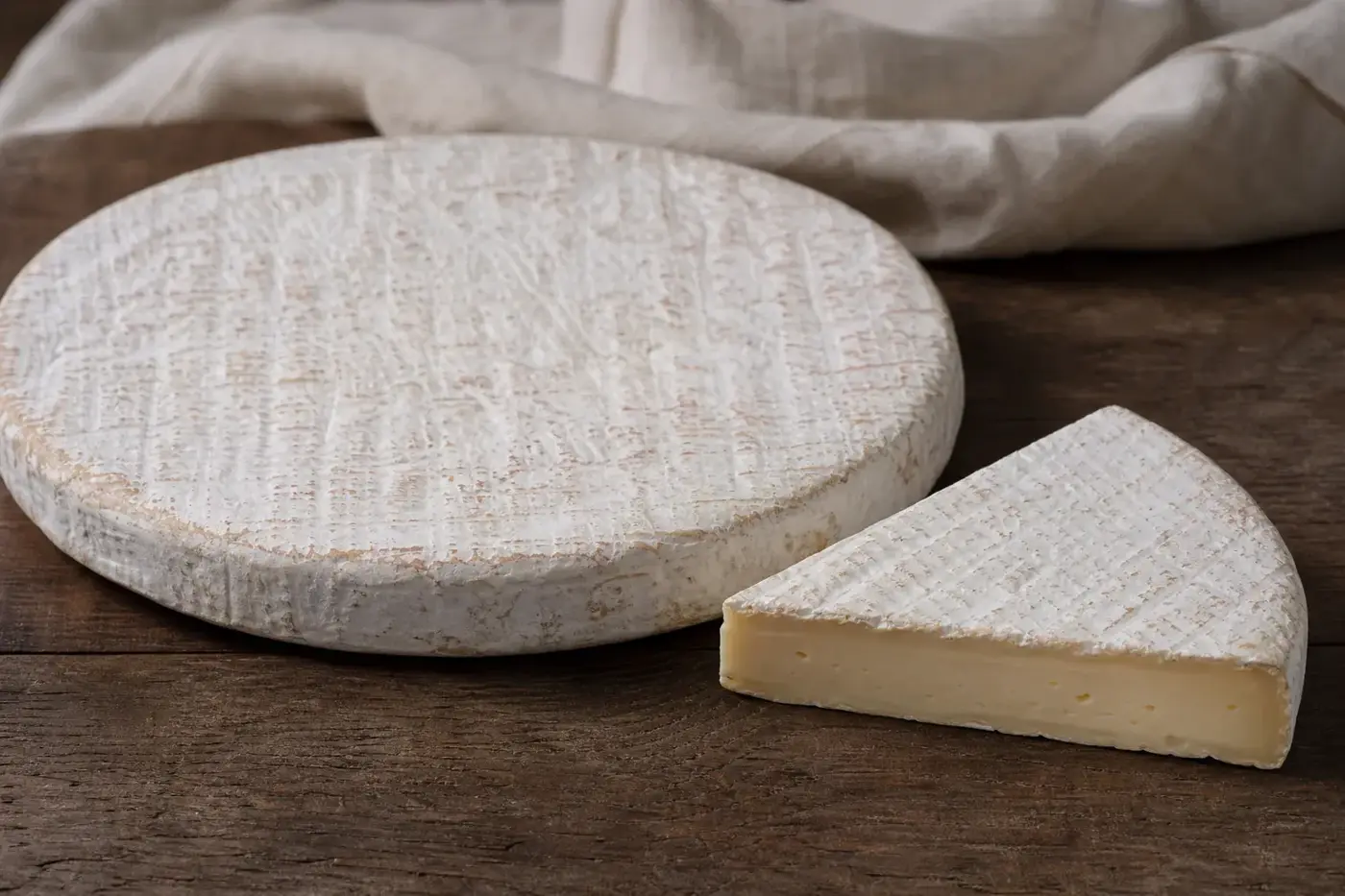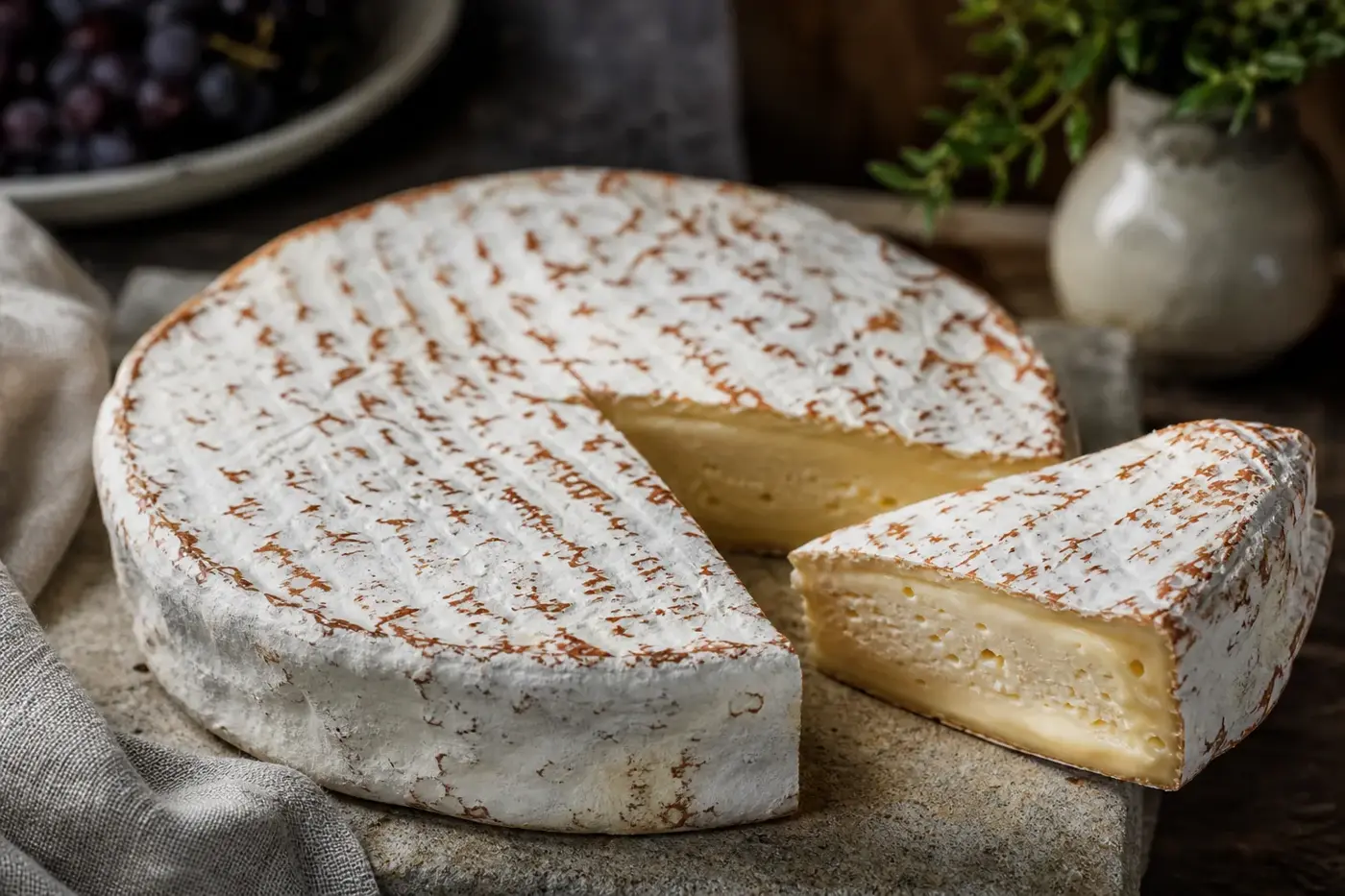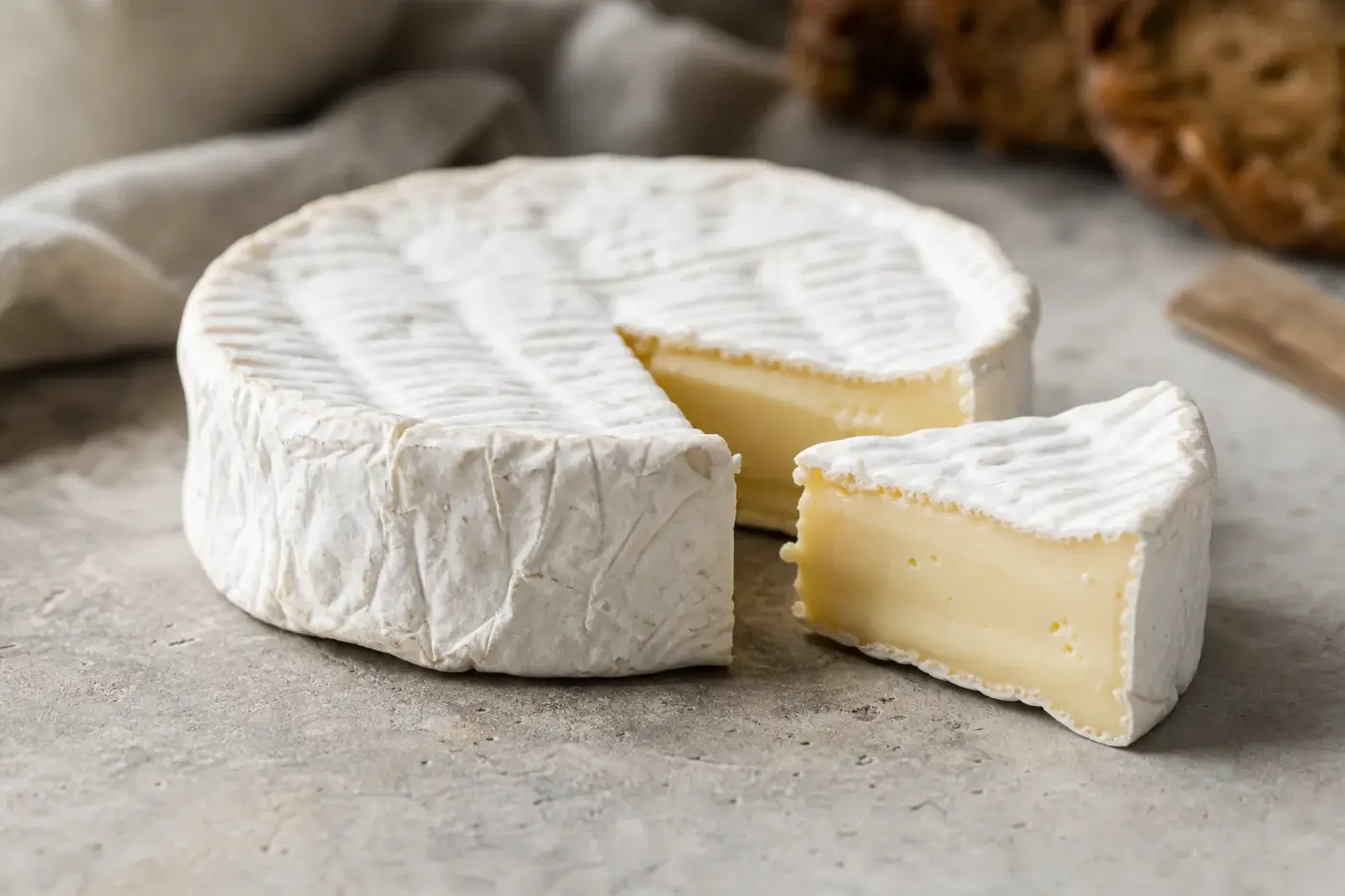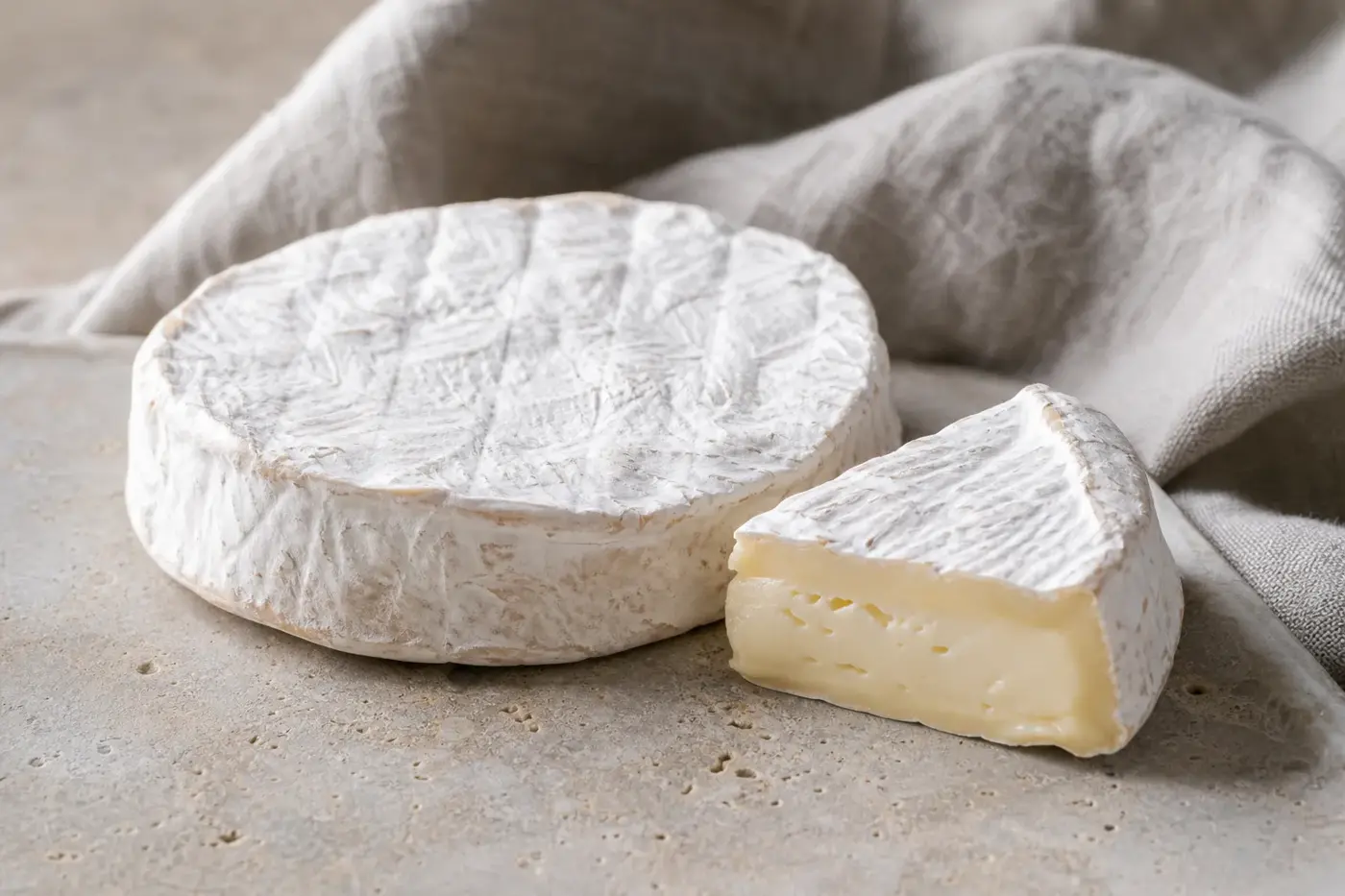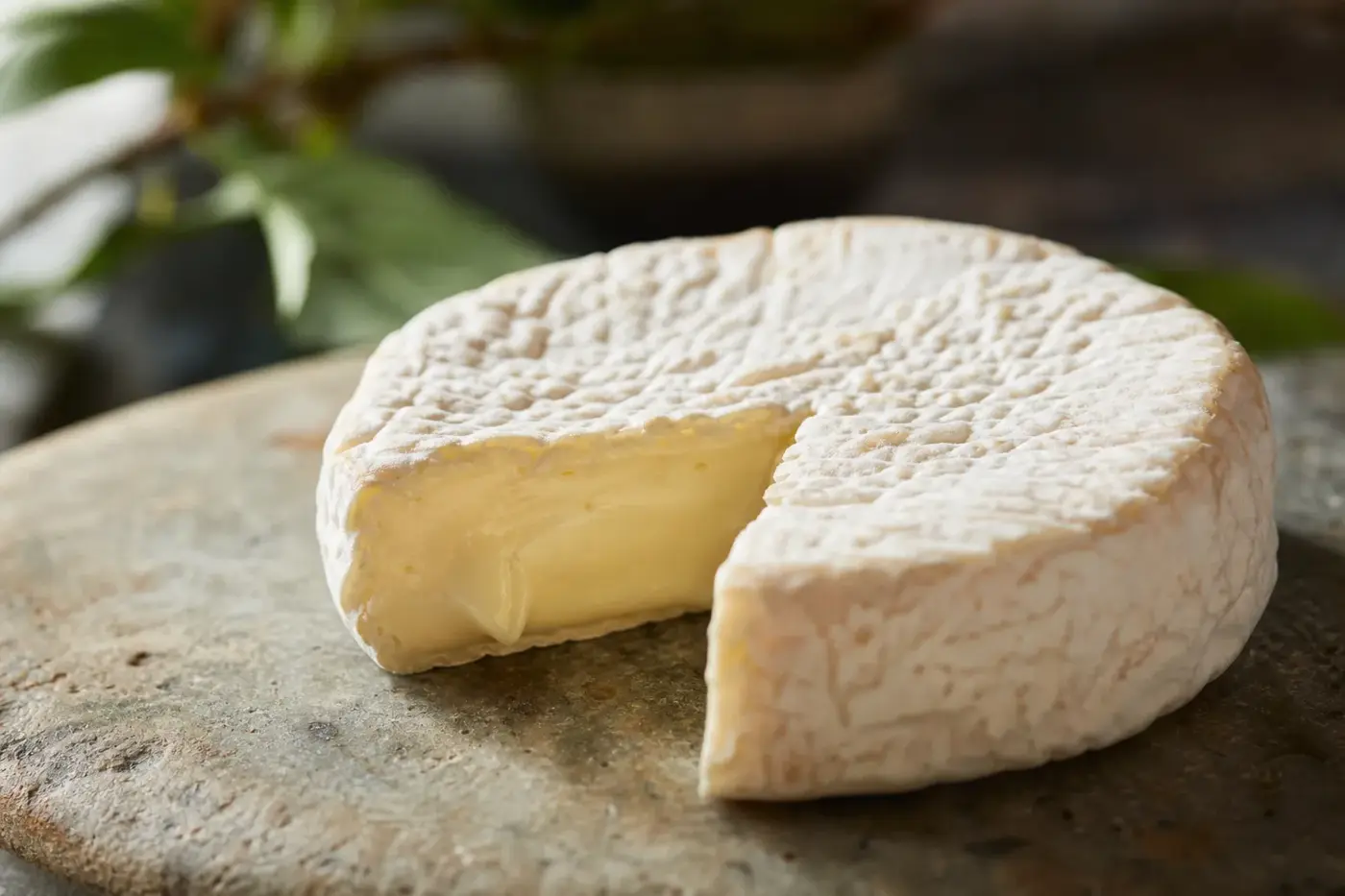
Your knife meets a small, pale disc. Will it give you a neat wedge, or should you have brought a spoon? From the French Alpine foothills, Saint-Marcellin is a cow's milk cheese whose texture owes as much to drying as to age. Local tradition welcomes both deliberately firm cheese and a softer version with a flowing centre: two pleasures, with different cutlery requirements. [1,3,6]
A delicate rind, a choice of centres
Look for a low disc with rounded edges, rather than a miniature tall wheel. INAO describes a very fine rind, sometimes lightly wrinkled, ranging from white through beige to grey-blue. Beneath it, the cheese is cream-coloured. Its published tasting description brings together fruit, honey notes and moderate saltiness. [1,3]
The producers' committee describes textures from dry to supple, soft and flowing. That gives you something useful to say at the cheese counter. Rather than asking for the oldest cheese, explain whether you want neat pieces for bread or a centre you can scoop. [6]
The specification gives those choices names. Sec is the firmer local tradition; moelleux receives gentler drying and a ripening approach that encourages softness. Age alone will not tell you which you are buying. A firm Saint-Marcellin may be exactly as its maker intended, not lagging behind a softer neighbour. [3]
Follow Saint-Marcellin towards the Vercors
The cheese takes its name from the town in Isère that first served as its trading centre. Its production area lies east of the Rhône, against the Vercors massif, with Saint-Marcellin at its heart. It extends into Isère, Drôme and Savoie, though the specification's commune list fixes the precise boundary, rather than those department names. [1,4,7]
Picture the country below and beside the mountains, not just high summer pastures. INAO links this cheese to the drying winds also used for walnuts. Cheeses rested in suspended baskets called tommiers. Buildings used for drying walnuts could shelter drying cheese too. [1]
From farm tommes to railway journeys
The earlier farm cheeses could contain goat's milk as well as cow's milk. The producers' committee describes small farm-made tommes from the plains and valleys of Isère, made with whatever milk the holding supplied. This is a story that begins with mixed milk, rather than an exclusively goat's milk cheese that later changed its recipe. [5]
During the nineteenth century, travelling collectors called coquetiers carried the cheese beyond the farms. They gathered farm produce for nearby towns, while better transport and the railway opened up a wider market. After the First World War, growing demand and less reliable farm supplies prompted collectors to help establish dairies. [5]
Today's cow's milk Saint-Marcellin emerged through that gradual change. The committee places its development within the shift from mixed farming to organised dairy production. [5]
Read the name, not the ceramic dish
The geographical connection begins before the milk reaches the cheesemaker. The published EU single document requires milk production, cheesemaking and maturation to take place within the defined area. PGI means protected geographical indication, or IGP in French. Here, that protection reaches beyond the dairy door. [4]
Look for the exact name Saint-Marcellin, the producing workshop's identification and the PGI identification. The single document specifies the EU PGI logo and/or the wording Indication Géographique Protégée. It sets no particular packaging rule. A ceramic dish, however appealing, is not proof of the protected name. [4]
Defra also records Saint-Marcellin as a registered PGI in Great Britain, effective from 31 December 2020 at 23:00. Check that GB entry separately from the EU registration. For the wider distinction, see protected names explained. [2]
How milk becomes your little disc
Acidification does much of the work of setting the milk for this lactic cheese, alongside animal rennet, the enzyme coagulant. The curd is the solid portion that becomes cheese; whey is the liquid that drains away. The published specification sets out the process like this. [3]
| Stage | What happens to your cheese |
|---|---|
| Preparing the milk | Whole milk receives lactic cultures; ripening organisms may also be added. |
| Setting the milk | Milk sets in individual vessels over 12 to 24 hours. |
| Filling the moulds | Curd goes into rounded moulds without preliminary draining. |
| Draining and salting | At least 14 hours in moulds; both faces are dry-salted. |
| Bringing on the texture | Surface drying, ventilated drying and maturation develop the finished cheese. |
Source: the specification's production method. [3]
Those drying stages help explain why sec and moelleux feel different. To follow what happens as curd forms and cheese matures, visit how cheese is made.
Farmhouse or dairy? Keep asking
Historically, farmhouse production brought milk production and cheesemaking together on one holding. The dairies in the committee's account developed around collected milk. That tells you where and how production was organised, not whether the milk is raw or thermised. [5,6]
Ask about both, rather than assuming that a small producer and a larger dairy necessarily treat milk differently. Check the individual product's label for its milk treatment. Thermisation and pasteurisation are different processes; raw, thermised and pasteurised cheese explains the distinction.
Choose the texture you want to eat
Tell the cheesemonger when you plan to eat your cheese and how you would like it to feel. Ask whether it is sec or moelleux, and how yielding it is now. The producers' committee describes cheeses sold with and without a cup, across a range of textures. [6]
A small ceramic pot supports cheese that has become too soft to move neatly. Leave a flowing cheese in its container and spoon out portions; cut a firmer disc into small wedges. The pot has a practical job, not just a promising future in your cupboard. The label may carry instructions specific to that product. [6]
Ask for a cheese that will hold its shape on a board, or one to share from its cup. Either request is more useful than asking for the best Saint-Marcellin. When you find one you love, note the producer's name and labelled milk treatment so you can make a similar choice next time. [6]
Keep it chilled and keep the label
Follow the pack's storage instructions, including its date and any directions after opening. As a concrete national reference, the US FDA recommends a refrigerator temperature of 4.4 °C (40 °F) or below. Refrigerate perishable purchases within two hours, or within one hour when the outside temperature exceeds 32 °C (90 °F). [8]
Keep the packaging details until you finish the cheese. They allow you to match the product and batch against an official recall notice, such as those published by France's RappelConso and the UK's Food Standards Agency. For wrapping and refrigerator organisation, turn to the cheese storage guide. [9,10]
A RappelConso notice dated 4 July 2026 concerns an 80 g Saint-Marcellin IGP sold in France. It identifies lot 11255206, incorrectly dated 9 September 2027 instead of 24 June 2026. If that matches your cheese, do not eat it, and return it to the retailer. [9]
Bring bread, then a little sweetness
Fresh bread, figs, walnuts, other nuts and honey are the producers' committee's suggested companions. Begin with plain bread and cheese, then try one accompaniment at a time. You can decide whether you prefer the cheese alone, with sweetness or with crunch. Figs and walnuts make a small plate without needing a long supporting cast. [6]
For a non-alcoholic drink, choose still or sparkling water. Let the cheese and its accompaniments supply the flavour contrast.
Meet its relative, Saint Félicien
Saint Félicien is a related cheese, not another spelling of Saint-Marcellin. Whichever you choose, check the individual product's label for its ingredients and milk treatment. [4,7]
General information only, not medical advice: follow the official guidance where you live.
Questions people ask
What does Saint-Marcellin taste like?
INAO describes fruit and honey notes with moderate saltiness. The texture can range from dry to soft and flowing.
What is the difference between sec and moelleux Saint-Marcellin?
Sec is the firmer local tradition. Moelleux receives gentler drying and a ripening approach that develops a softer texture, so age alone will not tell you which you are buying.
Is Saint-Marcellin made with raw milk?
Saint-Marcellin is made with whole cow’s milk, but the permitted milk treatments are not verified on this page. Check the individual product’s label for its milk treatment.
Is Saint-Marcellin made with animal rennet?
Yes, the specification lists animal rennet as the coagulant. Acidification also helps set the milk.
What does the protected name Saint-Marcellin guarantee?
The published EU single document requires milk production, cheesemaking and maturation to take place within the defined area. Check the label for the name, the producing workshop’s identification and the PGI identification; a ceramic dish is not the identifying mark.
Sources
[1] Institut national de l'origine et de la qualité, Saint-Marcellin, official product profile, undated retrieved edition, November 2026.
Read at inao.gouv.fr
[2] Department for Environment, Food & Rural Affairs, Saint-Marcellin, Great Britain protected food and drink names register, published 4 January 2021, retrieved November 2026.
Read at gov.uk
[3] French Ministry of Agriculture, Cahier des charges de la dénomination « Saint-Marcellin », specification approved by the order of 10 January 2014, published in the ministry bulletin on 30 January 2014.
Read at info.agriculture.gouv.fr
[4] European Commission, Publication of an application pursuant to Article 6(2) of Council Regulation (EC) No 510/2006, Saint-Marcellin single document, 2012/C 384/16, Official Journal C 384, 13 December 2012, pages 21 to 25. Official indexed text retrieved; direct document access requires editorial verification.
Read at eur-lex.europa.eu)
[5] Comité du Saint-Marcellin et du Saint-Félicien, L’histoire du Saint-Marcellin IGP, producer organisation's historical account, webpage dated September 2026.
Read at fromage-saint-marcellin.fr
[6] Comité du Saint-Marcellin et du Saint-Félicien, A chacun son Saint-Marcellin !, producer organisation's product and serving descriptions, webpage dated September 2026.
Read at fromage-saint-marcellin.fr
[7] Comité du Saint-Marcellin et du Saint-Félicien, L’IGP Saint-Marcellin, producer organisation's geographical account, webpage dated September 2026.
Read at fromage-saint-marcellin.fr
[8] US Food and Drug Administration, Safe Food Handling, consumer guidance, undated retrieved edition, November 2026.
Read at fda.gov
[9] RappelConso, Saint Marcellin IGP 80g, recall reference 2026-07-0039, version 1, published 4 July 2026.
Read at rappel.conso.gouv.fr
[10] Food Standards Agency, Alerts, official food and allergy alert index, retrieved November 2026.
Read at alerts.food.gov.uk
[11] Comité du Saint-Marcellin et du Saint-Félicien, Comment déguster le Saint-Marcellin IGP ?, producer organisation's serving and drink suggestions, webpage dated September 2026.
Read at fromage-saint-marcellin.fr
This desk-researched article brings together official product information, the published specification, register information, attributed producer accounts and national handling guidance.
Last checked: November 2026
Last checked November 2026.
The editors suggest you read next