Slovenský Oštiepok
Turn it in your hand: an egg, an oval, perhaps a pine cone.
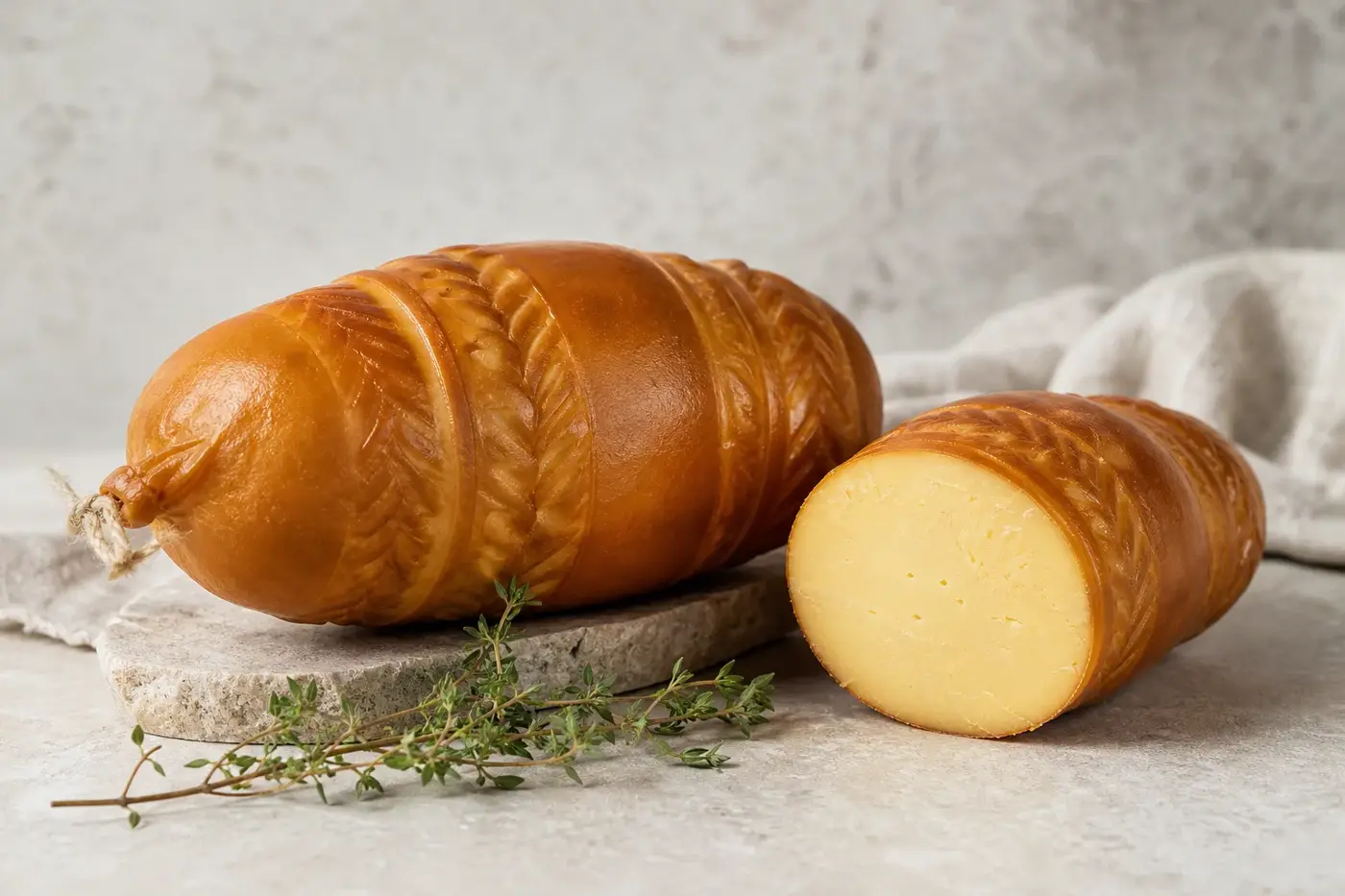
Turn it in your hand: an egg, an oval, perhaps a pine cone. Follow the carved patterns around Slovenský Oštiepok and you have a little of Slovakia's mountain cheesemaking tradition in your palm. Brine salts this semi-hard cheese; smoke is optional. Today, farm cheesemakers and dairies both carry the tradition on. [1][2]
| What to know | The details |
|---|---|
| Registered name | Slovenský oštiepok [1] |
| Cheese style | Semi-hard cheese [1] |
| EU registration | 26 September 2008, recorded by Defra [3] |
| EU current register status | Not specified here |
| Great Britain status | Registered PGI; UK scheme registration 31 December 2020, 23:00; status recorded November 2026 [3] |
| Authority and identifier | European Commission; application reference SK/PGI/005/0549/30.03.2006 [1] |
| Current EU register identifier | Not specified here |
| Where it is made | Defined mountainous area of Slovakia [2] |
| Milk choices | Farm production: raw sheep's milk or mixed raw sheep's and cow's milk. Dairy production: pasteurised sheep's milk, cow's milk or a mixture. [2] |
| Smoke or no smoke? | Smoking is optional [2] |
Start on the mountainside, then admire the carving
This cheese's story begins with the salaš, a small mountainside sheep farm. The specification places Slovenský Oštiepok within Slovakia's mountain sheep-farming tradition, citing records from the early eighteenth century. Dairy production followed during the 1960s and 1970s. [1]
Before you reach for the knife, give the decoration its moment. Turn the cheese over, follow the pattern around its middle and look closely at each end. A whole cheese lets you appreciate that work in a way a loose slice never can. Consider it a brief pause for admiration before appetite takes charge.
A Slovak name rooted in the mountains
Slovenský means Slovak, and the full registered name is Slovenský oštiepok, with a lower-case second word. Defra records its original EU registration as 26 September 2008. Its November 2026 listing gives it registered protected geographical indication, or PGI, status in Great Britain. [3]
That PGI ties the name to a defined Slovak mountain area. Both the milk and every stage of production must come from within it, according to the specification. [2]
At the counter, look for the full registered name before reading the individual product details. “Smoked sheep's cheese” is a description, not the same thing. If you want to untangle the schemes, the guide to protected names explains their differences.
Two traditions, three useful questions
Traditional farm production begins with raw sheep's milk, either alone or mixed with raw cow's milk. Dairy production uses pasteurised sheep's milk, cow's milk or a mixture. The specification sets no minimum sheep's milk percentage for either route. [2]
Ask three separate questions: which milk, which milk treatment, and which production method? The answers tell you more than calling every patterned cheese smoked sheep's cheese. If several cheeses are heading for your table, put those details on their serving cards.
You can explore the treatments in raw and pasteurised cheese. Keep the product label with your purchase, especially if someone at the table needs to avoid raw milk. The pattern alone cannot answer that question.
This page summarises published guidance from the official sources it cites. It is not medical advice. Guidance differs between countries and changes over time, so check the current source for where you live, and ask your doctor, midwife, pharmacist or dietitian about your own circumstances.
Follow the curd through hot whey and carved moulds
On the farm, the work begins with rennet, an enzyme preparation that coagulates the milk. The maker cuts and gathers the curd, its solid part, then works it by hand, dipping it in hot whey and fitting a carved ring around it. Further impressions can decorate the ends. [2]
The farm cheese is cooled and unmoulded before spending 12 to 24 hours in brine, depending on its size. Drying follows, with hardwood smoking an option. [2]
The dairy route includes starter cultures, pressing and acidification. Optional steaming and kneading can come before moulding, followed by brining and drying. Smoking remains optional for the protected product, whichever route it takes. [2]
Let the cheese in front of you guide your choice. Ask the seller who made it and how that version is produced. If you can, compare smoked and unsmoked examples with the same simple accompaniment. Take a small bite of each alone first.
Give the flavour a chance beyond the smoke
Look for a firm, smooth, shiny surface, described in the specification as golden-yellow to golden-brown after smoking. Inside, the paste runs from white to buttery-yellow: firm, slightly fragile, and allowed to have small cracks or cavities. The flavour is savoury, moderately salty and mildly piquant to sour, with smoke in smoked versions. [1]
Now put those words to work. Notice the resistance under your knife, then how the cheese feels as you chew. Compare the centre with a piece nearer the surface. Check the maker's guidance before eating the rind or any coating.
Keep salt, acidity and smoke separate in your notes, rather than asking “strong” to do all the work. Add the maker's name, milk mixture and whether your cheese is smoked or unsmoked. Keep the wrappers until you have finished, so you can find that version again or deliberately try something different.
Look past the pattern and read the label
The label must identify hand-made or factory-made production and, where appropriate, the milk percentages. The specification also requires the cheese to be sold whole, preserving its decorated shape. That distinctive appearance is part of what the rules protect. [1][2]
Read those details alongside the full registered name and producer's identity. Buying online? Ask for a photograph of the actual label rather than relying on the product heading. At the cheese counter, ask to see the original packaging.
Think about the meal, too. On a board, the whole form gives you something to admire before cutting. For sandwiches, consider how much you will use after opening and whether you want smoke to lead the filling. The guide to reading a cheese label walks you through the remaining pack information.
Meet its Polish relative, Oscypek
Slovenský Oštiepok and Polish Oscypek belong to related mountain cheesemaking traditions. Their names, though, are not translations of one another. Oscypek's 2006 EU application described a Polish cheese made with at least 60% sheep's milk, shaped as a spindle or double cone, with smoking included in production. [4]
Compare them by milk proportions, shape, smoking and place of production. If your recipe calls for Oscypek, using Slovenský Oštiepok is a substitution, so name the cheese you actually use. Taste it before deciding how much extra salt or smoky seasoning the dish needs.
Give it the board, then try it warm
Start with a few slices and bread. These serving suggestions take their cue from the specification's description of a firm, salty cheese that may also be smoky. [1] A simple first taste helps you decide what else belongs on the plate.
For a cheeseboard, show off the decorated form before cutting manageable slices across it. Put chutney or preserve in a separate dish so everyone can taste the cheese alone. Give each cheese its own knife and, if you are serving several, a small name card. Even a memorable cheese benefits from an introduction.
For sandwiches, try thin slices with cucumber and a little mustard, or with apple and leaves. Go lightly with the mustard, taste, then add more if you want. With a smoked version, begin with a plain filling and keep pickles and stronger condiments on the side.
For something warm, try small pieces over potatoes, folded into a vegetable filling or tucked into a toasted sandwich. Cook a small portion first to see how your particular cheese behaves. Then adjust the cut and quantity, keeping that first attempt simple enough to judge the cheese itself.
Following a recipe? Keep its handling and cooking instructions. Make any cheese substitution clear.
Bread, fruit and a drink: start simply
Plain rye bread or a lightly flavoured sourdough gives you a useful starting point. Keep the bread simple while you get to know the cheese, then try fresh apple or pear, cutting only what the plate needs. Offer dried fruit and sweet preserves separately so you can compare bites with and without them.
Start with sparkling water or unsweetened apple juice, served separately. For a more structured tasting, try the same cheese with water first, then juice, and notice which you prefer. One bread, one fruit and one drink are enough for a useful first comparison. Your first tasting need not become a small catering operation.
Write your favourite combination beside the maker's name. Next time you plan a cheeseboard, that little record will serve you better than a hazy memory of liking “a smoked cheese”.
Keep it chilled, with the milk details close by
Keep your cheese chilled and follow the pack's storage and after-opening instructions. For home storage, UK Food Standards Agency guidance for England, Northern Ireland and Wales recommends a fridge between 0 °C (32 °F) and 5 °C (41 °F). Chilled food should stay out for the shortest possible time. [5]
Serve only what you intend to eat, leaving the rest refrigerated. Keep the label with the cheese so the date and instructions stay handy. GOV.UK distinguishes use-by dates, which concern safety, from best before dates, which concern quality: follow the relevant date and storage instructions. [6]
For more practical detail, see storing cheese at home. If you need to avoid raw milk, check the individual label or ask the producer to confirm pasteurisation.
For pregnancy in the UK, the NHS lists pasteurised semi-hard cheeses among foods that are safe to eat. Consult its current pregnancy guidance and your midwife about your circumstances. [7]
Questions people ask
What milk is used to make Slovenský Oštiepok?
Farm production uses raw sheep's milk, either alone or mixed with raw cow's milk. Dairy production uses pasteurised sheep's milk, cow's milk or a mixture.
Is Slovenský Oštiepok always smoked?
No, smoking is optional. Smoked versions have a golden yellow to golden brown surface and a smoky flavour.
Where is Slovenský Oštiepok made?
It is made in a defined mountainous area of Slovakia. The specification requires both the milk and every stage of production to come from within that area.
Is Slovenský Oštiepok the same as Oscypek?
They belong to related mountain cheesemaking traditions, but their names are not translations of one another. Oscypek's 2006 EU application described a Polish cheese shaped as a spindle or double cone, with smoking included in production.
How can I serve Slovenský Oštiepok?
Try a few slices with plain rye bread or lightly flavoured sourdough, and serve apple or pear alongside. For warm dishes, try small pieces over potatoes or in a toasted sandwich.
Sources
- European Commission, Publication of an application: “Slovenský oštiepok”, 2007/C 308/10, Official Journal C 308, 19 December 2007, specification summary, sections 4.2 to 4.8. Official specification summary.
- Industrial Property Office of the Slovak Republic, Špecifikácia: Slovenský oštiepok, undated specification document published on the official website, sections 4.2 to 4.5. Slovak specification.
- Department for Environment, Food & Rural Affairs, Slovenský oštiepok, protected food name register entry, published 4 January 2021, live entry checked November 2026. GB register entry.
- European Commission, Publication of an application: “Oscypek”, 2006/C 180/09, Official Journal C 180, 2 August 2006, specification summary, sections 4.1 to 4.6. Oscypek specification summary.
- Food Standards Agency, How to chill, freeze and defrost food safely, published 18 December 2017, live guidance checked November 2026. Official chilling guidance.
- GOV.UK, Understanding food labelling: Best before and use-by dates, live guidance, revision date not displayed, checked November 2026. Official date-label guidance.
- NHS, Foods to avoid in pregnancy, live guidance, checked November 2026, section “Cheese, milk and other dairy”. Official pregnancy guidance.
Researched from official specification documents, the GB protected food name register and UK public health guidance, with serving suggestions identified as editorial recommendations.
Last checked: November 2026
Last checked November 2026.
The editors suggest you read next