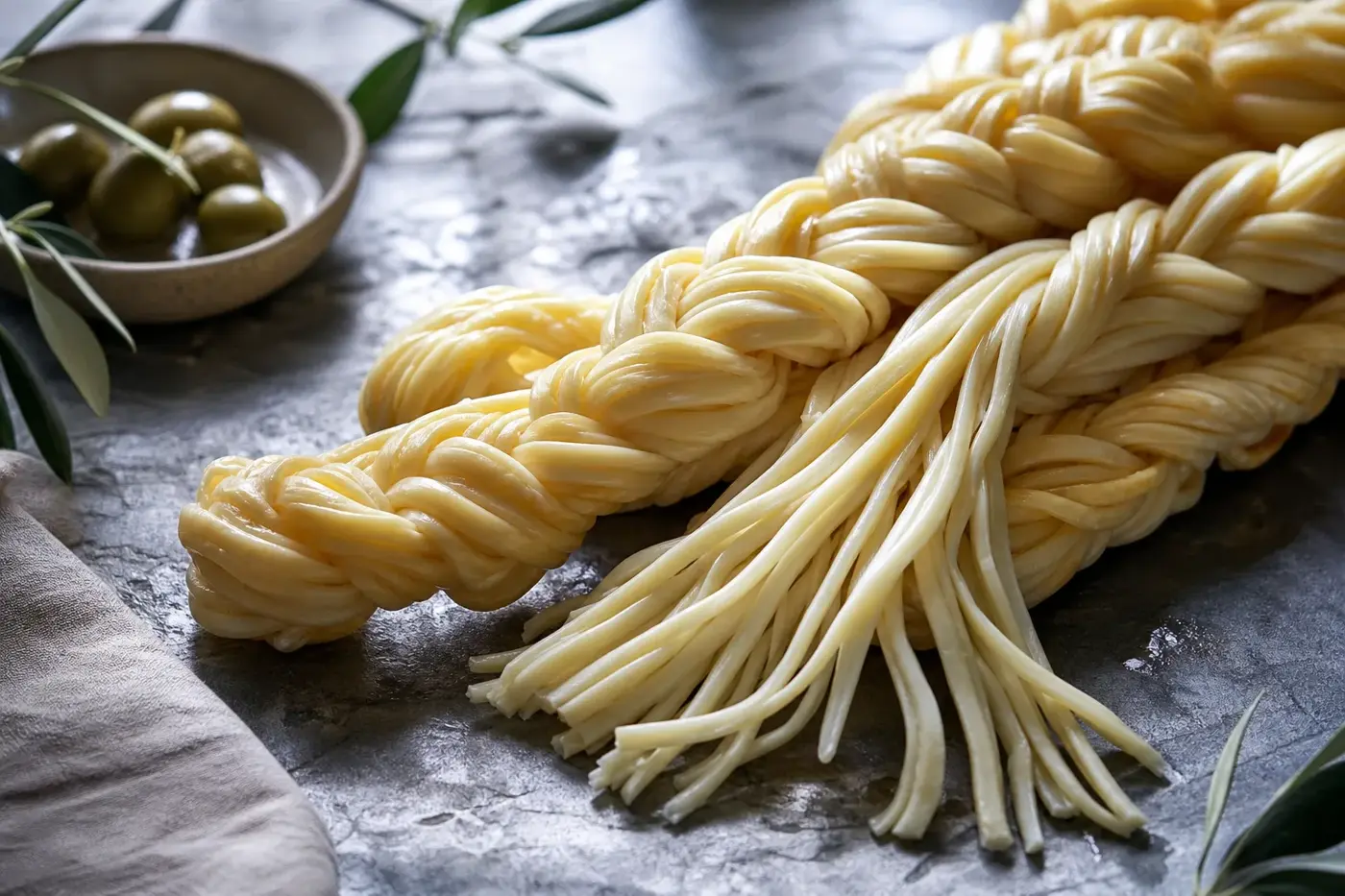
Loosen the end of a cheese braid and pull. A strand comes free, then parts into finer fibres. With Korbáčik, you can begin exploring the cheese before you have taken a bite. Finally, a good reason to play with your food.
Warm curd, pulled into threads, cooled and plaited, becomes this little whip of Slovak stretched-curd cheese. Its strongest association is with Orava. The regional name Oravský korbáčik has protected geographical indication status in both the EU and Great Britain, under separate registers.[1][2][3]
| Your quick guide | What to look for |
|---|---|
| Familiar name | Korbáčik; plural korbáčiky.[1] |
| Style | Slovak stretched-curd cheese shaped into a small whip or braid.[1] |
| Full registered regional name | Oravský korbáčik.[2][3] |
| EU registration authority and identifier | European Commission; published application identifier SK-PGI-0005-0774-04.05.2009.[1][2] |
| EU legal record | PGI entered by Commission Implementing Regulation (EU) No 243/2011; record status in November 2026: in force.[2] |
| Great Britain | Oravský korbáčik is registered as a PGI; UK scheme registration dated 31 December 2020; registration information as of November 2026.[3] |
| Northern Ireland | Registration status unknown here. |
| Switzerland | Registration status unknown here. |
| United States | Registration status unknown here. |
| Milk for the protected cheese | Cow’s milk, raw or pasteurised, made into the starting lump cheese.[1] |
| Size of the protected cheese | Braids 10 to 50 cm long, with strands 2 to 10 mm thick.[4] |
| Your two versions | Unsmoked and smoked.[4] |
Follow the little whip back to Orava
Korbáčik means “little whip”. It is a name you can understand simply by looking at the cheese, rather than tasting it. The Slovak specification compares the shape with a miniature woven willow whip of the kind traditionally made for Easter.[1][5]
Its regional roots lead you to Orava, in mountainous north-western Slovakia. The protected production area follows the Orava river basin, bounded by Poland and the specified district boundaries of Námestovo, Dolný Kubín and Tvrdošín. The specification ties the plaiting craft particularly to the skills of local women.[5]
The historical account records an oral tradition of domestic production during the second half of the nineteenth century. That is not an established invention date. The thread running through this history is handwork: pliable cheese drawn into strands, then shaped into that recognisable little whip.[5]
Look for the name that brings Orava with it
Korbáčik is the familiar style name. Oravský korbáčik is the exact regional name entered in the EU register as a protected geographical indication, or PGI. Its registration regulation was adopted on 11 March 2011 and published on 12 March, with entry into force specified for the twentieth day after publication.[2]
If you want the regional product, look for that complete name. Its specification requires the label to identify the cheese as smoked or unsmoked. Production and initial packaging must happen within the defined area, although the starting lump cheese may come from elsewhere.[1]
A braid tells you how a cheese was shaped. The full protected name tells you about its geographical and production identity too, so give the packet a moment before opening it. The guide to protected cheese names helps you distinguish a style, a registered name and a brand.
Before the plait, a closer look at the milk
The protected cheese starts as fermented, partially ripened lump cheese made from cow’s milk. Its specification allows raw milk or pasteurised milk with a lactic acid culture. Those cultures are microorganisms that develop acidity in the cheese.[1]
Curd is the coagulated solid part of milk, separated from the liquid whey. By the stretching stage, though, the material for Korbáčik is already cheese. It must be in the right condition for heating and stretching, with a starting acidity of pH 4.9 to 5.2 under the protected specification.[1]
When you choose a packet, ask two useful questions: what milk went into it, and how was that milk treated? The protected name allows alternatives. On its own, it cannot tell you which treatment the producer used.[1]
If your dietary choices depend on it, ask about the coagulant too. Rennet is a milk-clotting preparation, and its source matters to some vegetarians. Read the producer’s or retailer’s product declaration rather than relying on the traditional appearance; Rennet explained sets out the distinctions.
From warm cheese to fine threads
Hot water turns the prepared cheese into parenina, a compact, elastic mass ready for shaping. For the protected method, fermented cheese is first cut and grated, then worked in the water. Kneading, stretching and folding smooth it until strands can be drawn out.[5]
There is plenty of handcraft to admire here. This describes the protected commercial process, however, not a recipe for making cheese at home.[1][5]
| The stage | How the braid takes shape |
|---|---|
| Heating and kneading | Prepared lump cheese softens in hot water and is worked into a pliable mass.[5] |
| Drawing and cooling | Strands are pulled by hand or formed with grooved rollers, then cooled in drinking water.[1] |
| Gathering and salting | Cooled strands are wound, cut, tied and dipped in brine.[5] |
| Draining and plaiting | Excess brine drains away; folded strands are braided and secured with another cheese strand.[5] |
| Optional smoking | The braid receives hardwood smoke before packaging.[1] |
Those long threads have a traditional name: vojky. Stretching makes them; braiding arranges them. Pull a finished piece apart and you find texture within texture: fine fibres inside strands, and strands gathered into the larger plait.[4][5]
The prescribed braid begins with at least two strands folded in half. They are plaited along two-thirds of their length, then fastened with a cheese strand. The loose ends complete the little whip’s distinctive outline.[5]
Let your fingers discover the texture
Pale strands with separable fibres define the protected cheese’s appearance. The specification describes an elastic consistency, firm but not hard, which becomes less elastic as the cheese matures. The general style’s rind status remains uncertain here.[1]
For flavour, the Slovak agriculture ministry gives you three useful words: milky, salty and slightly acidic. That tells you rather more than “mild”. Expect a lactic character alongside the salt, with those fibres providing much of the interest.[4]
You have two textures to explore. The plait reveals the shaping work; a strand pulled apart reveals the finer fibres inside. Try pulling rather than slicing, and taste the cheese alone before inviting anything else onto the plate.
Will you choose creamy white or golden smoke?
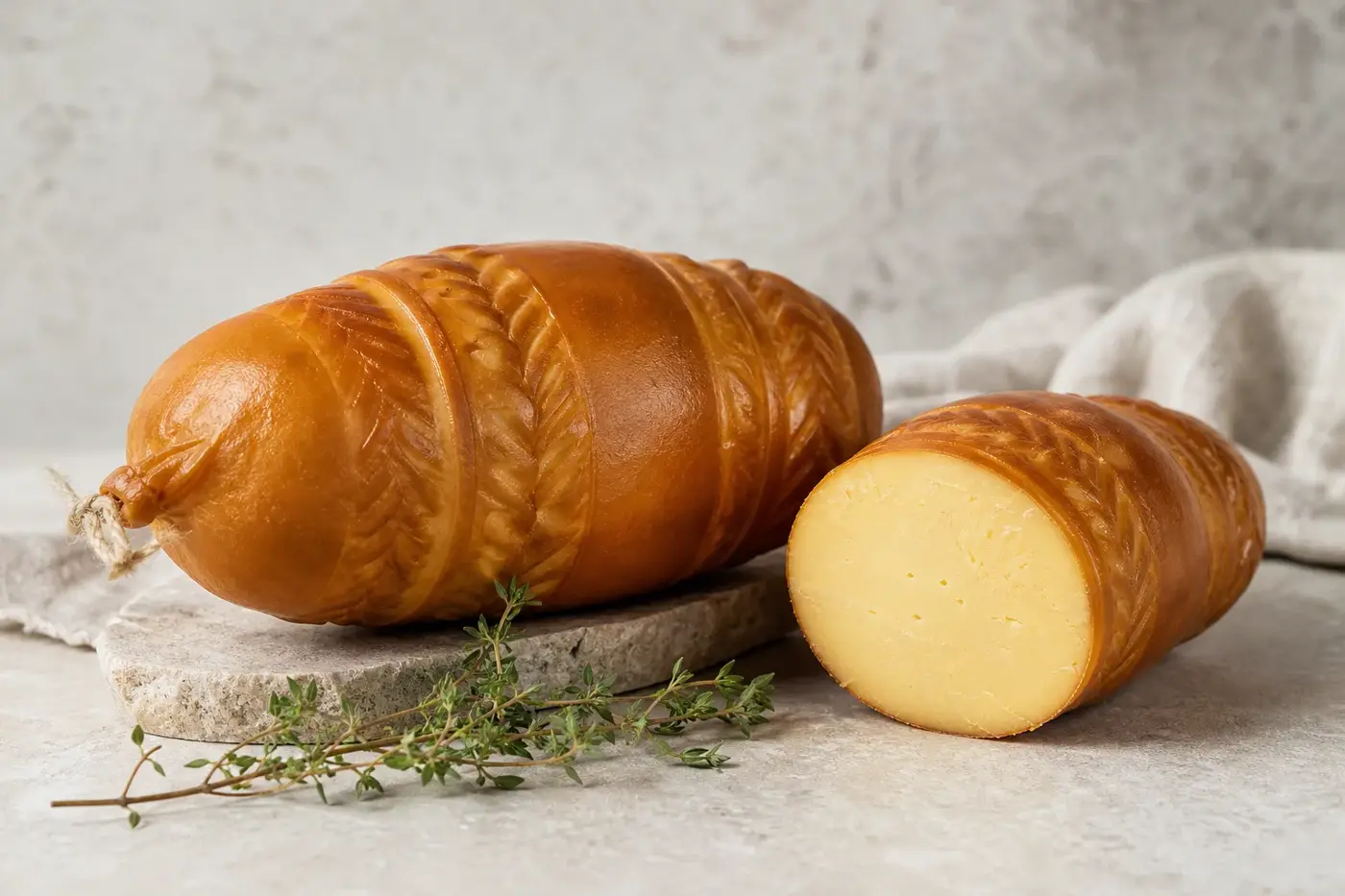
Unsmoked Oravský korbáčik is white to creamy white, with no smoky aroma, according to the Slovak ministry. The smoked version runs from slightly yellow to golden yellow and has a characteristic smoke aroma. Both share the same basic fibrous structure and consistency beneath that difference.[4]
For the protected smoked cheese, the specification describes direct cold smoking with hardwood smoke at approximately 30 °C. This is a separate manufacturing stage. It does not tell you which milk treatment was used for the starting cheese.[1]
Choose unsmoked if you want to focus on milk, acidity and strands. Choose smoked when you want the smoke aroma to share your attention. Those choices follow the documented differences, not a league table: you need not appoint a winner.[4]
Give that braid a plate of its own
Set a braid on a plain plate. Loosen an end, separate a strand and pull gently along its length. Taste a thicker piece, then a few fine fibres: you will notice the stretched structure more readily than with a plateful of cut pieces.
For your first tasting, keep the accompaniments simple:
- Offer plain bread with the unsmoked cheese, then return to a taste of cheese alone.
- Try cucumber, radishes or apple in separate bites, rather than dressing everything together.
- With the smoked version, offer bread and a little sharp pickle. Keep the pickle separate so you can vary each mouthful.
- Pour water or an unsweetened alcohol-free drink alongside either version.
These are serving suggestions, not documented Orava customs. Leave the braid visible and give each person a portion to pull apart, rather than cutting the whole packet into indistinguishable pieces. You have a rather lovely plait here; there is no need to give it a severe haircut.
Keep the tasting practical, too. UK Food Standards Agency guidance says to keep chilled food out of refrigeration for the shortest possible time.[6]
Pull up a plate for Chechil and Parenica
String cheeses invite comparison, but each has its own identity. Armenian producer Dili describes its Chechil as firm, stringy and pronouncedly salty. It lists pasteurised cow’s milk, starter, rennet and salt as ingredients. That describes Dili’s product, not every cheese sold as Chechil.[7]
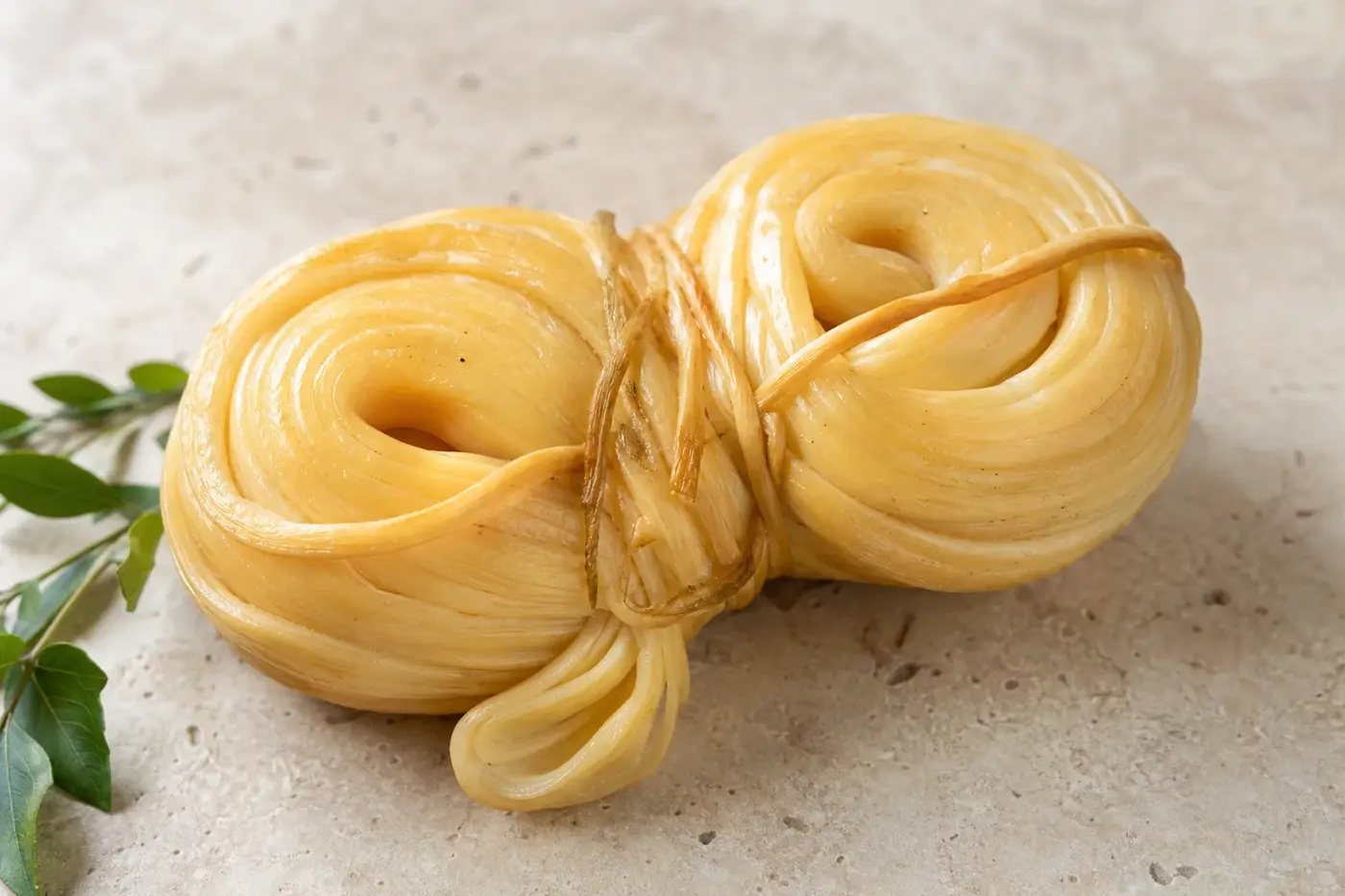
Parenica takes stretched cheese in a different direction. The specification for Slovenská parenica describes a ribbon rolled into two connected coils and gently smoked. It requires raw sheep’s milk, or a mixture of raw sheep’s and cow’s milk containing at least 50% sheep’s milk.[8]
You can spot the clearest distinction before taking a bite: strands plaited into a whip versus ribbon wound into coils. Chechil belongs in the string-cheese conversation too. Shared texture, though, does not make it Oravský korbáčik.[1][7][8]
For a side-by-side tasting, first compare how the cheeses come apart, then turn to flavour. Leave each label beside its cheese, especially when milk species and treatments differ. You can enjoy the family resemblance without losing sight of each cheese’s identity.
Read the label, then make room in the fridge
Start with the full product name, milk treatment, ingredients and storage instructions. If regional origin matters to you, choose by the complete registered name, not the braid’s appearance. Buying unpackaged cheese? Ask the retailer for equivalent product information.[1][3]
UK FSA guidance recommends a home fridge temperature between 0 and 5 °C. Keep your cheese refrigerated and follow the packaging instructions, including any shorter period after opening. The guide to storing cheese at home covers wider storage questions.[6][9]
A use-by date concerns safety; a best-before date concerns quality, as UK government guidance explains. Do not eat cheese after its use-by date. Good refrigeration matters before then too, because poor storage can make food unsafe earlier.[9]
If you have dietary restrictions, read the complete declaration. UK official guidance identifies milk as an allergen. It also explains that allergens in prepacked food must be clearly identified in the ingredients list.[10]
For pregnancy, consult the UK NHS guidance on cheese, milk and other dairy, with November 2026 as the reference point here. Compare its advice with your product information.[11] The distinctions between raw, thermised and pasteurised cheese help you understand what to ask the maker.
General information only, not medical advice: follow the official guidance where you live.
Questions people ask
What is the difference between Korbáčik and Oravský korbáčik?
Korbáčik is the familiar name for the Slovak cheese style. Oravský korbáčik is the exact regional name registered as a protected geographical indication in the EU and Great Britain.
What milk is Oravský korbáčik made from?
The protected cheese starts with fermented, partially ripened lump cheese made from cow’s milk. The specification permits raw milk or pasteurised milk with a lactic acid culture, so the name alone does not tell you which treatment was used.
What is the difference between smoked and unsmoked Oravský korbáčik?
Unsmoked cheese is white to creamy white and has no smoky aroma. The smoked version is slightly yellow to golden yellow and has a characteristic smoke aroma; both have the same basic fibrous structure and consistency.
Is Korbáčik suitable for vegetarians?
The source of rennet matters to some vegetarians. Check the producer’s or retailer’s product declaration rather than judging by the cheese’s appearance.
How should I store Korbáčik?
The UK Food Standards Agency recommends a home fridge temperature between 0 and 5 °C. Keep the cheese refrigerated and follow the packaging instructions, including any shorter period specified after opening.
Sources
- European Commission, Publication of an application: Oravský korbáčik, Official Journal C 188, 13 July 2010, pages 15 to 19. Published single document.
- European Commission, Commission Implementing Regulation (EU) No 243/2011 of 11 March 2011, 2011, Articles 1 and 2 and Annex; EUR-Lex status checked November 2026. Registration instrument.
- Department for Environment, Food & Rural Affairs, Oravský korbáčik, UK protected food names register, published 2021, live record checked November 2026. GB register entry.
- Ministry of Agriculture and Rural Development of the Slovak Republic, Zverejnenie žiadosti „Oravský korbáčik“ v OJ, 2010. Official product description.
- Industrial Property Office of the Slovak Republic, Oravský korbáčik: single document and specification, application-era document, publication date not stated in the retrieved file. Slovak specification.
- Food Standards Agency, How to chill, freeze and defrost food safely, live guidance checked November 2026. Official refrigeration guidance.
- Dili, Chechil Cheese Dili 300g, undated manufacturer’s product description and ingredients, checked November 2026. Commercial producer source, used only for its own product description. Product catalogue.
- Industrial Property Office of the Slovak Republic, Slovenská parenica: specification, application-era document, publication date not stated in the retrieved file, section 4.2. Product specification.
- UK Government, Understanding food labelling: Best before and use-by dates, live guidance checked November 2026. Official date guidance.
- UK Government, Understanding food labelling: Allergen labelling, live guidance checked November 2026. Official allergen guidance.
- NHS, Foods to avoid in pregnancy, live guidance checked November 2026. Official pregnancy guidance.
Researched from official registration instruments, Slovak specifications, UK public guidance and an attributed Armenian producer description; serving suggestions are editorial, with no site tasting or production trial.
Last checked: November 2026
Last checked November 2026.
The editors suggest you read next