Tor
Look up from White Lake’s farm in Somerset and you can see Glastonbury Tor on the skyline.
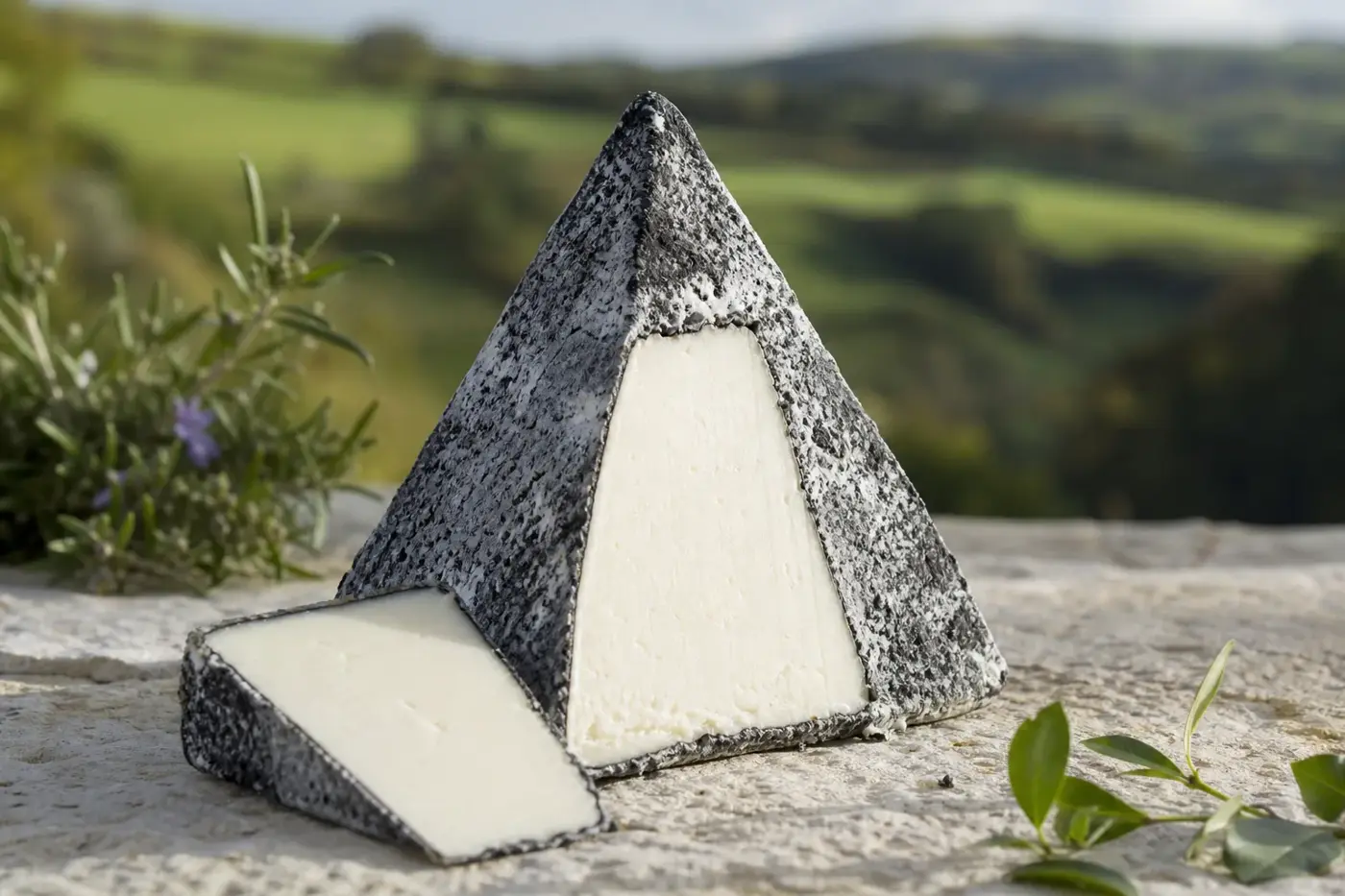
Look up from White Lake’s farm in Somerset and you can see Glastonbury Tor on the skyline. Look down at the dairy’s dark, lightly ash-coated pyramid of goat’s cheese and the family resemblance becomes clear. Beneath that pointed silhouette, the maker describes a firm texture, lemony tang and a subtle peppery undertone. In 2024, this little piece of Somerset took the Best English Cheese trophy at the British Cheese Awards.[1][4]
| Tor at a glance | The details |
|---|---|
| Maker’s product name | Tor.[1] |
| Maker and location | White Lake Cheese, Bagborough Farm, Pylle, near Shepton Mallet, Somerset, England.[2] |
| Milk and treatment | Goat’s milk, thermised and unpasteurised.[1] |
| Coagulant | Vegetarian rennet, according to the maker.[1] |
| Style and shape | Soft, lactic cheese shaped into a pyramid and lightly coated with ash.[1] |
| Declared format | 190 g on the maker’s product page as at November 2026.[1] |
A Somerset landmark in a coat of ash
That dark surface has a job beyond looking handsome. White Lake describes Tor as a fresh lactic cheese with a light ash coating, rather than a thick outer covering. In its explanation of ash-coated cheeses, the maker says charcoal ash helps neutralise surface acidity and encourages rind development. It also contributes appearance and subtle flavour.[1][3]
So the coating belongs to the making as much as to the look. White Lake links it to Tor’s restrained peppery undertone. When you taste it, think of that pepperiness as a counterpoint to the citrus character beneath.[1]
The point has a purpose, too. In the British Cheese Awards organiser’s 2024 announcement, White Lake explained that the pyramid celebrates Glastonbury Tor, visible from the farm. The maker chose that silhouette to distinguish Tor from more familiar French pyramid cheeses.[4]
Come down to Bagborough Farm
Tor comes from White Lake Cheese at Bagborough Farm in Pylle, near Shepton Mallet, Somerset. The business’s published account dates its foundation to 2004. Its home is a family farm with cheesemaking roots reaching back to the 1930s.[2]
The dairy works with goat’s, sheep’s and cow’s milk. White Lake says its supplies include milk from its own French Alpine goat herd, alongside milk from other suppliers. It does not identify the milk source for each individual batch of Tor.[2]
The premises are designed for small-batch production, with room to experiment. You can see that spirit in Tor: a recognisable lactic goat’s cheese format, given a distinctive shape and a light ash coating. The Somerset connection is hard to miss.[2][4]
Bagborough Farm and its view towards Glastonbury Tor give this cheese a clear sense of place. But a regional name is only part of its story. If you want to explore the rest, how to tell cheese styles apart gives you a framework built around milk, rind, texture and method.
What Tor’s milk label tells you
Tor is made from thermised goat’s milk. White Lake also explicitly lists it as unpasteurised. You should therefore not treat it as a pasteurised cheese.[1]
Thermisation is the gentler heat treatment. White Lake’s terminology guide describes heating milk at a lower temperature and for less time than pasteurisation. Keep that distinction in mind when you read a label: unpasteurised does not necessarily mean the milk has received no heat treatment at all.[3]
The maker also declares vegetarian rennet. Rennet is a preparation containing enzymes that help milk coagulate into a gel. “Vegetarian” tells you the maker’s suitability claim, rather than the identity of the precise enzyme preparation used in Tor.[1][5]
If those milk treatments still feel tangled, Raw, thermised and pasteurised milk takes you through the differences. It is a useful companion to the wording on the label.
From goat’s milk to that pointed pyramid
Lactic cheesemaking and rennet can work together. White Lake describes Tor as a lactic cheese and confirms the use of vegetarian rennet. Coagulation can involve acidification, enzymes or both. During fermentation, bacteria turn milk sugar into lactic acid, helping milk proteins form the structure that becomes cheese.[1][5]
The coagulated material is curd; the liquid separated from it is whey. Removing whey concentrates the milk solids, while moulding gives the cheese its format. White Lake’s public description gives you the essentials of the finished Tor, rather than a detailed sequence of handling steps.[5]
Here is how those essentials come together in your pyramid. The precise stage and method of applying Tor’s ash are not established.
| Stage | What happens along the way |
|---|---|
| Milk preparation | Goat’s milk is thermised.[1] |
| Coagulation | A lactic cheese is made with vegetarian rennet.[1] |
| Forming | The cheese is shaped into a pyramid.[1] |
| Surface treatment | A light coating of ash is added.[1] |
Ash links the making to the maturation, too. White Lake explains that moderating surface acidity helps create conditions for rind development. The maker also credits the coating with contributing flavour.[3]
If you would like to follow the whole journey, how cheese is made takes you further. It runs from coagulation through whey separation to shaping.
Ask your cheesemonger about this particular Tor
Before you choose your pyramid, ask whether it is firm or further along in maturation. The condition of the cheese in front of you is your most useful guide. Start there when deciding what you want to serve.
White Lake’s general guidance distinguishes young, firm cheese from medium-ripe and ripe cheese. Its FAQ says the dairy aims to dispatch cheese ready to eat, although some cheeses arrive younger. The care page also explains that cheeses can leave the dairy at different stages.[6][7]
Those descriptions give you useful language for a conversation at the counter. There is no established Tor-specific maturation schedule here, nor a precise account of weekly changes in rind colour, aroma and internal texture. Ask about the particular pyramid rather than assuming how it will cut or feel.
Choose the stage that suits your plans, then follow the storage and date instructions on the actual pack. White Lake’s general discussion of maturation helps you understand the background. It does not replace those instructions.[6][7]
Follow the lemon, then the quiet peppery note
Lemon, goat’s cheese tang and a subtle peppery undertone are White Lake’s three central flavour references for Tor. The maker links the pepperiness to the ash. Its statement published by the British Cheese Awards organiser also emphasises citrus, lactic character and restrained pepperiness.[1][4]
“Lactic” is a useful word to take into your first mouthful. White Lake explains it as a refreshing, yoghurt-like sourness. That gives you something more precise to look for than “strong” or “mild”. Those two words do tend to get all the work.[3]
The maker describes Tor’s texture as firm, while classifying it as a soft cheese. You need not choose between the two: soft identifies the style, while firm describes the body in White Lake’s product account. The condition of your particular cheese still matters when you cut and taste it.[1]
For a focused tasting, begin with a small piece on its own and consider whether the acidity suggests lemon or yoghurt. Notice how closely the paste holds together and how long the tang lasts. Record the aroma separately in your own words, then try another mouthful with bread. This is a suggested tasting method, not a recorded tasting of Tor.
Tor’s moment at the British Cheese Awards
Tor won the Best English Cheese trophy at the British Cheese Awards 2024. The Royal Bath & West Society confirmed the result in its published announcement. Judging took place at the Bath & West Showground on 22 March 2024.[4]
The announcement gives you more than a trophy to note. It names Tor, describes the ash-coated pyramid and records White Lake’s explanation of the local landmark behind its shape. It is a dated portrait of the qualities the maker sees as this cheese’s signature.[4]
Make a little room for Tor at the table
Start with plain bread or an unflavoured cracker. Give yourself a taste of the cheese before bringing in anything sweet or sharp. Check the pack’s instructions about the rind before serving it.
White Lake recommends honey, fresh figs, fig jam and stone fruit with goat’s cheeses. For a savoury turn, it suggests caramelised onion chutney and pickled beetroot.[8] Put these beside the cheese rather than over it, so everyone can choose their own balance.
The table brings together the maker’s published pairing advice and serving suggestions based on its description of Tor’s flavour. You can keep the arrangement simple. There is still plenty to explore.
| Accompaniment or drink | How to enjoy it |
|---|---|
| Fresh fig or a little fig jam | Try sweetness against the lactic tang, following White Lake’s goat’s cheese pairing advice.[8] |
| Pickled beetroot | Serve a small amount beside the cheese, following the maker’s savoury suggestion.[8] |
| Plain bread and water | Taste the cheese first, before adding another flavour. |
| Alcohol free apple drink | Try it as a suggested fruit contrast. |
Water is equally suitable for a tasting. Choose it when you want to concentrate on the cheese itself.
On a small board, give Tor a little space. There is no need to invite every chutney in the cupboard. Several assertive accompaniments can make its character harder to explore, so keep them in separate dishes and include a plain option. You can then move between the cheese alone and a contrasting mouthful.
Keep Tor cool and its wrapping close
Refrigerate Tor and keep its original wrapping. White Lake recommends both for soft cheese. Its care guidance also mentions foil for cheese kept between servings.[7]
If you follow Food Standards Agency advice in England, Wales and Northern Ireland, your fridge should be between 0 and 5 °C. Follow the storage instructions on the packaging. Use a fridge thermometer to check the temperature, as the agency recommends.[9]
Take out only what you intend to serve shortly. The FSA advises keeping chilled food out of the fridge for the shortest possible time during preparation.[9] NHS guidance says to eat ready to eat foods within four hours of removing them from the fridge.[10]
Follow any instructions supplied with the cheese about its rind, and ask the maker for confirmation before including it in a tasting. Keep the wrapping so you have batch details and storage directions to hand. For the wider practical method, see how to store cheese at home.
This page summarises published guidance from the official sources it cites. It is not medical advice. Guidance differs between countries and changes over time, so check the current source for where you live, and ask your doctor, midwife, pharmacist or dietitian about your own circumstances.
What to know about rennet, milk and safety
White Lake declares vegetarian rennet for Tor. The cheese contains goat’s milk. Turn to the actual packaging for the complete ingredient and allergen information.[1]
In the UK, the NHS advises against eating mould ripened soft cheeses such as brie, camembert and chèvre during pregnancy unless cooked until steaming hot.[11] Its guidance gives the full categories and exceptions. The guidance cited here is current as at November 2026.
For other individual circumstances, follow the official advice for where you live. Discuss your dietary questions with the appropriate healthcare professional.
Questions people ask
Is Tor made from pasteurised milk?
No. White Lake makes Tor with thermised goat’s milk and lists it as unpasteurised. Thermisation uses a lower temperature and a shorter heating period than pasteurisation.
Is Tor suitable for vegetarians?
White Lake declares vegetarian rennet for Tor. The cheese contains goat’s milk, so check the packaging for complete ingredient and allergen information.
What does Tor taste like and what can I serve with it?
White Lake describes a lemony tang and a subtle peppery undertone. For goat’s cheeses, the maker recommends accompaniments including fresh figs, fig jam, honey and pickled beetroot.
How should I store Tor?
White Lake recommends refrigerating soft cheese and keeping its original wrapping. The Food Standards Agency advises a fridge temperature of 0 to 5 °C in England, Wales and Northern Ireland, and recommends following the packaging instructions.
Can I eat Tor during pregnancy?
The NHS advises against mould ripened soft cheeses such as brie, camembert and chèvre during pregnancy unless cooked until steaming hot. Check the NHS guidance for the full categories and exceptions, and ask your healthcare professional about your circumstances.
Sources
- White Lake Cheese, “Tor”. Current product description, product information and care text, undated, retrieved November 2026. Primary maker source for milk treatment, vegetarian rennet, format and attributed tasting notes.
- White Lake Cheese, “Introduction to Your Cheese”, Our story. Current webpage, undated, retrieved November 2026. Primary maker account of its foundation, milk sourcing and Bagborough Farm location.
- White Lake Cheese, “Cheese Terminology Explained!” Current webpage, undated, retrieved November 2026. Maker’s explanations of thermisation, lactic flavour and charcoal ash.
- Royal Bath & West Society, “Tor named Best English Cheese at British Cheese Awards”. Press release concerning the British Cheese Awards 2024. Primary award-organiser confirmation, including an attributed maker statement.
- Tetra Pak, Dairy Processing Handbook, Chapter 16, “Cheese”. Current online edition, retrieved November 2026. Technical equipment manufacturer’s account of coagulation, curd, whey and moulding.
- White Lake Cheese, “FAQ”. Current webpage, undated, retrieved November 2026, section “Will my cheese arrive ripe and ready?”
- White Lake Cheese, “Caring for Your Cheese”. Current webpage, undated, retrieved November 2026. Primary maker guidance on refrigeration, wrapping and dispatch at different maturity stages.
- White Lake Cheese, “Perfect Pairings”. Current webpage, undated, retrieved November 2026. Maker’s general goat’s cheese accompaniment suggestions.
- Food Standards Agency, “How to chill, freeze and defrost food safely”. Published 18 December 2017, current retrieved version, November 2026. Applies to England, Northern Ireland and Wales.
- NHS, “Listeriosis”. Page last reviewed 10 November 2023, retrieved November 2026, section “How to avoid listeriosis”.
- NHS, “Foods to avoid in pregnancy”. Direct source link and current wording require verification before publication.
Researched through the maker’s published descriptions, an award organiser’s primary announcement, a technical handbook and official UK food safety guidance; serving suggestions are identified as editorial suggestions.
Last checked: November 2026
Last checked November 2026.
The editors suggest you read next
West Country Farmhouse Cheddar Cheese
Large pieces of curd turn and stack under the cheesemaker’s hands.