Vacherin Mont-d'Or
Your spoon slips through the pale centre of Vacherin Mont-d’Or, while a band of spruce keeps the soft cheese in place.
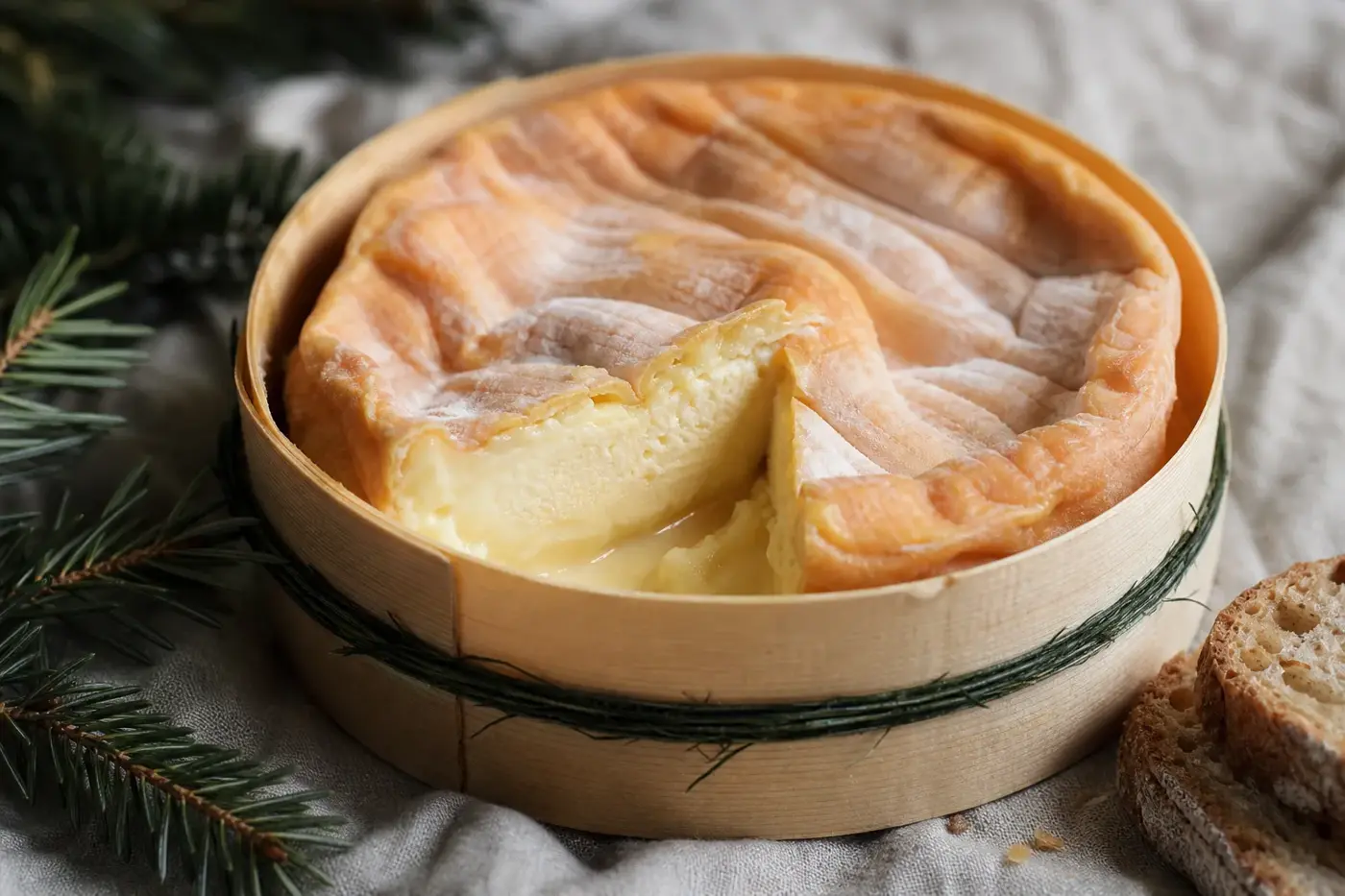
Your spoon slips through the pale centre of Vacherin Mont-d’Or, while a band of spruce keeps the soft cheese in place. The wood lends its woody, resinous character, too. Made seasonally in the Vaud Jura from thermised cow’s milk, this Swiss washed-rind cheese arrives in a wooden box, with a yielding paste beneath its supple rind. You could call the box sensible planning. [1][3][4]
| What you might want to know | The detail |
|---|---|
| Familiar and registered name | Vacherin Mont-d’Or. [1][2] |
| Registration authority and register ID | Swiss Federal Office for Agriculture, OFAG/FOAG. Register ID: Not established. [2] |
| Protection in Switzerland | Registered AOP, appellation d’origine protégée. Registration decision: 7 May 2003; registration notice published: 16 June 2003. Status as of November 2026. [2] |
| Binding production document | Swiss Cahier des charges Vacherin Mont-d’Or, incorporating amendments through the decision of 13 October 2020. [1] |
| Milk and treatment | Cow’s milk, thermised. [1][3] |
| Coagulant and cultures permitted | Natural rennet and selected cultures authorised for the designation. [1] |
| Minimum ripening | At least 17 days. [1][5] |
| What it looks like and weighs | Round, with a supple, undulating washed rind; whole cheeses range from 350 g to 3 kg. [3] |
| When you will find it | Production: 15 August to 31 March. Sales: September to April. [1][3] |
Follow the box home to the Vaud Jura
Follow Vacherin Mont-d’Or home and you reach the Vallée de Joux and the adjoining Vaud Jura foothills. Its Swiss AOP ties the name to this defined area and a prescribed way of making it. The wooden box alone does not earn the name. The official register lists it separately from Vacherin fribourgeois, another Swiss cheese with its own specification. [2][5]
Look closer and the map becomes remarkably precise. It includes specified parts of Jura-Nord vaudois and Morges, selected communes in Gros-de-Vaud and Nyon, designated alpine pastures, and named Franco-Swiss alpine holdings. Individual pastures and exclusions count: “made in Vaud” covers more ground than the area set out in Article 2 of the specification. [1]
The connection starts before milk reaches the dairy. Conditions governing its origin tie the cheese to this place before cheesemaking begins. [1] If you would like to untangle a geographical designation from a cheese style, explore protected cheese names.
Smaller cheeses, a seasonal tradition
Picture the Vallée de Joux pastures towards the season’s end, with less milk coming in. The historical account submitted with the Swiss registration application describes cheesemakers adapting by making smaller cheeses. Large wheels had become less practical as milk production declined. Those smaller cheeses became known as vacherins. [6]
A few early records let you trace the local trade. A toll law dated 6 June 1812 mentions vacherins; an innkeeper’s manuscript follows in 1823, then an account book records purchases and deliveries in 1845. Each predates the often-repeated story of a French soldier bringing the recipe during the war of 1870. The application treats that soldier story as legend. [6]
In 1865, the dairy society at Les Charbonnières began making the cheese. The producer organisation places that milestone within an already established regional tradition. What emerges is a cheese shaped locally over time, rather than credited to one person’s moment of inspiration. [7]
That seasonal rhythm remains part of the Swiss specification. Production runs from late summer through March, with the producer group setting the definitive date of the first manufacture each season. Sales continue through April, giving the last cheeses time to ripen and reach their destination. The dairy’s calendar and your shopping calendar finish at different points. [1][3]
From warm milk to the ripening cellar
Thermised cow’s milk is the starting point for Swiss Vacherin Mont-d’Or. The specification requires a minimum treatment of 62 °C for 15 seconds, or an equivalent combination of time and temperature, followed by a positive phosphatase test. This is distinct from pasteurisation. [1] You can explore the differences in raw, thermised and pasteurised milk.
The registration dossier also describes requirements for feed and milk delivery. These include feeding without silage during production for this cheese. Its historical explanation connects the cheese’s character with the local milk supply and the handling practices that developed around it. [6]
Inside the dairy, cultures and rennet, the preparation that coagulates milk, turn the milk into curd. The curd is gathered into moulds and lightly pressed. Each young cheese then leaves its mould, receives a spruce band and goes into brine, a salt-water bath. The wood is already doing its work before the cheese reaches the cellar. [1][5]
The producer organisation gives each stage a clear purpose. Moulding establishes the shape, the band provides support, and brining prepares the cheese for cellar ripening. At this point, you would see a young, pale round. That wrinkled top and spoonable centre are still to come. [4]
Ripening, also called affinage, takes place on spruce boards. Turning and washing develop the rind and yielding consistency over at least seventeen days. Only afterwards does the cheese go into its box. First the band, then the box: two pieces of spruce with distinct roles. [4][5]
Spruce, snug boxes and those lovely wrinkles
The first band is a strip of spruce inner bark, known in French as liber. Wrapped around the young cheese, it supports the developing paste through salting and cellar ripening. The producer organisation describes the wood as part of the cheese’s structure and character. There is more going on here than handsome packaging. [3][4]
After cellar ripening, the box takes its turn. Each cheese is fitted into a new spruce box slightly smaller than itself, gently compressing it. That snug fit creates the characteristic waves across the top. The wrinkles form where the supple rind meets its final wooden home. [5]
The spruce makes itself known in the flavour as well. The producer organisation’s technical description identifies woody spruce-resin notes associated with both band and box. Its manufacturing account follows the wood from packaging manufacture through to the final hand-boxing of the cheese. [3][4]
When you serve it, leave that support in place around the soft centre. Spoon the cheese away from the wood. The band and box are packaging, not part of your portion.
Get to know your first spoonful
Start with a look at the rind. The producer organisation describes it as amber-yellow to reddish-brown, washed, supple and slightly undulating. Underneath, you should find ivory-yellow paste that is soft and slightly runny. Boxes vary in colour and consistency, so use that description as a guide rather than expecting every cheese to look identical. [3]
Now taste. The organisation describes a lightly salted, mildly acidic flavour, with spruce adding its distinctive woody, resinous contribution. Notice the wood contact and soft texture alongside the strength of flavour. Together, they help explain why band, rind and yielding centre all matter to this cheese’s identity. [3]
The manufacturing account explains that the paste becomes progressively more flowing as the cheese ripens. A spoonable centre does not necessarily mean someone has heated it. Maturation can manage that by itself. The organisation presents spooning, warm serving and oven preparation as separate ways to enjoy Vacherin Mont-d’Or. [4]
For your first taste, try a little on its own before reaching for bread or potatoes. Watch how the paste moves, then notice the balance between salt and acidity. Does the spruce come through more clearly in the aroma or the finish? Those small observations give you words for what you enjoy when choosing your next box.
Three names to take to the cheese counter
At the counter, read the full name and origin together. This is your simplest way to distinguish Swiss Vacherin Mont-d’Or from its French neighbour and the larger, sliceable Vacherin fribourgeois. The shared vocabulary can be confusing. Milk treatment and texture bring the differences into focus. [3][8][9]
| Cheese | Where it comes from, according to the source | Your guide to milk and texture |
|---|---|---|
| Vacherin Mont-d’Or | Vaud Jura, Switzerland | Thermised cow’s milk; soft paste that can become spoonable. [3][5] |
| Mont d’Or, also called Vacherin du Haut-Doubs | French Haut-Doubs, associated with Pontarlier and Morteau | Raw cow’s milk cheese in spruce, according to the French producer organisation. [9] |
| Vacherin fribourgeois | Canton of Fribourg and Münchenwiler, Switzerland | Semi-hard, sliceable cheese in wheels of 6 to 10 kg, as defined by its Swiss specification. [8] |
The Swiss and French seasonal cheeses share a regional vocabulary: soft paste, spruce and winter eating. Their producer accounts distinguish the milk treatments clearly, thermised on the Swiss side and raw on the French side. Vacherin fribourgeois belongs to a different texture class altogether. [7][8][9]
So “vacherin” alone leaves an important question unanswered. Ask for the full name, particularly if your plans involve spooning a soft centre from a box. Arriving home with a slicing cheese would leave your spoon somewhat underemployed.
Choose a box for the meal you have in mind
You can buy Swiss Vacherin Mont-d’Or during its permitted sales season, September to April. “Winter cheese” captures something of its appeal, but not the full window. Keep in mind that these sales dates are separate from the period when dairies may make it. [1][3]
Begin with the full designation and the name of the maker or affineur, the specialist who matures cheese. The producer organisation explains that several cheesemakers and affineurs sell Vacherin Mont-d’Or under their own distinct brands. Different names on the boxes can represent different businesses working within the same AOP. [10]
Tell your cheesemonger how you plan to eat it. “For spooning tonight” or “for a meal later in the week” is more useful than simply asking for “the ripest cheese”. Ask about that particular box’s condition, its date marking and the supplier’s storage instructions.
Look for the published characteristics: a supple, waved rind and pale, soft paste. [3] Consider those alongside the label and the seller’s information about that batch. The cheese in front of you matters more than an abstract idea of perfect ripeness. [11]
Make room in the fridge
Refrigerate your cheese and follow the packaging instructions, including any directions for storage after opening. Food Standards Agency guidance for England, Northern Ireland and Wales recommends a domestic fridge temperature between 0 and 5 °C (32 to 41 °F). It also says dairy products should be kept in the fridge. [11]
Keep the original supporting box and protective packaging where practical. Before saving any cheese for another day, read its label: the FSA specifically directs consumers to follow storage instructions and date markings. [11] For help organising your fridge and handling different styles, see storing cheese at home.
Set the table and let the cheese lead
Bread and potatoes are the producer organisation’s straightforward serving suggestions. Spoon the soft paste onto bread, or serve it with potatoes. Either gives the cheese your attention without requiring an elaborate dish around it. [4]
If you want to serve it at room temperature, bring out only what you intend to eat at that sitting. FSA guidance for England, Northern Ireland and Wales says chilled food should spend the shortest possible time outside refrigeration during preparation, with a maximum of four hours. Follow any shorter limits in the product instructions. [11]
Once the paste flows, use a spoon. Place the supported cheese on a plate to catch drips, with bread offered separately so guests can take manageable portions. For oven-warmed cheese, follow that product’s cooking and packaging directions, including whether its container is suitable for heating.
Keep your first serving simple. If you would like something crisp or sharp alongside it, try apple slices, a small portion of cornichons or a plain green salad. They offer a contrast to the cheese’s published soft texture and lightly salted profile without taking over the plate. [3]
Sparkling water or an alcohol free apple drink can sit happily alongside it. Choose something you enjoy, since no particular pairing defines the cheese. For a broader look at matching flavours and textures, explore cheese and wine pairing.
General information only, not medical advice: follow the official guidance where you live.
Questions people ask
Where is this Swiss Vacherin made?
It comes from the Vallée de Joux and adjoining Vaud Jura foothills. Its Swiss AOP defines the production area and the method of making.
When is Swiss Vacherin available?
Production runs from 15 August to 31 March. The sales season runs from September to April.
Is Swiss Vacherin made from raw milk?
No, it is made from thermised cow’s milk. The specification requires treatment at a minimum of 62 °C for 15 seconds, or an equivalent combination of time and temperature.
How is Swiss Vacherin different from French Mont d’Or?
The Swiss cheese is made with thermised cow’s milk in the Vaud Jura. French Mont d’Or comes from the Haut Doubs and is made with raw cow’s milk.
How should I store and serve Swiss Vacherin?
The Food Standards Agency advises keeping dairy products in the fridge and following the storage instructions and date markings on the label. Its guidance for England, Northern Ireland and Wales recommends a fridge temperature between 0 and 5 °C. For serving, keep the spruce support in place and spoon the cheese away from the wood.
Sources
[1] Swiss Federal Office for Agriculture. Cahier des charges Vacherin Mont-d’Or. Registered by decision of 7 May 2003, incorporating amendments through 13 October 2020; official file listed 26 January 2021. Articles 1 to 3, 10, 13 to 15 and 17 to 20.
[2] Swiss Federal Office for Agriculture. AOP / IGP, appellations d’origine et indications géographiques. Live register listing, Vacherin Mont-d’Or entry, checked November 2026.
[3] Interprofession du Vacherin Mont-d’Or. Specification sheet for Vacherin Mont d’Or made from thermised milk. AI 00.03.1, revision D, effective 7 July 2026. Producer organisation technical document, particularly section 1.1.
[4] Interprofession du Vacherin Mont-d’Or. La fabrication. Undated online manufacturing and serving account, checked November 2026.
[5] Interprofession du Vacherin Mont-d’Or. L’AOP. Undated online explanation of the designation and method, checked November 2026.
[6] Swiss Federal Office for Agriculture. Résumé de la demande d’enregistrement du Vacherin Mont-d’Or. Registration application summary, official file listed 27 July 2016. Historical dossier and explanation of the geographical connection.
[7] Interprofession du Vacherin Mont-d’Or. L’histoire. Undated producer organisation historical account, checked November 2026.
[8] Swiss Federal Office for Agriculture. Cahier des charges Vacherin fribourgeois. Incorporating amendments through 22 February 2023. Articles 2 and 3. (blw.admin.ch)
[9] Syndicat interprofessionnel du Mont d’Or. Dossier de presse Mont d’Or 2025-2026. Producer organisation account of the French cheese, particularly the introduction and production description.
[10] Interprofession du Vacherin Mont-d’Or. Vacherin Mont-d’Or AOP: commercial factsheet. English document, 2026. Section on cheesemaker-affineurs and their brands.
[11] Food Standards Agency. How to chill, freeze and defrost food safely. Published 18 December 2017, current online guidance checked November 2026. Applies to England, Northern Ireland and Wales.
[12] Swiss Federal Food Safety and Veterinary Office. Mises en garde et rappels : aliments. Live warning and recall listing, inspected November 2026.
[13] Food Standards Agency. Alerts. Live food and allergy alert listing, inspected November 2026.
This desk-researched article compares the Swiss register and production specification with producer organisation documents, the neighbouring cheese’s Swiss specification, and attributed French producer information, using official consumer guidance for storage.
Last checked: November 2026
Last checked November 2026.
The editors suggest you read next