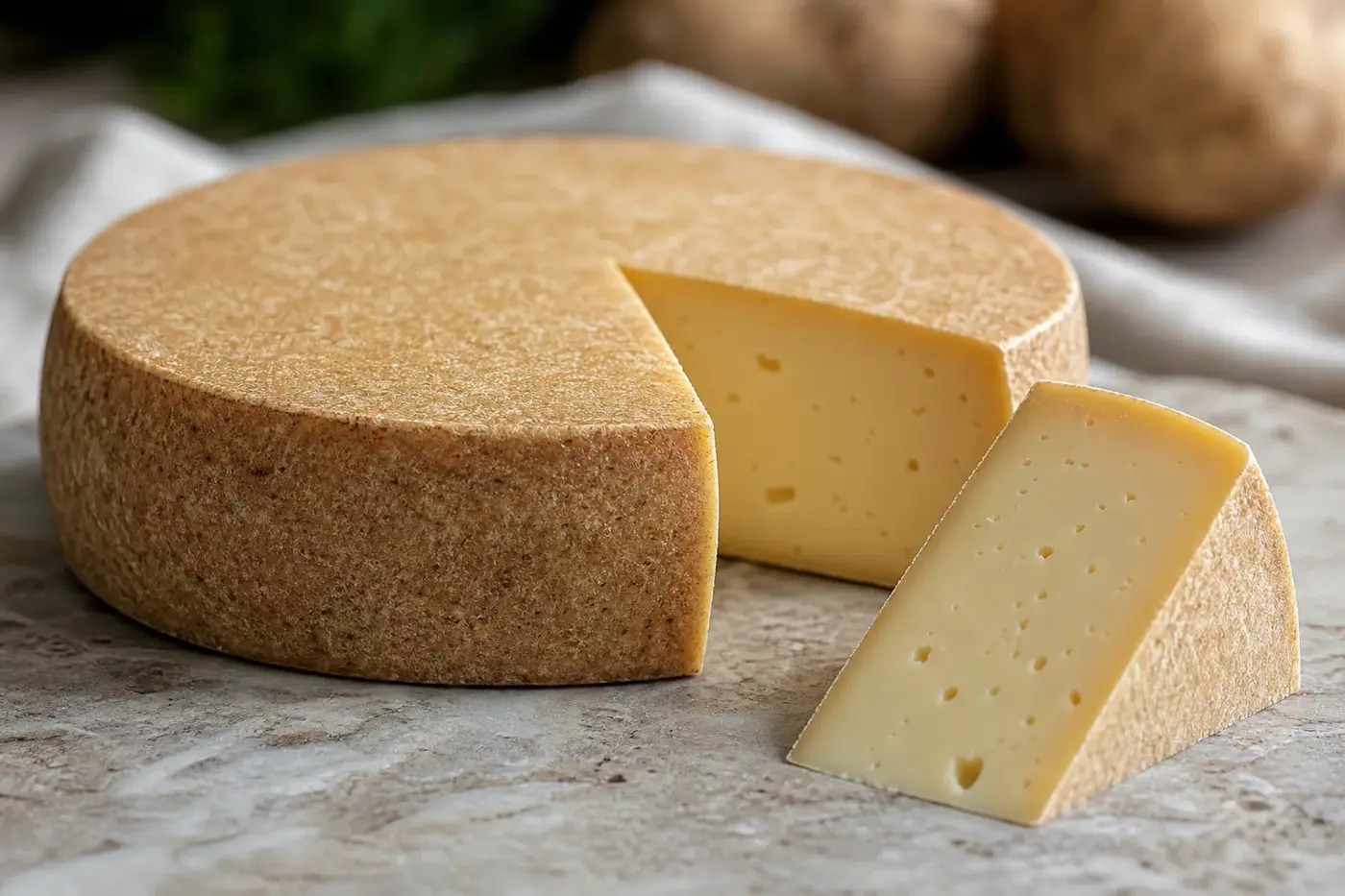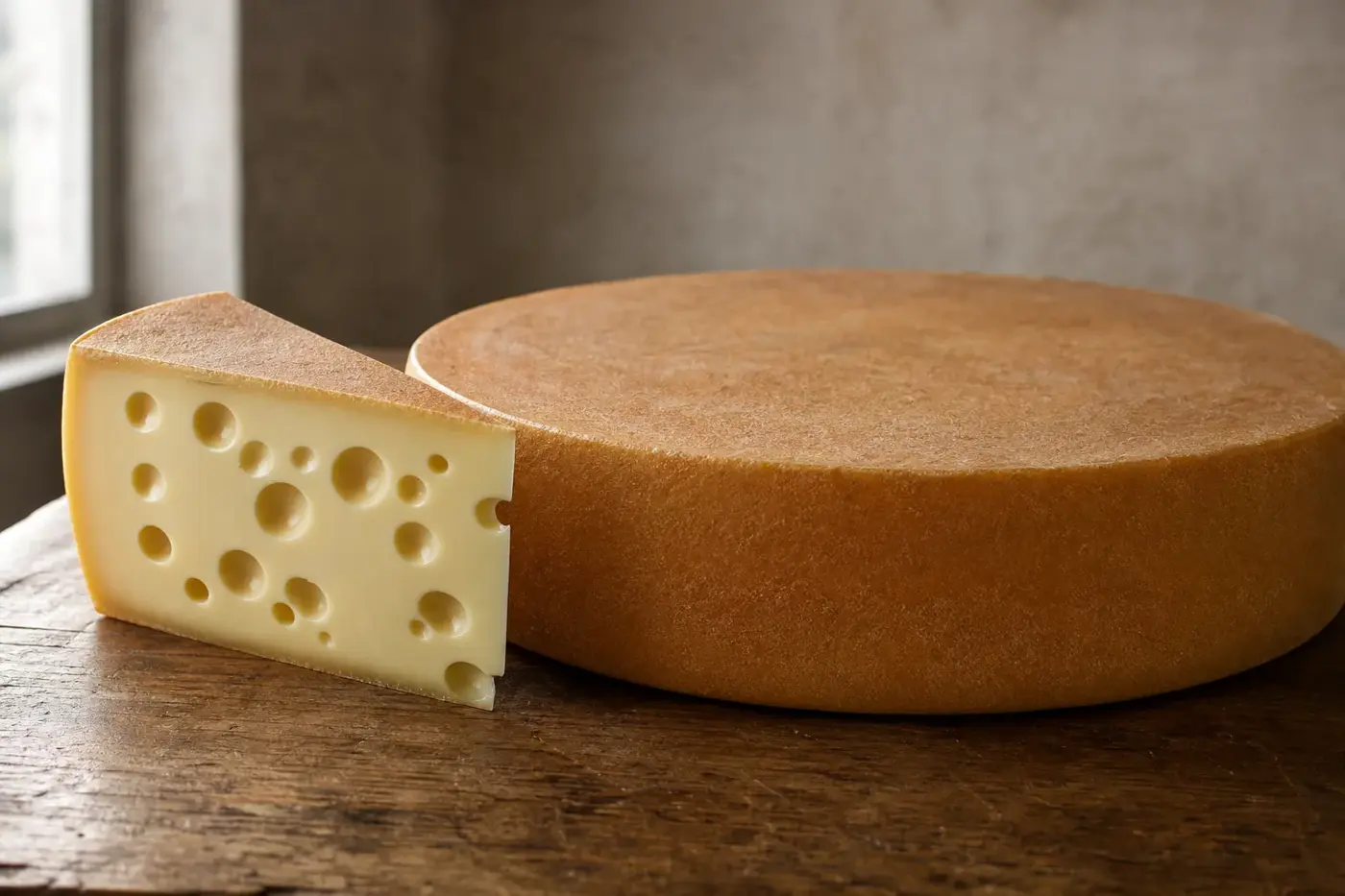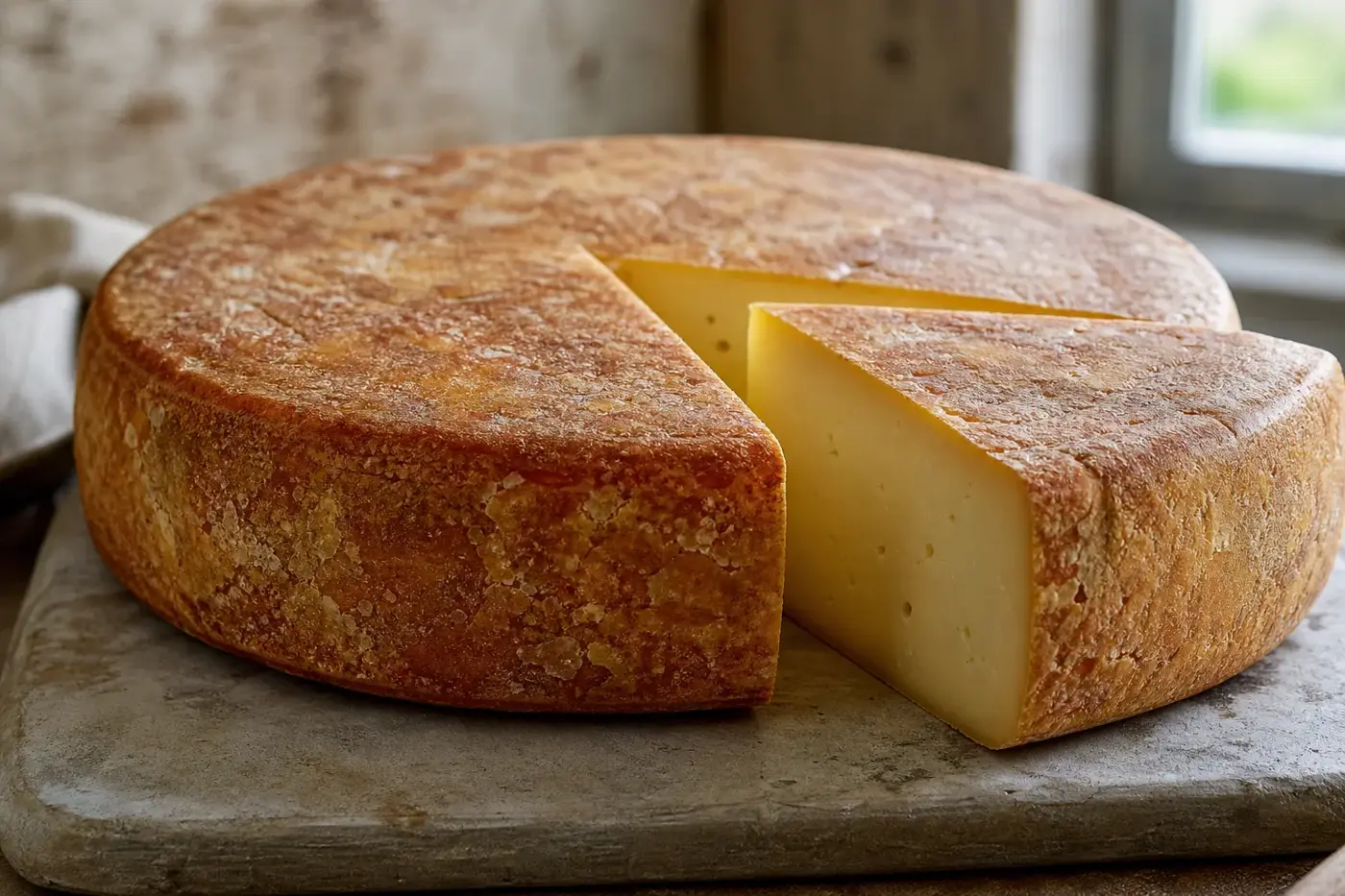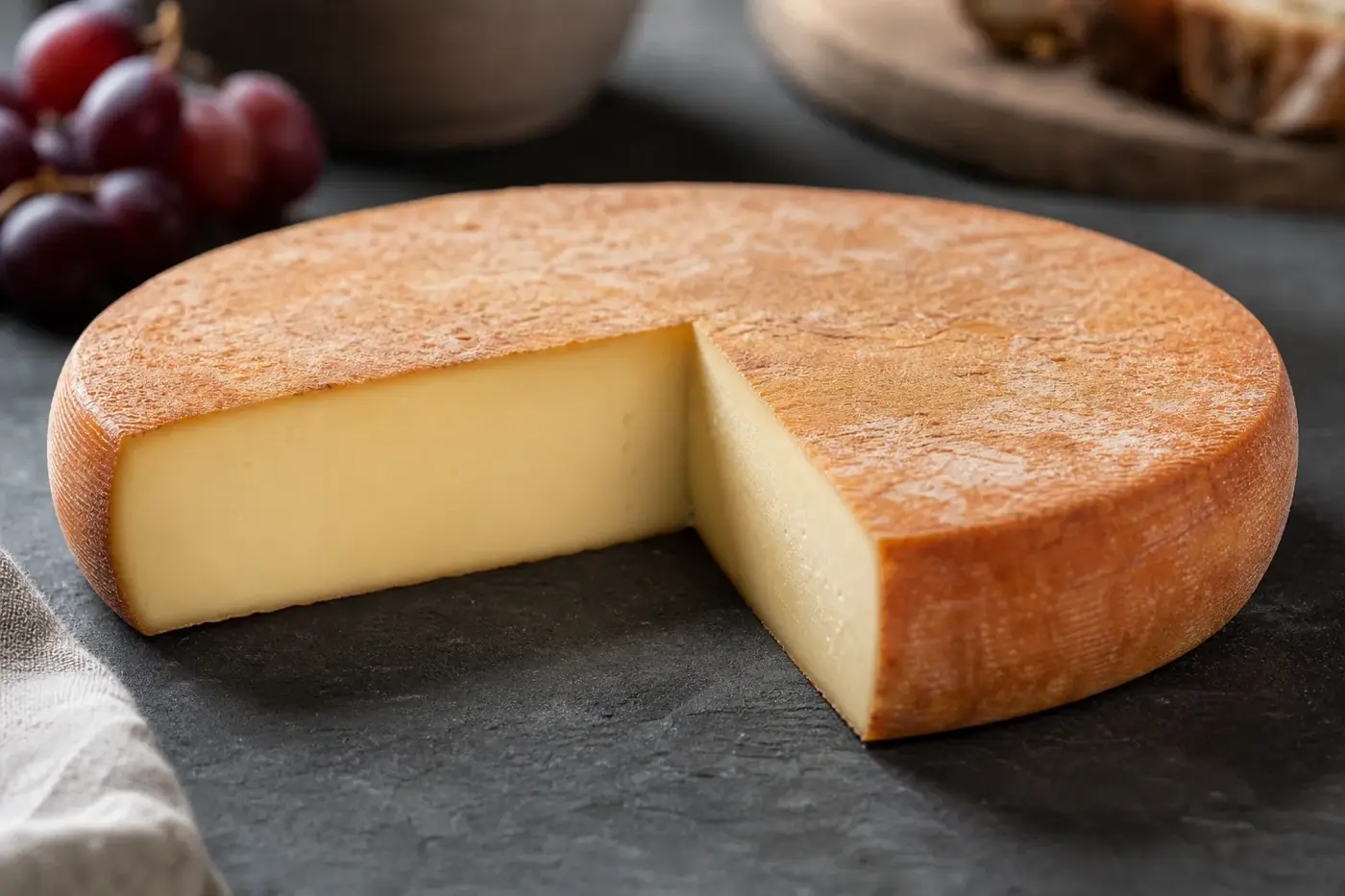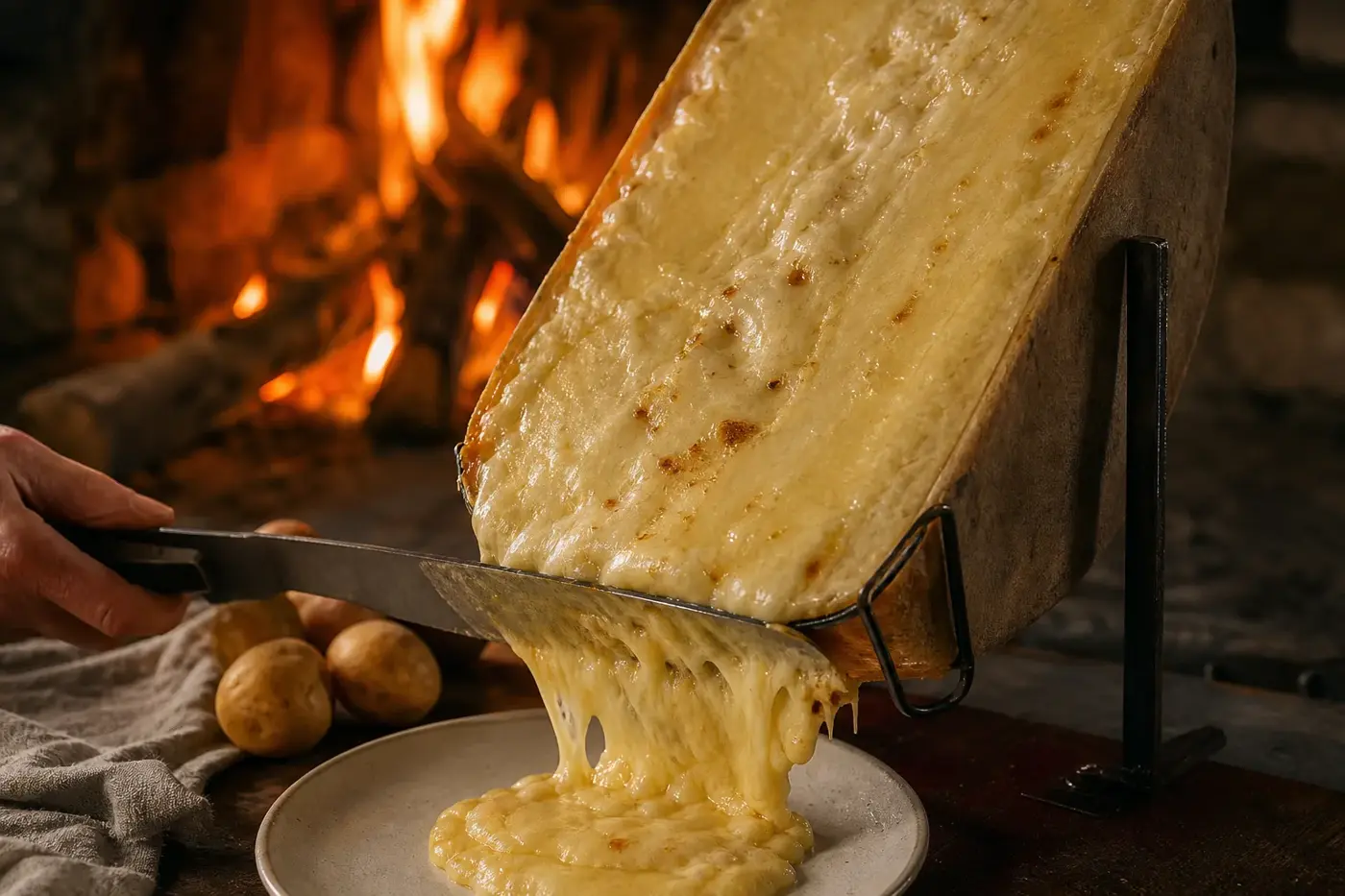
A cut wheel faces the fire in Valais. Its exposed surface softens, melts and slips onto your plate with a scrape. This is the ritual behind Raclette du Valais, a raw cow’s milk cheese whose Swiss AOP ties it to a particular place, production method and maturation. Patience has rarely looked so well rewarded.[1][3][7]
Your Raclette du Valais essentials
| What to know | The detail |
|---|---|
| Registered names | Raclette du Valais; Walliser Raclette.[1][2] |
| Swiss status | Registered AOP; November 2026.[1] |
| Authority and identifier | Federal Office for Agriculture; register ID: Not verified.[1] |
| Where it is made | Valais, with the specified Spittelmatten alpine pasture exception in Kandersteg, canton Bern.[2] |
| Milk and coagulant | Raw cow’s milk; calf rennet.[2][3] |
| Allergen | Milk.[2] |
| Minimum maturation | Three months for Raclette du Valais.[2][6] |
| Wheel size | 29 to 32 cm across; 6 to 8 cm high; 4.6 to 5.8 kg.[2] |
| Rind | Natural, washed surface; brown to orange.[2] |
Follow the milk into the Valais mountains
Your cheese might begin in a village dairy or a summer alpine dairy in the Swiss Alps. The producing interprofession describes cows feeding on hay and grass from local meadows and mountain pastures. No single breed has the job: Hérens, Brown Swiss, Simmental and other cattle all appear in its account.[3][4]
Take this distinction with you to the cheese counter: an Alpine address does not necessarily mean summer pasture production. The AOP covers both village production and cheese made on summer pastures. If you want summer production, ask for the dairy and production date, rather than relying on the Alpine canton on the label.[3][4]
Look for the name, not just the mountain
Raclette du Valais and Walliser Raclette are registered Swiss names governed by a specification. AOP means appellation d’origine protégée, or protected designation of origin. The Federal Office for Agriculture’s register records publication of the registration on 21 December 2007, separately from the earlier decision and court proceedings.[1]
Raclette alone is not protected, as the Swiss specification expressly records. Generic raclette cheese can come from elsewhere and be made differently. The full name tells you more than a mountain illustration, a Swiss flag or a promise of a good melt.[2][5]
The protected cheese and the meal are different things, too. Your tabletop raclette supper can involve several cheeses, but in Switzerland, cheese carrying the registered name must meet the designation’s requirements. The guide to protected names helps you navigate the wider terminology.[1][5]
From the copper vat to the cellar
Those open copper vats are working equipment, not scenery. Both they and calf rennet are requirements.[2] The interprofession’s account begins with fresh milk arriving at the village dairy, where the cheesemaker adds lactic cultures and rennet. The cultures introduce selected microorganisms; the rennet sets the milk into a gel, then cutting creates curd grains as liquid whey separates.[3]
Stirring and heat come next. The cut curd reaches 36 to 45 °C before moulding and pressing. The specification allows salting in brine or on the surface; in the interprofession’s illustrated account, the pressed cheeses take the brine route.[2][3]
Then the work moves to affinage, the controlled maturation that gives the wheels their washed rind. Washing and rubbing care for the surface while the inside becomes supple. The AOP association describes wooden maturation boards, while the interprofession details regular turning and cellar care. Raclette du Valais must mature for at least three months.[2][3][6]
Read the clues on the wheel
Look along the side of the low, round wheel for an impressed dairy or regional name. This marked edge, called the heel, makes the connection to its origin visible and can help you identify a cut piece. The natural rind is slightly damp, brown to orange, without a wax coating.[2][3]
Inside, you’ll find pale paste, a smooth, yielding texture and sparse small openings. The specification limits those holes to 2 to 3 mm across. This is not a densely perforated cheese; it saves its spectacle for the heat.[2][4]
Taste a little of the season
Start with fresh lactic flavour, vegetal notes and fruitiness: that is the Swiss AOP association’s description of Raclette du Valais.[6] Switzerland Cheese Marketing adds a milky aroma with a slight acidic edge.[7] These gentle characteristics give you a starting point, rather than a promise that every wheel will taste alike.
Season makes a measurable difference. Agroscope’s 2021 characterisation examined cheese bought from 21 dairies using chemical, physical, sensory and microbiological analyses. Among those cheeses, winter milk tended to produce a firmer, whiter paste than summer milk, reflecting feeding-related changes in milk fat composition.[4]
Milk, manufacture and maturation all shape the finished cheese, as the interprofession emphasises.[3] For your own comparison, ask a cheesemonger for two pieces with dairy names and production dates. Consider aroma, acidity, salt and texture separately. Ask how each cheese matured, rather than letting age alone choose for you.
A fireside legend, and a history worth savouring
Melting cheese in Valais is documented in 1574, according to Switzerland’s culinary heritage inventory.[9] The interprofession links raclette to racler, the French verb meaning to scrape, and retells a vineyard fireside origin story as a legend.[8] Enjoy the story, but look to the documented practice for firmer historical footing.
Wider recognition came at the Swiss national exhibition in Lausanne in 1964. The culinary heritage inventory describes that moment and the meal’s subsequent spread. It records two familiar arrangements: the Valais half-wheel, heated at a fire or beneath an electric element, and the individual pans that became common elsewhere.[9]
Raclette, then, names both a cheese and a way of gathering around melted cheese. In the Valais tradition, someone tends the wheel and serves successive scrapings. Your meal arrives plate by plate, rather than as one finished dish set before everyone at once.[7][9]
Beside the embers, wait for your scraping
Switzerland Cheese Marketing describes serving a half-wheel beside the embers. Once the cut face melts, the cheese is scraped straight onto your plate. An electric half-wheel machine follows the same principle, holding that face beneath a heat source so the server can scrape away the softened surface.[7]
Only the exposed layer is served each time. The rest waits as the wheel returns to the heat for the next plate. Use equipment designed for the job, follow its operating instructions, and keep hands and serving space clear of the hot element.[7]
Bring the little pans to the table
Individual pans make sliced Raclette du Valais practical for a smaller gathering. Swissmilk describes pans and spatulas, with cooked potatoes and pickles alongside.[5] Here, you’re melting slices rather than scraping a heated wheel.
Have the accompaniments ready before you begin. Put a slice in each pan, follow the appliance’s instructions and slide the melted cheese onto your plate. Bring out small amounts as needed, leaving the reserve refrigerated. For England, Wales and Northern Ireland, the FSA advises keeping chilled food out for the shortest possible time during preparation, with a maximum of four hours.[10]
Give potatoes and pickles their place
Boiled potatoes in their skins, cornichons and small pickled onions are the most direct companions. Swissmilk suggests black tea to drink.[5] Keep the potatoes plain and the pickles alongside, so you can move between warm cheese and something sharp and crisp.
Black tea gives you an alcohol-free option rooted in that Swiss serving advice.[5] Water is another straightforward choice, especially if you’re comparing cheeses and concentrating on their differences. Serve either with the meal. Keep the pickles and onions within reach, rather than piling them over the melted cheese.
Bring home the cheese, and its label
Look for the full Raclette du Valais AOP name. If you’re buying a cut portion, ask to see the original wheel label. The interprofession describes both the impressed origin marking and a casein identification mark recording the dairy and production date.[3] The AOP association describes whole wheels, halves, cut pieces and slices.[6]
Keep the label with your cheese so its dates and handling instructions remain close to hand. Follow the storage and opening instructions supplied with the piece. FSA guidance for England, Wales and Northern Ireland recommends a home fridge between 0 and 5 °C (32 to 41 °F), with dairy products refrigerated.[10] For the wider routine, see storing cheese at home.
Raw milk: find the guidance for you
Children, pregnant people, older people and people who are unwell are particularly vulnerable to food poisoning from some unpasteurised dairy products, according to UK NHS guidance (November 2026).[11] Its pregnancy guidance allows pasteurised semi-hard cheese and says any cheese cooked until steaming hot can be eaten.[12]
Raclette du Valais uses raw milk, so consider both milk treatment and cheese category when you consult official guidance.[3][6] For pregnancy, the NHS’s cooking advice is to heat cheese until steaming hot.[12] If you have individual concerns, consult the current guidance for your country and speak to a doctor, midwife or dietitian.
General information only, not medical advice: follow the official guidance where you live.
Questions people ask
Is all raclette cheese Raclette du Valais?
No. Raclette du Valais and Walliser Raclette are registered Swiss names, but the word raclette alone is not protected. Generic raclette cheese can come from elsewhere and be made differently.
How is Raclette du Valais made?
It is made from raw cow’s milk in open copper vats, using calf rennet. The curd is heated, moulded and pressed, and the cheese must mature for at least three months.
How is Raclette du Valais traditionally served?
In Valais, a cut wheel is heated at a fire and the softened cheese is scraped straight onto a plate. It can also be served in individual pans, with cooked potatoes and pickles alongside.
What does Raclette du Valais taste like?
The Swiss AOP association describes a fresh lactic flavour with vegetal and fruity notes. Switzerland Cheese Marketing notes a milky aroma with a slight acidic edge.
Can I eat Raclette du Valais during pregnancy?
Raclette du Valais is made from raw milk. NHS pregnancy guidance says that any cheese cooked until steaming hot can be eaten. Consult the current NHS pregnancy guidance and speak to a doctor or midwife about your circumstances.
Sources
- Swiss Federal Office for Agriculture. AOP / IGP: appellations d’origine et indications géographiques, live register, Raclette du Valais entry, checked November 2026. Records the registration history and amendments through the decision of 6 May 2026.
- Swiss Federal Office for Agriculture. Cahier des charges: Raclette du Valais, current specification linked from the register, 2026 version. Articles 1 to 3 and 7 to 11 cover names, area, physical characteristics, milk, coagulant, manufacture and maturation.
- Interprofession Raclette du Valais AOP. Fabrication du fromage, undated, retrieved November 2026. The producing industry body’s account of milk supply, manufacture, identification and cellar care.
- Agroscope. Caractérisation du Raclette du Valais AOP, Agroscope Science, No. 115, 2021. Original research examining cheese from 21 dairies, including composition, texture, melting, sensory properties and microbiology.
- Swissmilk. 20 infos sur la raclette, undated, retrieved November 2026. Swiss dairy industry serving guidance, including tabletop pans, accompaniments and drinks.
- Swiss Association of AOP-IGP. Raclette du Valais AOP, undated, retrieved November 2026. Industry association account of maturation, typical flavour and sale formats.
- Switzerland Cheese Marketing. Choisir son fromage à raclette, undated, retrieved November 2026. Industry account of the cheese’s character and traditional and electric half-wheel serving methods.
- Interprofession Raclette du Valais AOP. Histoire de la raclette, undated, retrieved November 2026. The producing industry body’s account of the name and its recorded origin legend.
- Culinary Heritage of Switzerland. Raclette du Valais (AOP), inventory entry, bibliography including material consulted in March 2017, retrieved November 2026. Historical synthesis distinguishing the cheese, the meal and changing serving practices.
- Food Standards Agency. How to chill, freeze and defrost food safely, published 2017, current online guidance retrieved November 2026; applies to England, Northern Ireland and Wales.
- NHS. Dairy and alternatives in your diet, current online guidance retrieved November 2026, particularly the section on unpasteurised dairy products and vulnerable groups.
- NHS. Foods to avoid in pregnancy, current online guidance retrieved November 2026, cheese, milk and other dairy section.
This desk-researched article brings together the Swiss register and specification, original dairy research, documented culinary history, attributed industry descriptions and official UK food guidance.
Last checked: November 2026
Last checked November 2026.
The editors suggest you read next