Altenburger Ziegenkäse
Cut into Altenburger Ziegenkäse and caraway makes its entrance.
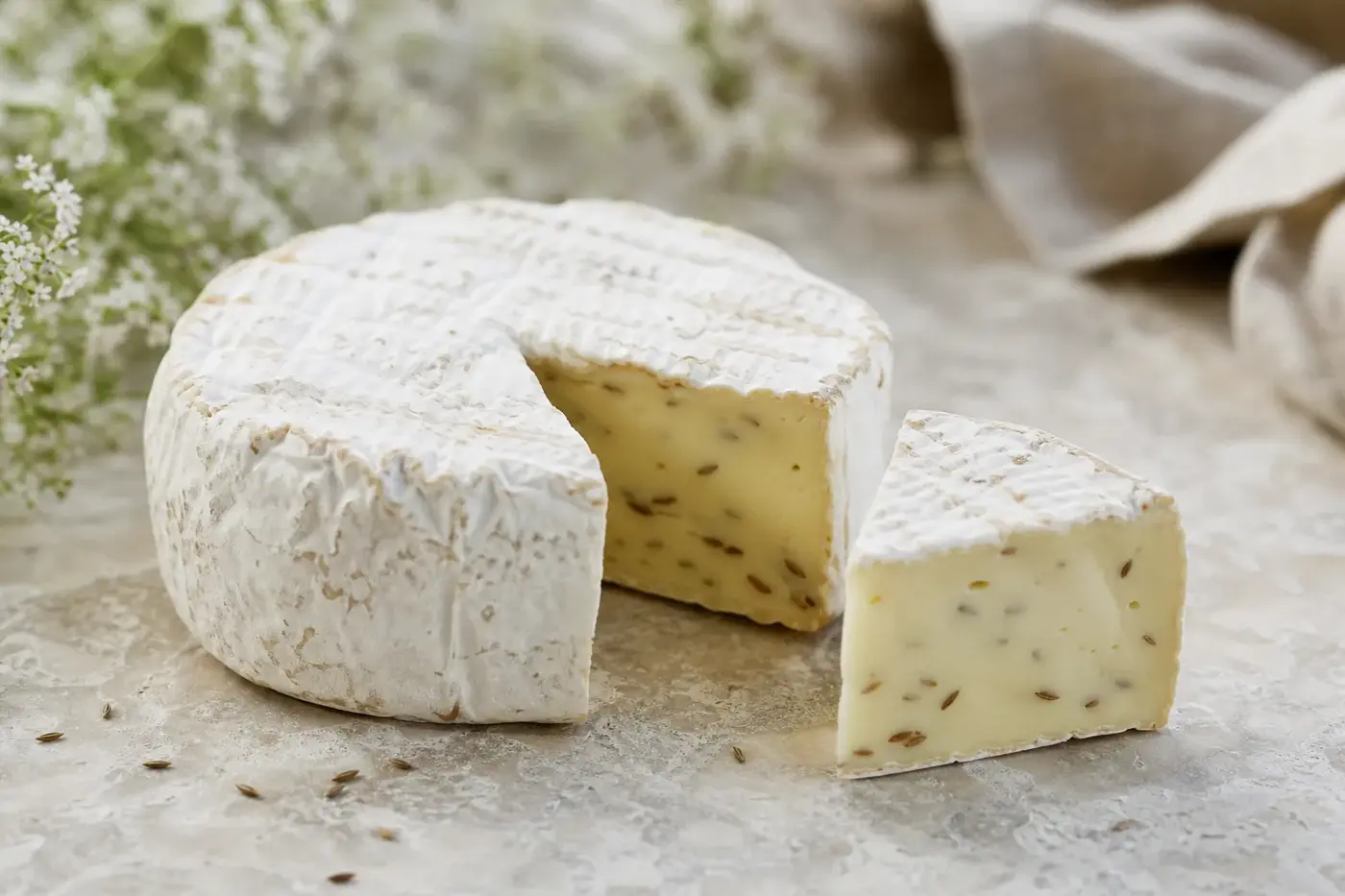
Cut into Altenburger Ziegenkäse and caraway makes its entrance. This German soft cheese can be mild and firm or strong and soft, depending on ripeness, according to its producer.[5] Its name holds another surprise: Ziegenkäse means goat cheese, but the documented commercial version contains 15% goat milk and 85% cow milk. Associated with Altenburg, its full name is registered as a protected designation of origin in the EU.[1,2,5]
| What to look for | The details |
|---|---|
| Name on the pack and in the register | Altenburger Ziegenkäse.[1,2] |
| Registration authority and identifier | European Commission; PDO-DE-0461.[1] |
| EU status | Registered PDO; original registration 24 January 1997. Status at November 2026.[1,2] |
| Great Britain status | Registered PDO under the UK scheme from 31 December 2020 at 23:00. Status at November 2026.[2] |
| Original EU registration instrument | Commission Regulation (EC) No 123/97.[3] |
| Home country | Germany.[1,2] |
| Milk in the documented commercial product | 15% goat milk and 85% cow milk, declared by Der Grüne Altenburger.[5] |
| Minimum goat milk in the current registered specification | Not established here |
| Legally delimited production area | Not established here |
| Permitted milk treatment and coagulant | Not established here |
| Legal minimum maturation | Not established here |
| Documented commercial size | 250 g.[5] |
| Documented commercial fat declaration | At least 30% fat in dry matter.[5] |
| UK pregnancy guidance | NHS guidance on white-rinded, mould-ripened soft cheese, as at November 2026.[10] |
Let caraway lead you to the first bite
Mixed milk, soft cheese and caraway: that is your starting point. Der Grüne Altenburger describes a flavour that moves from mild to strong as the cheese ripens. Its consistency travels from firm to soft, with caraway given an explicit place in the description.[5]
That tells you rather more than Ziegenkäse alone. When choosing, read the full food description and milk proportions. The name is an introduction, not the whole conversation.
You would not be alone in expecting an entirely goat milk cheese. The German consumer information service Lebensmittelklarheit records shoppers making that assumption, then discovering cow milk in the smaller print.[4] Milk is only part of the picture: rind and texture matter too, as the guide to how to tell cheese styles apart explains.
Look past the goat and read the recipe
The documented commercial recipe contains 15% goat milk and 85% cow milk.[5] Those figures describe a particular product. They do not state the minimum goat milk required by the current protected specification.
A minimum sets a threshold; declared proportions describe a recipe. Neither the protected name nor a picture of a goat tells you the precise composition of every pack. The goat may have secured the portrait, but you still need the full food description.
Here, goat milk shares the stage with cow milk, caraway and maturation. It cannot explain the finished flavour on its own. The producer gives both ripeness and caraway a prominent place in its description.[5]
Buying for a dietary requirement? Turn the pack over and ask one straightforward question: which milks does this contain? It is a small habit worth keeping, especially when you are choosing for someone else.
Follow the milk towards Altenburg
Altenburg gives this cheese its geographical identity. The official records name Germany as its country of origin. The registered name keeps that association with the place firmly in view.[1,2]
For a glimpse of the farming connection, turn to Der Grüne Altenburger. The producer says goat milk for its cheese range comes from surrounding farms, arrives at the dairy and undergoes checks before processing.[6] Its account lets you follow the route from nearby holdings to cheesemaking.
A place name, a dairy address and the farms supplying milk tell different parts of a regional food’s story. Start with the complete registered name to identify Altenburger Ziegenkäse. Then read the producer and food description on the pack to get to know the particular cheese you are taking home.
A place in the register, a past at the dairy
The clearest independently dated milestone in the cited records is European registration. Commission Regulation (EC) No 123/97 was adopted on 23 January 1997 and published the following day. The official name records give 24 January 1997 as the original registration date.[1,2,3]
That date marks formal recognition, not the recipe’s first appearance. Der Grüne Altenburger’s account reaches back more than a century. It describes cheese recipes developed through the dairy’s own practice.[6]
These accounts tell different parts of the story. The legal record fixes a moment of recognition; the producer describes continuity in farming and cheesemaking. Together, they place the cheese as a regional speciality and a recognised geographical name, without assigning the recipe a founding year.
Meet the little round and turn the pack over
A round, 250 g cheese appears in Lebensmittelklarheit’s published consumer record. Its appearance reminded the shopper of Camembert, and the current producer page also lists a 250 g format.[4,5] If you want a small whole cheese, that gives you a useful reference.
Resemblance only gets you so far, though. Look at the actual pack and, where possible, the cut face. Ask a cheesemonger to show you the texture and explain its present maturity: what this cheese is like now matters more than what it resembles.
Give the commercial declaration “30% fat in dry matter” a moment, too.[5] It leaves the cheese’s water out of the calculation. That is not the same as fat per 100 g in a nutrition declaration, a distinction you can explore in the guide to reading a cheese label.
Into the dairy, where hands turn the curd
Cubes of curd go into moulds and are turned by hand in Der Grüne Altenburger’s account of making its goat cheese range.[6] Before shaping begins, the dairy warms the milk and adds mould cultures, lactic acid bacteria and rennet. Rennet helps turn the milk into a gel, ready for cutting.
Salting comes next, followed by a move to the ripening room. The dairy links this maturation to the development of mild flavour and characteristic aroma.[6]
Each stage has a purpose. Coagulation creates curd, shaping gives it form, and maturation develops the cheese beyond that first structure. In Altenburger Ziegenkäse, caraway brings its own recognisable seasoning.[5,6]
This is the maker’s account of its range, rather than this cheese alone. For the milk treatment and coagulant used in your particular product, consult the pack or ask the maker directly. The guide to how cheese is made walks you through the underlying stages.
Find the ripeness you want to eat
Mild to strong, firm to soft: the producer puts ripeness at the heart of this cheese’s character.[5] You might favour a firmer example for neat slices. A softer one gives you a more yielding texture.
For your first taste, try a small piece alone before reaching for bread. Notice the firmness at the centre, the aroma as you cut and how clearly the caraway comes through. Those observations give you useful words for your next visit to the cheese counter.
Ask the seller about its condition now, rather than simply requesting the oldest example. Age need not win every cheese counter argument. The better questions are how firm, how soft and how strong you would like it.
Get to know the protected name
Altenburger Ziegenkäse appears as a PDO in the official EU register and separately as a registered protected name in Great Britain.[1,2] On German packaging, you may encounter geschützte Ursprungsbezeichnung. It is commonly shortened to g.U.[4]
Lebensmittelklarheit explains the designation through production within a defined area and compliance with specified criteria.[4] When you are buying, distinguish the complete geographical name from a general description such as goat cheese. Look for the full name to identify this speciality.
Protection has its own record in each jurisdiction, with distinct entries for the EU and Great Britain.[1,2] For Northern Ireland and other jurisdictions, consult the relevant local register rather than assuming those entries tell the whole story. The guide to protected names explained sets out the wider framework and terminology.
Bring bread, then see what follows
Crusty country bread is the producer’s recommended companion for Altenburger Ziegenkäse.[7] It is a straightforward place to begin. You get room to explore the cheese without too much else competing for your attention.
Apple or pear slices are another serving suggestion. Start with cheese and bread, then add fruit if you enjoy the contrast. Let a heavily seasoned chutney wait until you know how much caraway character you want to retain.
Sparkling water or alcohol free beer makes a suitable drink. Taste the cheese before settling on its companion. Your preference matters, and so does the strength of the cheese in front of you.
When serving, follow the pack’s storage instructions. Bring out only the portion you intend to eat, and keep the refrigeration limits below in mind.
From the shop to your fridge
Before buying, read the complete name, milk description, date marking and storage instructions. Once opened, follow the pack’s directions. The UK Food Standards Agency advises a domestic fridge temperature between 0 and 5 °C (32 to 41 °F); this guidance applies to England, Northern Ireland and Wales.[8]
Keep chilled purchases cold on the journey home. In its hot-weather advice, the FSA recommends choosing chilled foods last, using cool bags with ice packs where possible and refrigerating purchases promptly.[9] These steps are especially useful when you have a longer journey than the trip from a local shop.
In hotter than usual weather, the FSA advises discarding perishable picnic or barbecue food left unrefrigerated for more than two hours. It also advises against eating food after its use-by date.[9]
For pregnancy in the UK, the NHS advises against eating soft cheeses with a white coating outside, whether made from pasteurised or unpasteurised milk, unless cooked until steaming hot all the way through.[10] Consult the linked official advice for your circumstances and country.
General information only, not medical advice: follow the official guidance where you live.
Questions people ask
Is Altenburger Ziegenkäse made entirely from goat milk?
No. The documented commercial product contains 15% goat milk and 85% cow milk. The minimum goat milk requirement in the current protected specification was not verified.
What does Altenburger Ziegenkäse taste like?
The cheese is seasoned with caraway. Its producer describes it as moving from mild and firm to strong and soft as it ripens.
Where does Altenburger Ziegenkäse come from?
The cheese is associated with Altenburg in Germany. Its full name is registered as a protected designation of origin in the EU and as a protected name in Great Britain.
What can I serve with Altenburger Ziegenkäse?
The producer recommends crusty country bread. The page also suggests apple or pear slices.
Can I eat Altenburger Ziegenkäse during pregnancy?
The NHS advises against eating soft cheeses with a white coating on the outside, whether made from pasteurised or unpasteurised milk, unless cooked until steaming hot all the way through. Check the current NHS pregnancy guidance and ask your doctor or midwife about your circumstances.
Sources
- European Union Intellectual Property Office and European Commission, GIview: Altenburger Ziegenkäse, record EUGI00000013264, file PDO-DE-0461, live record retrieved November 2026. Official record. The indexed record identifies Germany, PDO status, the identifier and the recorded priority date.
- Department for Environment, Food & Rural Affairs, Altenburger Ziegenkäse, published 4 January 2021, live register entry retrieved November 2026. Great Britain register entry. The entry records registered PDO status, the UK scheme date and the original EU registration date.
- European Commission, Commission Regulation (EC) No 123/97 of 23 January 1997 supplementing the Annex to Commission Regulation (EC) No 1107/96, Official Journal L 22, 24 January 1997. Binding registration instrument.
- Verbraucherzentrale Bundesverband, Lebensmittelklarheit, Erlaubt: Altenburger Ziegenkäse mit mindestens 15 Prozent Ziegenmilch, undated live edition retrieved November 2026. Consumer information and recorded label examples. This is a secondary account of recipe requirements, and a primary record of the complaints and label examples it publishes.
- Der Grüne Altenburger, Altenburger Ziegenkäse, undated product page retrieved November 2026. Producer’s product description. Commercial primary source for its own declared composition, format, fat basis and maturity descriptions.
- Der Grüne Altenburger, Herstellung, undated production account retrieved November 2026. Producer’s manufacturing account. Commercial primary source describing the company’s cheese range, rather than the registered specification for this individual cheese.
- Der Grüne Altenburger, Genießer-Tipps, undated serving guidance retrieved November 2026. Producer’s serving suggestions. Commercial primary source for country bread and beer suggestions.
- Food Standards Agency, How to chill, freeze and defrost food safely, published 18 December 2017, live guidance retrieved November 2026. Official refrigeration guidance.
- Food Standards Agency, Food safety in a heatwave, advice for consumers, published 27 June 2024, live guidance retrieved November 2026. Official hot-weather guidance. Covers refrigeration, shopping, transport, use-by dates and the stated hot-weather disposal limit.
- NHS, Foods to avoid in pregnancy, live edition retrieved November 2026. Official UK pregnancy guidance.
Researched through official registration records, the original registration instrument, published consumer records, attributed producer information and UK official food safety guidance.
Last checked: November 2026
Last checked November 2026.
The editors suggest you read next
Allgäuer Emmentaler
Two Swiss dairymen arrive in Weiler in 1821, carrying cheesemaking knowledge into the western Allgäu.