Allgäuer Emmentaler
Two Swiss dairymen arrive in Weiler in 1821, carrying cheesemaking knowledge into the western Allgäu.
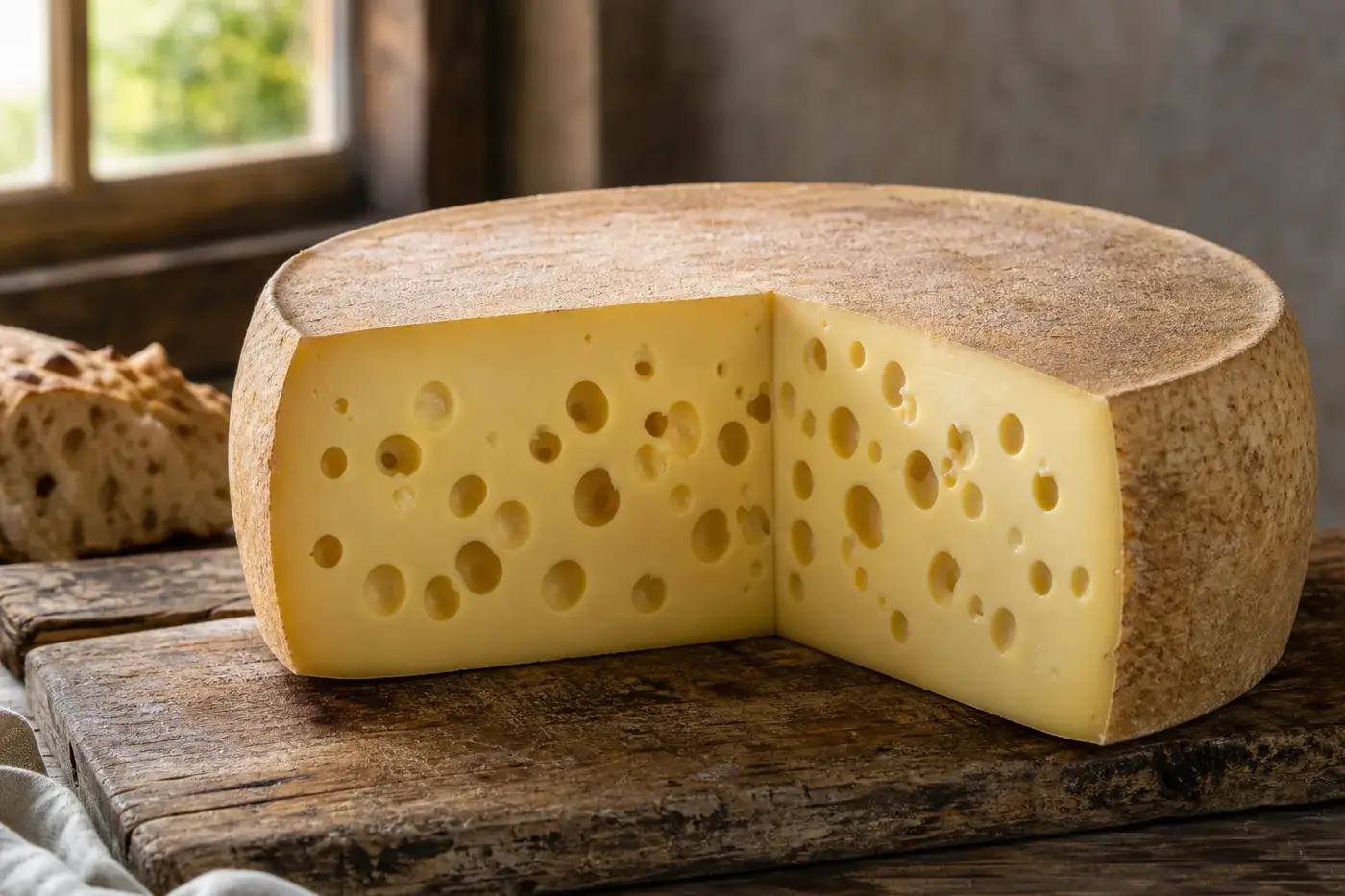
Two Swiss dairymen arrive in Weiler in 1821, carrying cheesemaking knowledge into the western Allgäu. In southern Germany’s grass and hay country, their methods take root. You can still taste that inheritance in Allgäuer Emmentaler: raw cow’s milk, rounded eyes and a gently sweet, nut-like character developed through bacterial fermentation and maturation. [1][2][3]
| What you might want to know | The details |
|---|---|
| Name to look for | Allgäuer Emmentaler. [4][5] |
| EU register identifier and status | Current eAmbrosia record: confirmation outstanding. |
| Great Britain protection | Registered PDO; UK scheme registration dated 31 December 2020 at 23:00. Status reference: November 2026. [4] |
| Northern Ireland protection | Confirmation outstanding. |
| Switzerland protection | Confirmation outstanding. |
| United States protection | Confirmation outstanding. |
| Where it is made | Defined districts and cities in Bavaria and Baden-Württemberg, southern Germany. [2] |
| Milk | Raw cow’s milk from the production area. [1][2] |
| Legal minimum maturation | Current specification: confirmation outstanding. |
| Traditional shape and size | Rind-matured wheel of at least 60 kg manufacturing weight, or rectangular block of at least 40 kg. [2] |
| Rennet in your piece | Ask for the maker’s declaration; one named product uses microbial rennet. [6] |
| Product-specific lactose content | Confirmation outstanding. |
Meet the Swiss newcomers who changed the cheese
Those two dairymen brought more than a name or a wheel shape. Bavaria’s official culinary heritage account records their arrival in Weiler in 1821. Local hard cheesemaking already existed, but the newcomers brought experience of the Swiss method and established Emmentaler production. [1]
Some of that knowledge belonged below ground. Swiss-style fermentation cellars helped cheesemakers control the conditions in which the characteristic holes developed. The same regional account follows village dairies as they expanded, then larger cooperative and private dairies processing the milk of whole villages. [1]
That exchange across the Alps gives you a useful introduction to the cheese. It is German and regional, with a documented Swiss technical inheritance. The eyes catch your attention first, but local milk, an established manufacturing method and maturation give it its identity.
Ask for the whole name at the counter
Allgäuer Emmentaler is registered in Great Britain as a PDO, or protected designation of origin. For its current EU registration details, turn to the official register. [4]
The Bavarian agricultural authority’s published summary draws a precise production boundary. In Bavaria, it includes the districts of Lindau, Oberallgäu, Ostallgäu and Unterallgäu, plus Kaufbeuren, Kempten and Memmingen. Ravensburg and Bodenseekreis form the Baden-Württemberg portion; milk production, cheesemaking and maturation all happen within this area. [2]
At the counter, plain Emmentaler is not the same designation as the full regional name. Look for Allgäuer Emmentaler, then ask about the maker and stated age. Those details bring your particular piece into focus; protected names explained explores the broader principles.
Follow the milk through grass and hay country
Your cheese begins with raw cow’s milk from that defined production area. Before renneting, when enzymes are added to set the milk, the Bavarian authority’s summary specifies a maximum temperature of 40 °C. [2]
The cows’ feed ties the milk to the landscape. The same summary describes fresh grasses, legumes and herbs during the green-fodder season, principally hay in winter, and restrictions on silage and other fermented feeds. Grass and hay have work to do here, beyond making the dairy look picturesque. [2]
“Raw milk” describes the starting material, not every stage that follows. The curd is heated later during the hard-cheese process. Keep milk treatment separate from curd heating and the terminology becomes clearer; see raw, thermised and pasteurised milk. [1]
Watch the cheese harp get to work
First, rennet causes milk proteins to form a gel. A cheese harp cuts that set milk into curd, the solid material destined to become cheese, and whey, the liquid released around it. Bavaria’s heritage account describes the harp at work, followed by stirring, heating and pressing into shape. [1]
Stirring and heating encourage the curd to release whey. Pressing brings the grains together into a continuous body, while a brine bath adds salt and helps form the exterior. The regional account describes curd heating to around 50 °C: a production detail, not an instruction for making it at home. [1]
Next come the bacteria, with two distinct jobs. Lactic acid bacteria first turn milk sugar into lactic acid. Propionic acid bacteria use that acid, producing flavour compounds and the carbon dioxide that creates the eyes; Agroscope identifies Propionibacterium freudenreichii as central to this fermentation in Emmentaler-type cheeses. [3]
The order matters. Acidification establishes the young cheese, and pressing gives it a continuous body. During controlled maturation, gas-producing fermentation reshapes that body from within.
Take a closer look inside those holes
Those rounded openings are cavities made by gas during ripening. Propionic fermentation produces carbon dioxide, which collects, expands and pushes the surrounding paste aside. Agroscope describes this fermentation as the defining link between the large holes and the sweet, nut-like character of Emmentaler-type cheeses. [3]
For that to happen, the paste needs some give. Agroscope’s sensory research overview identifies an elastic texture as a prerequisite for good eye formation. A brittle body would respond differently to pressure from within, so gas and cheese structure must work together. [7]
Even a large eye can have a microscopic beginning. In experimental work, Agroscope showed that tiny plant particles can hold air bubbles, giving carbon dioxide nuclei around which to accumulate. That explains a general mechanism, not the particle content of the particular Allgäuer Emmentaler on your plate. [8]
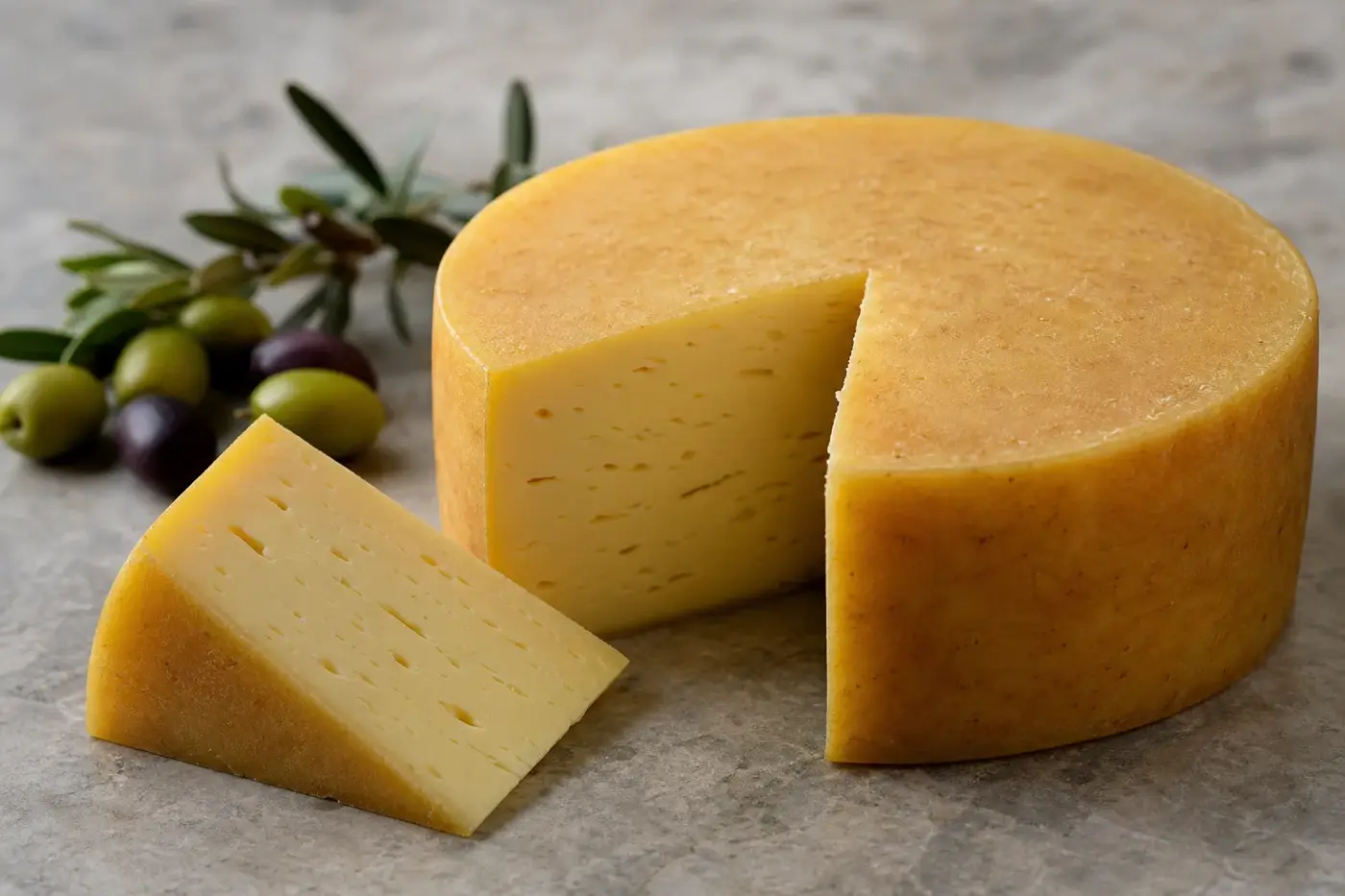
The Bavarian authority describes the visible result as rounded, regularly distributed eyes approximately 1 to 3 cm across. Next time you meet a cut wheel, pause for a look. There is more going on than a collection of convenient gaps. [2]
Discover what a few more months can bring
A maker’s stated age deserves your attention. One documented dairy offers a three-month version described as mild and a six-month version described as würzig, meaning more pronounced or savoury. These are that dairy’s descriptions of its own cheeses at different maturities. [9]
For the legal minimum maturation period and required cellar conditions, consult the current specification. Keep those requirements separate from the maker’s stated age: they answer different questions.
Inside the maturing cheese, enzymes break proteins into smaller components, including peptides and amino acids. Bacterial activity adds further flavour compounds. Agroscope describes these processes working together, rather than offering one tidy chemical explanation for “nuttiness”. [3]
Age starts the conversation, but cannot describe the whole cheese. Ask whether the dairy’s older version brings greater savoury intensity, a firmer body or a longer finish. A younger cheese may suit thin slices and sandwiches particularly well; a more pronounced example can take centre stage on a simple plate.
Find the gold, the yellow and the hazelnut
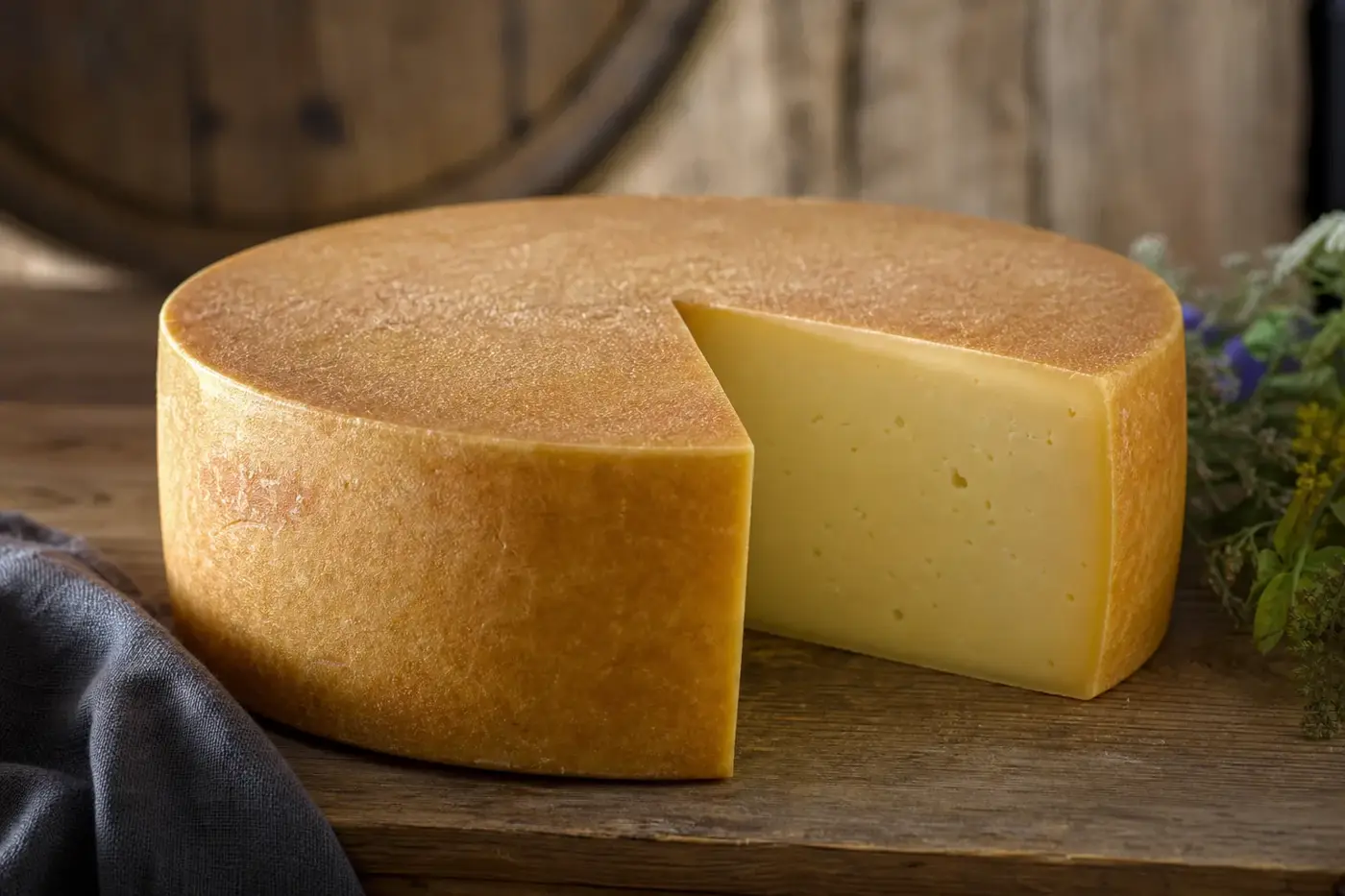
A whole wheel is no modest little cheese. The published regional description gives a minimum manufacturing weight of 60 kg for a rind-matured round. You are rather more likely to take home a wedge, slab or packet of slices than to clear a chair for it. [2]
Bavaria’s heritage account describes a smooth golden rind and a matt-yellow interior. Rounded, cherry-sized eyes interrupt the cut face. In the same account, the flavour is distinctly nut-like. [1]
Producer ÖMA offers a closer portrait of one of its Allgäuer Emmentaler products. Its tasting notes describe a hay-like aroma and a mild, savoury hazelnut character. Those notes belong to that product, rather than every cheese carrying the name. [6]
Agroscope’s sensory overview describes the broader Swiss-type family as sweet and nutty. Cultures, production conditions and ageing all shape the result. Taste two cheeses with the same regional name and you can still find differences between dairies and maturities. [7]
Meet its cheese-counter neighbours
Swiss Emmentaler, Allgäuer Bergkäse and Dutch Maasdam offer three useful comparisons. One leads you towards the manufacturing tradition, another towards the region. The third introduces the wider family of large-eyed cheeses.
| Cheese | What you can learn from the comparison |
|---|---|
| Swiss Emmentaler AOP | Shares raw-milk manufacture and propionic fermentation in Agroscope’s technical account. [3] |
| Allgäuer Bergkäse | Shares the regional production area in Bavaria’s summaries, but has smaller, sparse eyes and a four-month minimum maturation. [2] |
| Dutch Maasdam | Belongs to the large-eyed, propionic-fermented family; sampled Maasdam-type cheeses contained more moisture than sampled Allgäuer Emmentaler in Agroscope’s small comparison. [3] |
Agroscope’s composition table used two samples per category. Its Maasdam comparison describes those samples, rather than setting a fixed composition for every cheese bearing either name. [3]
Choosing a substitute or putting together a cheese plate? Decide which quality matters to you. Large eyes offer a visual resemblance, but age, moisture and flavour tell you more about how a cheese will eat and suit your dish.
Bring home a piece you can get to know
Buy by the full name, then ask for the dairy and maturation period. If your piece comes from a cut wheel, ask when it was cut and request storage instructions. A small piece with a clear identity tells you more than an anonymous slab called “Swiss-style”.
Keep the label or wrapping so those instructions stay close to hand. For England, Wales and Northern Ireland, the Food Standards Agency advises keeping a domestic fridge between 0 and 5 °C and following the product’s storage instructions. The consumer-guidance reference date here is November 2026. [10]
For serving temperature guidance, consult the relevant food safety agency’s current advice. Keep the product’s own storage instructions to hand.
Thin slices let you appreciate the elastic body; modest wedges make comparing ages straightforward. Taste the cheese alone before adding anything else, and notice whether sweetness, savoury depth or aroma comes forward first. For more on wrapping and refrigeration, see how to store cheese at home.
Start with bread, then make supper
Begin with rye or mixed-grain bread, apple or pear, and the cheese. Bread gives you a substantial base, while fresh fruit brings a contrasting bite. Give the cheese your attention before inviting strong chutneys onto the plate.
For a drink, try sparkling water or an apple drink with a tart edge. Treat these as serving suggestions, rather than tested pairings.
There is a regional kitchen story to follow, too. Bavaria’s heritage source names Allgäuer Emmentaler as an ingredient in Allgäuer Käsespätzle. ÖMA recommends its own product grated over dishes, sliced on bread or cubed for a cheese plate. [1][6]
Those uses give you starting points for potato bakes, vegetable gratins and toasted sandwiches. Choose the maturity according to how much you want the cheese flavour to stand out. The maker’s description of mild or more pronounced cheese helps here; follow a complete recipe for the dish.
This page summarises published guidance from the official sources it cites. It is not medical advice. Guidance differs between countries and changes over time, so check the current source for where you live, and ask your doctor, midwife, pharmacist or dietitian about your own circumstances.
Let the maker guide your rennet and lactose choices
Vegetarian suitability depends on the particular product, not just the cheese name. ÖMA declares microbial rennet for its documented Allgäuer Emmentaler. For another purchase, consult the maker’s declaration; rennet explained sets out the different coagulants and their implications. [6]
Take the same product-specific approach to lactose. ÖMA describes its cheese as naturally lactose-free, and Bergkäserei Weizern also makes a lactose-free declaration for its Allgäuer Emmentaler. A maker’s declaration and a batch-specific laboratory result are different forms of information. [6][9]
Fermentation explains why lactose can fall substantially during cheesemaking. If you need a product with a confirmed lactose-free status, use the current maker’s declaration rather than the name or style alone. You can explore the wider evidence and terminology in lactose in cheese.
Questions people ask
Why does Allgäuer Emmentaler have holes?
Propionic acid bacteria produce carbon dioxide during maturation. The gas collects and expands, pushing the elastic cheese aside to form rounded eyes approximately 1 to 3 cm across.
Where is Allgäuer Emmentaler made?
It is made in defined districts and cities in Bavaria and Baden-Württemberg in southern Germany. Milk production, cheesemaking and maturation all take place within this area.
Is Allgäuer Emmentaler made from raw milk?
Yes, it is made from raw cow’s milk from the defined production area. The curd is subsequently heated during cheesemaking.
Is Allgäuer Emmentaler suitable for vegetarians?
Suitability depends on the particular product. ÖMA declares microbial rennet for its Allgäuer Emmentaler, but the page advises checking the maker’s declaration for another purchase.
Is Allgäuer Emmentaler lactose free?
ÖMA and Bergkäserei Weizern each make a lactose free declaration for their Allgäuer Emmentaler. Neither retrieved product page supplies a batch specific laboratory result, so check the current maker’s declaration.
Sources
- Bavarian State Ministry’s GenussErbe Bayern, Allgäuer Emmentaler, undated online entry, accessed November 2026. Regional history, manufacturing account and description.
- Bayerische Landesanstalt für Landwirtschaft, Bayerische Originale: Herkunftsschutz, November 2021 edition, entries for Allgäuer Emmentaler and Allgäuer Bergkäse, pp. 12 to 15. Official regional specification summaries.
- Agroscope, Käse Typ Emmentaler: Überblick über die Arten von Hart- und Halbhartkäse mit Propionsäuregärung und über spezifische Aspekte ihrer Herstellung, ihrer Qualität und der Ernährung, Agroscope Science 134, 2022. Technical report.
- Department for Environment, Food & Rural Affairs, Allgäuer Emmentaler, GB protected food names register, published 4 January 2021, accessed November 2026. Registered status and registration dates.
- Spain’s Ministry of Agriculture, Fisheries and Food, Indicaciones geográficas no españolas: Unión Europea, retrieved register extract, edition date not verified. Entry identifying PDO-DE-0459. The direct eAmbrosia record was also retrieved, but its record fields were not readable through the research interface.
- ÖMA Beer GmbH, ÖMA Allgäuer Emmentaler g.U. foliengereift-Bioland, undated product page, accessed November 2026. Commercial producer source for its own ingredients, sensory descriptions and handling suggestions. Product declaration.
- Agroscope, Sensory characteristics of swiss-type cheese varieties, 2023, institutional repository abstract. Sensory and texture overview.
- Agroscope, press release supplement explaining experimental findings on cheese eye formation, 2015. Plant particles and carbon dioxide.
- Bergkäserei Weizern eG, Allgäuer Emmentaler, undated product page, accessed November 2026. Commercial producer source for its three-month and six-month descriptions and lactose declaration. Product range.
- Food Standards Agency, How to chill, freeze and defrost food safely, published 18 December 2017, accessed November 2026; applies to England, Northern Ireland and Wales. Official consumer guidance.
Researched through official regional records, government registration information, Agroscope publications and explicitly attributed producer declarations.
Last checked: November 2026
Last checked November 2026.
The editors suggest you read next