Tilsit
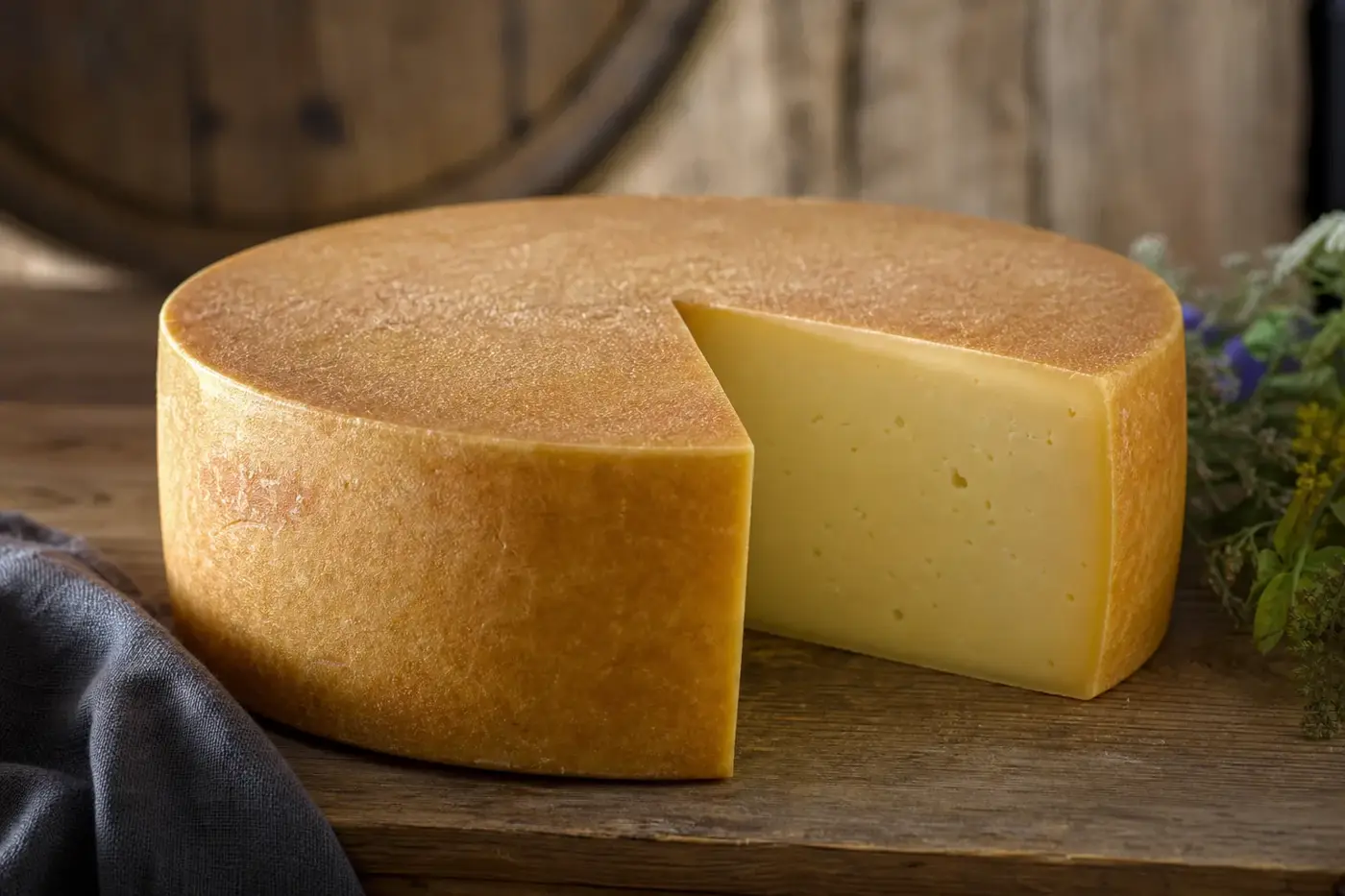
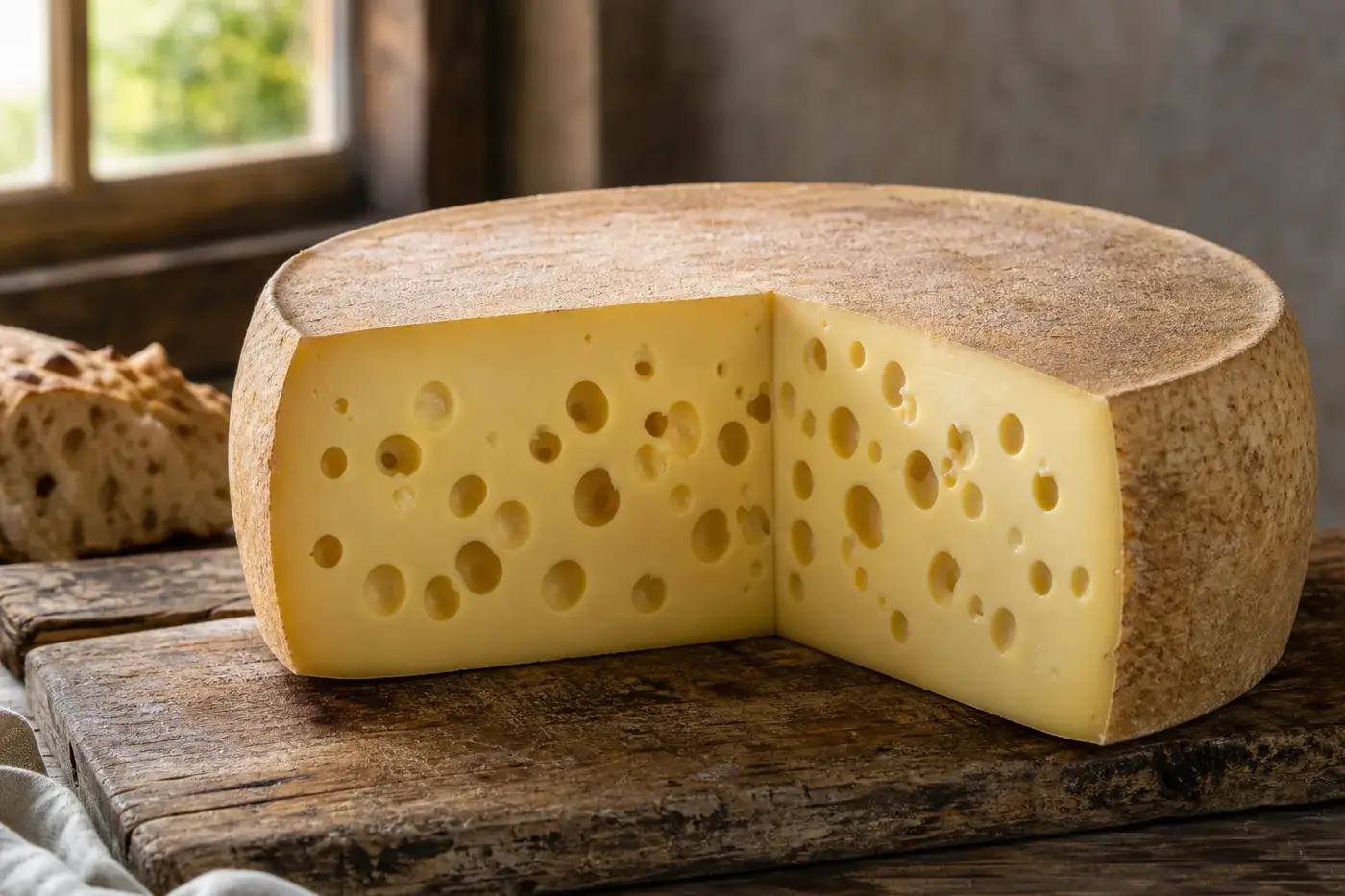
Your knife slips through a yellow-brown to reddish rind into pale, supple cheese, its surface scattered with ragged slits or smaller round eyes.
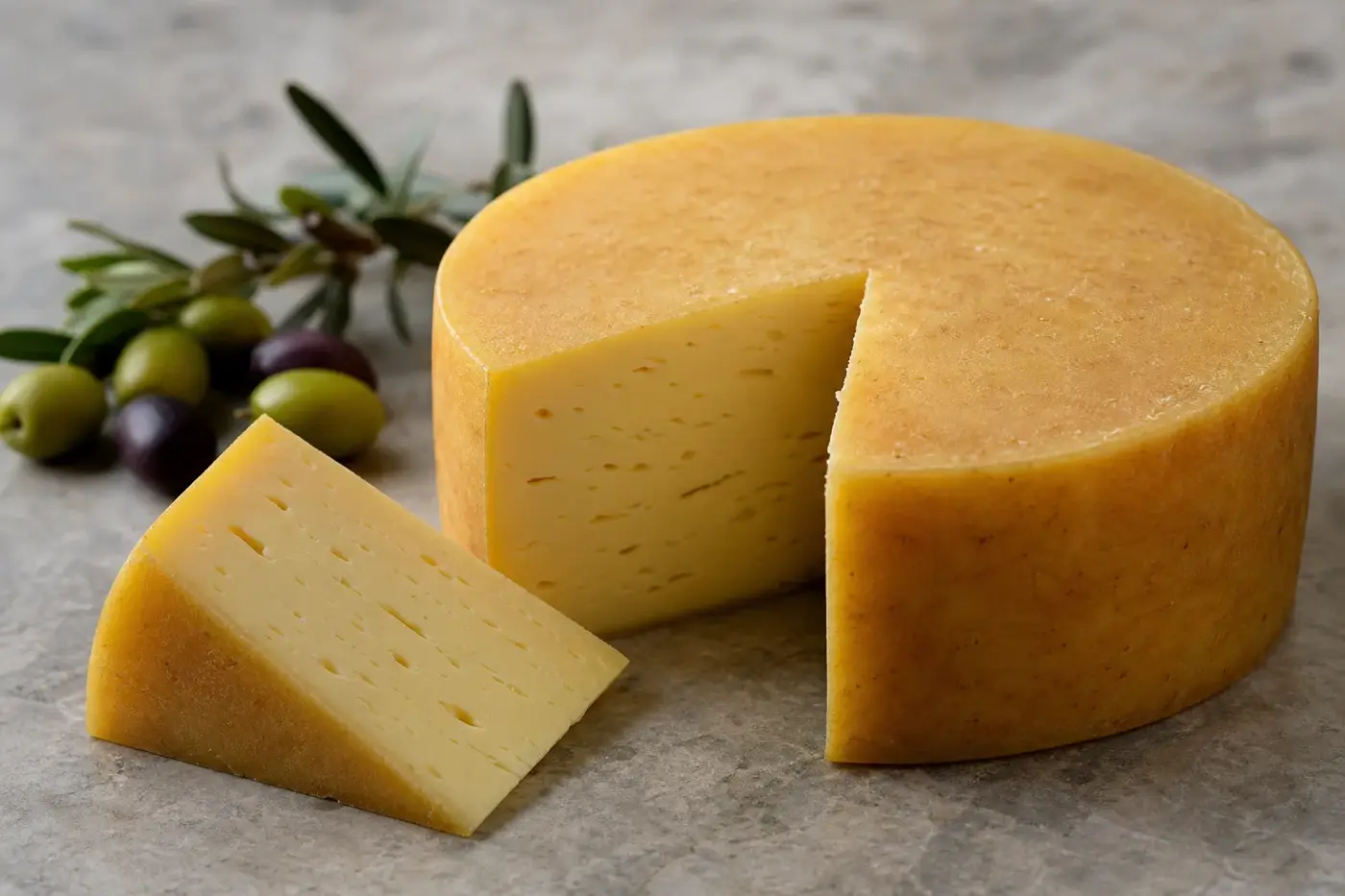
Your knife slips through a yellow-brown to reddish rind into pale, supple cheese, its surface scattered with ragged slits or smaller round eyes. The first taste might be mild or markedly savoury. Tilsit keeps you guessing a little: this semi-hard cow's milk cheese carries an East Prussian name into German and Swiss dairies, where careful surface ripening shapes its character.[3][4][7][8][9]
| What to know | The essentials |
|---|---|
| Name and style | Tilsit, also Tilsiter; a cheese family with German and Swiss interpretations.[3] |
| Protected name | Holsteiner Tilsiter is registered as a PGI in Great Britain.[5] |
| Where the story starts | Tilsit in East Prussia, today Sovetsk in Russia.[1] |
| Milk and treatment | Cow's milk; you will find raw, thermised and pasteurised examples.[4][7][8] |
| What sets the milk | Animal or microbial rennet, depending on the product.[7][8] |
| That distinctive rind | Surface-ripened, with appearance and treatment varying between cheeses.[4][8] |
Follow the name back to Tilsit
Follow the name and you arrive in the former East Prussian town of Tilsit, now Sovetsk in Russia. The town's historical association records both names. Its archive offers glimpses of the local dairying past, including an early twentieth-century description of the cheese.[1][2]
Open the archived 1907 dairy dictionary and you meet an unpressed, cylindrical cheese called Tilsiter, with production associated with the 1840s. The dictionary distinguishes it from an earlier soft cheese made on an estate near Tilsit. What emerges is a local tradition taking shape, rather than a single grand moment of invention.[2]
Dutch settlers, Swiss immigrants and a failed attempt to make Gouda all feature in stories about its beginnings. The archive's later commentary treats the damp-cellar explanation as a supposition. Read these accounts alongside the developing local cheese trade: cheese history does not always oblige with a tidy origin story.[2]
An East Prussian name finds new homes
By the end of the nineteenth century, Tilsit had reached Schleswig-Holstein. That is the timeline given in the historical account within the European Commission's published Holsteiner Tilsiter application. Modern German production has roots stretching back before the upheavals of the twentieth century.[4]
In Switzerland, the producers' organisation dates production to 1893 and describes a deliberate adaptation of the method. Today, it places the tradition in eastern Switzerland, from the Zürich uplands through Toggenburg and Thurgau towards Lake Constance. Follow that route and you find Swiss Tilsiter's own texture, openings and maturation practices: an East Prussian recipe given a distinctly Swiss expression.[3][6]
Holsteiner Tilsiter also has a specific legal identity. As of November 2026, it is a registered protected geographical indication in Great Britain's official register. That entry covers Holsteiner Tilsiter, not the status of other names in Great Britain or elsewhere.[5]
The British register records entry on 31 December 2020. Its original EU registration is dated 6 December 2013.[5]
Take a closer look at your slice
The 2012 Holsteiner Tilsiter document describes a thin yellow-brown rind around light-yellow, springy, supple paste. Inside, you find characteristic eyes and cracks; the cheese itself takes wheel or loaf form. Swiss production guidance describes round cheeses, while product accounts show a reddish-brown surface developed through regular rind care.[4][6][8]
A typical Swiss wheel weighs about 4.3 kg. According to the Swiss production account, it measures approximately 25 cm across and 8 cm high. Unless your household takes cheese unusually seriously, a freshly cut piece is probably the more manageable proposition.[6]
Look at the pattern in your slice rather than counting the holes. Narrow, uneven openings belong to one part of the tradition; smaller rounded eyes are familiar in Swiss examples. They tell you about manufacture, not which cheese deserves a prize.[3][10]
A supple cheese takes patient work
Tilsit's texture begins with decisions in the vat. Rennet, the enzyme preparation that sets milk into a gel, allows the cheesemaker to cut that gel into curd, leaving liquid whey alongside it. In the Swiss process, milk cultures go in before setting, then the curd is cut into grains.[6]
Some whey is replaced with warm water, and the mixture is gently heated. The producers' organisation explains that retaining more water in those grains gives you a more supple finished cheese.[6]
Pressing marks a clear departure from the past. The archived 1907 account describes unpressed Tilsiter; today's Swiss method includes pressing and repeated turning. The Swiss organisation links its round eyes to gas from cultures and to particles that give holes somewhere to begin.[10]
After brining, the cheesemaker's attention turns to the rind. Holsteiner Tilsiter's published description names Brevibacterium linens in the surface treatment, while Swiss producers describe repeated washing or smearing and turning. This deliberate surface ripening helps build the colour and character you meet in the finished cheese.[4][8]
Milk treatment matters, but so do age, moisture, starter cultures and rind management. Raw milk alone does not tell you how pungent your cheese will be. For the terminology, see raw, thermised and pasteurised cheese; rennet types explains why vegetarian suitability needs its own check.[6][7][8][9]
Follow the labels from mild to savoury Extra
Swiss label colours give you a useful starting point within the producers' organisation's range. Treat them as product identifiers, not grades that apply to every Tilsit you encounter. Here is how the organisation describes them.[7][8][9]
| Swiss example | Milk treatment on the label | Published maturation | Flavour and texture |
|---|---|---|---|
| Green label | Pasteurised | 1 to 2 months | Mild, slightly acidic; soft-slicing.[7] |
| Red label | Raw, partly thermised | At least 3 months | Mild-aromatic; fine, soft-slicing paste.[8] |
| Black label Extra | Raw, partly thermised | At least 5 months | Strong, savoury character.[9] |
Notice “partly thermised” on the red and black product sheets. It gives you a more precise picture than a broad description such as traditional raw-milk Tilsiter. Thermisation is a heat treatment distinct from pasteurisation.[8][9]
Let the cheesemonger know what you fancy
Start with maker, milk treatment and maturity, then follow your appetite. Are you after sandwich-friendly mildness or something more assertive? If you are buying a cut piece, ask to see the original label.[7][8]
That label matters for rennet, too. The Swiss green product declares microbial rennet, while the red declares animal rennet. Vegetarian suitability belongs to the particular Tilsit, not the name alone.[7][8]
For a whole cheese, ask how the rind has been treated and whether it needs further maturation. For a wedge, look for a supple cut face rather than a visibly dried edge, and ask when it was cut. Choose a size you expect to use, follow the supplier's storage instructions, and keep the details explained in reading a cheese label.[6][12]
Tell the cheesemonger where your purchase is heading: thinly sliced on bread, served at the end of a meal, or melted into a dish. That gives them more to work with than a request for the strongest Tilsit. Maturity labels belong to particular ranges.
Bring bread, fruit and something refreshing
Start with contrast. Rye bread or plain sourdough suits a more savoury Tilsit, while fresh apple or pear gives you a crisp, juicy counterpoint. With a milder cheese, simple bread and fruit leave room for its slight acidity to show.[7][9]
For your glass, try sparkling apple juice diluted with water, or sparkling water. Both bring freshness alongside the cheese, with no need for elaborate accompaniments. You can explore broader principles in cheese and wine pairing.
From the cheeseboard to a comforting supper
On a cheeseboard, serve mild Tilsit before a stronger surface-ripened example so you can follow the contrast. Cut manageable slices rather than large cubes. Slices let you adjust the balance of rind and paste, especially when you are discovering the style; plain bread and one fresh fruit are enough.
In the kitchen, milk, fat content, manufacture and age all affect how your cheese behaves, as the Swiss organisation's cooking guidance explains. Try Tilsit in a toasted sandwich, over cooked potatoes, or folded into a sauce. Choose a milder cheese for a quieter result and a more mature example when you want the cheese to lead.[11]
Taste before deciding how much salt or mustard the rest of your dish needs. Give the cheese its say first.
Keep it cool and understand the rind
Keep the original label, including its date and instructions after opening. The Food Standards Agency's guidance for England, Northern Ireland and Wales advises keeping dairy products in a fridge set between 0 and 5 °C. Wrap cut surfaces and use a clean covered container to prevent drying and contact with other foods, following any more specific pack instructions.[12]
Take out only the portion you need and let it lose its refrigerator chill, rather than warming a whole wheel. The same agency advises keeping chilled food out for the shortest possible time, with a maximum of four hours during preparation. Treat that as a limit, not a target for displaying your cheese.[12]
Moisture and a strong scent can belong to a surface-ripened rind's intended character. Ask the maker or cheesemonger whether your particular rind is intended to be eaten, and whether any coating or surface treatment changes that advice. Remove non-food coverings such as wax or plastic, then follow the product's instructions for the rind itself.[4][8]
Unexpected growth or deterioration is a separate matter from ordinary rind ripening. Follow the product's date and storage instructions, and consult mould on cheese. A strong smell is not a safety test.[12]
For UK pregnancy guidance on cheese and milk, consult the NHS advice for November 2026. Ask your midwife or doctor about your own circumstances.[13]
For help with wrapping and fridge organisation, turn to how to store cheese at home.
General information only, not medical advice: follow the official guidance where you live.
Questions people ask
Where does Tilsit cheese come from?
Tilsit takes its name from the former East Prussian town of Tilsit, now Sovetsk in Russia. The cheese is also made in Germany and Switzerland.
What does Tilsit taste like?
Tilsit ranges from mild to markedly savoury. In the Swiss producers' range, the green label is mild and slightly acidic, while the black label Extra has a strong, savoury character.
Is Tilsit suitable for vegetarians?
It depends on the particular cheese. The Swiss green label product declares microbial rennet, while the red label declares animal rennet.
Can you eat the rind on Tilsit?
Ask the maker or cheesemonger whether the particular rind is intended to be eaten and whether its treatment changes that advice. Follow the product's instructions and remove non-food coverings such as wax or plastic.
How should Tilsit be stored?
The Food Standards Agency advises keeping dairy products in a fridge set between 0 and 5 °C in England, Northern Ireland and Wales. Wrap cut surfaces, use a clean covered container and follow any more specific instructions on the pack. Consult the Food Standards Agency for its guidance.
Sources
-
Stadtgemeinschaft Tilsit and Kreisgemeinschaft Tilsit-Ragnit. Tilsit Stadt und Land, undated current homepage, accessed November 2026. Identifies historic Tilsit with present-day Sovetsk and describes the association's historical collections. Source.
-
Stadtgemeinschaft Tilsit. 35. Tilsiter Rundbrief, 2005/2006, pages 127 to 128, “Noch etwas über den Tilsiter”. Reproduces extracts from Wörterbuch der Milchwirtschaft, 1907, followed by a later chronology and commentary. Archived issue.
-
Sortenorganisation Tilsiter Switzerland. Tilsiter. Der Schweizer Käse. Fakten, Meinungen und Impressionen, 2018, particularly “Technologie und Bedeutung des Tilsiter-Käses im Wandel der Zeit”, pages 26 to 29. Industry-published historical and technical account. Anniversary volume.
-
European Commission. Holsteiner Tilsiter: single document accompanying publication of an application, 2012/C 288/08, published 25 September 2012. Historical application document, used here for its dated product description and historical account. Official document.
-
Department for Environment, Food & Rural Affairs. Holsteiner Tilsiter, protected food and drink names register, published 4 January 2021, current entry accessed November 2026. Official register entry.
-
Sortenorganisation Tilsiter Switzerland. Tilsiter-Herstellung: traditionelles Handwerk mit zeitgemässer Technologie and Über uns, undated current pages, accessed November 2026. Production account; organisation and production area.
-
Sortenorganisation Tilsiter Switzerland. Der Grüne: mild, undated current product sheet, accessed November 2026. Producer organisation's declarations and tasting description. Product sheet.
-
Sortenorganisation Tilsiter Switzerland. Der Rote: mild aromatisch, undated current product sheet, accessed November 2026. Producer organisation's declarations and tasting description. Product sheet.
-
Sortenorganisation Tilsiter Switzerland. Der Schwarze: extra, undated current product sheet, accessed November 2026. Producer organisation's declarations and tasting description. Product sheet.
-
Sortenorganisation Tilsiter Switzerland. Agroscope erforscht die genauen Gründe für die Löcher im Käse, undated current article, accessed November 2026. The organisation's explanation of research on eye formation. Article.
-
Sortenorganisation Tilsiter Switzerland. Tilsiter-Kocheigenschaften, undated current article, accessed November 2026. Industry-published cooking guidance. Cooking account.
-
Food Standards Agency. How to chill, freeze and defrost food safely, published 18 December 2017, current GOV.UK text accessed November 2026. Applies to England, Northern Ireland and Wales. Official guidance.
-
NHS. Foods to avoid in pregnancy, current guidance accessed November 2026, section “Cheese, milk and other dairy”. Official guidance.
-
Food Standards Agency. Alerts, current official alerts index accessed November 2026. Consultation and the limits of the recall check are recorded below. Official alerts.
Researched through archived dairy descriptions, an official geographical-name record, published Swiss production and product information, and UK public-health guidance; pairing and meal suggestions are editorial synthesis.
Last checked: November 2026
Last checked November 2026.
The editors suggest you read next
Allgäuer Emmentaler
Two Swiss dairymen arrive in Weiler in 1821, carrying cheesemaking knowledge into the western Allgäu.