American Swiss Cheese Explained
Cut a pale slice of American Swiss and the rounded holes come into view, followed by a sweet, gently nutty bite.
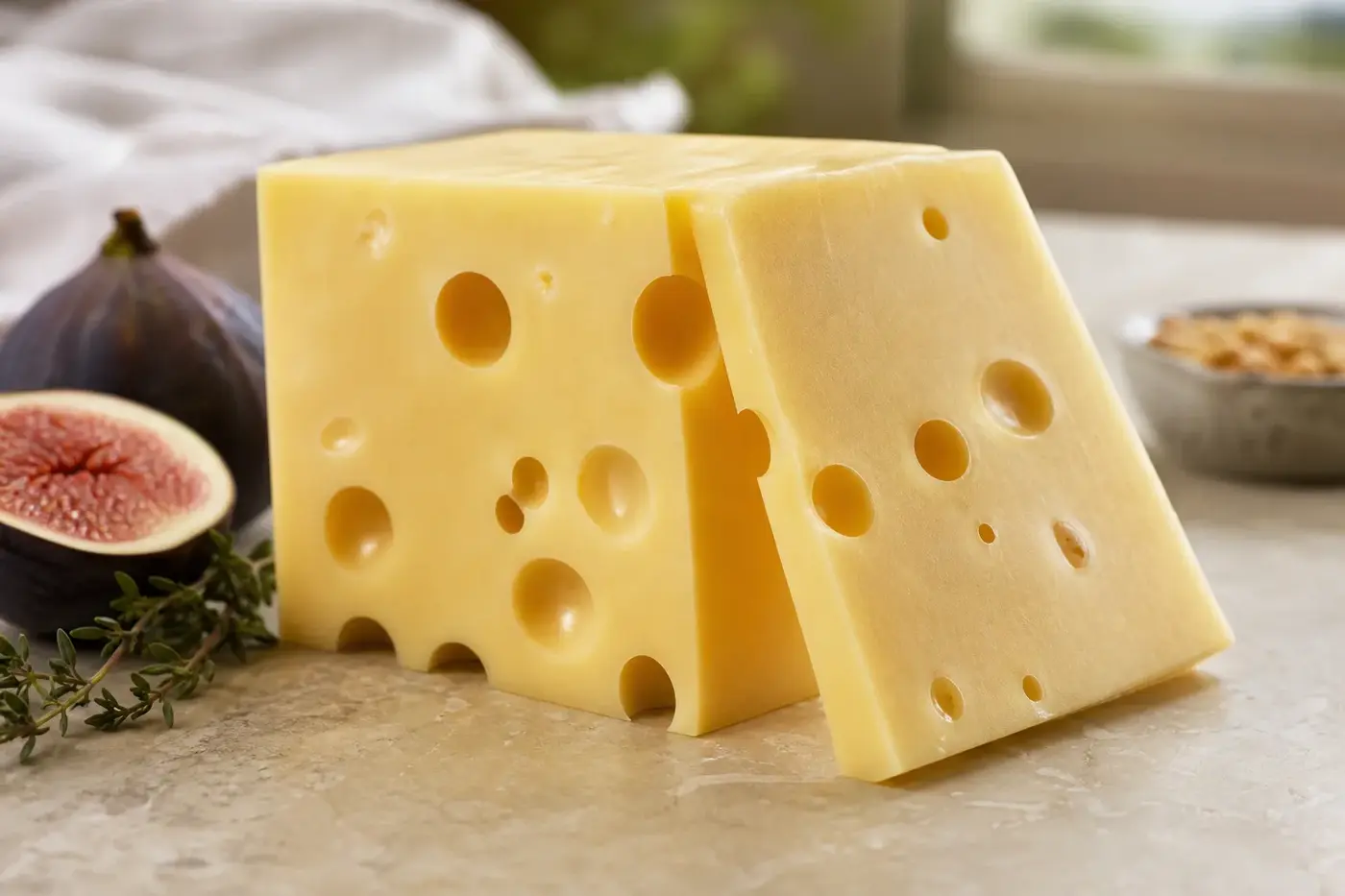
Cut a pale slice of American Swiss and the rounded holes come into view, followed by a sweet, gently nutty bite.[1][3] Behind that familiar slice is a story reaching back to 1845, when Swiss settlers founded New Glarus in Wisconsin’s Green County and brought cheesemaking knowledge that helped shape American dairying.[2] Today, “American Swiss” means a cheese style made in the United States, rather than a single protected regional cheese.[1][2][3]
| Your quick guide | American Swiss cheese |
|---|---|
| Style | Firm cheese with eyes that develop as it matures.[1][3] |
| American historical heartland | New Glarus and surrounding Green County, Wisconsin.[2] |
| Milk | Cow’s milk; the US standard also permits non-fat milk and cream.[1] |
| US legal standard | 21 CFR 133.195, “Swiss and emmentaler cheese”.[1] |
| US composition rules | At least 43% milkfat in dry matter; no more than 41% moisture in the whole cheese.[1] |
| US minimum age | At least 60 days, including cheese made with pasteurised dairy ingredients.[1] |
| What you can expect | USDA purchasing requirements describe sweet, nutty flavour balanced by sourness, with a firm, smooth body.[3] |
Follow the Swiss settlers to Wisconsin
Green County’s cheese story begins with a move beyond wheat. As the agricultural economy changed, the cheesemaking knowledge brought by New Glarus’s Swiss settlers became increasingly valuable. The Wisconsin Historical Society records household cheesemaking expanding rapidly into factory production after 1870.[2]
Look at the local milestones and you can see that change taking shape. The New Glarus Historical Society records a cheese factory established in 1868, followed the next year by Emmentaler-style cheesemaking on a nearby farm.[4] American milk was meeting methods carried across the Atlantic by people who knew them well.
That history helps you untangle an apparent contradiction on the label. “Swiss” can name an American cheese style, while “made in Switzerland” identifies a country of manufacture. Look for the manufacturing country alongside the food’s name: Swiss alone is not a forwarding address.
Get to know that sweet, nutty slice
Sweetness, nuttiness and the sour notes of lactic fermentation all belong here. The USDA’s flavour description of American Swiss brings them together, while its purchasing specification calls for a uniform, firm, smooth body, coloured white to light yellow.[3] Your familiar pale yellow slice fits the description, but a whiter cheese belongs just as comfortably.
Those holes have a proper name: eyes. Usually rounded or slightly oval, they appear throughout the paste, the cheesemaker’s word for the cheese beneath its surface. USDA requirements distinguish developed eyes from cracks and other openings, and accommodate both rinded cheese and rindless blocks.[3]
You should find a cheese that cuts cleanly but has some give, rather than crumbling. The Canadian Dairy Commission describes Swiss-style cheeses as firm, with a hazelnut-like taste and useful melting properties.[5] Age, cultures and manufacturing choices give each example its character: one tastes restrained, another more distinctly fermented.[3][6]
The small beginnings of those famous holes
The eyes begin with bacteria getting to work. Starter cultures, bacteria added to guide the process, first turn milk sugar into lactic acid. During maturation, propionic acid bacteria use lactate, the form of lactic acid present in the cheese.[5][6] These linked fermentations create much of the character you taste in American Swiss.
The second fermentation is associated with Propionibacterium freudenreichii, including strains traditionally identified as subspecies shermanii. It produces carbon dioxide, which gathers inside the developing cheese and creates the eyes.[5] What you see in your slice is bubbles held inside a solid food.
Culture choice and conditions inside the cheese help shape the pattern you see. A peer-reviewed study compared two propionic bacterial cultures across three brining treatments in experimental Swiss-type cheeses. Increasing salt inhibited one culture more strongly than the other, changing eye volume and distribution.[6] Those eyes tell a story of managed fermentation, not simply time spent maturing.
At the cheese counter, you can keep the lesson simple. Bigger holes do not automatically mean older, stronger or better cheese. Bacterial strain, salt, gas movement and the cheese’s firmness all influence the result.[6] There is no need to judge your lunch by its missing bits.
From milk to a slice full of eyes
American Swiss starts with a compact curd; the openings arrive later, through controlled fermentation. Curd is the coagulated milk material, while whey is the liquid released from it. You can follow the wider process in how cheese is made.
The US standard describes a procedure using cultures and clotting enzymes. The curd is cut into small particles, heated and stirred, then pressed into shape. Salting follows, then staged maturation: a warmer period encourages eyes to develop before cooler storage. Other procedures are permitted if they produce the same physical and chemical properties.[1]
Each stage contributes something you can recognise in the finished cheese. Heating establishes the firm body, pressing joins the curd grains, and later fermentation opens spaces inside that joined structure.[1][5] The result is compact enough for thin slices, yet punctuated by substantial holes.
American Swiss or Swiss Emmentaler? Let place guide you
American Swiss is an American-made style governed by US food standards. Its closest comparison, Emmentaler, is also a registered protected designation of origin in Switzerland, administered through the Federal Office for Agriculture.[1][8] The names may sound similar, but they tell different stories about production and place.
Put the US federal standard beside the Swiss registered specification and the differences become clearer. Here are the details worth knowing, from milk treatment to maturation.
| What to look for | American Swiss | Swiss Emmentaler AOP |
|---|---|---|
| Where it is made | Made in the United States; the federal standard defines no regional production area.[1] | Milk production, cheesemaking and maturation tied to the specified Swiss area.[9] |
| Milk treatment | Dairy ingredients may be pasteurised.[1] | Raw milk required.[9] |
| Minimum maturation | At least 60 days.[1] | Whole wheels matured within the area to at least four months, under the specification’s monthly-production averaging provision.[9] |
| Shape and size | USDA requirements accommodate rindless blocks and rinded cheese.[3] | Round wheels weighing 75 to 120 kg.[9] |
| Flavour and texture guide | USDA describes sweet, nutty notes balanced by sourness.[3] | The specification describes elastic paste and a slightly acidic, sweet, lightly spicy character.[9] |
The Swiss specification takes you right into the detail: ivory paste in winter, pale yellow in summer, and most eyes measuring 2 to 4 cm.[9] Those descriptions belong to the registered Swiss cheese. They are not rules for every American Swiss product you encounter.
Nor does every Alpine cheese come with great big holes. The Canadian Dairy Commission notes that Gruyère can have much smaller, fewer or absent eyes.[5] A shared tradition of cooked, pressed curd still leaves room for distinct cheeses. Explore Le Gruyère for its separate identity and production rules.
Meet Baby Swiss, the gentler option
If smaller eyes and a milder flavour sound like your sort of cheese, meet Baby Swiss. Dairy Farmers of Wisconsin describes a smoother, creamier texture, attributing these qualities to smaller wheels and shorter maturation than conventional Swiss.[10]
The industry organisation also highlights its mild, buttery character. You can see why that would appeal in sandwiches and egg dishes.[10] Treat these as useful style tendencies, though, rather than one recipe followed by every producer.
Some differences are less obvious than a change of name. American Swiss may have a rind or come as a rindless block, and USDA sensory requirements explicitly relate flavour to age.[3] Look for a declared maturation period and the maker’s description, then decide whether you want a quiet sandwich cheese or something more assertive.
Keep those eyes in perspective when you choose. Texture, flavour description and intended use together tell you more than counting the holes in a slice.[6]
Look beyond the wrapping on your slice
A slice may be natural cheese or a processed cheese product. Its shape tells you little, so begin with the complete food name.
Under 21 CFR 133.169, “pasteurized process cheese” is a US category made by grinding or breaking up cheese, mixing it and applying heat, with an emulsifying agent. The regulation also addresses how products made from Swiss cheese are named.[11]
“Swiss cheese” and “pasteurized process Swiss cheese” therefore identify different manufacturing categories. There is another distinction to keep in mind: pasteurising milk before cheesemaking is different from heat-processing finished cheese.
Read the food name first, then the ingredients and storage instructions. How to read a cheese label takes you through that sequence in more detail. Neither a square shape nor individual wrapping tells you which category you have inside.
Find your Swiss for the sandwich, plate or pan
Start with what you want your American Swiss to do. For cold sandwiches, the USDA’s firm, smooth body is a useful reference point. If you are cooking, the Canadian Dairy Commission highlights the melting and baking qualities of Swiss-style cheese.[3][5]
Baby Swiss offers a milder option. Dairy Farmers of Wisconsin recommends it for omelettes, frittatas, quiches and macaroni cheese. Its suggested rye-bread sandwich brings together the cheese, turkey or ham, onion and lettuce.[10] That gives the relatively mild flavour a clear setting without asking it to dominate.
For a simple serving plate, try rye bread, crisp apple and a little mustard, with water or an alcohol-free apple drink. You are looking for contrast: firm fruit and sharp mustard alongside the cheese’s sweet, fermented notes. Let the particular cheese in front of you guide the balance.
At the stove, think about how much flavour you want the cheese to contribute. Mild Baby Swiss suits dishes where eggs or vegetables should stay prominent; a more developed cheese can provide more of the seasoning.[3][10] Taste before adding extra salt.
Give your American Swiss a good home
Keep American Swiss refrigerated and follow its packaging instructions. For readers in England, Northern Ireland and Wales, the Food Standards Agency recommends a fridge temperature between 0 °C and 5 °C. Its guidance says to refrigerate dairy products and observe their storage instructions and date marking.[12]
If you move your cheese into another container, keep the original instructions with it. An unopened block, a deli-cut piece and an opened packet of slices may have different directions. Use those supplied for the product you have.
Put out a manageable serving and leave the rest in the fridge. The FSA advises keeping chilled food out for the shortest possible time during preparation.[12] For wrapping and everyday organisation, turn to how to store cheese at home.
Read the label with your diet in mind
Cheese and other dairy foods provide protein and calcium, as the NHS identifies.[13] For your particular American Swiss, check the nutrition label for fat, saturated fat, salt and protein. Compare equal quantities when choosing between products.
The legal minimum for fat in dry matter is not the same measurement as fat per 100 g of cheese. Dry matter excludes water. You cannot read the legal figure directly as the packet’s nutritional fat percentage.[1]
For lactose content, you need product-specific information. The NHS distinguishes lactose intolerance, difficulty digesting milk sugar, from allergy to milk protein, and advises discussing dietary changes with a GP or dietitian.[13][14] A lactose-free statement does not establish that a cheese is suitable for someone with a milk allergy.
If you are choosing vegetarian cheese, the clotting enzymes matter. The US standard permits animal, plant or microbial enzymes, so “American Swiss” alone cannot answer that question.[1] Check the label, and ask the maker if it leaves the coagulant unidentified.
General information only, not medical advice: follow the official guidance where you live.
Questions people ask
Is American Swiss cheese made in Switzerland?
No. American Swiss is a cheese style made in the United States. Swiss Emmentaler AOP has a specified Swiss production area and must be made from raw milk.
Why does American Swiss cheese have holes?
The holes, called eyes, form during maturation. Propionic acid bacteria produce carbon dioxide, which gathers inside the developing cheese.
What is the difference between Baby Swiss and American Swiss?
Dairy Farmers of Wisconsin describes Baby Swiss as having smaller eyes, a milder flavour and a smoother, creamier texture. It attributes these qualities to smaller wheels and shorter maturation than conventional Swiss.
Is American Swiss cheese vegetarian?
The name alone cannot tell you. The US standard permits animal, plant or microbial clotting enzymes, so check the label and ask the maker if it does not identify the coagulant.
How should American Swiss cheese be stored?
Keep it refrigerated and follow the packaging instructions. For England, Northern Ireland and Wales, the Food Standards Agency recommends a fridge temperature between 0 °C and 5 °C and advises observing storage instructions and date marking.
Sources
- US Food and Drug Administration. 21 CFR 133.195: Swiss and emmentaler cheese. Code of Federal Regulations, edition revised 1 April 2025, paragraphs (a) to (d). Official text.
- Wisconsin Historical Society. Cultural Resource Management in Wisconsin, Volume 1: Settlement. Undated online edition, Swiss settlement section. Society publication.
- US Department of Agriculture, Agricultural Marketing Service. Swiss Cheese Commodity Requirements. August 2022, physical analysis and melting requirements. These are purchasing requirements, distinct from the federal standard of identity. USDA document.
- New Glarus Historical Society. New Glarus Historical Timeline. Undated online edition, entries for 1868 and the following year. Historical timeline.
- Canadian Dairy Commission. Emmentaler and Swiss-Style Cheese. Undated online edition. Used for fermentation, broad style characteristics and culinary properties, not current Swiss legal requirements. Commission account.
- Agroscope research record. The effect of NaCl and metabolic profile of propionibacteria on eye formation in experimental Swiss-type cheese. International Dairy Journal, volume 89, 2019, pages 86 to 95. Published abstract consulted. Research record.
- Agroscope. Tiny hay particles form “eye starting points” in cheese. Research communication and explanatory supplement, 2015. Official research communication.
- Swiss Federal Office for Agriculture. AOP / IGP Ursprungsbezeichnungen und geografische Angaben. Online register, Emmentaler entry, including amendments recorded through 4 November 2025. Official register.
- Swiss Federal Office for Agriculture. Pflichtenheft Emmentaler. Retrieved specification incorporating the Federal Administrative Court judgment of 2 April 2025, Articles 1 to 8. Official specification.
- Dairy Farmers of Wisconsin. Baby Swiss. Undated online edition. Industry account with a promotional interest in Wisconsin cheese. Industry description.
- US Food and Drug Administration. 21 CFR 133.169: Pasteurized process cheese. Code of Federal Regulations, edition revised 1 April 2025. Official text.
- Food Standards Agency. How to chill, freeze and defrost food safely. Published 18 December 2017, current retrieved guidance for England, Northern Ireland and Wales. Official guidance.
- NHS. Dairy and alternatives in your diet. Current retrieved online edition. NHS guidance.
- NHS. Lactose intolerance. Current retrieved online edition. NHS guidance.
This article was researched from official food standards, Swiss registration documents, American historical collections, dairy research and attributed industry descriptions.
Last checked: November 2026
Last checked November 2026.
The editors suggest you read next
How to Tell Cheese Styles Apart: Milk, Rind, Texture and Method
Watch mozzarella curd being worked and stretched in hot water.