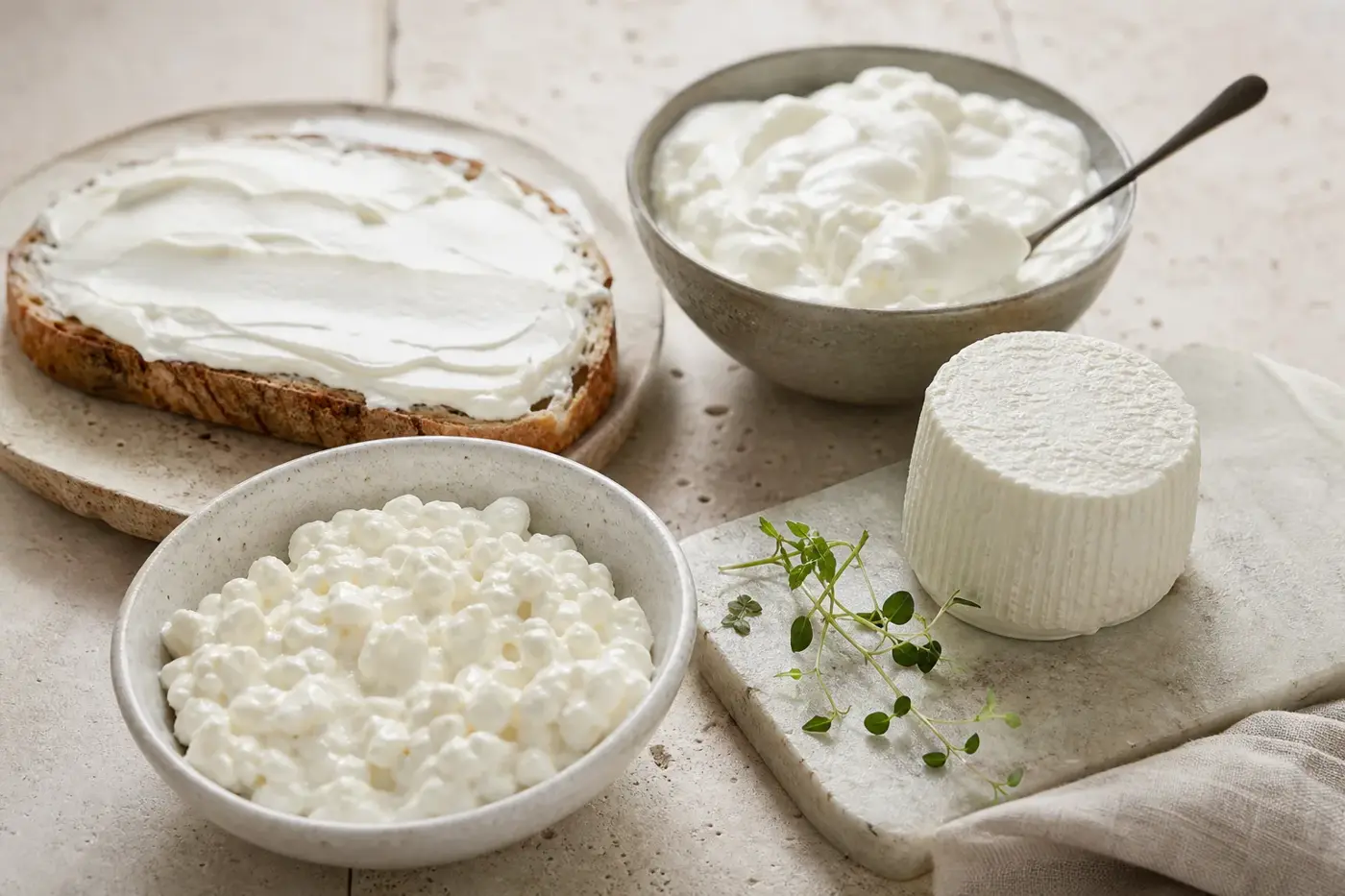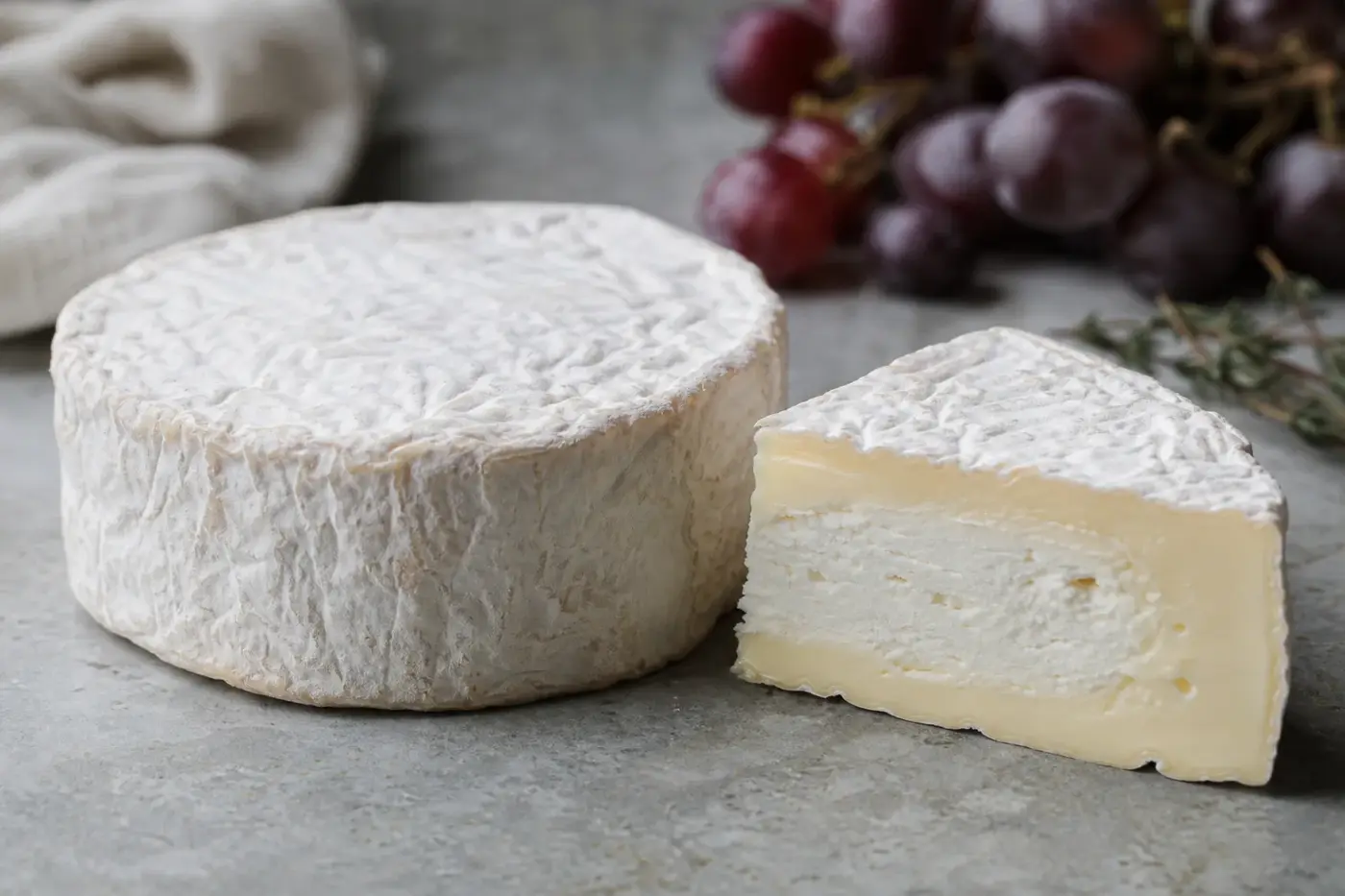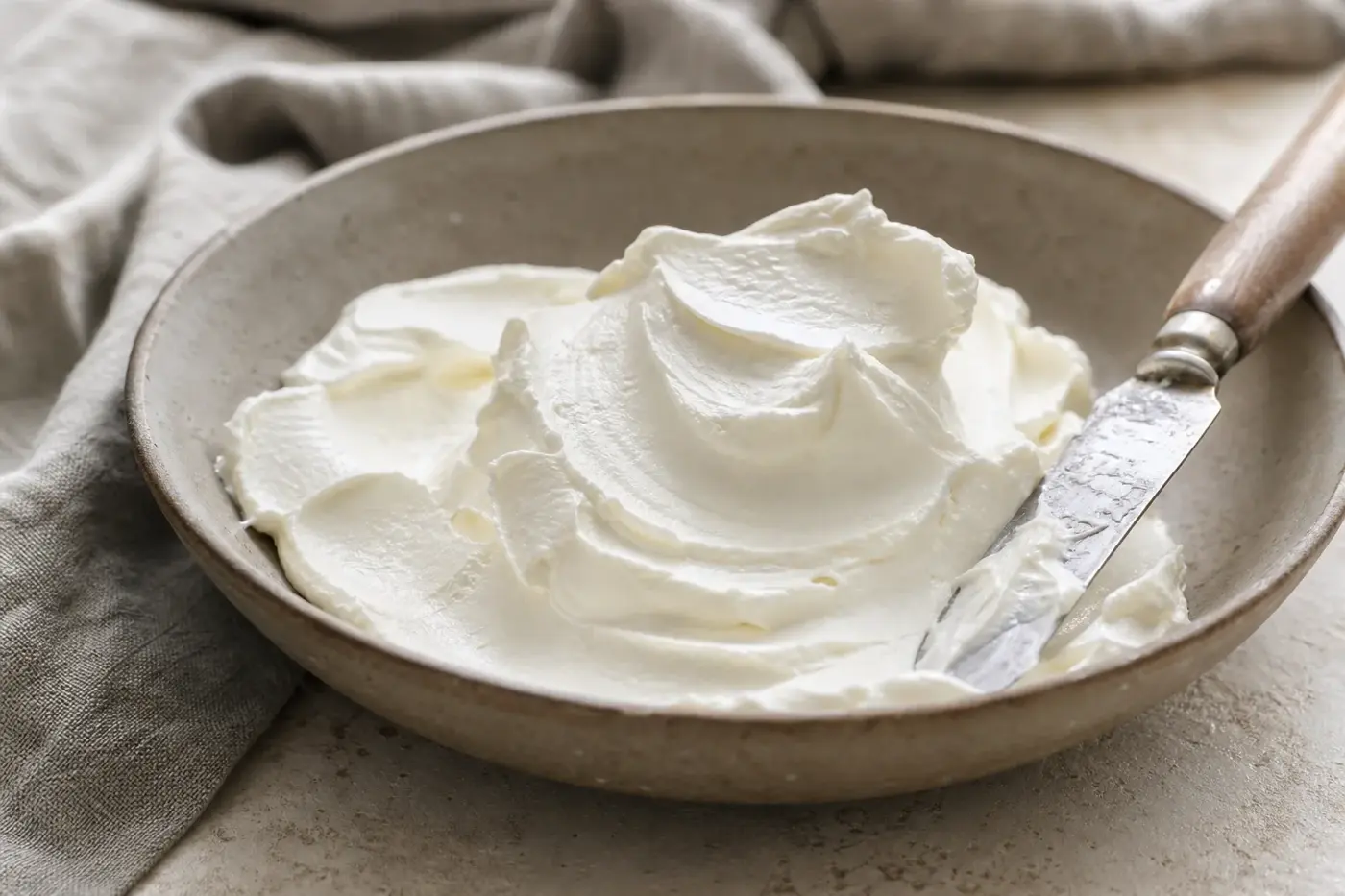
Sweep your knife through cream cheese. That smooth, yielding paste makes spreading look effortless, though behind it sits a delicate structure: an acid-set network of milk proteins holding fat and water. Fresh, soft and unripened, it gives you mild lactic tang rather than flavours developed through ageing. Its texture owes as much to careful working as to ingredients. [1,2]
| Your quick guide | Cream cheese |
|---|---|
| Style | Fresh, soft and unripened. [1] |
| Texture and rind | Smooth paste, with no developed rind. [1,2] |
| US standard | 21 CFR 133.133. Consult the current requirements. [3] |
| Milk allergen | Contains milk. [3] |
| Ageing | Unripened. [3] |
From milk to that first smooth spoonful
Cream cheese usually begins with milk and cream blended to the required composition, then heat-treated and homogenised. Homogenisation breaks fat into smaller droplets and helps bring them together with milk proteins. It shapes the cheese's structure, not merely its looks. [4]
Next come starter cultures: bacteria selected to produce acidity. As acidity rises, milk proteins gather into a gel, turning liquid milk into curd through coagulation. Some methods also use rennet, a milk-clotting enzyme preparation, to help the mixture set. [5]
Other processes add acidity directly. A laboratory study used glucono-delta-lactone, an ingredient that gradually releases acid, to illustrate this alternative. The route matters: acidification and the treatment that follows help determine the cheese's structure. [1]
Removing whey, the liquid separated from the milk gel, concentrates the curd. Heating and mechanical working turn it into a smooth paste, while salt supplies seasoning. Stabilisers can help retain water and limit syneresis, the technical name for liquid separating out. Methods and ingredient combinations vary. [5,6]
Want to follow the journey beyond the cream cheese tub? Explore how cheese is made.
Why smoothness is more than a fat figure
Fat content cannot tell you the whole story of how firmly cream cheese sets. Water, protein, acidity, heating and mechanical treatment all have a say. In a controlled study of medium-fat cream cheese, homogenisation produced smaller fat droplets and firmer cheese. Stronger or longer mixing reduced curd particle size, making it more spreadable. [4]
That helps explain why two products with similar nutrition panels can behave differently under your knife. Stabilisers matter too: experimental cheeses made with different gums had different firmness and flow properties. Choose for the job, rather than expecting every smooth white cheese to share a CV. [6]
Before the tub: a cheese course and a cow
Picture cream cheese on the cheese course, rather than in its wrapper. A British household dictionary records it there, placing the name in culinary use. The edition's date remains uncertain, so that passage alone cannot establish a chronology. [7]
A US court record published in 1913 gives you a glimpse of its commercial life. It describes an American cheese business adopting tin-foil wrappers around 1895, printed with a cow and wording identifying cream cheese. Together, the records trace an earlier culinary category and its later packaged life, not a single moment of invention. [8]
Reading cream cheese labels on either side of the Atlantic
In the United States, cream cheese has a standard of identity in 21 CFR 133.133. For its current compositional and processing requirements, consult the operative text. [3]
In Britain, look for “full fat soft cheese”. The UK Philadelphia Original ingredient declaration, for example, uses that description, followed by salt, guar gum and citric acid. You're reading the manufacturer's description of that product, not a formula shared by every British cream cheese. [9]
Following a recipe from another country? Check the food's description, fat per 100 g, ingredients and required format, and treat a spreading tub separately from a packet specified for baking. British labelling guidance explains food names, ingredient declarations and allergen information. For help bringing those details together, try reading a cheese label. [18]
Get to know its fresh cheese neighbours
Sharing a use does not make two cheeses interchangeable. Their manufacture and structure differ, so compare ingredients and your recipe's requirements before reaching for a substitute. [10]
| Cheese | What sets it apart | What that means in your recipe |
|---|---|---|
| Cream cheese | Smooth acid-set cheese worked into a paste. [1] | Adds body and a mild tang. |
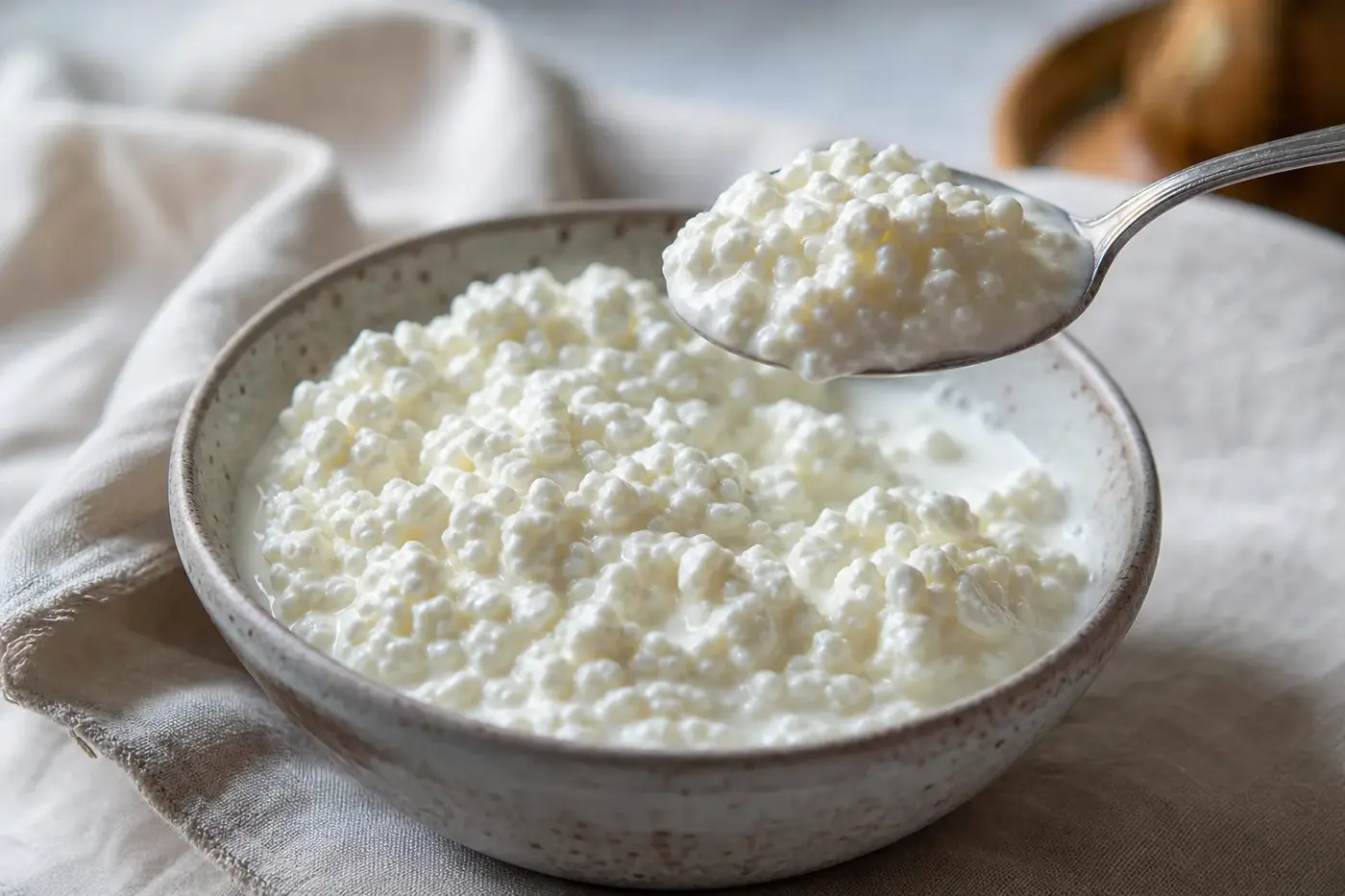
| Cottage cheese | Separate fresh curds, often with a cream dressing. [10] | Blending changes texture, not composition. |
| Mascarpone | Details not covered here. | Details not covered here. |
| Fromage frais | Details not covered here. | Details not covered here. |
| Processed cheese | Details not covered here. | Details not covered here. |
Find the right tub for the job
Start with the recipe's specification. Full-fat, reduced-fat and whipped cream cheeses are different formulations, not simply different serving sizes. Swapping them changes the balance of water, fat, protein or incorporated air. Use quantities by weight whenever your recipe provides them. [4,14]
For a savoury spread, count herbs, garlic and pepper as part of the dish's seasoning. For a sweet filling, begin with the plain product requested. Garlic has its talents, but reading the room is not one of them. Check ingredients for added flavourings and texturisers, and read allergen information for the whole product, not just its dairy base. [9,18]
Stabilisers have a particular job. Trials comparing xanthan, guar and locust bean gums found that their choice and combination altered texture. A short ingredient list tells you one thing; a particularly firm texture tells you another. Neither alone predicts how well the cheese will suit your recipe. [6]
Make the most of spreads, bakes and sauces
As a spread, cream cheese gives you a cohesive paste rather than separate curds. Its mild acidity contrasts with sweet ingredients. For frosting, a published King Arthur Baking method beats softened cream cheese with butter before adding sugar, then adjusts consistency with milk. That sequence makes your starting texture important. [2,11]
For cheesecake, match the cheese to the recipe before changing anything else. The final set depends on the whole mixture, including any eggs, cream, starch or gelatine. A recipe built around one cheese's water and fat balance may need adjustment if you choose another formulation. [1,14]
Making a sauce? Add manageable pieces, stir them evenly through the liquid and follow the recipe's heating instructions. Research shows that heat and mechanical working change cream cheese's structure. Smoothness depends on your treatment as well as its ingredients. [1,4]
If your recipe calls for softening, take out only what you need. For households in England, Wales and Northern Ireland, the Food Standards Agency advises keeping chilled food out of the fridge for the shortest possible time during preparation. [12]
Keep your cream cheese cool from the start
Keep cream cheese covered and follow the pack's storage and opening instructions. For households in England, Wales and Northern Ireland, the Food Standards Agency recommends a fridge temperature between 0 and 5 °C (32 to 41 °F). Use a thermometer to check it. [12]
Once you've opened it, follow that particular product's instructions. As one US example, Philadelphia's manufacturer says to reseal and refrigerate immediately after use, then consume within ten days of opening or by the printed date, whichever comes first. Your own pack is your guide. [14]
For UK use-by labels, the FSA says not to eat food after the date, even if it looks and smells satisfactory. Your nose cannot establish its safety. Keep that distinction in mind with an opened tub; how to store cheese at home covers the wider handling guidance. [13]
Freezing can change the texture. The US manufacturer's FAQ advises against freezing its product because of quality changes. If your filling or frosting needs to be particularly smooth, choose cheese stored as its maker recommends. Don't expect it to perform unchanged after freezing. [14]
This page summarises published guidance from the official sources it cites. It is not medical advice. Guidance differs between countries and changes over time, so check the current source for where you live, and ask your doctor, midwife, pharmacist or dietitian about your own circumstances.
Understand lactose, milk allergy and pregnancy guidance
Lactose intolerance and milk allergy concern different parts of milk. The UK NHS distinguishes difficulty digesting milk sugar from an allergy to milk protein. Its lactose guidance lists cheese among dairy foods that can contain lactose. Look for a specific lactose-free declaration on cream cheese, rather than assuming fermentation removes it all. [15,16]
Lactose-free dairy still contains milk proteins. NHS clinical guidance on cow's milk protein allergy explains why lactose-free milk products are unsuitable for affected infants, and why goat's or sheep's milk is not a suitable replacement. Ask your clinician or dietitian about an appropriate alternative for your circumstances. [16]
For pregnancy in the UK, the NHS includes pasteurised cream cheese among the soft cheeses you can eat. It advises checking packaging for pasteurisation and treats unpasteurised dairy foods separately. Read its current pregnancy food guidance and follow your midwife's advice for your circumstances. [17]
November 2026 is the reference point for these UK sources. For more on milk sugar and milk protein, continue with cheese allergy versus lactose intolerance. For product-specific lactose questions, see lactose in cheese.
Questions people ask
Can you eat cream cheese during pregnancy?
The NHS includes pasteurised cream cheese among the soft cheeses that can be eaten during pregnancy and advises checking the packaging for pasteurisation. Read the current NHS pregnancy food guidance and follow your midwife’s advice for your circumstances.
Does cream cheese contain lactose?
The NHS lists cheese among dairy foods that can contain lactose. Look for a specific lactose free declaration rather than assuming fermentation removes it all, and see the NHS lactose guidance.
How should cream cheese be stored?
Keep it covered and follow the pack’s storage and opening instructions. For households in England, Wales and Northern Ireland, the Food Standards Agency recommends a fridge temperature between 0 and 5 °C, checked with a thermometer.
Can you freeze cream cheese?
Freezing can alter its texture. The US Philadelphia manufacturer advises against freezing its product because of quality changes.
What is the difference between cream cheese and cottage cheese?
Cream cheese is a smooth cheese worked into a paste, while cottage cheese has separate fresh curds, often with a cream dressing. Blending cottage cheese changes its texture but not its composition.
Sources
- Springer Nature, Food Biophysics, “Effect of Process and Formulation Variables on the Structural and Physical Properties in Cream Cheese using GDL Acidulant”, 2022. Research article examining formulation, processing and cream cheese structure.
- Journal of Dairy Science, “Characterization of Particles in Cream Cheese”, 2004. Publisher search extract describing typical flavour, consistency and manufacture.
- US Food and Drug Administration, 21 CFR 133.133: Cream cheese, eCFR current-section page, retrieved November 2026. Official-text verification remains subject to the editorial flag below.
- Wiley, International Journal of Dairy Technology, “Effect of homogenisation of cheese milk and high-shear mixing of the curd during cream cheese manufacture”, volume 71, pages 417 to 431, 2018.
- Foods, “The Impact of Divergent Algal Hydrocolloids Addition on the Physicochemical, Viscoelastic, Textural, and Organoleptic Properties of Cream Cheese Products”, 2023. Research article and indexed abstract.
- Journal of Dairy Science, “Behavior of stabilizers in acidified solutions and their effect on the textural, rheological, and sensory properties of cream cheese”, volume 103, pages 2065 to 2076, 2020. Indexed research abstract.
- Project Gutenberg, Mrs. Beeton's Dictionary of Every-Day Cookery: The “All About It” Books, digitised historical text. Passage on the cheese course. Original edition particulars require confirmation before publication.
- US District Court, Eastern District of Pennsylvania, Lawrence v. P. E. Sharpless Co., 203 F. 762, 1913, reproduced judicial opinion. Passage describing packaging adopted around 1895.
- Philadelphia UK, “Philadelphia Original”, manufacturer product declaration, undated, retrieved November 2026. Commercial product source.
- Tetra Pak, Dairy Processing Handbook, “Cheese”, online chapter, retrieved November 2026. Equipment manufacturer's technical reference; verification scope recorded below.
- King Arthur Baking, “Cream Cheese Frosting”, published recipe, retrieved November 2026. Commercial baking reference; used to illustrate a published method, not a site-tested recipe.
- Food Standards Agency, “How to chill, freeze and defrost food safely”, GOV.UK publication, published 18 December 2017, current retrieved version, November 2026. Applies to England, Wales and Northern Ireland.
- Food Standards Agency, “Not checking use-by dates and consuming foods past the use-by dates”, 2023, retrieved November 2026. Includes the agency's household guidance on use-by dates.
- Kraft Heinz, Philadelphia US, “FAQ”, storage and freezing sections, undated, retrieved November 2026. Manufacturer instructions for its US products.
- NHS, “Lactose intolerance”, current online guidance, retrieved November 2026.
- NHS South West London Integrated Medicines Optimisation Committee, “Cow's Milk Protein Allergy”, current online clinical guidance, retrieved November 2026. Infant-specific exclusions are reported within that scope.
- NHS, “Foods to avoid in pregnancy”, current online guidance, retrieved November 2026. See “Cheese, milk and other dairy”.
- Department for Environment, Food and Rural Affairs, “Food labelling: giving food information to consumers”, GOV.UK guidance, published 27 April 2015, current retrieved version, November 2026.
This piece was researched from published dairy research, historical records, official guidance and attributed manufacturer declarations, with outstanding verification recorded for the editor below.
Last checked: November 2026
Last checked November 2026.
The editors suggest you read next
How to Tell Cheese Styles Apart: Milk, Rind, Texture and Method
Watch mozzarella curd being worked and stretched in hot water.