Asiago
Put a slice of Asiago fresco beside a piece of stagionato and the difference is there before you taste.
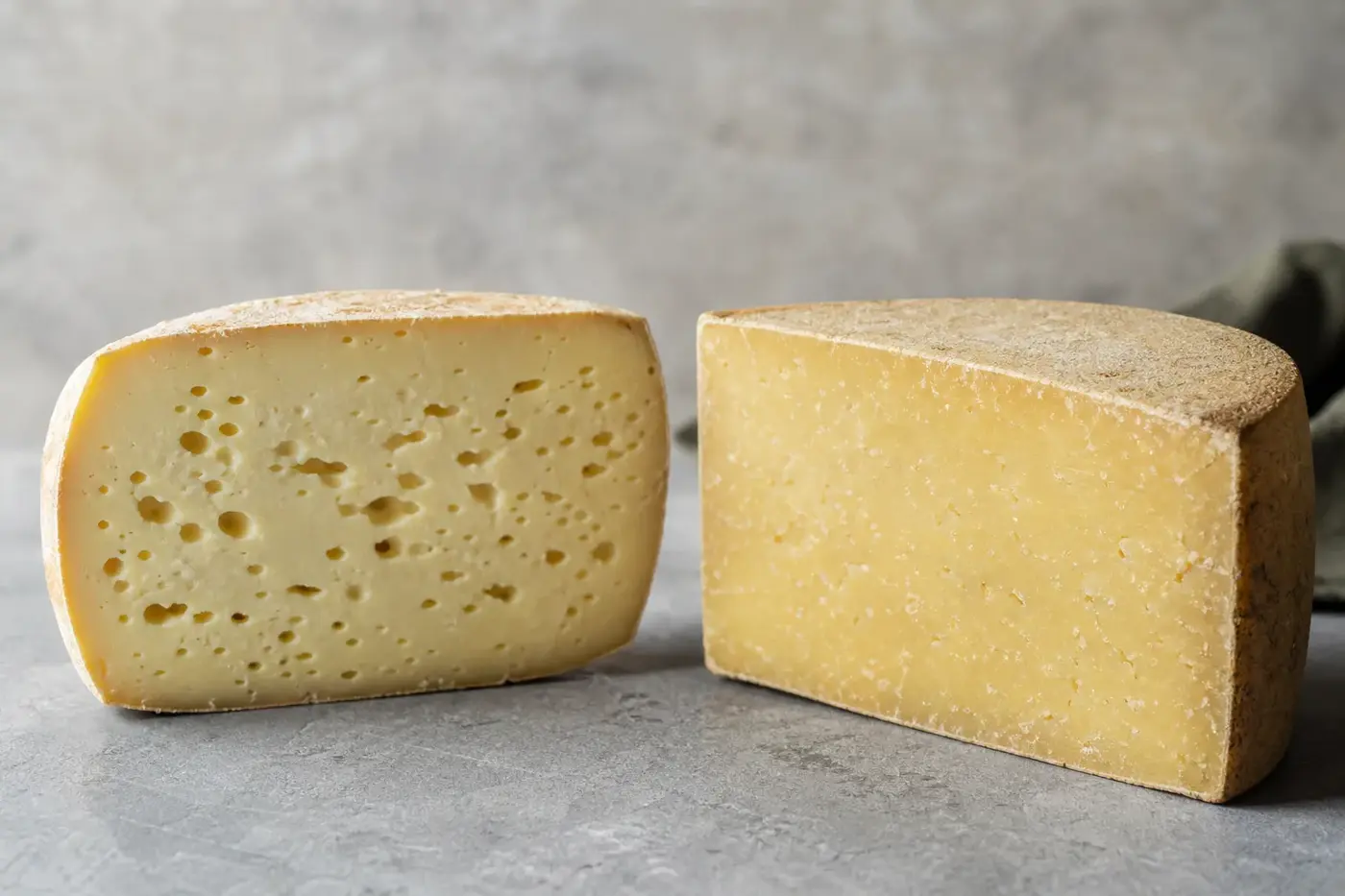
Put a slice of Asiago fresco beside a piece of stagionato and the difference is there before you taste. One is pale and supple, with conspicuous, irregular holes; the other is firmer, its flavour more deeply savoury. They share a north-eastern Italian tradition rooted in the Asiago plateau, with a production territory stretching into the hills and plains of Veneto and neighbouring Trentino. Getting to know both is the pleasure, and the key to choosing well. [2,3,4]
| Fact | Detail |
|---|---|
| Name you will see, and registered name | Asiago. [5] |
| Cheese styles | Cow’s milk cheese: fresco, also called pressato, and stagionato, also called d’allevo. [1] |
| EU registration authority and current register ID | European Commission; current register ID: not established here. |
| EU and Northern Ireland protection | Not established here. |
| Great Britain protection | Registered PDO; UK scheme registration dated 31 December 2020 at 23:00. November 2026 register information. [5] |
| Switzerland protection | Not established here. |
| United States protection | Not established here. |
| Original EU registration date | 21 June 1996, as recorded by the GB register. [5] |
| Where it is made | Vicenza and Trento provinces, with defined parts of Padova and Treviso provinces. [4] |
| Milk used | Whole cow’s milk for fresco; cow’s milk partially skimmed by allowing cream to rise for stagionato. [4] |
| What sets the milk | The consortium describes bovine rennet or a vegetable coagulant for both styles. [2,3] |
| Current legal minimum maturation | Not established here. |
| Published maturation guidance | Consortium guidance: fresco at least 20 days; stagionato includes mezzano at 4 to 10 months, vecchio at 10 to 15 months and stravecchio beyond 15 months. [2,3,6] |
Start on the plateau, then look beyond it
Asiago’s historical home is the plateau in Vicenza province, close to the boundary with Trento. The published specification places its origins there; the consortium describes today’s landscape as a succession of mountains, Vicenza’s hills and lower plains. Think beyond the high summer pasture: the name belongs to a defined regional tradition, not a promise that every wheel comes from upland grass. [1,4]
The territory takes in all of Vicenza and Trento provinces, but only specified parts of Padova and Treviso. Milk production and cheesemaking happen within those boundaries, and the published specification also places maturation inside the production area. When you want to establish provenance, look for the actual designation and origin information. A dairy address elsewhere or an Italian-looking presentation tells you less. [1,4]
For cheese sold under the Asiago name elsewhere, read the country of production and the complete label. The name alone does not establish Italian PDO origin. Protection depends on jurisdiction: Great Britain’s official register lists Asiago as a registered PDO, while the legal position in other markets needs separate attention. See protected names for a fuller explanation. [5]
A long history, with two paths to follow
The published specification traces cheesemaking on the Asiago plateau to around the year 1000. By the early twentieth century, its account describes production spreading into neighbouring territory. This is the story of a cheese tradition, rather than a surviving recipe proving that medieval Asiago was identical to either style you can buy today. [1]
Modern Asiago follows two production paths, not simply two lengths of ageing. Fresco starts with whole milk and includes pressing; stagionato starts with partially skimmed milk and follows a different pattern of curd-making and maturation. An older piece of fresco does not become stagionato just by staying longer in a maturing room. Cheese has its limits, even when patience is involved. [2,3,4]
The older names help you navigate labels and cheese-counter conversations. Pressato points towards pressing and is the alternative name associated with fresco; d’allevo is associated with stagionato. Both pairs appear in the published specification. The consortium now presents its principal ranges as fresco and stagionato, so knowing all four terms helps you connect the label with the cheese. [1,2,3]
How the milk becomes two different cheeses
The first decisive difference is the milk: whole for fresco, partially skimmed for stagionato. In the consortium’s descriptions, bovine rennet or a vegetable coagulant sets it into curd, the solid material that becomes cheese. Cutting the curd lets whey, the surrounding liquid, drain away. Both styles then undergo further heating before moulding, identification, salting and maturation; how cheese is made explains the wider sequence. [2,3,4]
Curd size and heating help set the styles apart. For fresco, the consortium describes relatively large pieces, between walnut and hazelnut size, heated to about 44 °C. For stagionato, the pieces are smaller, approximately hazelnut-sized, and heated to about 47 °C. The two cheeses are taking different forms well before the maturing room enters the picture. [2,3]
For fresco, the drained curd is cut, turned and salted, then portioned into moulds. Pressing compacts the pieces and encourages further drainage. Stagionato is also moulded and turned, but the consortium’s account describes no corresponding pressing stage. Both styles receive identifying marks, and salting can be completed either dry or in brine. [2,3]
For current rules on permitted milk treatments for fresco and stagionato, consult the applicable requirements. Thermisation is a heat treatment distinct from pasteurisation. To find out how an individual cheese’s milk was treated, read its label or product information rather than relying on the style name.
Meet fresco: supple, milky and gently tangy
Milk, yoghurt and butter are the flavour references in the consortium’s description of fresco, alongside sweetness and slight acidity. Picture a white to pale straw-coloured interior, scattered with irregular holes. Its yielding texture and clear dairy character are central to the style. These are the consortium’s tasting notes, rather than a fromage.co.uk tasting. [2]
Those openings belong there, so you need not look for a perfectly closed paste. The published specification describes a thin, elastic rind and standard cylindrical fresco wheels measuring 30 to 40 cm across, standing 11 to 15 cm high and weighing 11 to 15 kg. Your small counter-cut portion reveals only part of a substantial whole. [1]
The consortium gives fresco at least 20 days of maturation. The industry’s 2024 restaurant guidance describes fresco at 20 to 40 days and fresco riserva beyond 40 days. Ask for the actual age as well as the name when you compare cheeses. Riserva is useful information if you are choosing between a milder table cheese and one with more developed character. [2,7]
Meet stagionato: sweetness with a savoury depth
Mezzano shows why aged Asiago deserves more than the shorthand “strong”. The consortium describes a compact yet elastic cheese, with a straw-yellow interior and small to medium holes. Its tasting account brings sweetness and savouriness together with suggestions of grass, hay, dried fruit and butter. You can have developed aroma without losing elasticity or sweetness. [3]
With later maturation, the industry guidance describes the colour moving towards ochre and the flavour becoming more pronounced and savoury. The consortium presents stravecchio as particularly intense, suitable on its own or with honey or preserves. Age gives you a useful steer. The next question is which texture and flavour you want on your plate or in your dish. [6,7]
Let the age names guide your choice
| Name on the label | Published maturation guidance | What to expect or try |
|---|---|---|
| Fresco riserva | More than 40 days in the 2024 industry guide. [7] | Another expression of fresco. |
| Mezzano | 4 to 10 months in consortium guidance. [3] | Elastic aged cheese balancing sweetness and savouriness. |
| Vecchio | 10 to 15 months in consortium guidance. [6] | More developed flavour for baked pasta or savoury baked dishes. |
| Stravecchio | More than 15 months in consortium guidance. [6] | Intense table cheese, including with honey or preserves. |
Ask for the actual maturation alongside the age description. It gives you a clearer basis for comparison than the name alone. The consortium’s suggested uses leave room for both styles: fresco brings its yielding texture and dairy character, while stagionato offers several degrees of development. There is no need to make one evict the other from your cheeseboard. [2,3,6]
What the mountain designation really tells you
Above 600 metres is the defining altitude in the consortium’s account of prodotto della montagna. It describes Asiago whose milk is produced, processed and matured above that height within the production territory, using milk from cows fed without silage. This is a specific connection with mountain production, rather than simply a pastoral picture on the packaging. [4]
For the mountain designation’s current additional requirements, consult the applicable rules on maturation and rind treatments. Keep these details separate from the altitude threshold.
Read mountain origin and maturation as different pieces of information. Establish the style first, fresco or stagionato, then the age, then the mountain designation. Together, they give you a more useful picture of the cheese you will eat than altitude alone. [2,3,4]
Good questions at the counter, good habits at home
Begin with three questions: which style is it, how long has it matured, and where was it made? Ask about milk treatment and coagulant too if either affects your choice. Since the consortium describes both bovine and vegetable coagulants, the Asiago name cannot tell you which was used for an individual cheese. [2,3]
Keep the label from prepacked cheese so its storage instructions and date stay with your portion. If you buy cheese cut to order, ask the seller to identify its style and maturation; a small wedge’s appearance is a less reliable guide. The guide to reading a cheese label explains the wider information worth looking for.
For household storage in England, Northern Ireland and Wales, the Food Standards Agency advises keeping the refrigerator between 0 and 5 °C, refrigerating dairy products, and following the package’s storage and date instructions. Follow any product-specific instructions after opening, too. The agency’s guidance, dated here to November 2026, is linked in the Sources below. [8]
During preparation, the same FSA guidance says chilled food should spend the shortest possible time outside the refrigerator, with a maximum of four hours. Take out the portion you intend to serve and leave the remaining cheese refrigerated, rather than keeping it on the table. See storing cheese at home for the broader practical routine. [8]
Give both styles a place at your table
For a side-by-side comparison, taste fresco before moving towards the older stagionato. Begin with plain bread and water, and try each cheese before adding an accompaniment. Notice the spring of the paste, the size of the holes, the balance of sweetness and acidity, and how long the savoury finish lasts. The consortium’s descriptions give you useful reference points, not an exam paper. [2,3,6]
Fresco lends itself to slices and cubes. The consortium’s published dishes use it in salads, filled preparations and fonduta, a melted cheese preparation. Reach for it when you want a soft dairy contribution rather than the stronger seasoning effect of an older cheese. Its texture matters as much as its flavour. [2]
For stagionato, the consortium suggests mezzano with yellow polenta or fresh fruit, vecchio in baked pasta and savoury baked dishes, and stravecchio with honey or preserves. Start with a modest amount of accompaniment, particularly beside a very mature piece, so you can still taste the cheese’s own character clearly. Water provides an alcohol-free drink throughout the tasting. [6]
Choose slicing, melting or grating according to the job you need the cheese to do. None is a higher use than another. Slice fresco for a sandwich or plate, look to the consortium’s melted-cheese dishes for cooking ideas, and choose an appropriately firm stagionato for shavings or grating. The industry’s restaurant guidance recognises slices, cubes and grated presentations. [2,7]
Before cooking, decide whether Asiago should supply the main cheese texture or a finishing accent, then choose its age. Fresco and stravecchio both belong in the kitchen, but substituting one for the other changes the intended character. The consortium’s serving suggestions give you a useful starting point: younger dairy flavours, an intermediate table cheese, or a mature savoury emphasis. [2,3,6]
General information only, not medical advice: follow the official guidance where you live.
Questions people ask
What is the difference between Asiago fresco and stagionato?
Fresco, also called pressato, is made with whole cow’s milk and is pressed. Stagionato, also called d’allevo, is made with partially skimmed cow’s milk and follows a different production process. An older fresco does not become stagionato simply through further maturation.
How long is Asiago matured?
The consortium gives fresco at least 20 days of maturation. For stagionato, its guidance describes mezzano at 4 to 10 months, vecchio at 10 to 15 months and stravecchio beyond 15 months.
Is Asiago vegetarian?
The consortium describes both bovine rennet and vegetable coagulant for fresco and stagionato. Check the label or ask the seller which was used for a particular cheese.
Where is Asiago made?
The defined production area includes all of Vicenza and Trento provinces and specified parts of Padova and Treviso provinces. Milk production, cheesemaking and maturation take place within those boundaries. The name alone does not establish Italian PDO origin, so check the country of production and the complete label.
How should Asiago be stored?
For households in England, Northern Ireland and Wales, the Food Standards Agency advises keeping the refrigerator between 0 and 5 °C, refrigerating dairy products and following package storage and date instructions. It also says chilled food should spend the shortest possible time outside the refrigerator, with a maximum of four hours. See the agency’s guidance linked in the page’s sources.
Sources
- Consorzio Tutela Formaggio Asiago, Disciplinare di produzione della denominazione di origine protetta “Asiago”, specification file dated 27 November 2019 and published in the consortium’s document library following the 2020 amendment. Articles 1 to 6. Specification PDF.
- Consorzio Tutela Formaggio Asiago, Asiago DOP fresco, undated product and production guide, accessed November 2026. Commercially interested industry source; tasting descriptions and suggested dishes are attributed to it. Product guide.
- Consorzio Tutela Formaggio Asiago, Asiago DOP stagionato formaggio Mezzano, undated product and production guide, accessed November 2026. Commercially interested industry source. Product guide.
- Consorzio Tutela Formaggio Asiago, Produzione formaggio Asiago, undated geographical and milk-production guide, accessed November 2026. Origin guide.
- Department for Environment, Food & Rural Affairs, Asiago, GB protected food names register, published 4 January 2021, accessed November 2026. Official register entry.
- Consorzio Tutela Formaggio Asiago, Asiago DOP stagionato ambasciatore della lentezza, undated article, accessed November 2026. Commercially interested industry source for its maturation descriptions and serving suggestions. Consortium article.
- AFIDOP and FIPE, Linee guida per la valorizzazione dei formaggi DOP e IGP nei menu della ristorazione, 2024, Asiago section, pages 10 to 11. Industry guidance, distinct from binding legislation. Guidance PDF.
- Food Standards Agency, How to chill, freeze and defrost food safely, published 18 December 2017, current retrieved guidance accessed November 2026; applies to England, Northern Ireland and Wales. Official household guidance.
This desk-researched draft compares the consortium’s published production and sensory accounts with its published specification, industry serving guidance, the GB register and official household refrigeration advice.
Last checked: November 2026
Last checked November 2026.
The editors suggest you read next
Parmigiano Reggiano
Break into a wheel of Parmigiano Reggiano and flakes fall away, revealing a finely granular cheese, pale straw to straw in colour.