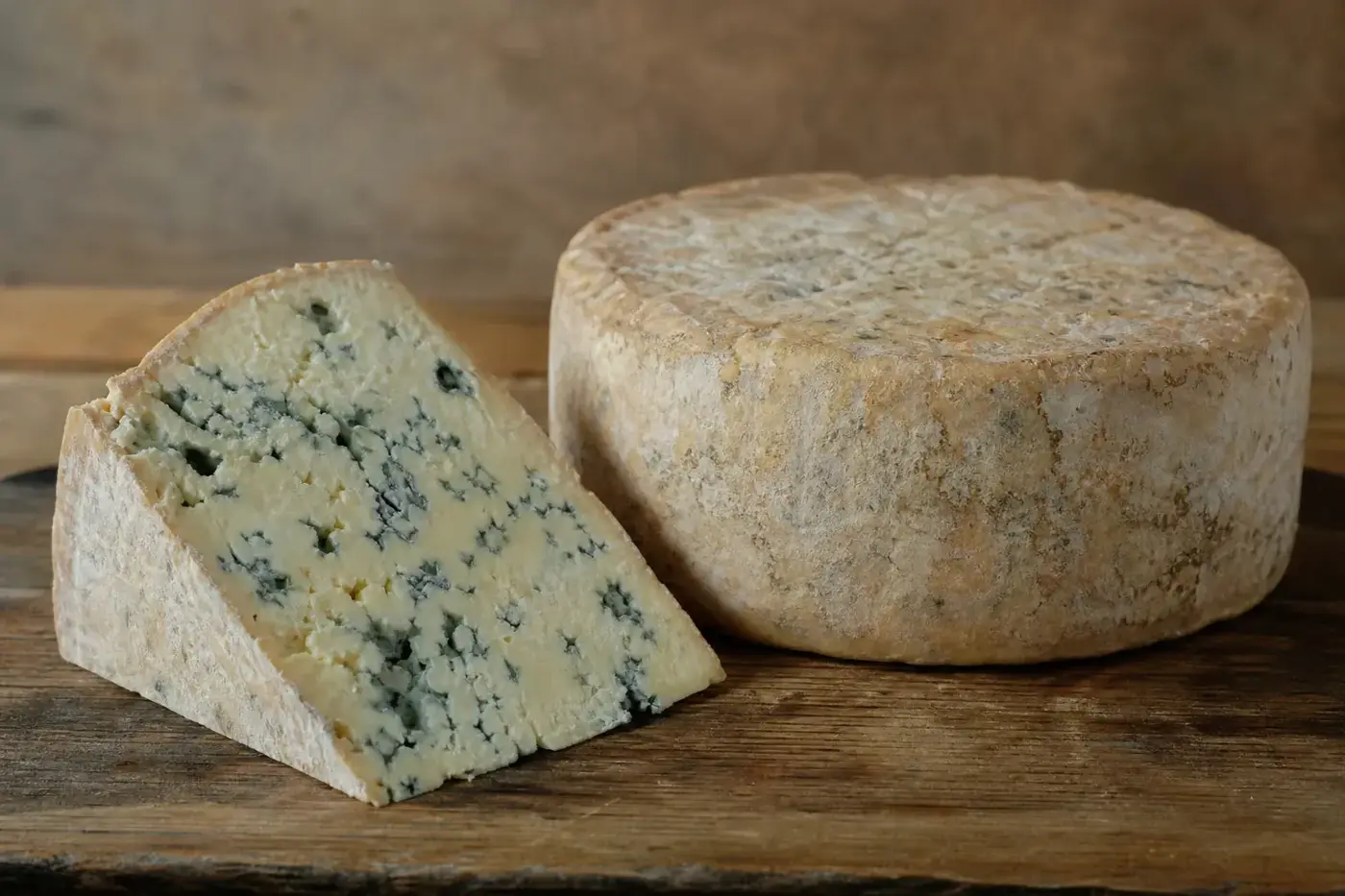
A needle pierces a young blue cheese. Air slips into the spaces inside, bringing the oxygen that lets blue mould grow through the paste. What eventually reaches your plate might be soft and spreadable or sharp and crumbly. Milk, culture and maturation help decide which. [1,12]
Cut a slice and meet the blue
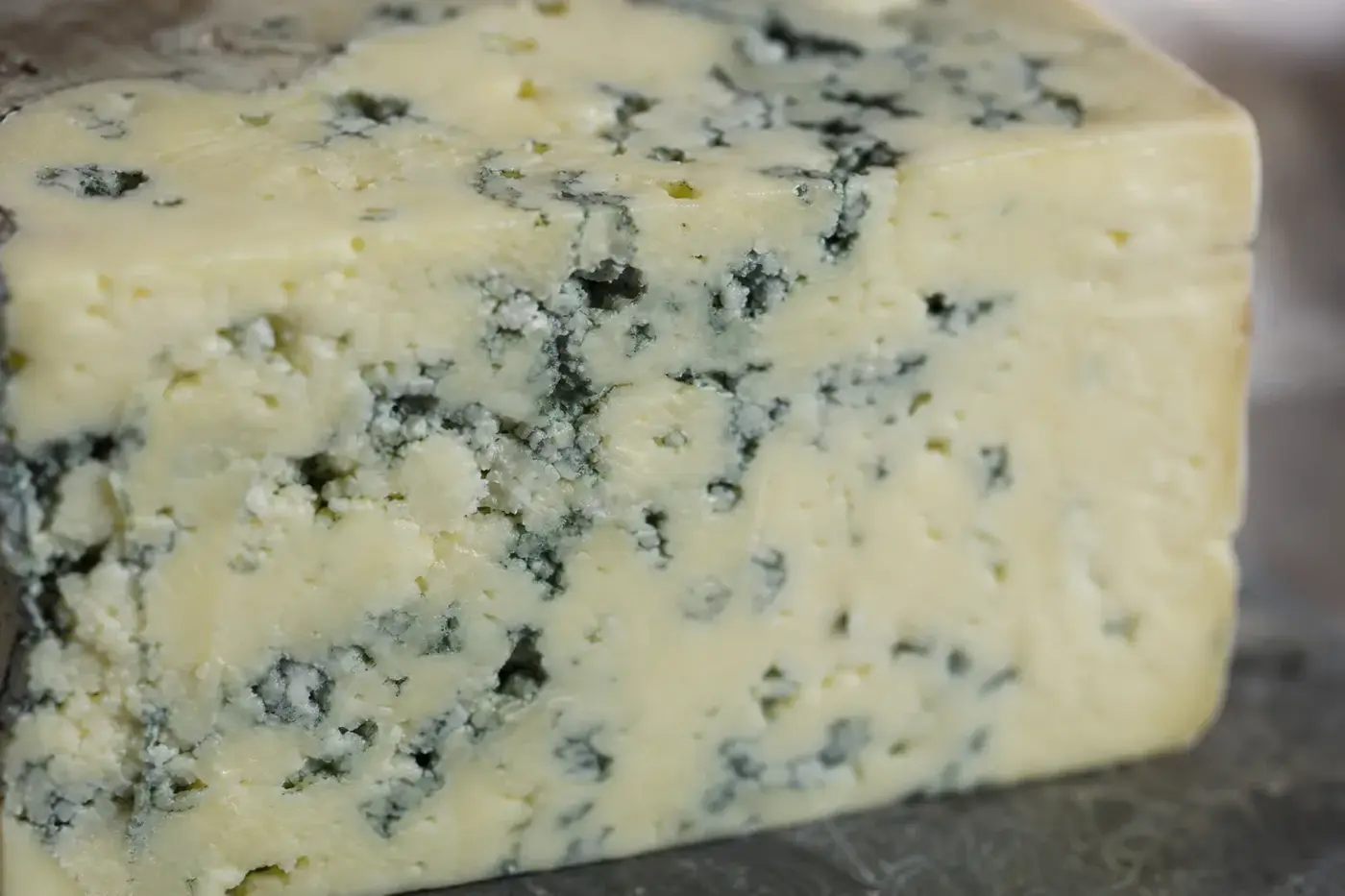
Cut into a blue cheese and you find the reason for its name: mould growing through the paste, or body, in blue or blue-green veins. Nobody has stirred colouring into the milk. Those colours come from mould spreading through the spaces inside. [12]
The outside cannot tell you everything. A white surface coat and blue internal veins are different ripening features, and one cheese can have both. When you compare cheese families, look beneath the surface. For the wider vocabulary, try how to tell cheese styles apart. [11,12]
This page summarises published guidance from the official sources it cites. It is not medical advice. Guidance differs between countries and changes over time, so check the current source for where you live, and ask your doctor, midwife, pharmacist or dietitian about your own circumstances.
Meet the mould behind the character
Penicillium roqueforti takes centre stage in the research discussed here. It is also the culture specified for Blue Stilton, and cheesemakers select distinct lines within the species, called strains. [1,2] For other blue mould cultures and any applicable permissions, authoritative sources remain essential.
Those choices matter to the finished cheese. Controlled studies comparing P. roqueforti strains found differences in their activities and ripening chemistry. That does not mean the experiments tasted every cheese bearing a familiar name. [3,4]
At the counter, a species name only takes you so far. It cannot tell you how an individual cheese tastes, so ask the maker or seller about the piece in front of you.
Follow the curd and let the air in
First comes curd, the solid gel formed when milk sets and liquid whey drains away. Under the Stilton specification, blue mould may go into the milk or be sprayed onto the curds. The curd is cut, drained, salted and placed in cylindrical moulds, without applied pressure. [1]
The spaces between those pieces of curd give mould room to develop. Piercing opens routes from outside, bringing oxygen into those spaces. The FSA's blue cheese assessment explicitly describes this extra maturation step. [12]
Those finished veins, then, are not simply straight needle tracks. They follow the mould's growth through accessible spaces: culture supplies the organism, while piercing helps provide the conditions it needs. Follow the bigger picture in how cheese is made. [1,12]
Milk begins the story, time carries it on
Milk supplies the starting material, but it does not write the whole character of your cheese. Research covers blues made from both cow's and sheep's milk, with cultures and cheesemaking methods adding further differences. Change the animal and you change only one part of the process. [2]
Moisture affects how your cheese handles. Salt brings flavour and changes the environment in which its microorganisms work. Laboratory research has explored salt, temperature and acidity as influences on the fat-breaking activity of P. roqueforti. These factors work together, rather than acting as separate quality scores. [5,12]
Age changes texture, not just strength. The Stilton specification describes a slightly crumbly younger cheese, a softer mature version and a drier vintage one. Milk composition, cheese size, storage temperature and the manufacturer's method help explain varying maturation times. Ask what “older” means for your particular piece. [1]
Will you spread it, slice it or crumble it?
Choose texture and flavour separately. Decide whether you want to spread, slice or scatter your cheese, then consider how much sharpness and blue aroma you enjoy. Soft does not necessarily mean gentle. The younger Stilton in its specification combines some crumbliness with a milk-like background. [1,12]
For bread, look for a yielding paste; for slices, something cohesive; for breaking over a dish, something flaky. These are serving suggestions, not formal cheese categories. Ask about the actual cut, rather than expecting the family name on its label to do all the work.
Darker blue is not a dependable strength rating, either. Experimental work shows that mould populations affect visible blue growth and ripening chemistry alike. Use colour alongside a description or sample. The darkest patch has not won a competition for strongest flavour. [3]
Roquefort, Stilton and Gorgonzola: three names worth knowing
Put these three names together and you have useful contrasts in milk and origin. Roquefort, Stilton and Gorgonzola all appear as registered PDO names on the Great Britain register in November 2026. PDO means protected designation of origin: its specifications govern particular products, not the whole blue-cheese family. For Roquefort and Gorgonzola production details, their operative specifications remain the essential reference. [6]
| Name | Milk | Where it comes from | What to look for |
|---|---|---|---|
| Roquefort | Sheep | France | Sheep's milk sets it apart from the two cheeses below. [2,6] |
| Blue Stilton | Pasteurised cow's milk | Leicestershire, Derbyshire and Nottinghamshire, England | Made without applied pressure; develops its own coat. [1] |
| Gorgonzola | Cow | Italy | The same milk species as Stilton, but a distinct named cheese. [2,6] |
Want to untangle origin rules from everyday style names? Explore protected names explained.
Follow your nose into the ripening room
Behind blue cheese's transformation are two busy processes. Proteolysis breaks proteins into smaller components; lipolysis breaks down milk fat, releasing free fatty acids. Blue-cheese cultures contribute enzymes, the biological catalysts that drive those reactions. Further reactions produce volatile compounds that reach your nose and contribute aroma. [2,4]
Among those aroma compounds, methyl ketones play an important part. Their formation helps give blue cheese its recognisable character beyond saltiness or acidity. The culture partly determines their amount and balance. Those blue veins cannot tell you the whole flavour story. [2,3]
One sheep's milk experiment compared three commercial cultures across nine cheesemaking trials. After thirty days, two cultures had produced more free fatty acids than the third. Yet the measured protein-breakdown parameters did not differ significantly between cultures. Ripening does not move forward at one tidy pace. [2]
Find your blue, one small taste at a time
Start with a texture you enjoy, then ask for the intensity you want. Be specific: spreadable with restrained blue aroma; flaky with a milky background; firmer and more pronounced. A cheese name starts the conversation. A description gets you closer to the right piece.
Try a small piece on its own before reaching for bread or fruit. Notice texture first, then salt and acidity, then the aroma left after swallowing. Compare two contrasting pieces rather than assembling a large selection. Moving straight between them makes the differences easier to describe.
Keep the label, or note the producer, cheese and maturity description. Use your own words, including anything you disliked. That gives a cheesemonger more to work with than “stronger” or “milder”. Your next favourite deserves better directions than “the blue one”.
Give the cheese first say in a pairing
Begin plainly, then add one contrast. Bread keeps the cheese in the foreground; pear, apple or a little dried fruit takes it somewhere sweeter. Taste the cheese first and add the accompaniment afterwards. You get to decide whether the combination improves it.
Water is a useful alcohol-free starting point. If you want to explore, try unsweetened tea with a mild blue, or a fruit-led alcohol-free drink with a sharper cheese. Treat these as invitations to experiment, not fixed matches.
For a direct comparison, pour two alcohol-free drinks and taste each with the same cheese. Keep the accompaniments unchanged and vary only the drink. Do you prefer a pairing that repeats sweetness, or one that leaves the cheese's sharper character more exposed?
Keep it cool and serve a little at a time
Follow your cheese's storage instructions, and keep the label when you cut or rewrap a piece. The FSA's home guidance for England, Wales and Northern Ireland recommends a fridge temperature between 0 and 5 °C. [9,10]
Serve a small portion and leave the rest refrigerated. The same FSA guidance says chilled food should spend the shortest possible time outside the fridge during preparation, with a maximum of four hours. Follow any stricter instructions on the product. [9]
Use-by dates concern safety; best-before dates concern quality. Read the after-opening instructions as well as the pack date, and discard cheese kept beyond its use-by date. Correct storage matters before that date, too. Get the practical details in how to store cheese at home. [10]
Know when it is time to discard your blue
Expected blue veins are one thing; unwanted mould is another. The FSA distinguishes mould deliberately introduced into cheeses such as Stilton from unwanted growth on foods. If you cannot identify growth as part of the cheese, leave it uneaten and ask the seller. Do not taste it to investigate. [11]
If a recall applies, follow the notice for the identified product and batch. Neither smell nor appearance can tell you whether cheese contains Listeria. [12] For unexpected mould, consult current Food Standards Agency guidance.
Pregnancy and vulnerable groups: find the UK guidance you need
The NHS pregnancy guidance for November 2026 says soft blue-veined cheeses, including Danish blue, Gorgonzola and Roquefort, should be thoroughly cooked until steaming hot. That applies whether their milk is pasteurised or unpasteurised. It lists hard cheeses, including Stilton, among those you can eat during pregnancy. [7]
The NHS's wider dairy guidance advises certain groups to avoid some cheeses, including soft blue-veined cheese. These groups are infants and young children, people over sixty-five, pregnant people, and people with a long-term medical condition or weakened immune system. It also explains that these cheeses can be used in cooked recipes. Follow the agency's current guidance for the particular group. [8]
Both milk treatment and the cheese's characteristics matter. Pasteurisation is not the end of the handling chain: the FSA's blue-cheese assessment discusses contamination during later production and maturation. Consult the linked NHS sources for UK advice, or your own country's official agency if you live elsewhere. [12]
Questions people ask
How does blue cheese get its veins?
A needle pierces the young cheese, letting oxygen reach spaces inside it. Blue mould grows through those spaces, forming the veins.
Does darker blue cheese taste stronger?
Darker blue is not a dependable guide to strength. The page suggests using colour alongside a description or sample.
What is the difference between Roquefort, Stilton and Gorgonzola?
Roquefort is a French cheese made from sheep’s milk. Blue Stilton is made in England from pasteurised cow’s milk, while Italian Gorgonzola is also made from cow’s milk.
Can you eat blue cheese during pregnancy?
The NHS pregnancy guidance says soft cheeses with blue veins, including Danish blue, Gorgonzola and Roquefort, should be thoroughly cooked until steaming hot, whether made with pasteurised or unpasteurised milk. It lists hard cheeses, including Stilton, among those that can be eaten during pregnancy. Check the current NHS pregnancy guidance for details.
How should blue cheese be stored?
The Food Standards Agency’s home guidance for England, Wales and Northern Ireland recommends a fridge temperature between 0 and 5 °C. It says chilled food should spend the shortest possible time outside the fridge during preparation, with a maximum of four hours. Check the FSA guidance and follow any stricter instructions on the product.
Sources
-
Department for Environment, Food and Rural Affairs. Product specification: Stilton Cheese, version linked from the Great Britain register, undated. Sections 4.2, 4.3 and 4.5.
-
Agris Sardegna, Salvatore and colleagues. Evaluation of lipolysis and volatile compounds produced by three Penicillium roqueforti commercial cultures in a blue-type cheese made from ovine milk. Italian Journal of Food Science, volume 27, 2015, pages 437 to 442.
-
International Journal of Food Microbiology. Strong effect of Penicillium roqueforti populations on volatile and metabolic compounds responsible for aromas, flavor and texture in blue cheeses, volume 354, article 109174, 2021. Retrieved abstract and indexed methods summary.
-
Farahat, Rabie and Farag. Evaluation of the proteolytic and lipolytic activity of different Penicillium roqueforti strains. Food Chemistry, 1990, pages 169 to 180. Retrieved abstract.
-
International Journal of Food Microbiology. The effects of environmental conditions on the lipolytic activity of strains of Penicillium roqueforti, 1999. Retrieved study introduction and description of experimental variables.
-
Department for Environment, Food and Rural Affairs. Great Britain protected food-name register entries: [Roquefort](../roquefort/), Stilton Blue Cheese and [Gorgonzola](../gorgonzola/). Live entries, checked November 2026.
-
NHS. Foods to avoid in pregnancy, live guidance, checked November 2026. Section “Cheese, milk and other dairy”.
-
NHS. Dairy and alternatives in your diet, live guidance, checked November 2026. Sections “Cheese” and “Cheese in your child's diet”.
-
Food Standards Agency. How to chill, freeze and defrost food safely, 2017, live publication checked November 2026. Applies to England, Northern Ireland and Wales.
-
GOV.UK. Understanding food labelling: Best before and use-by dates, live guidance, checked November 2026.
-
Food Standards Agency. Natural toxins factsheet, archived factsheet, approximately 2002. Retrieved passage distinguishing deliberately introduced cheese mould from unwanted growth.
-
Food Standards Agency. The risk to vulnerable consumers from Listeria monocytogenes in blue cheese, 2023 assessment. Sections on cheese characteristics, maturation and contamination.
This desk-researched article brings together official product records, published cheesemaking experiments and UK consumer guidance; practical tasting and pairing suggestions are editorial recommendations.
Last checked: November 2026
Last checked November 2026.
The editors suggest you read next
How to Tell Cheese Styles Apart: Milk, Rind, Texture and Method
Watch mozzarella curd being worked and stretched in hot water.