Bulgarian Cheese
Lift the lid of a wooden barrel in a damp cellar in Cherni Vit, in the Balkan Mountains.
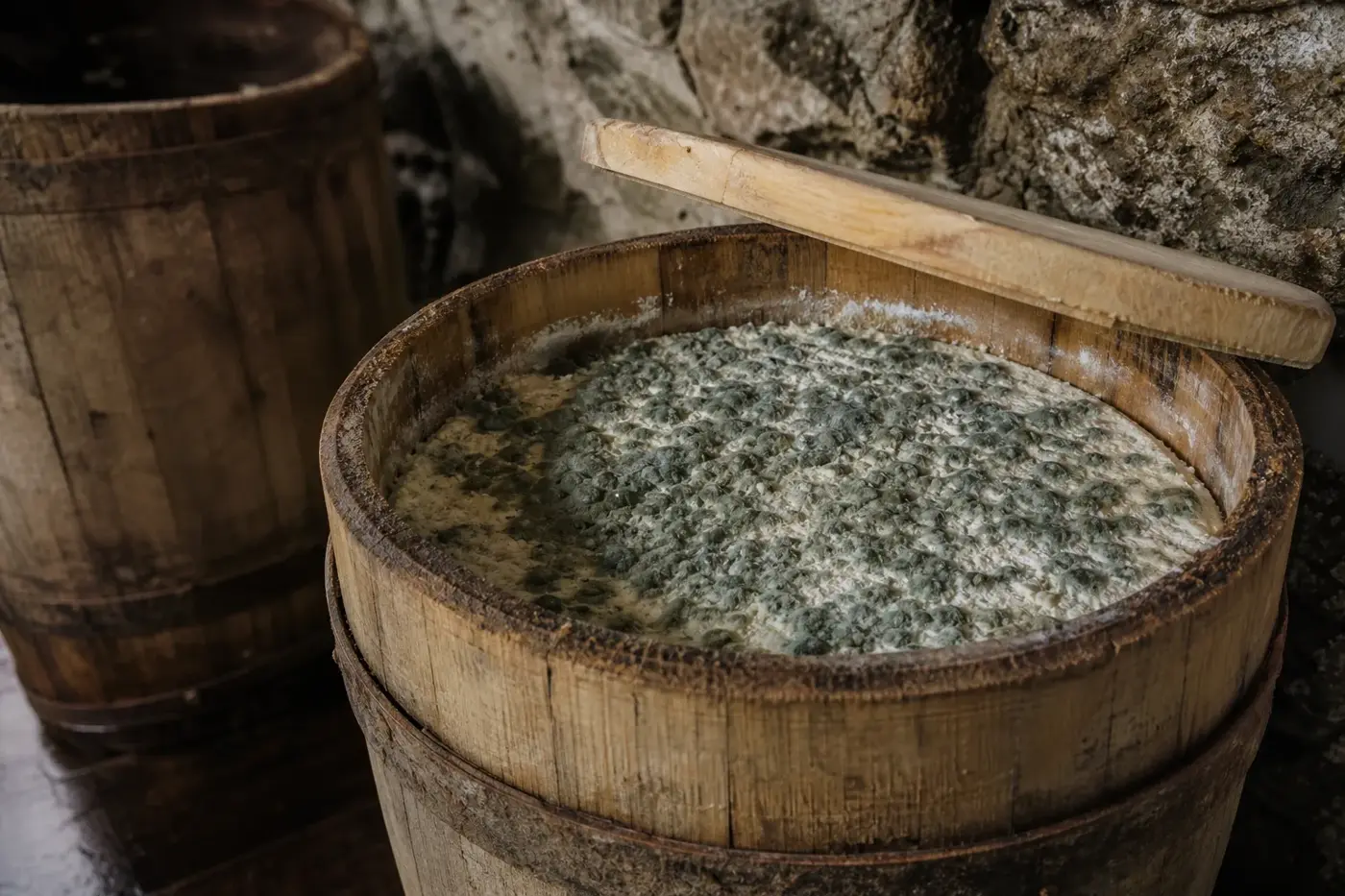
Lift the lid of a wooden barrel in a damp cellar in Cherni Vit, in the Balkan Mountains. Inside, traditional sheep’s milk cheese meets the air that allows green-blue mould to grow.[1] It is quite an entrance, even for cheese. Leave room for Bulgaria’s everyday companions too: white brined sirene, served at the table and folded into familiar dishes, and firm, stretched-curd kashkaval.[4,5]
| At a glance | Your bearings |
|---|---|
| Country | Bulgaria.[2] |
| Signature styles | White brined sirene and stretched-curd kashkaval.[4,5] |
| Full registered cheese name | Българско бяло саламурено сирене/Bulgarsko byalo salamureno sirene.[3] |
| EU application identifier | PDO-BG-02656.[2] |
| Registration authority | European Commission.[3] |
| EU legal status | PDO registration regulation in force, November 2026.[3] |
| Legally defined PDO production area | The Republic of Bulgaria.[2] |
Follow the barrels down from the mountains
Cherni Vit’s green cheese keeps time with mountain grazing. Slow Food’s preservation account describes cheese made during the grazing season from local Teteven sheep’s milk, sometimes mixed with goat’s milk. The curd is pressed, salted and packed into lime-wood barrels.[1]
When the grazing season ends, the barrels travel down from the mountain pastures to village cellars. Opening them lets in moist air, and mould develops spontaneously across the surface, sometimes reaching inside the cheese. The pastoral calendar, the wood and the cellar conditions each play their part.[1]
Slow Food records this tradition around Cherni Vit in Teteven municipality, Lovech district. Its account follows both the method and the project working to preserve it. If you hope to meet a producer, arrange things directly before travelling.[1]
This is a compelling place to begin exploring an unusual regional tradition. For the cheese you will meet across Bulgarian meals, turn to sirene. Bulgaria’s official tourism portal describes white brined cheese as an almost constant presence on the table.[4]
Four milks, plenty to discover
Look beyond the mountain summer pastures and Bulgaria’s dairy landscape opens out. The published PDO document describes natural and cultivated meadows supplying fresh grass, hay and silage. Lowland pastures belong to the picture too.[2]
So do cows, sheep, goats and buffalo. The registered white brined cheese permits milk from each species, separately or mixed. The European Commission’s registration announcement explicitly recognises that range.[9]
Before you choose, read the milk declaration. Comparing different milks is revealing, but try two producers’ cheeses made from the same milk as well. Ask about the dairy, maturation and milk treatment, not just the animal, so you have a clearer basis for comparison.
For a first tasting, choose cow’s milk sirene and a sheep’s milk version, if both are available, then add kashkaval. Keep the accompaniments simple and compare texture, salt and acidity. Note what you find in those particular cheeses: one tasting need not speak for every Bulgarian example.
Get acquainted with the cheeses on your plate
Sirene: what happens in the brine
The brine is doing more than keeping a block of sirene company. In the PDO production sequence, milk is pasteurised and coagulated into a gel. The curd is cut, pressed and salted, then left to mature in brine.[2]
What should you look for when you cut into it? The published description gives sirene a moderately firm, pliant texture, a clean white cut surface and pronounced lactic acidity balanced by salt. It singles out starter cultures and maturation in brine as important to flavour development.[2]
Milk composition matters, but it does not work alone. The producer’s handling of the curd, salting and maturation also shape the finished cheese. At the counter, go beyond “Is this Bulgarian?” and ask which milk it contains, who made it and how it matured.[2]
There is another distinction worth taking to the cheese counter: sirene is a broad style, while the PDO is a registered product with a complete name. Look for that full name if you want the protected cheese. The guide to protected names explains how a designation differs from a general style description.
Kashkaval: a cheese shaped by stretching
With kashkaval, you meet another side of Bulgarian cheesemaking. The curd develops acidity before being heated and worked into a cohesive mass, then shaped and matured. A Bulgarian Academy of Sciences review describes this stretched-curd tradition and distinguishes products made from different milks.[5]
Cow’s and sheep’s milk versions give you useful starting points. The review’s table, based on BDS 14:2010, also includes goat’s, buffalo’s and mixed-milk kashkaval. Yellow colour can only tell you so much; the milk declaration tells you more.[5]
Pay attention to texture as you taste. Does the slice bend readily, how does it break when bitten, and how does the flavour develop as you chew? Record your observations alongside the maker and stated maturity. For the differences between stretching, pressing and other methods, see how cheese is made.
Leave a little room for krockmach
Krockmach takes sheep’s milk in a different direction. A regional food study published through the Black Sea Cross Border Cooperation programme records it as a speciality of north-eastern Bulgaria. The method concentrates milk, salts it and allows further maturation in small pottery containers.[6]
This is a different tradition from cutting a pressed block of sirene. Ask about krockmach when you explore regional dairy foods. A local name can lead you to a method that a broad shop category hides.
Note the producer’s spelling and ask what the product contains. With less widely documented foods, those details help you understand what is in front of you. Similar names are not a reason to assume identical recipes.
The long name to take to the cheese counter
Българско бяло саламурено сирене/Bulgarsko byalo salamureno sirene is an EU protected designation of origin, or PDO. Registration came through Commission Implementing Regulation (EU) 2023/1571, adopted on 24 July 2023, published on 31 July and in force from 20 August 2023. EUR-Lex records the act as in force.[3]
Behind that name sits a defined set of ingredients and production requirements. The Commission identifies whole cow’s, sheep’s, goat’s, buffalo’s or mixed milk, with starter cultures containing Lactococcus lactis subsp. lactis, Lactobacillus casei, Lactobacillus delbrueckii subsp. bulgaricus and Streptococcus thermophilus.[9]
The published single document requires pasteurisation and production within Bulgaria. Cow’s and goat’s milk cheeses must mature for at least 45 days. For sheep’s, buffalo’s and mixed-milk cheeses, the minimum is 60 days.[2]
When you buy, distinguish the complete registered name from the shorter word sirene. Read it alongside the dairy’s name and the milk declaration. The PDO defines the production framework, but you still get to choose the textures and flavours you enjoy.
Pull up a chair at the Bulgarian table
Sirene is not confined to a plate of cheese on its own. Bulgaria’s official tourism portal places white brined cheese among the country’s everyday foods. It also describes banitsa as a familiar breakfast pastry, with cheese among its fillings.[4]
Three dishes offer a useful introduction to the cheese’s place in the kitchen. As you try them, notice what happens when sirene meets the other ingredients:
- Shopska salad: white cheese tops a vegetable salad, bringing sirene together with fresh vegetables. Bulgaria’s tourism portal identifies it as a particularly familiar national salad.[4]
- Banitsa: a cheese filling brings sirene into baked pastry. Cheese is not the only option; other fillings belong to the broader banitsa tradition too.[4]
- Mish mash: this vegetable and egg scramble appears in the PDO document among the traditional dishes made with the registered cheese.[2]
Taste a little cheese separately before you tuck into the dish. It makes the cheese’s own salt and acidity easier to recognise alongside the pastry, eggs or vegetables.
For a simple tasting at your table, serve bread and vegetables with the cheese. Keep some sirene in pieces, crumble a little over the vegetables and slice the kashkaval separately. You can follow each cheese’s character while exploring how it works in a meal.
From village barrels to dairy laboratories
Set the wooden barrels aside for a moment: milk collecting points and laboratories also belong to Bulgaria’s dairy history. Archival research published by Eindhoven University of Technology traces the move towards organised milk collection and centralised processing during the twentieth century.[7]
From the 1930s, collecting points, cooperatives, dairy stations, veterinary services and laboratories became part of efforts to supply urban consumers. A substantial reorganisation in 1935 established regional collection and processing structures. These connected milk producers with towns.[7]
After the Second World War, state organisation and mechanisation changed dairy production’s scale. In 1953, dairy sectors came together under the state Dairy Industry organisation. Research and training institutions subsequently supported processing technology, equipment and starter cultures, including work on white cheese.[7]
Now bring Cherni Vit’s barrels back into the picture. One history follows coordinated collection and processing; the other preserves knowledge closely tied to a village and its grazing cycle. Together, they give you a fuller view than a simple split between household craft and factory production.[1,7]
Plan a visit with cheese at its heart
Begin a cheese visit with questions, not just a destination. Village dairies, farmers’ markets and restaurants offer different routes in. A dairy can explain production, a market can help you compare, and a restaurant can show you what the cheese does in a dish.
For Cherni Vit, start with an enquiry using the Slow Food project’s contact information. Before you travel, confirm who currently receives visitors. Ask whether a tasting can be arranged and which cheeses will be available.[1]
At a village dairy or market stall, keep these questions handy. They tell you far more than appearance alone:
- Which animal’s milk is used, and is it a mixture?
- Is the milk pasteurised?
- Was the cheese made here, or selected from another dairy?
- How long has it matured?
- What storage instructions apply after opening?
In a restaurant, ask which dairy supplies the sirene and whether the kitchen can identify the milk. Try it in a salad or pastry, then request a separate portion to compare, where offered. A clear account of provenance is more useful than a picturesque menu description.
Before setting out, check the venue’s own current information, booking requirements and accessibility. Taking cheese across a border? Consult the official rules for your precise route before travelling.
Bring your cheese home and keep it well
Start with the label: maker, milk species, milk treatment, date marking and storage instructions. Buying a cut portion? Ask for the same details. The guide to reading a cheese label gives you a fuller checklist.
For brined cheese, ask how the seller recommends keeping it once opened and whether to retain the supplied brine. For kashkaval, ask how to protect the cut face, then follow the packaging instructions. Write down the opening date so you can follow any stated after-opening period.
If you are storing cheese at home in England, Wales or Northern Ireland, consult the Food Standards Agency’s current chilling guidance. Follow the storage instructions on the packaging too.[8]
For more on wrapping and handling different styles, turn to storing cheese at home. Keep the producer’s instructions with your cheese, especially if you throw away the original packaging.
General information only, not medical advice: follow the official guidance where you live.
Questions people ask
What is the difference between sirene and kashkaval?
Sirene is a white cheese matured in brine. Kashkaval is made by heating and working the curd into a cohesive mass before shaping and maturation.
Why does Cherni Vit cheese develop green mould?
After the grazing season, barrels of cheese are taken from the mountain pastures to village cellars. When the barrels are opened, moist air enters and mould develops spontaneously on the cheese’s surface, sometimes reaching the interior.
What is the protected Bulgarian cheese name?
The registered PDO name is Българско бяло саламурено сирене/Bulgarsko byalo salamureno sirene. It can be made from cow’s, sheep’s, goat’s or buffalo’s milk, or a mixture. Cow’s and goat’s milk cheeses must mature for at least 45 days, while sheep’s, buffalo’s and mixed milk cheeses require at least 60 days.
What Bulgarian dishes use sirene?
White cheese tops the vegetables in shopska salad and is a filling for banitsa, a familiar breakfast pastry. The PDO document also names mish mash, a vegetable and egg scramble, among traditional dishes made with the registered cheese.
How should I store Bulgarian cheese at home?
Follow the storage instructions on the packaging and ask the seller how to keep opened brined cheese, including whether to retain the supplied brine. For household storage in England, Wales and Northern Ireland, consult the Food Standards Agency’s current chilling guidance.
Sources
[1] Slow Food Foundation for Biodiversity. Tcherni Vit Green Cheese. Presidium description, undated, retrieved November 2026.
Read at fondazioneslowfood.com
[2] European Commission. Publication of an application for registration: Българско бяло саламурено сирене/Bulgarsko byalo salamureno sirene. Single document 2023/C 129/07, Official Journal C 129, 13 April 2023, pages 67 to 71.
Read at eur-lex.europa.eu)
[3] European Commission. Commission Implementing Regulation (EU) 2023/1571 of 24 July 2023 entering a name in the register of protected designations of origin and protected geographical indications. Official Journal L 192, 31 July 2023; EUR-Lex legal status and dates retrieved November 2026.
Read at eur-lex.europa.eu
[4] Ministry of Tourism of the Republic of Bulgaria. Wine & Cuisine. Official tourism portal, undated, retrieved November 2026.
Read at visitbulgaria.com
[5] Bulgarian Academy of Sciences researchers. Traditional Bulgarian Dairy Products: Ethnic Foods with Health Benefits. Microorganisms, volume 9, article 480, 2021. Production descriptions and kashkaval table only; no health conclusions adopted.
Read at pmc.ncbi.nlm.nih.gov
[6] Black Sea Cross Border Cooperation programme, LOC FOOD project. Studies on the current situation of traditional products designation, market potential in Bulgaria. 2021 publication, regional product entry “Krockmach”, page 38.
Read at blacksea-cbc.net
[7] Eindhoven University of Technology. Producing Bulgarian yoghurt: manufacturing and exporting authenticity. Doctoral research, 2013, chapters on mass production and post-war industrial development.
Read at research.tue.nl
[8] Food Standards Agency. How to chill, freeze and defrost food safely. Published 18 December 2017, current retrieved text November 2026; applies to England, Northern Ireland and Wales.
Read at gov.uk
[9] European Commission Representation in Bulgaria. ЕК одобри „Българско бяло саламурено сирене“ като защитено наименование за произход. 31 July 2023.
Read at bulgaria.representation.ec.europa.eu
This desk-researched article brings together official registration documents, Bulgarian cultural material, academic research and attributed preservation records.
Last checked: November 2026
Last checked November 2026.
The cheeses of Bulgaria
The editors suggest you read next
French Cheese: The Complete Guide
Picture Normandy’s pastures, then follow the milk towards the Loire’s goat dairies, the Jura’s shared cheesemaking traditions and the sheep country of the Pyrenees.