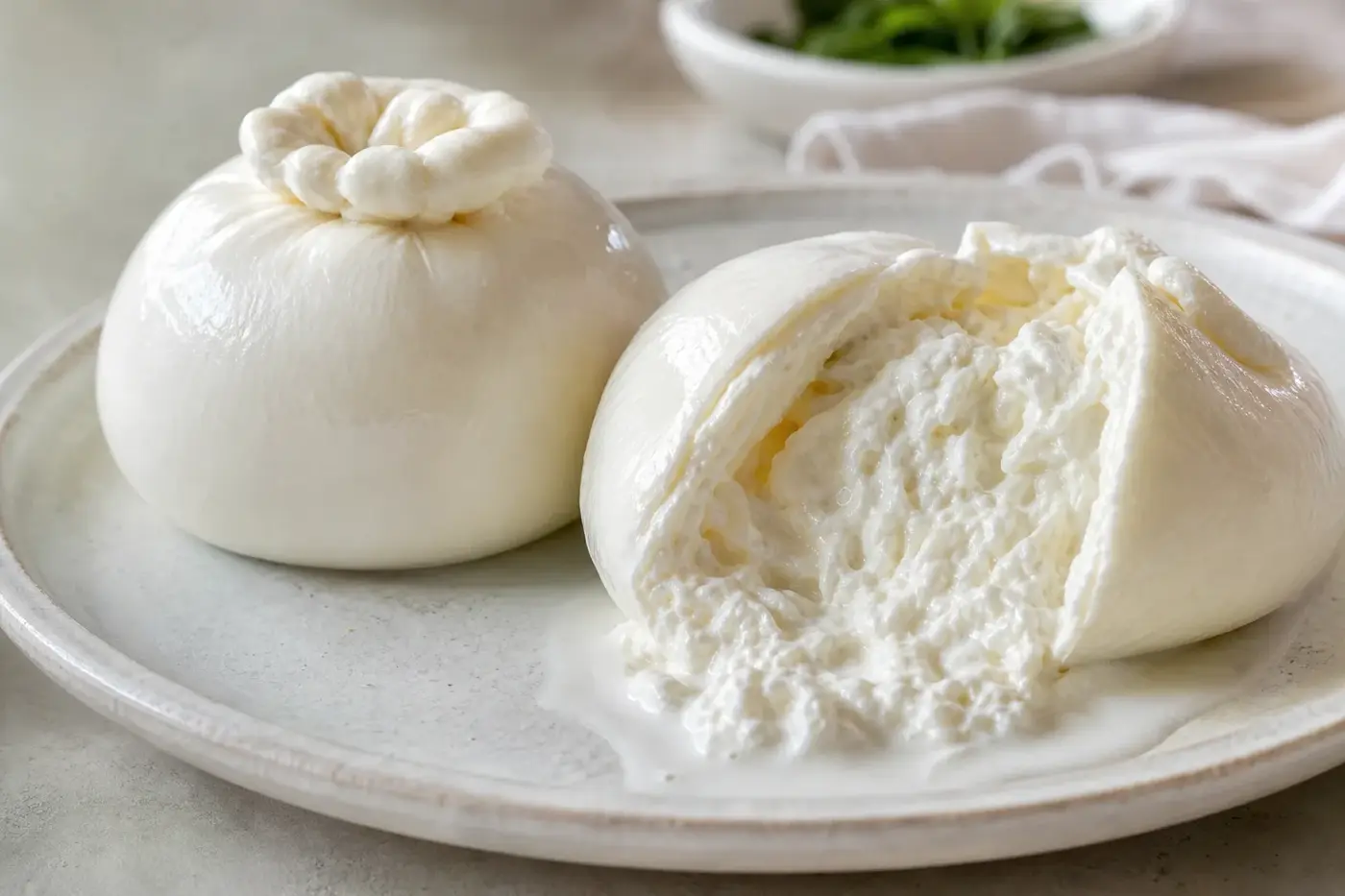
Your knife slips through the delicate pouch. Cream spills across the plate, bringing loose strands of cheese with it. This is stracciatella, burrata’s yielding heart, tucked inside a firmer stretched-curd casing. Rooted in Puglia’s fresh dairy cheesemaking tradition, burrata is made to be eaten promptly, with a structure quite unlike mozzarella’s.[1][2]
| At a glance | What you need to know |
|---|---|
| Familiar name | Burrata, a fresh, filled stretched-curd cheese.[1][5] |
| Traditional home | Puglia, particularly Andria, southern Italy.[3] |
| What makes it burrata | A stretched-curd casing filled with shredded stretched curd and cream.[1][2] |
| Milk | Commonly cow’s milk; buffalo-milk versions also exist.[1][4] |
| Related regional name | Burrata di Andria entered the EU register as a protected geographical indication, PGI, under Commission Implementing Regulation (EU) 2016/2103. Current register status: unconfirmed.[6] |
| EU registration reference | Original application: IT-PGI-0005-01393. Latest amendment reference: PGI-IT-01393-AM02.[2][3] |
| Pregnancy guidance | UK: NHS Foods to avoid in pregnancy, November 2026.[9] |
That first cut is half the pleasure
Burrata brings two forms of cheese together in one small parcel. The outside is pasta filata, meaning stretched curd: curd worked into something cohesive and pliable. Inside, strands of that cheese mingle with cream rather than becoming another solid ball. The casing holds its shape; the filling has other plans.[1][2]
That construction helps you choose between burrata and mozzarella. Cut mozzarella and you find cheese all the way through. Cut burrata and you open a container made of cheese, releasing cream and strands. A whole burrata makes that opening part of your meal; a tub of stracciatella takes you straight to the filling.[1][5]
You may hear the casing called a skin, but it is stretched cheese, not a separately developed rind. Serve both parts together. The firmer outside gives the soft strands and cream a contrasting texture, and deserves its place on your plate.[1]
Snowbound milk and a Puglian cheesemaker
Heavy snowfall left milk unable to reach town, and a cheesemaker needed a way to use it. This is the origin story preserved in the official account supporting Burrata di Andria’s geographical indication. The account places burrata’s development in the first decades of the twentieth century, while identifying the snowbound tale as oral tradition.[3]
In the telling, the cheesemaker mixed cream with pieces of stretched curd, then tucked them inside another piece of stretched cheese. The account connects the idea to mantèche, cheese casings used to hold butter. Behind the ingenuity lay a practical wish: to use dairy ingredients without waste.[3]
If you like following a food’s history, there is a publication to pursue too. The EU application identifies a reference in the 1931 Guida del Touring Club, separate from the orally handed-down story. Together, they give you the historical outline: an early twentieth-century Puglian development associated with Andria, with a traditional account explaining the filled pouch.[3]
How the cheesemaker makes a pouch hold cream
The skill lies in making stretched curd work as both container and contents. In the traditional method, heated curd is stretched until it can be shaped, then formed into an open pouch. Shredded stretched curd and cream go inside before the opening is gathered and sealed.[1][2][5]
Those two jobs call for different handling. The outer curd must stay continuous enough to hold the filling, while the inner curd is deliberately pulled into strands. Burrata di Andria’s registered description specifies hand-shredded filling. Its permitted closure can have a small gathered top rather than a large, conspicuous knot.[2]
So do not let a handsome topknot do your shopping for you. Read the description and ingredients, and look at the condition of the pack, rather than judging origin or method by the silhouette. For the wider journey from milk to curd, see how cheese is made.
Stracciatella takes you straight to the heart
Inside burrata, stracciatella brings shredded stretched cheese and cream together. The official regional description connects its name with tearing. The curd is pulled into ragged strips, which keep their individual structure in the cream.[3]
Look closely when you cut your burrata. The centre has recognisable strands, not the uniform flow of a completely smooth sauce. You get both threads of cheese and the cream surrounding them. In the registered product’s description, those threads can vary in length and width.[2]
You can buy stracciatella on its own, too. Fattoria Maccazzola describes its version as burrata’s heart sold separately, with hand-pulled mozzarella strands bound with cream.[5] Choose it when you want a spoonable topping or filling. Choose whole burrata when opening the pouch belongs to the dish.
Buying just the centre gives you more freedom with portions. Spread a spoonful across several pieces of toast, or dot it over individual plates. A whole burrata releases its filling at once when you cut it. Neither is better: one is ready to spoon, the other ready for its opening moment.
Burrata or mozzarella? Let texture decide
Fior di latte is a name used for cow’s-milk mozzarella. Fattoria Maccazzola’s descriptions make the differences clear: its fiordilatte is stretched cow’s-milk mozzarella, its burrata is a filled pouch, and its stracciatella is strands mixed with cream.[5] Picture those three structures and your choice becomes much easier.
| Cheese or name | What you get | Choose it when you want |
|---|---|---|
| Burrata | A stretched-curd pouch with a separate filling of cream and strands.[1] | A firmer casing and a centre that spills out. |
| Mozzarella | Stretched cheese without burrata’s separate cream filling.[5] | Cheese you can slice or tear throughout. |
| Fior di latte | Cow’s-milk mozzarella.[5] | Cow’s-milk mozzarella, not a burrata-style filling. |
| Stracciatella | Shredded stretched cheese mixed with cream, also sold separately.[5] | Burrata’s filling, without the pouch. |
Think of burrata as more than a softer mozzarella. Its construction decides how you portion it, how it sits on your plate and what happens at the first cut. Choose by structure and you will have a clearer idea of what each cheese brings to dinner.
Milk, cream and the pleasure of that first bite
Fresh or heated milk, butter and cream: these are the aromas named in the published description of Burrata di Andria. The same description records cream flowing out when the cheese is cut.[2] They give you useful signposts for burrata’s milky, buttery character, rather than the stronger ripened flavours of aged cheeses.
Much of the pleasure comes from texture. Your knife meets resistance from the outer layer before the centre loosens across the plate. That balance matters as much as flavour. For handling, including freshness and serving temperature, follow the maker’s instructions rather than assuming a particular effect on texture.
Cow’s milk is the familiar starting point, but buffalo-milk versions exist too. Fattorie Garofalo describes its burrata as containing buffalo-milk stracciatella made from mozzarella strips and fresh cream.[4] Read the ingredients rather than assuming every burrata has the same milk composition.
When you compare packs, look for the milk species, milk treatment and any separate details about the cream. The name on the front cannot tell you everything. If those details are missing, you have useful questions to put to your cheesemonger.
Get to know the name Burrata di Andria
Burrata names the broad style. Burrata di Andria is the regional name entered in the EU register as a PGI under Regulation (EU) 2016/2103. Its current register status is unconfirmed.[6]
The official description accompanying the 2024 amendment specifies cow’s milk, a stretched-curd casing and a filling of hand-shredded stretched curd with cream. Its production and packaging area covers the whole of Puglia, called Apulia in the English document. It is not confined to the town of Andria.[2]
Look for the complete regional designation on your pack. “Burrata” alone is not the same name. If you would like to untangle the broader difference between a cheese style and a registered geographical name, turn to protected names explained.
Buy for your meal, then follow the label
Start with your meal, not just the cheese counter. Choose a pack whose stated date fits when you plan to eat it, then read the storage conditions and instructions for use after opening. UK Food Standards Agency guidance says food with a use-by date must be used by that date. Smell and appearance cannot establish safety once it has passed.[7][8]
Read any instructions about packaging liquid too. The regional product’s published requirements allow several packaging formats, including containers with preserving liquid.[2] Liquid does not establish origin. Follow your particular pack’s directions and drain the cheese for serving, rather than treating every burrata identically.
For home storage, the FSA recommends a fridge between 0 and 5 °C in its guidance for England, Northern Ireland and Wales. Refrigerate your cheese promptly and follow the pack’s storage conditions.[7] A fridge thermometer tells you more than the position of the control dial.
Once your pack is open, follow the manufacturer’s instructions. If none are supplied, the FSA’s listeria guidance for England, Northern Ireland and Wales says to use opened foods within two days, while still observing the use-by date.[8] Planning to finish a small pack at one meal avoids an opened remainder to manage.
Set the plate for all that cream
Give burrata a shallow plate and simple company. Tomatoes, bread and olive oil make a useful starting combination: bread catches the cream and strands, while tomatoes offer contrast. Taste before adding more salt. Keep your dressing restrained enough for the milk and cream to remain noticeable.
Let the cheese lose a little fridge chill while you finish preparing the meal, without aiming for a fixed spell at room temperature. In England, Northern Ireland and Wales, the FSA advises eating ready-to-eat food shortly after refrigeration, within four hours, or two hours on a very warm day. Keep it out of direct sunlight too.[8]
Lift your burrata onto its plate and open it just before you eat. Give everyone some outer pouch as well as filling. The centre may get all the attention, but the casing has done more than hold dinner together.
For hot dishes, add burrata after cooking if you want to keep the contrast between casing and centre. Try it on finished pasta, roasted vegetables or a pizza once the pizza leaves the oven. If official guidance calls for thorough cooking, follow it. Warmth from the finished dish is not a substitute.[9]
This page summarises published guidance from the official sources it cites. It is not medical advice. Guidance differs between countries and changes over time, so check the current source for where you live, and ask your doctor, midwife, pharmacist or dietitian about your own circumstances.
Pregnancy and listeria: know the guidance
The NHS explicitly includes pasteurised burrata and mozzarella among the soft cheeses you can eat during pregnancy in the UK. Look for pasteurisation information on the packaging. Its listeriosis guidance lists unpasteurised dairy products among foods to avoid.[9][10]
Pregnant people, people with weakened immune systems and older people are among the groups the FSA identifies as at greater risk from listeriosis. Its advice includes careful refrigeration, observing use-by dates and following opened-pack instructions. Preventing contamination between raw foods and ready-to-eat foods matters too.[8]
Pasteurisation does not replace careful handling afterwards. The FSA notes that listeria can contaminate ready-to-eat foods and grow at low temperatures.[8] Follow current official advice for your country and ask your clinician about your circumstances. For the wider context, read the listeria and cheese safety guide.
Questions people ask
What is the difference between burrata and mozzarella?
Mozzarella is stretched cheese throughout. Burrata has a stretched cheese casing filled with strands of cheese and cream.
Can you eat the outside of burrata?
Yes. The outer layer is stretched cheese, not a separately developed rind. It can be served with the filling.
What is the filling inside burrata called?
It is called stracciatella and consists of shredded stretched cheese mixed with cream. Stracciatella is also sold on its own.
Can you eat burrata during pregnancy?
The NHS includes pasteurised burrata among the soft cheeses that can be eaten during pregnancy in the UK. See the NHS guidance Foods to avoid in pregnancy and check the packaging for pasteurisation.
How should burrata be stored after opening?
Follow the manufacturer's instructions. Where none are supplied, the Food Standards Agency advises using opened foods within two days while still observing the use by date; its guidance applies to England, Northern Ireland and Wales.
Sources
- Italian Ministry of Agriculture. Disciplinare di produzione della Indicazione Geografica Protetta “Burrata di Andria”, September 2023 file. Articles 2, 3 and 5. Official specification.
- European Commission. Publication of an approved standard amendment to a product specification, C/2024/1948, published 5 March 2024. Burrata di Andria, amendment PGI-IT-01393-AM02 and accompanying single document. Official publication.
- European Commission. Publication of an application pursuant to Article 50(2)(a) of Regulation (EU) No 1151/2012, 2016/C 263/05, 20 July 2016, pages 7 to 10. Historical account and original application reference. Official Journal document.
- Fattorie Garofalo. 100% Buffalo Milk Burrata, undated product description, retrieved November 2026. Producer statement about its own product. Product description.
- Fattoria Maccazzola. Products, undated catalogue, retrieved November 2026. Fiordilatte, Burrata classica and Stracciatella entries. Producer statements about its own products. Product catalogue.
- European Commission. Commission Implementing Regulation (EU) 2016/2103 of 21 November 2016 entering a name in the register of protected designations of origin and protected geographical indications [Burrata di Andria (PGI)]. Articles 1 and 2. Binding registration act.
- Food Standards Agency. How to chill, freeze and defrost food safely, published 18 December 2017, live text retrieved November 2026. Applies to England, Northern Ireland and Wales. Official guidance.
- Food Standards Agency. Listeria, published 8 January 2018, live text retrieved November 2026. Sections 1, 3 and 5; applies to England, Northern Ireland and Wales. Official guidance.
- NHS. Foods to avoid in pregnancy, live text retrieved November 2026. “Cheese, milk and other dairy”. Official pregnancy guidance.
- NHS. Listeriosis, reviewed 10 November 2023, live text retrieved November 2026. “Risks of listeriosis” and “How to avoid listeriosis”. Official guidance.
Researched from official EU publications, the Italian product specification, producer descriptions and UK public health guidance; serving suggestions are editorial recommendations.
Last checked: November 2026
Last checked November 2026.
The editors suggest you read next
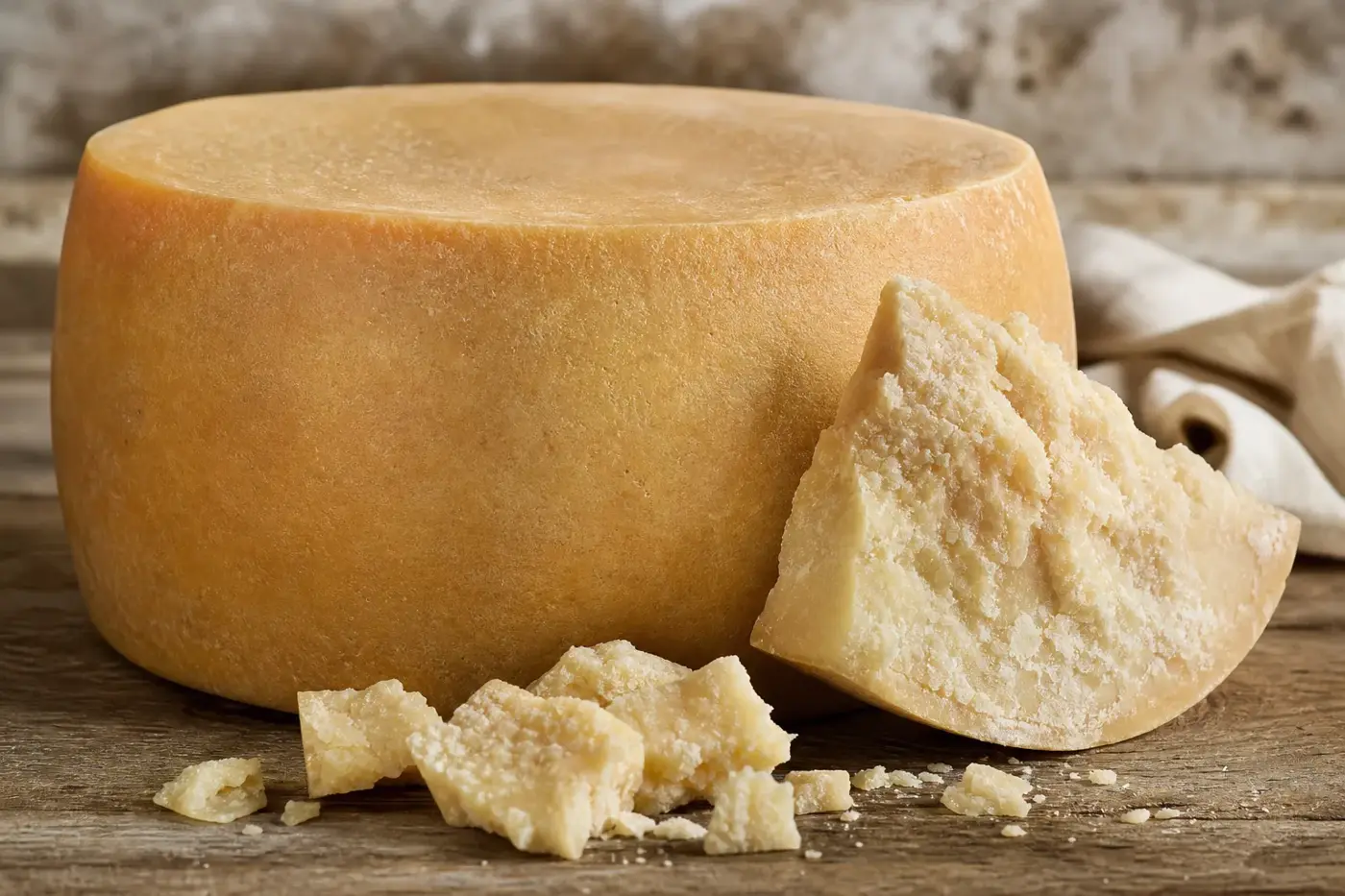
Parmigiano Reggiano
Break into a wheel of Parmigiano Reggiano and flakes fall away, revealing a finely granular cheese, pale straw to straw in colour.