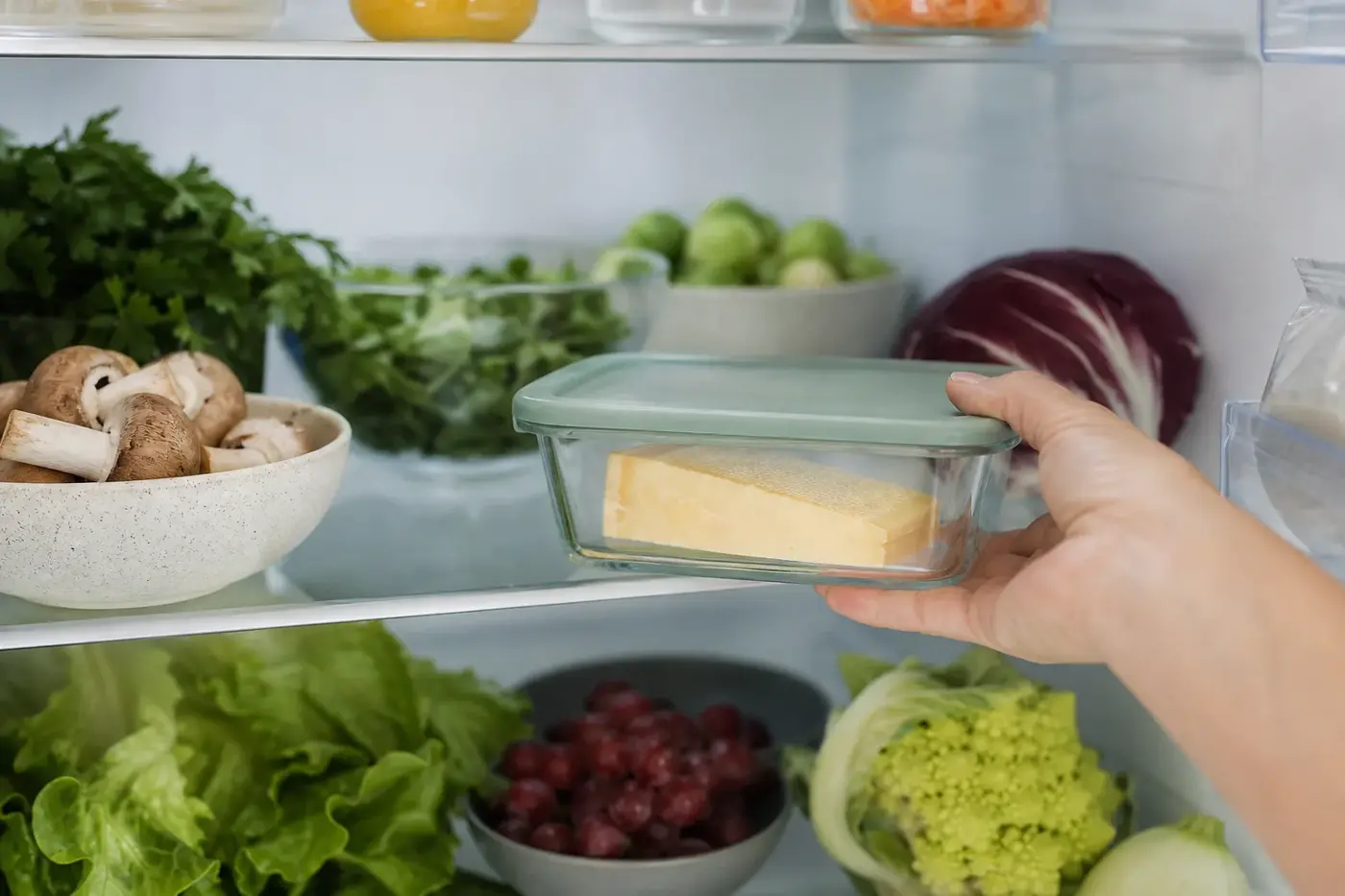
The doorbell rings. Your cheese has arrived, but its journey matters before you lift the lid: a changed delivery day can leave it sitting in a warehouse, Neal’s Yard Dairy warns.[7] A safe order begins before dispatch, with a traceable seller, clear cheese information and a plan to unpack promptly. At the doorstep, handling, packaging and dates come before appearance or aroma.[1][2]
The handling advice here comes from the FSA for England, Wales and Northern Ireland, alongside NHS guidance for England. The consumer rights section covers UK purchases. If you live elsewhere, your local authority is the place to turn for advice and remedies.[2][3][4]
Get to know the person selling your cheese
Before you settle on a cheese, find the seller’s trading name, physical postal address and working contact details. On a marketplace, check that these belong to the business taking your order, not simply the platform. The FSA’s online buying checklist recommends looking for a physical address or phone number.[1]
Buying from a UK seller? Ask which local authority registers its food business, then check with that council’s food safety team. FSA registration guidance includes online sellers. Look up the hygiene record where available, matching both trading address and name, and remember that some businesses are exempt from a rating.[1][5]
Customer feedback gives you another useful view. Read recent accounts for recurring missed deliveries, damaged wrapping or poorly handled complaints, rather than relying on the headline score. Compare several experiences and use this service check alongside the official record.[1]
Meet the cheese before you commit
Choosing is part of the pleasure. It is also where a modest cheese order can develop ambitions.
Find out the milk species, milk treatment, ingredients or allergen information, and storage instructions before choosing. Ask about anything missing, including added flavourings and accompaniments tucked into a mixed box. If the treatment terms are unfamiliar, the guide to raw milk, thermised and pasteurised cheese explains them.[3][6]
In England, Wales and Northern Ireland, FSA guidance requires allergen information before you complete an online purchase and when the food arrives. Milk and egg are among the specified allergens. Request details for every cheese, including any proposed substitution, and tell the seller about an allergy before ordering.[2][3]
Planning cheese for a later occasion? Ask how much usable life the seller expects it to have when it reaches you. Save the product description and written answers, then use the guide to reading a cheese label to compare the details on arrival.[4]
Give your cheese a well-planned journey
The packaging must suit the cheeses, the expected weather and the longest likely journey. Ask the seller how it meets those needs. FSA guidance says food needing refrigeration must stay cool in transit, with suitable insulation or coolant where needed. Postal packaging must remain intact, and delivery should be as quick as possible, ideally overnight.[2]
Get the actual dispatch day, expected arrival day and arrangements for weekends or holidays. Mention any postcode that means a longer route. For an occasion, agree a delivery early enough to resolve a problem without taking the cheese beyond its stated storage life.[2][7]
Sending a gift? Give the recipient the delivery date and storage information beforehand: a workable handover matters more than a perfect surprise. Ask for cheese names and handling instructions inside the box, so they can identify every piece without your order confirmation.[2][3]
Ask about the journey that does not go to plan
Ask three direct questions: what temperature conditions is your order packed for, how long does that protection last, and what happens after a missed delivery? Find out who monitors delays. Establish whether the seller replaces an order when its safe handling cannot be established.[2]
An extra day changes more than your diary. Neal’s Yard Dairy, a commercial cheesemonger, advises customers against changing the delivery day because cheese can be left in a warehouse. Speak to the seller before redirecting a parcel already on its way.[7]
Give the parcel a proper welcome
Choose a handover that lets someone deal with the cheese promptly. Use this comparison alongside the seller’s transport arrangements and FSA guidance on keeping chilled deliveries cool.[2][7]
| Your situation | What to arrange | What to confirm |
|---|---|---|
| Someone can receive it | Delivery to home or work | Someone can unpack and refrigerate it promptly. |
| You will be out | Another agreed day or a trusted recipient | Your recipient has storage instructions and can refrigerate it. |
| Collection is your only practical option | Collection from the seller | How your cheese will be held until you collect it. |
| A doorstep or locker is suggested | Another arrangement | Temperature control throughout the unattended period. |
Open the box promptly, then take a careful look
An insulated box is not a reason to put off unpacking. Open it promptly and work through these checks, keeping chilled cheese out for the shortest practical time.[2][8]
- Record the arrival: note the time and any delay shown by tracking. If the parcel is damaged, photograph it before opening.[7]
- Check the packaging: look for outer damage, broken inner seals, leaks and contamination. Keep questionable items separate and contact the seller.[2]
- Read the dates: use by is about safety; best before is about quality. Discard cheese delivered past its use by date.[4]
- Assess the temperature: follow the seller’s arrival instructions. If you use a food thermometer, follow its instructions and record the reading and where you took it. Ask the seller to assess any departure from its stated transport conditions.[2]
- Compare cheese with order: check identity, allergen information and storage instructions, including those for substitutions.[3]
The FSA recommends a home fridge temperature between 0 and 5 °C.[8] If cheese needing refrigeration arrives warm after an unexplained delay, do not eat it while you seek advice from the seller and the local authority’s food safety team.[2][5]
Keep the tracking record even if the box looks immaculate. An unexpected overnight stop needs explaining, so send the journey details with your photographs. Assessing the delivery means considering both its route and the condition you can observe at your door.[2][7]
Listen to the aroma, but know its limits
A few droplets, damp wrapping and a leaking container tell different stories. Describe moisture precisely when you contact the seller. Neal’s Yard Dairy’s storage advice notes that some wrapping can make cheese sweat and affect its flavour, so discuss that quality issue alongside your handling checks.[9]
If the aroma is stronger than you expected, ask whether it suits the cheese’s intended ripeness. Moisture or aroma that the seller identifies as normal is separate from a broken seal, missed refrigeration or an expired use by date. As FSA guidance stresses, you cannot see, smell or taste harmful bacteria.[4][10]
Unexpected mould needs advice specific to that cheese. The guide to mould on cheese explains the distinction between intended ripening and unwanted growth. If your product is covered by a recall, follow the official notice’s instructions.[11]
Choose for the people at your table
Before ordering a selection or gift, think about who will eat it. The FSA identifies pregnant people, older people and those with weakened immunity as groups at higher risk from listeriosis. Its guidance lists soft mould-ripened cheeses, blue-veined cheeses and products made from unpasteurised milk among foods associated with listeria.[10]
For pregnancy in England, NHS guidance (November 2026) advises against mould ripened soft cheese with a white coating, such as brie, camembert or chèvre, and soft blue cheese unless cooked until steaming hot all the way through. This applies whether the milk is pasteurised or unpasteurised. The NHS lists hard cheeses made from either pasteurised or unpasteurised milk as suitable.[6]
For babies and young children, read the NHS guidance on dairy and cheese (November 2026).[12] For other people at higher risk, consult the FSA guidance on listeria (also November 2026) and ask a healthcare professional about individual circumstances.[10] You can find further context in the listeria and cheese safety guide.
Have the fridge ready before the doorbell rings
Clear fridge space before your delivery arrives. FSA advice for England, Wales and Northern Ireland recommends a fridge between 0 and 5 °C, checked with a fridge thermometer. Refrigerate cheeses that need it promptly, keep their labels and follow each item’s storage instructions.[8]
Leave sealed products sealed until you need them, unless the seller says otherwise. Follow directions for liquid, wrapping or containers, and note the opening date if instructions specify a period after opening. Keep ready-to-eat cheese protected from raw foods and dirty packaging.[8][10]
A use by date relies on correct storage: mishandled food can become unsafe sooner. If instructions give both a use by date and an after-opening period, follow whichever limit comes first. For wrapping and containers beyond that first unpacking, turn to how to store cheese at home.[4][8]
If something is wrong, make the next step clear
Give the seller a clear account, with your order number, delivery time, tracking history and a description of the problem. Add photographs of damaged packaging, labels, batch details and the cheese. Include any temperature reading, saying when and how you measured it, and keep your order confirmation and written exchanges.[7]
Say what remedy you want, such as a replacement or refund, and ask how the seller wants the problem recorded. Disposing of unsafe food safely takes priority over keeping it as evidence. For a suspected food safety problem, ask the local authority’s food safety team how to report it.[5][7]
For UK consumer purchases, changing your mind is different from receiving faulty goods. Regulation 28(1)(c) of the Consumer Contracts Regulations 2013 excludes goods liable to deteriorate or expire rapidly from the cancellation provisions. That exception depends on the goods: buying cheese online does not automatically give you an unrestricted change-of-mind return right.[13]
Faulty goods come with separate rights. The Consumer Rights Act 2015 requires satisfactory quality and conformity with the description, and GOV.UK explains that faulty or misdescribed goods attract refund rights. Act promptly: section 22(4) shortens the usual short-term rejection period where goods can reasonably be expected to perish sooner.[14][15]
General information only, not medical advice: follow the official guidance where you live.
Questions people ask
How can I check whether an online cheese seller is legitimate?
Find the seller’s trading name, physical postal address and working contact details. For a UK seller, ask which local authority registers the food business and check the details with that council’s food safety team.
What should I do if my cheese arrives warm after a delay?
If it needs refrigeration and arrives warm after an unexplained delay, do not eat it while seeking advice from the seller and the local authority’s food safety team. Keep the tracking record and share the journey details with the seller.
Can I tell whether delivered cheese is safe by smelling it?
No. The FSA stresses that harmful bacteria cannot be seen, smelt or tasted. Ask the seller whether an unexpectedly strong aroma matches the cheese’s intended ripeness, and check handling and dates separately.
Which cheeses does the NHS advise against during pregnancy?
For pregnancy in England, the NHS advises against mould ripened soft cheese with a white coating and soft blue cheese unless cooked until steaming hot all the way through. It lists hard cheeses made from pasteurised or unpasteurised milk as suitable. See the NHS guidance on foods to avoid in pregnancy at https://www.nhs.uk/.
Can I return cheese bought online if I change my mind?
An online cheese order does not automatically carry an unrestricted change of mind return right, because goods liable to deteriorate or expire rapidly are excluded from the cancellation provisions. Faulty goods have separate rights, and GOV.UK explains that faulty or misdescribed goods attract refund rights.
Sources
- Food Standards Agency. Advice for buying food online, version 1, December 2016. Used for seller identity, address, hygiene-rating checks and customer feedback. Source PDF.
- Food Standards Agency. Starting a food business, live web edition retrieved November 2026, sections “Allergen information for food deliveries” and “Food delivery protocol”. Official guidance.
- Food Standards Agency. Food allergen labelling and information requirements technical guidance, updated 3 November 2026, particularly paragraphs 86 to 87 and 103 to 104. Applies to England, Northern Ireland and Wales. Official guidance.
- Food Standards Agency. Understanding food labelling: Best before and use-by dates, live web edition retrieved November 2026. Official guidance.
- Food Standards Agency. Food business registration, updated 25 June 2026. Official guidance.
- NHS. Foods to avoid in pregnancy, reviewed 15 June 2026, section “Cheese, milk and other dairy”. Official pregnancy guidance, checked November 2026.
- Neal’s Yard Dairy. Delivery & Returns, undated live web edition retrieved November 2026. A commercial seller’s account of its own arrangements, used for the attributed warehouse example and practical delivery synthesis. Seller’s guidance.
- Food Standards Agency. How to chill, freeze and defrost food safely, published 18 December 2017, live edition retrieved November 2026. Applies to England, Northern Ireland and Wales. Official storage guidance.
- Neal’s Yard Dairy. FAQs, undated live web edition retrieved November 2026, sections on arrival and cheese storage. A commercial seller’s own advice. Seller’s FAQs.
- Food Standards Agency. Listeria, undated consumer guidance, PDF edition retrieved November 2026. Official guidance PDF, checked November 2026.
- Food Standards Agency. Alerts, live food and allergy alerts index, November 2026. Official alerts.
- NHS. Dairy and alternatives in your diet, live web edition retrieved November 2026, sections on cheese and children’s diets. Official guidance, checked November 2026.
- UK legislation. The Consumer Contracts (Information, Cancellation and Additional Charges) Regulations 2013, SI 2013/3134, regulation 28(1)(c), official text retrieved November 2026. Regulation 28.
- UK legislation. Consumer Rights Act 2015, sections 9, 11 and 22, official texts retrieved November 2026. Section 9, section 11, section 22.
- GOV.UK. Accepting returns and giving refunds: the law, live web edition retrieved November 2026. Official guidance.
This piece was researched from official consumer guidance and legislation, with attributed cheesemonger guidance used for delivery and condition examples.
Last checked: November 2026
Last checked November 2026.
The editors suggest you read next