Caws Chwaral
Step inside a converted Catholic church on Bethesda’s High Street and you find a creamery and a cheese counter.
Step inside a converted Catholic church on Bethesda’s High Street and you find a creamery and a cheese counter. Here in Gwynedd, Cosyn Cymru makes Caws Chwaral, a name it translates as “Quarry Cheese”.[1,2]
Behind the name is a distinctive turn on a Caerffili recipe: unpasteurised sheep’s milk, traditional lamb’s rennet and several months of natural ripening. The maker calls it a slow-aged interpretation of the Welsh territorial tradition. Your patience is not required for quite as long as the cheesemaker’s.[1,2]
Get acquainted with Caws Chwaral
| What you might ask | What to know |
|---|---|
| Name | Caws Chwaral.[1] |
| Maker | Cosyn Cymru.[1] |
| Made at | Llaethdy Gwyn, Bethesda, Gwynedd, Wales.[2,3] |
| Milk | Unpasteurised sheep’s milk.[1] |
| Rennet | Traditional lamb’s rennet.[1] |
| Wheel size | 5 to 6 kg.[1] |
| Usual ageing | 2 to 5 months.[1] |
| Rind | Naturally ripened.[1] |
| Registered name, authority and register ID | Status unspecified |
| Protection by jurisdiction | EU: Unspecified; Great Britain: Unspecified; Northern Ireland: Unspecified; Switzerland: Unspecified; United States: Unspecified |
A Welsh name with a Bethesda address
“Quarry Cheese” gives you more than a broad Welsh address. Its home is Llaethdy Gwyn on Bethesda’s High Street, in Dyffryn Ogwen, where Cosyn Cymru makes sheep’s milk cheeses and yoghurt.[1,2]
The maker’s English translation of Caws Chwaral connects its Welsh identity to this particular working community. Keep Bethesda in mind as you get to know the cheese. The place belongs in the story as much as the recipe does.[1,2]
Come inside the church dairy
Cheesemaking and the retail counter share that converted Catholic church. Cosyn Cymru describes a purpose-built creamery and shop, with cheeses made by hand in small batches. You find production in the town itself, rather than tucked away at a distant dairy.[2]
The maker’s approach began with experiments on a family farm, followed by work at a small farm dairy in the Auvergne. Today, it describes responding to the milk rather than treating every batch identically. Local farms, seasonal pasture and weather all have a say in what happens next.[3]
Follow the milk back to the farm
Caws Chwaral starts with unpasteurised sheep’s milk.[1] Cosyn Cymru describes sourcing milk from individual local farms. If you would like to know the supplier behind your particular batch, ask the maker.[3]
One farming relationship comes with a date and a place. In July 2021, Business Wales reported that a farmer at Llanerchymedd on Anglesey supplied sheep’s milk to Cosyn Cymru. That Welsh Government account records a historical link in the local supply network; the maker’s current account speaks more broadly of local farms.[3,4]
For help untangling the milk terminology, start with raw, thermised and pasteurised cheese. It explains the different treatments.
Start with Caerffili, then leave room for difference
Think Caerffili, but give this cheese room to be itself. Cosyn Cymru places Caws Chwaral among its hard cheeses and describes the recipe as slow-aged Caerffili. Sheep’s milk and extended ripening shape this interpretation of a Welsh territorial recipe.[1]
That gives you a starting point, not a promise of identical character. A closer comparison depends on the particular Caerphilly you put alongside it. The maker’s description establishes inspiration and approach, rather than equivalence with another cheese.[1]
Give the wheel time to become itself
The maker names unpasteurised sheep’s milk and traditional lamb’s rennet, followed by natural maturation.[1] For the individual steps between milk and pressing, you will need the maker’s recipe.
You can follow the broader journey in how cheese is made, which explains curd formation, whey drainage and shaping. Whey is the liquid separated from the curd. Those stages give you the vocabulary for understanding a pressed cheese, while Caws Chwaral’s particular recipe remains with its maker.
The usual ageing period is 2 to 5 months.[1] Ask the maker for details of the maturation conditions, or how the rind and paste change during that time.
Take a closer look at rind and cut face
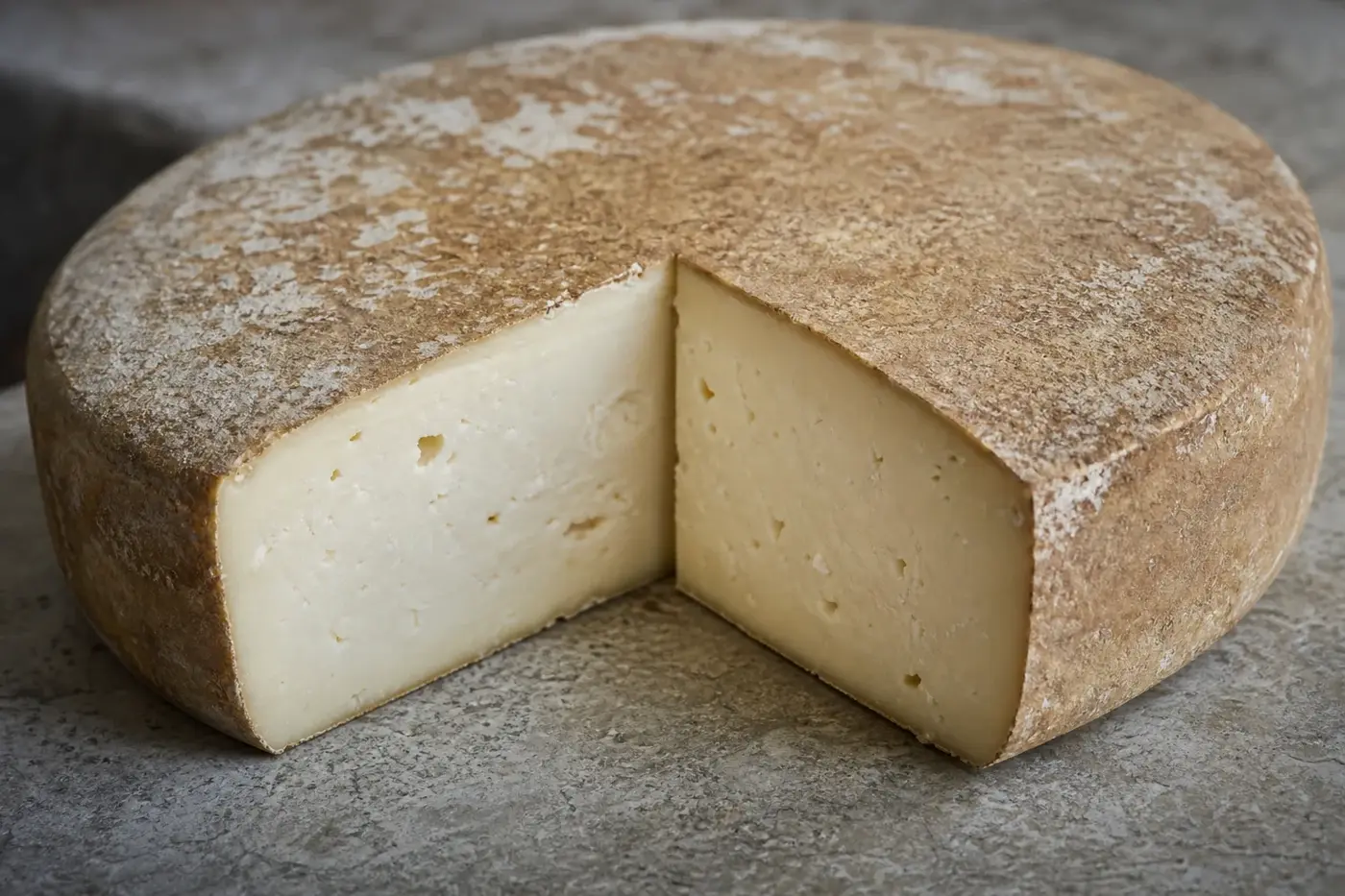
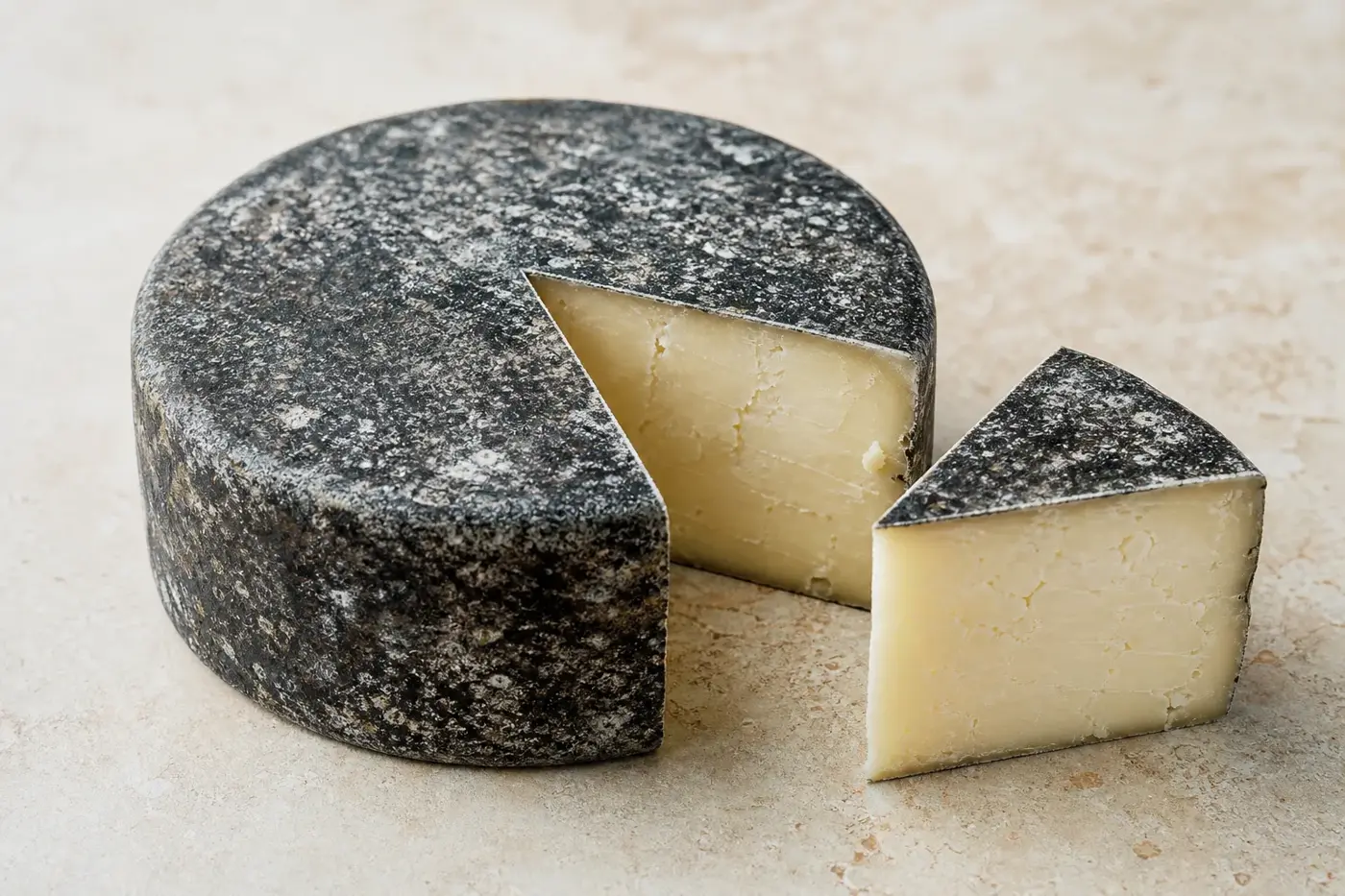
In the photograph accompanying the maker’s description, you can see a broad, round wheel with a low profile. Its uneven exterior is earthy in colour, with pale surface patches. The cut piece reveals a much lighter, ivory-coloured interior: close-textured, with a few small openings rather than conspicuous large holes.[5]
That is what the photograph shows, rather than a tasting note. Aroma, flavour and eating texture need a reliable product description or a recorded tasting. A photograph can only take your appetite so far.[5]
Let the cheese lead on the plate
Begin with a piece of cheese, plain bread or an unsweetened cracker, and water. Keep accompaniments separate, then add as much or as little as you like. Fresh apple or pear gives you a useful second comparison, bringing crisp texture without chutney covering every mouthful.
On a cheeseboard, give Caws Chwaral its own space. Avoid surrounding it with several strongly flavoured accompaniments, and cut a modest amount first, replenishing as needed. This lets you discover the character of your particular wheel, with bread and fruit as companions rather than distractions.
Give your piece a good home
Follow the storage instructions on the packaging. In England, Wales and Northern Ireland, the Food Standards Agency advises a domestic fridge temperature between 0 and 5 °C. It also advises keeping chilled food outside refrigeration for the shortest possible time during preparation, with a maximum of four hours.[6]
Check the current official guidance alongside the instructions supplied with your cheese. If your piece was cut and wrapped at the counter, ask the seller for storage and use instructions. For broader handling advice, turn to how to store cheese at home.
Follow your curiosity a little further
- How to Tell Cheese Styles Apart: Milk, Rind, Texture and Method: get comfortable with the terms used to describe your cheese.
- Rennet Explained: Animal, Microbial and Fermentation Produced: take a closer look at the ingredient named in the maker’s recipe.
General information only, not medical advice: follow the official guidance where you live.
Questions people ask
What milk and rennet are used in Caws Chwaral?
Caws Chwaral is made from unpasteurised sheep’s milk. Its maker uses traditional lamb’s rennet.
Is Caws Chwaral a Caerffili cheese?
Cosyn Cymru describes Caws Chwaral as a slowly aged interpretation of Caerffili. Caerffili is its starting point, but that does not mean it has an identical recipe or character.
How long is Caws Chwaral aged?
Caws Chwaral is usually aged for 2 to 5 months. It has a naturally ripened rind.
What does Caws Chwaral taste like?
The page does not give a verified description of its flavour, aroma or eating texture. In the maker’s photograph, the cut face is ivory coloured and closely textured, with a few small openings.
How should I store Caws Chwaral?
Follow the packaging instructions, or ask the seller for storage and use instructions if it was cut and wrapped at the counter. In England, Wales and Northern Ireland, the Food Standards Agency advises keeping a domestic fridge between 0 and 5 °C; check its current guidance alongside the cheese’s instructions.
Sources
-
Cosyn Cymru, “Products”, undated live edition, retrieved November 2026. The Caws Chwaral entry supplies the translation, milk treatment, rennet, format, maturation period and relationship to Caerffili.
Read at cosyn.cymru -
Cosyn Cymru, “Cosyn Cymru”, English homepage, undated live edition, retrieved November 2026. Describes the converted church, creamery, shop and small-batch production in Bethesda.
Read at cosyn.cymru -
Cosyn Cymru, “About us”, undated live edition, retrieved November 2026. Gives the cheesemaker’s account of training, local farm sourcing and responses to seasonal milk. These are the maker’s statements.
Read at cosyn.cymru -
Business Wales, Welsh Government, “New sheep milk venture hopes to shake-up the market”, 9 July 2021. Records a sheep’s milk supply relationship with Cosyn Cymru at that date.
Read at businesswales.gov.wales -
Cosyn Cymru, photograph accompanying the Caws Chwaral product entry, undated photograph, retrieved November 2026. Used only for visible appearance, not flavour, aroma or handling texture. Publication permission has not been established.
Read at cosyn.cymru -
Food Standards Agency, “How to chill, freeze and defrost food safely”, published 18 December 2017, live edition retrieved November 2026. The page expressly applies to England, Northern Ireland and Wales.
Read at gov.uk -
Specialist Cheesemakers Association, “James Aldridge Memorial Award”, undated live winners’ list, retrieved November 2026. Consulted to distinguish recognition for another Cosyn Cymru cheese from recognition for Caws Chwaral.
Read at specialistcheesemakers.co.uk
Researched through the maker’s English and Welsh pages, its product photograph, a dated Welsh Government supplier report and official food-storage guidance, with award attribution checked separately.
Last checked: November 2026
Last checked November 2026.
The editors suggest you read next
Caerphilly
Your knife meets a rind-ripened Caerphilly, and one wedge offers two pleasures: a fresh, crumbly centre and a softer, creamy layer just beneath the rind.