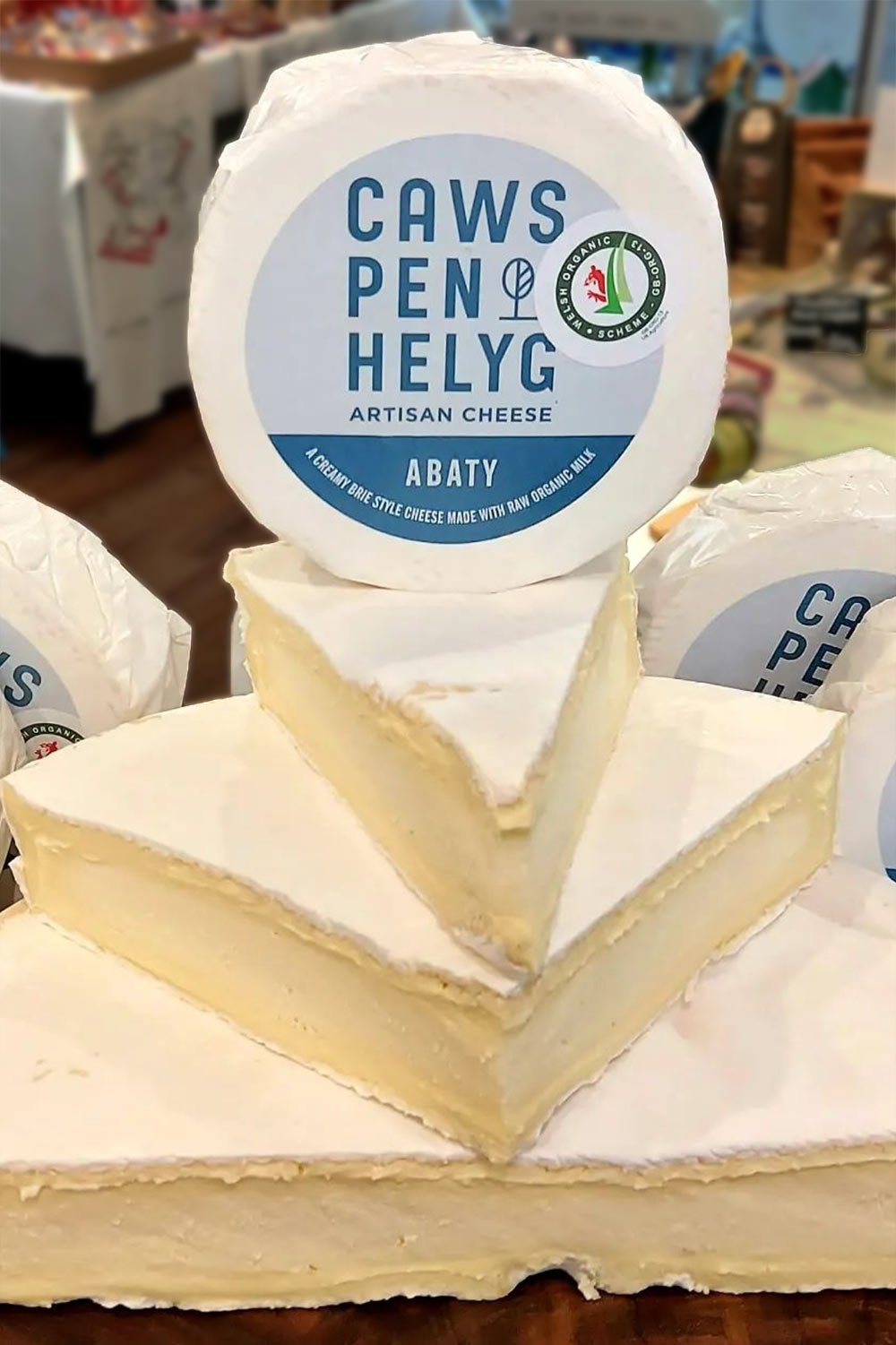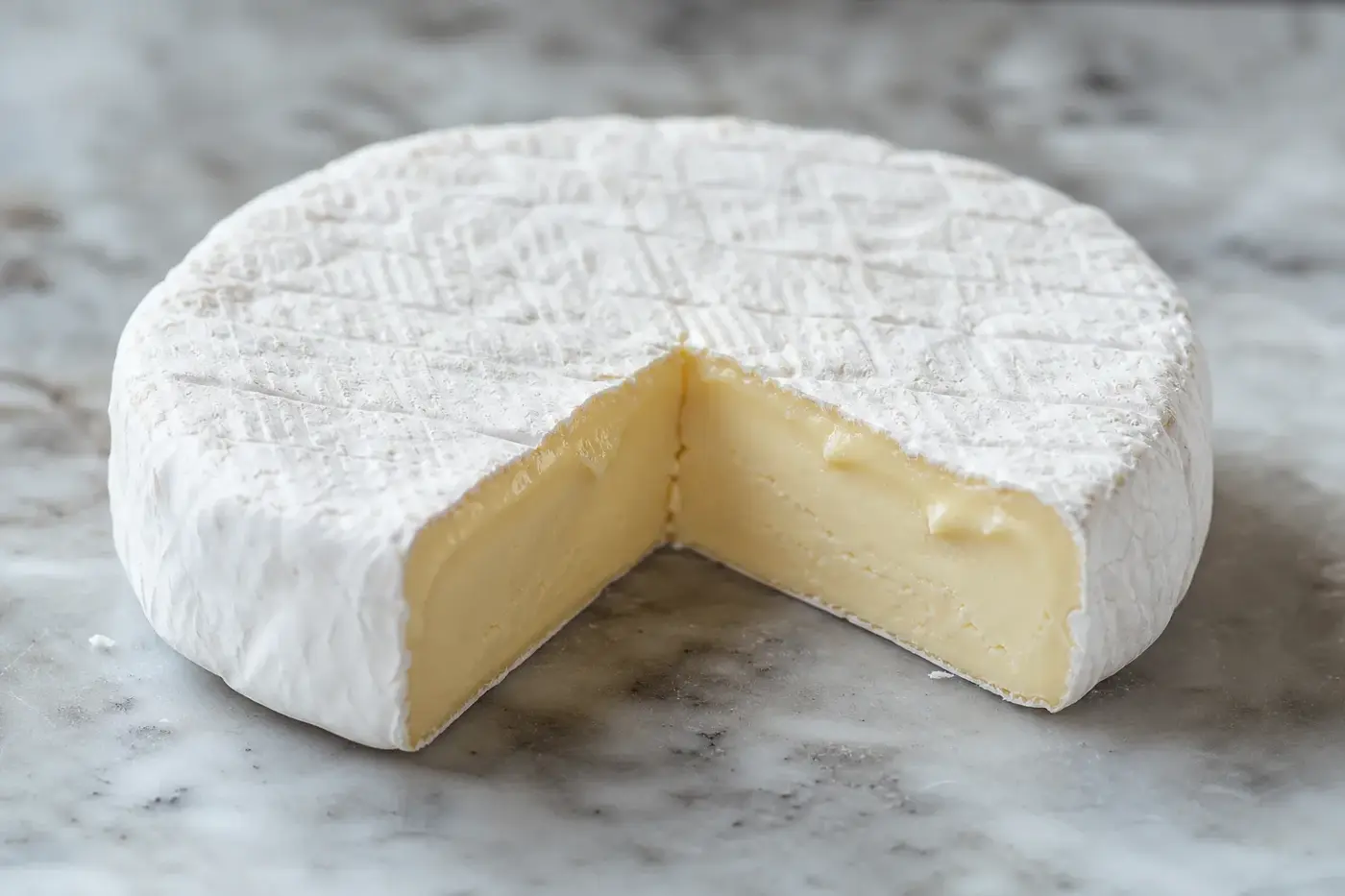
Cut through Abaty’s white rind and you reach a pale, yielding centre. Behind that inviting slice sits a very particular Welsh story: raw milk from one herd, made into a soft, Brie-style cow’s milk cheese by Caws Penhelyg near Aberystwyth in Ceredigion, Wales. You may recognise the shape. Its roots deserve a closer look. [1, 2, 3]
Your first look at Abaty
| What you want to know | The detail |
|---|---|
| Name | Abaty. [1] |
| Maker | Caws Penhelyg. [1] |
| Home | Near Aberystwyth, Wales. [1] |
| Style | Soft, Brie-style cheese. [1, 3] |
| Milk | Raw cow’s milk from a single herd belonging to the Jenkins family, as identified by the maker. [1, 3] |
| Appearance | White rind; pale cream to yellow paste in the maker’s photographs. [2] |
A small Welsh dairy with its own character
At Caws Penhelyg, cheese is made by hand, on the small scale of a micro-dairy. Abaty shares its home with Abaty Glas, the maker’s soft blue cheese. If you are after the Brie-style cheese, look for Abaty on the label. Its blue companion is a different cheese, not an alternative spelling. [1]
“Welsh Brie” gives you a useful first impression, but only part of the picture. The dairy near Aberystwyth and the herd supplying its milk give Abaty a more precise identity. Brie-style names the family resemblance; Abaty names the cheese; Caws Penhelyg names the people making it. [1, 3]
Those distinctions are worth remembering when you want another piece. For your first encounter, picture a soft cheese with a surface rind, rather than something hard for grating or threaded with blue veins. The broader guide to Brie introduces the family while keeping the style distinct from the individual cheese.
Follow the milk back to one herd
Abaty’s milk comes from the Jenkins family. Caws Penhelyg describes it as raw milk from a single herd. The Welsh Cheese Company, a stockist linked from the maker’s website, lists Abaty as an unpasteurised cow’s milk cheese. [1, 3]
Each phrase tells you something different. “Cow’s milk” identifies the animal species, “raw” or “unpasteurised” describes the milk treatment, and “single herd” explains the supply. Read together, they give you a picture of the starting material and its connection to the dairy. [1, 3]
For a closer look at milk treatments, turn to the guide to raw, thermised and pasteurised cheese. When you buy Abaty, keep its label or the cheesemonger’s information with your portion. That is especially useful if your wedge has been cut from a larger cheese.
There is more to that white rind
Look at the maker’s photographs and you will see a continuous white surface around round cheeses and cut wedges. Inside sits the paste: the cheesemaking word for the body of the cheese. That rind is more than wrapping, and Caws Penhelyg confirms that the cheese is handmade using raw milk. [1, 2]
| Part of the making | What you can learn about Abaty |
|---|---|
| Milk supply | Raw milk from the Jenkins family’s single herd. [1] |
| Scale | Handmade at a micro-dairy. [1] |
Why linger over the boundary between rind and paste? Research into related surface-ripened cheeses helps explain its importance. A 1996 Camembert study followed milk protein breakdown using electrophoresis, a laboratory method for separating proteins, alongside peptide analysis. Later breakdown progressed from the surface towards the centre. [4]
Another study, published in the Journal of Dairy Research in 2004, followed two controlled cheesemaking trials. These used pasteurised milk and a defined mixture of ripening organisms. Researchers measured microbial growth, acidity and protein breakdown, finding stronger measures of breakdown at the rind than in the centre. [5]
Those studies help explain the different textures you can encounter within this cheese family. Ripening can affect the outside and centre differently, leaving one part of a wedge softer than another. For the wider journey from setting milk into curd through draining to maturation, read how cheese is made. [4, 5]
Look closely, then let the cheese speak
In one photograph, Abaty’s cut faces stand clean and upright. In another, a softer-looking band sits beneath the rind. Across the maker’s images, you can see a white exterior and an interior ranging from pale cream to yellow: useful clues when you meet a piece at the counter. [2]
Caws Penhelyg calls Abaty creamy; the Welsh Cheese Company describes its texture as gooey. Both suggest a yielding cheese, but the photographs give you a good question for your cheesemonger: what is this particular piece like? A neat-slicing wedge and a softer portion offer different ways to enjoy it. [1, 2, 3]
Start with a small piece of paste, without bread or accompaniments. Does it hold together, spread readily or coat your mouth? Then taste a little rind with the paste. A heavily garnished cracker can wait its turn.
Give your nose a moment, too. Smell the cut face, then the rind, and choose words that fit the piece in front of you. A short note about aroma, firmness and finish will help you choose your next portion more than a bare verdict of “liked it”.
The dairy’s Royal Welsh Show moment
Caws Penhelyg won Best Organic Dairy Product at the 2022 Royal Welsh Show. The maker reports the award, and the awarding organisation’s published dairy results confirm it. Those results identify the entry by catalogue number rather than cheese name. [1, 6]
The dairy also appears elsewhere in the results, with first and third places in the farmhouse cow’s milk cheese class. It took first and second places in the soft cheese class without additives, too. These awards recognise the producer; the results do not name Abaty as the cheese receiving them. [6]
Make room for Abaty in the fridge
Keep Abaty refrigerated and follow the instructions supplied with it. For home storage in England, Northern Ireland and Wales, the Food Standards Agency advises a fridge temperature between 0 and 5 °C (32 to 41 °F), measured with a fridge thermometer. Return the cheese to the fridge after serving, and keep any instructions supplied with a cut portion. [7]
Read the words beside the date carefully. UK government guidance distinguishes a use-by date, which concerns safety, from a best-before date, which concerns quality. Do not eat food after its use-by date, even if it looks and smells satisfactory. [8]
For questions about quality and maturity, compare your cheese with the maker’s photographs and ask the seller something specific. “Will this piece slice neatly, or is it soft enough to spread?” explains how you want to serve it. That gives them more to work with than simply asking whether it is ripe.
If you suspect a safety problem, do not eat the cheese. Throw it away or follow any recall notice; take questions about quality to the seller. For help distinguishing expected cheese mould from unwanted growth, see mould on cheese. For wrapping and fridge organisation, turn to storing cheese at home.
Give Abaty the plate, not a crowd
Begin with Abaty, plain bread and one restrained accompaniment. Give yourself a chance to notice the difference between rind and paste before adding sweetness, acidity or seasoning. Keep chutney, fruit preserves and strongly flavoured crackers on the side, so everyone can choose how much to add.
Take out only the portion you expect to eat, not your whole supply. Under FSA guidance for England, Northern Ireland and Wales, chilled food should spend the shortest possible time outside the fridge during preparation, with a maximum of four hours. Separate heatwave guidance says to discard perishables left out for more than two hours in hotter than usual weather. [7, 9]
Use that limited serving period to arrange your bread and accompaniments, rather than leaving the cheese out for an extended display. In warm weather, bring out small portions as you need them. Follow any shorter handling instructions supplied with the cheese. [7, 9]
To give both rind and paste their moment, try this simple tasting:
- Choose a small wedge with both rind and paste.
- Look at the cut face before spreading it. Notice any differences between the centre and the area beneath the rind.
- Taste the paste first, then take a bite with rind.
- Add plain bread, followed by one accompaniment.
- Note which combination you would choose again, including the cheese’s texture when served.
A few slices of apple or pear, or a little fruit preserve served separately, make a simple starting point. Try a small amount with one bite, then return to the cheese alone. Which do you prefer? There is no obligation to give every mouthful a supporting cast.
For an alcohol-free drink, start with still water. Then try an unsweetened apple drink if you fancy a fruit accompaniment in the glass. Keeping your first tasting simple helps you decide what you want from a pairing. The wider cheese and wine pairing guide offers a framework for exploring other combinations.
General information only, not medical advice: follow the official guidance where you live.
Questions people ask
What is Abaty cheese?
Abaty is a soft, Brie style cow’s milk cheese made by Caws Penhelyg near Aberystwyth in Ceredigion, Wales. It has a white rind and a pale, yielding centre.
Is Abaty made with pasteurised milk?
No. Caws Penhelyg says Abaty is made with raw milk from a single herd, and the Welsh Cheese Company lists it as an unpasteurised cow’s milk cheese.
Is Abaty the same as Abaty Glas?
No. Abaty Glas is the maker’s soft blue cheese, while Abaty is the Brie style cheese. Look for Abaty on the label when choosing the latter.
What does Abaty look and feel like?
The maker’s photographs show a white rind and an interior ranging from pale cream to yellow. Caws Penhelyg describes Abaty as creamy, while the Welsh Cheese Company calls its texture gooey.
How should Abaty be stored?
The Food Standards Agency advises a fridge temperature between 0 and 5 °C for home storage in England, Northern Ireland and Wales. Check the Food Standards Agency’s current guidance and follow the instructions supplied with the cheese.
Sources
- Caws Penhelyg, Welcome, undated English-language maker page, current version retrieved November 2026. Maker’s page.
- Caws Penhelyg, Abaty-brie-style-welsh-cheese.jpg and Abaty-welsh-soft-cheese.jpg, undated product photographs linked from its English-language page, retrieved November 2026. First photograph; second photograph.
- The Welsh Cheese Company, Caws Penhelyg Abaty, undated retailer description, current version retrieved November 2026. Commercial stockist linked by the maker; its texture description is attributed. Product description.
- Nippon Shokuhin Kagaku Kogaku Kaishi, Proteolysis in Camembert Cheese during Ripening, volume 43, issue 6, pages 703 to 711, 1996. Published abstract retrieved November 2026. Research record.
- Journal of Dairy Research, Controlled production of Camembert-type cheeses. Part I: Microbiological and physicochemical evolutions, volume 71, issue 3, pages 346 to 354, 2004. Published abstract retrieved November 2026. Research record.
- Royal Welsh Agricultural Society, Dairy Produce Results 2022, 2022. Classes 4, 28 and 70. Official results.
- Food Standards Agency, How to chill, freeze and defrost food safely, published 18 December 2017, current retrieved version November 2026. Applies to England, Northern Ireland and Wales. Official guidance.
- GOV.UK, Understanding food labelling: Best before and use-by dates, current version retrieved November 2026. Official guidance.
- Food Standards Agency, Food safety in a heatwave, advice for consumers, published 27 June 2024, current retrieved version November 2026. Applies to England, Northern Ireland and Wales. Official guidance.
Researched from the maker’s current website and photographs, attributed stockist descriptions, official competition results, published research abstracts and official food-handling guidance.
Last checked: November 2026
Last checked November 2026.
The editors suggest you read next
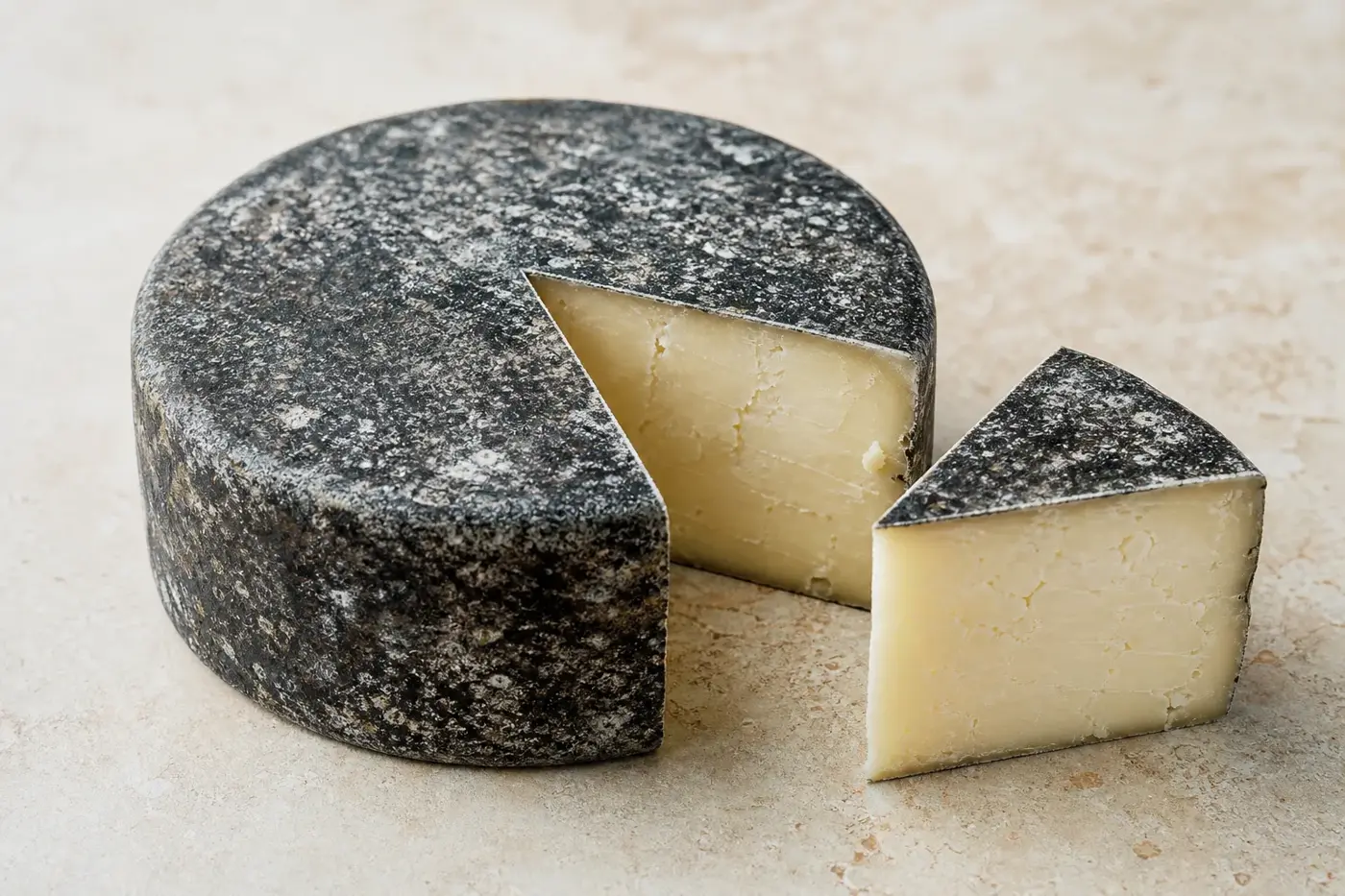
Caerphilly
Your knife meets a rind-ripened Caerphilly, and one wedge offers two pleasures: a fresh, crumbly centre and a softer, creamy layer just beneath the rind.