Cheddar vs Gouda: Taste, Texture and How to Use Each
Bite into a long-aged Gouda and, beneath your teeth, something crunches.
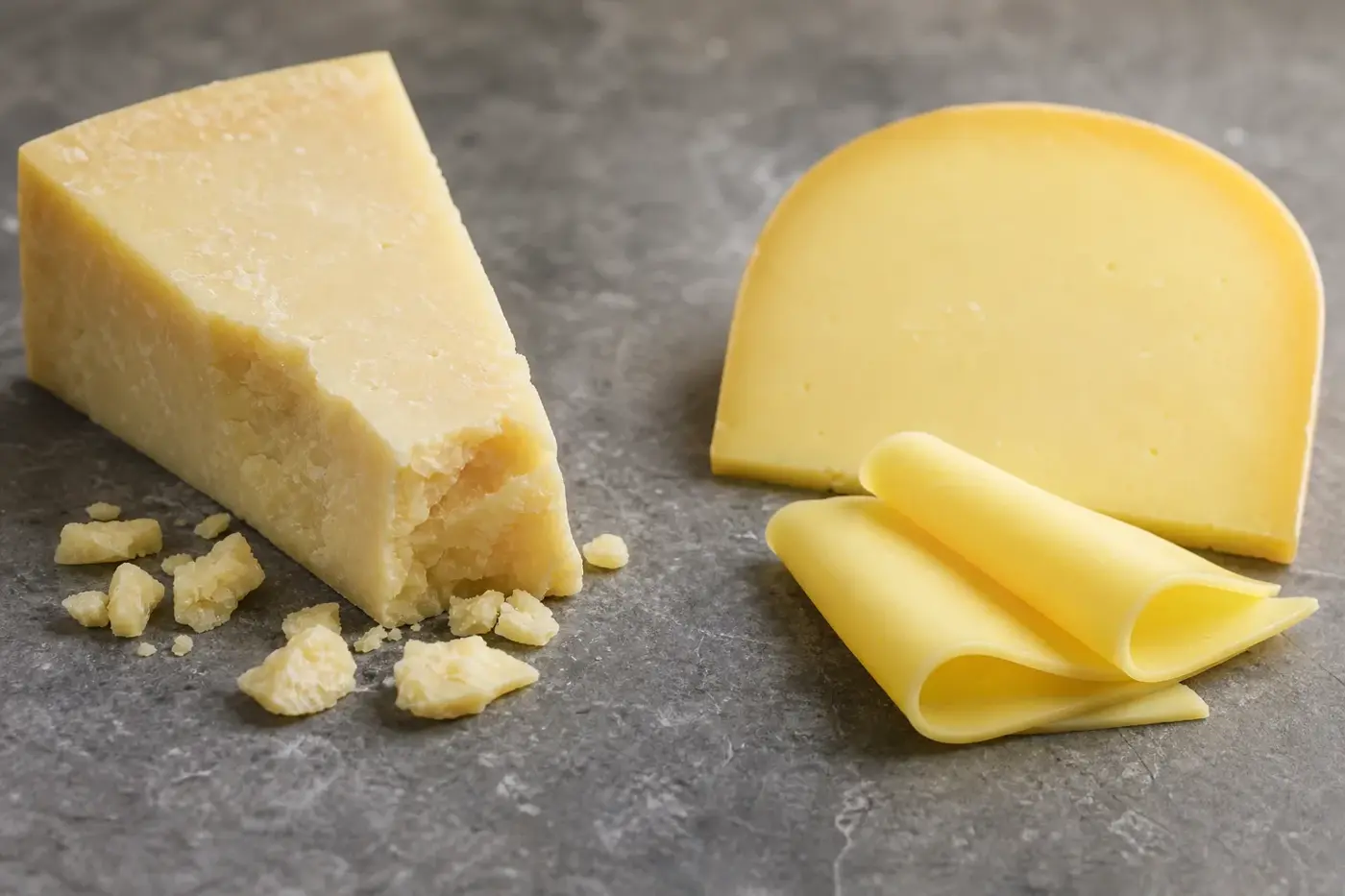
Bite into a long-aged Gouda and, beneath your teeth, something crunches. Those crystals can be tyrosine, an amino acid researchers identified using powder X-ray diffraction.[7] Quite a journey for a cheese that begins mild and supple. Cheddar travels too, from gentle sandwich companion to something sharp, deeply savoury and ready to crumble.[1][2]
For a quick choice, follow your appetite: Cheddar for tang and savoury emphasis, young Gouda for a gentler, sweeter beginning. Then ask about age. An old Gouda can be firm, concentrated and crystalline, far removed from the yielding slices of its youth.[1][2]
Start with a bite: tang, sweetness and surprises
With Cheddar, look first for acidity and savoury depth. You will often hear “sharp”, though the American Cheese Society’s sensory lexicon gives that word no single agreed definition. Acidity commonly contributes, alongside other flavours. The lexicon also identifies a sulphurous note in aged Cheddar, reminiscent of boiled egg or struck matches.[6]
Gouda often arrives more gently. Dairy Farmers of Wisconsin describes younger examples as mild, with sweetness, tang and a more caramel-like character emerging as they age. That is the progression in its published style guidance, not a promise that every Gouda will taste alike.[2]
Both names leave room for plenty of variation in producer, age and character, as Wisconsin’s dairy industry body makes clear. For a useful comparison, taste plain cheeses of reasonably similar maturity alongside each other. Otherwise, your young sandwich Gouda and long-aged farmhouse Cheddar are being judged as much on their birthdays as their style.[1][2]
There is overlap, too. The West Country Farmhouse Cheddar specification describes a rounded, nut-like flavour with a little sharpness, rather than aggressive acidity. Gouda Holland’s specification allows flavour to move from mild to strong with age. Choose the cheese in front of you, not just the name on its label.[4][5]
Watch the slabs: the work that shapes Cheddar
Picture the drained curd before a traditional Cheddar is pressed. Curd is the solid material formed when milk sets; whey is the liquid that separates from it. Once the whey has drained, the cheesemaker begins a deliberate sequence of work.[3][4]
First, the curd joins into a mass and is cut into slabs. The cheesemaker turns and stacks them repeatedly as acidity develops and more whey drains away. The American Cheese Society explains that stacking also holds warmth and makes the mass more uniform, leaving fewer pockets of trapped whey.[3]
Next comes milling. The slabs are cut or torn into smaller pieces so salt can be distributed more evenly, before the curd goes into moulds for pressing. Drainage, acid development and milling all help build the cheese’s eventual body. There is much more happening here than making curd fit a mould.[3]
For West Country Farmhouse Cheddar, those slabs must be turned and stacked by hand. The published specification explicitly requires it, keeping that work in the cheesemaker’s hands. This requirement belongs to the regional product; across the wider Cheddar family, equipment and handling can differ.[4]
Step up to the Gouda vat
Gouda’s gentler beginning owes much to washing the curd. For many Goudas, some whey is removed and water added while the curd is still being worked inside the vat. If you are picturing someone washing a finished cheese’s outside, think earlier. This happens before there is a finished cheese to handle.[3][11]
The important ingredient being reduced is lactose, the milk sugar that starter bacteria can turn into lactic acid. The American Cheese Society explains that washing removes lactose and some minerals. How long the curd remains in contact with the liquid affects how much lactose is left for acid production later.[3]
Less available lactose helps explain the flavour balance of washed-curd styles. Here, “sweet” describes the cheese’s character, not an added-sugar ingredient. In the European Commission’s account of Gouda Holland production, pressing follows washing, then comes immersion in brine: a saltwater bath.[3][11]
These early decisions give ripening its starting point. From there, the cheese develops through the interplay of its composition, cultures and maturation conditions. The vat has set things in motion, but there is still plenty of change ahead.[5]
Find your texture, from supple to crystalline
If you want neat slices, start young. Gouda Holland’s specification describes its cheese at four weeks as slightly soft to pliable, becoming firmer and tighter with maturity. The European Commission likewise describes young examples as soft and sweet, with older cheeses developing a firmer body.[5][11]
Cheddar takes a different textural route. Young examples can offer springy, curdy resistance; mature cheeses may break into shorter, more crumbly pieces. The American Cheese Society’s lexicon separates firmness, elasticity and crumbliness. These tell you how cheese feels and breaks, not how far it has climbed up a quality ladder.[6]
Then comes that crunch. Research using powder X-ray diffraction identified tyrosine in the crunchy crystals of long-aged Gouda, an amino acid associated with protein breakdown during ripening. Cheddar can form crystals too, including calcium lactate. Researchers have investigated its formation experimentally in relation to cheese composition and acidity.[7][8]
When choosing, ask two questions: how strong is the flavour, and how does the cheese bend or break? “Mature” alone cannot give you a precise answer to either. A stated age and the producer’s description are more useful than treating “mature”, “extra mature” and “aged” as interchangeable across both styles.
Get beneath the cloth, wax and rind
A handsome wrapping can catch your eye without telling you much about the cheese. Clothbound, waxed and sealed Cheddars offer different maturation and presentation formats, not a simple ranking of quality. Look at the cut cheese and ask how it matured. That tells you more about flavour and moisture.
Even a protected regional name need not insist on one shape. The West Country specification allows both cylinders and blocks. Its minimum maturation requirement applies to the cheese under that specification, whatever shape you find on the counter.[4]
Give Gouda the same attention. Dairy Farmers of Wisconsin describes production using wax or plastic coatings. Gouda Holland’s specification, by contrast, requires natural maturation, during which a dry rind develops. Maturation in foil is prohibited for that registered product.[2][5]
Before serving, distinguish the cheese’s own rind from anything applied to cover it. Remove cloth, wax and plastic, then follow the producer’s instructions for any remaining rind. If you are buying a cut wedge, ask about its original covering when that matters to how you plan to use it.
Choose your cheese for sandwiches, toasties and supper
In a cold sandwich, young Gouda can give a delicate filling room, while sharper Cheddar can take the lead. Wisconsin’s published recommendations also suggest young Cheddar for slicing and mature Gouda for sandwiches. Both styles have a place between your slices of bread.[1][2]
For a toastie, start with cheese that still feels reasonably pliable. The oldest piece does not automatically deserve the job, however impressive its credentials. Young Gouda is useful for an even melt; combine it with Cheddar if you want to adjust flavour separately from the melting component.[2][9]
For macaroni cheese, cauliflower cheese or a vegetable gratin, decide whether you want tang or a rounder flavour. Cheddar leads you towards the first; younger Gouda offers a gentler alternative. Wisconsin’s Gouda guidance specifically recommends young examples for sauces, pasta, gratins and casseroles.[1][2]
On a cheeseboard, neat slicing need not be the priority. An interesting fracture, a lingering flavour or an occasional crystal can be the attraction. Serve crumbly Cheddar in pieces that suit its structure, and hard aged Gouda in small shards. These suggestions follow the documented differences in texture.[5][6][7]
Get the melt, stretch and grating right
Moisture matters when you turn on the heat. Dairy scientist Patrick Polowsky describes young Gouda as a good melting cheese, while drier aged Gouda needs moisture around it to melt effectively. Two cheeses sharing a style name can behave quite differently in your pan.[9]
Age changes the protein structure, too. Polowsky explains that protein breakdown can weaken stretch, while acidity and the calcium linking proteins affect how readily that structure flows. Melting, stretching and making a smooth sauce are three separate properties. Consider each when choosing cheese for your dish.[9]
For a sauce, grate the cheese, add it gradually and avoid prolonged fierce heating. Try a younger cheese as your main melting component, with a smaller amount of older cheese for flavour. That puts the moisture and protein principles to work, rather than leaving age to make the decision.[9]
For grating, judge the piece you have. A firm, dry cheese suits a fine finishing layer; a softer one may be easier to slice. You might save a strongly flavoured aged cheese for the topping, especially if its distinctive texture would otherwise disappear into the dish.
Set out apple, almonds and a little curiosity
Apple is a useful place to begin comparing these cheeses. Dairy Farmers of Wisconsin recommends it with young Cheddar and aged Gouda, and suggests almonds or mustard for the latter. For aged Cheddar, it proposes apricot preserve. Its drinks guidance favours lighter wines with young Cheddar and sweeter or fuller-flavoured drinks with older cheeses.[1][2]
You can build a simple tasting around those published food suggestions and flavour descriptions. The combinations below offer a starting point, keeping the cheese at the centre rather than letting the accompaniments take over.[1][2]
With young Cheddar, try crisp apple, plain bread and sparkling water. For mature Cheddar, put out a little apricot preserve and diluted apple juice.
With young Gouda, choose apple, an unsweetened cracker and sparkling water. For aged Gouda, try almonds or a little mustard, with black tea.
If you are tasting side by side, keep the accompaniment unchanged at first. Try each cheese with plain bread before introducing fruit or preserve, so you can notice what the pairing changes. For a fuller approach, turn to the cheese and wine pairing guide.
Make a swap that suits your supper
Match the job before you match the name. For a sandwich, replace one sliceable cheese with another; for a sauce, look for a reasonably moist cheese that melts well. A finishing garnish may need a firm aged example instead.[9]
Replace sharp Cheddar with young Gouda and you will generally move towards the milder end of the documented flavour range. Taste before adding more seasoning, because salt and flavour intensity both matter. Swap the other way, replacing young Gouda with mature Cheddar, and expect a more assertive, tangy character.[1][2]
Aged Gouda needs more thought when it replaces a young melting cheese. Its firmer texture and need for surrounding moisture suggest using some as a grated finish, or combining it with a younger cheese. A straight swap may not be the most useful way forward.[5][9]
You can also get to know each style on its own. Read Cheddar and Gouda for a closer look.
Read the full name and find the place
West Country Farmhouse Cheddar Cheese and Gouda Holland carry protections that the broad style names do not. In November 2026, Great Britain’s register lists the former as a protected designation of origin, or PDO, and the latter as a protected geographical indication, or PGI. Both were registered in the Great Britain scheme on 31 December 2020.[10][12]
For West Country Farmhouse Cheddar, the specification defines the production area as the historical counties of Dorset, Somerset, Devon and Cornwall. It allows pasteurised or unpasteurised cows’ milk and requires at least nine months’ maturation. Its milk-sourcing provisions also include allowances for shortages.[4]
Gouda Holland is made in the Netherlands from Dutch cows’ milk, and matured there until it is a consumer-ready product. Its published specification requires at least 28 days’ maturation. EU registration protects “Gouda Holland” as a whole.[5]
When those requirements matter to you, look for the full registered name. The protected names explainer explains the distinction between origin protection and a cheese style.
Keep it chilled and serve a little at a time
Start with the storage instructions on your pack. FSA guidance for England, Northern Ireland and Wales in November 2026 recommends a domestic fridge temperature between 0 and 5 °C and keeping dairy products refrigerated. During preparation, it advises leaving chilled food outside refrigeration for the shortest possible time, with a maximum of four hours.[13]
Put out a modest portion and leave the reserve in the fridge. For wrapping, opened packs and longer storage, follow how to store cheese at home, alongside the product’s instructions.
General information only, not medical advice: follow the official guidance where you live.
Questions people ask
How do Cheddar and Gouda taste different?
Cheddar is known for acidity and savoury depth, while young Gouda is generally milder. As Gouda ages, it can develop sweetness, tang and a caramel-like character.
Why is Gouda curd washed?
Some whey is removed and water is added while the curd is still being worked. The washing removes lactose and some minerals, leaving less lactose available for subsequent acid production.
Which is better for melting, Cheddar or Gouda?
Young Gouda is a good choice for an even melt. Drier aged Gouda needs moisture around it to melt effectively, and can be combined with a younger cheese.
Can I substitute Gouda for Cheddar?
Yes, but match the cheese to its intended use. Young Gouda in place of sharp Cheddar will generally make the dish milder, while mature Cheddar in place of young Gouda will give a more tangy character.
What makes West Country Farmhouse Cheddar and Gouda Holland different from other Cheddar and Gouda?
West Country Farmhouse Cheddar must be made in the historical counties of Dorset, Somerset, Devon and Cornwall and matured for at least nine months. Gouda Holland must be made in the Netherlands from Dutch cows’ milk and matured there, with at least 28 days’ maturation.
Sources
-
Dairy Farmers of Wisconsin, Cheddar, undated, retrieved November 2026. Industry descriptions and its own sandwich and pairing recommendations.
Read at wisconsincheese.com -
Dairy Farmers of Wisconsin, Gouda, undated, retrieved November 2026. Industry descriptions of flavour, texture, coatings, cooking and pairings.
Read at wisconsincheese.com -
American Cheese Society, Best Practices Guide for Cheesemakers, second edition, February 2017, chapter 6, pages 64 and 65. Washing, draining, cheddaring and milling.
Read at projects.sare.org -
Department for Environment, Food & Rural Affairs, Product specification: West Country Farmhouse Cheddar, published specification retrieved November 2026, sections 4.2, 4.3 and 4.5.
Read at assets.publishing.service.gov.uk -
European Commission, Commission Regulation (EU) No 1122/2010, 2 December 2010, recital 8 and Annex II, particularly sections 4.2 and 4.5. Registration and published specification summary for Gouda Holland.
Read at eur-lex.europa.eu -
American Cheese Society, Cheese and Dairy Product Lexicon and Glossary, August 2018 version. Entries for curdy, sharp, sulphide, texture and tyrosine crystals.
Read at cheesesociety.org -
University of Vermont researchers, Crystal fingerprinting: elucidating the crystals of Cheddar, Parmigiano-Reggiano, Gouda, and soft washed-rind cheeses using powder x-ray diffractometry, Dairy Science & Technology, 2015. Research abstract retrieved through PubMed.
Read at pubmed.ncbi.nlm.nih.gov -
Washington State University researchers, Cheese pH, protein concentration, and formation of calcium lactate crystals, Journal of Dairy Science, volume 89, issue 11, 2006, pages 4144 to 4155.
Read at pubmed.ncbi.nlm.nih.gov -
Cheese Science Toolkit, Cheese Melt and Stretch, undated educational explanation, retrieved November 2026. Original explanatory diagrams and discussion of moisture, acidity, calcium and protein breakdown.
Read at cheesescience.org -
Department for Environment, Food & Rural Affairs, West Country Farmhouse Cheddar Cheese, Great Britain protected food name register, published 4 January 2021, retrieved November 2026. Status recorded as registered, PDO.
Read at gov.uk -
European Commission, Gouda Holland PGI / Noord-Hollandse Gouda PDO, undated, retrieved November 2026. Official account of washing, pressing, brining and maturation.
Read at agriculture.ec.europa.eu -
Department for Environment, Food & Rural Affairs, Gouda Holland, Great Britain protected food name register, published 4 January 2021, retrieved November 2026. Status recorded as registered, PGI.
Read at gov.uk -
Food Standards Agency, How to chill, freeze and defrost food safely, published 18 December 2017, current retrieved text, particularly section 1. Applies to England, Northern Ireland and Wales.
Read at gov.uk
This article was researched from official specifications, register records, published dairy research and attributed industry guidance; the cooking combinations are editorial suggestions, not site-tested recipes.
Last checked: November 2026
Last checked November 2026.
The editors suggest you read next
Brie vs Camembert: Rind, Texture and Other Differences
A long wedge of Brie waits on the counter.