Mozzarella vs Burrata
Cut into Burrata di Andria and watch the cream escape, bringing irregular shreds of stretched cheese along for the ride.
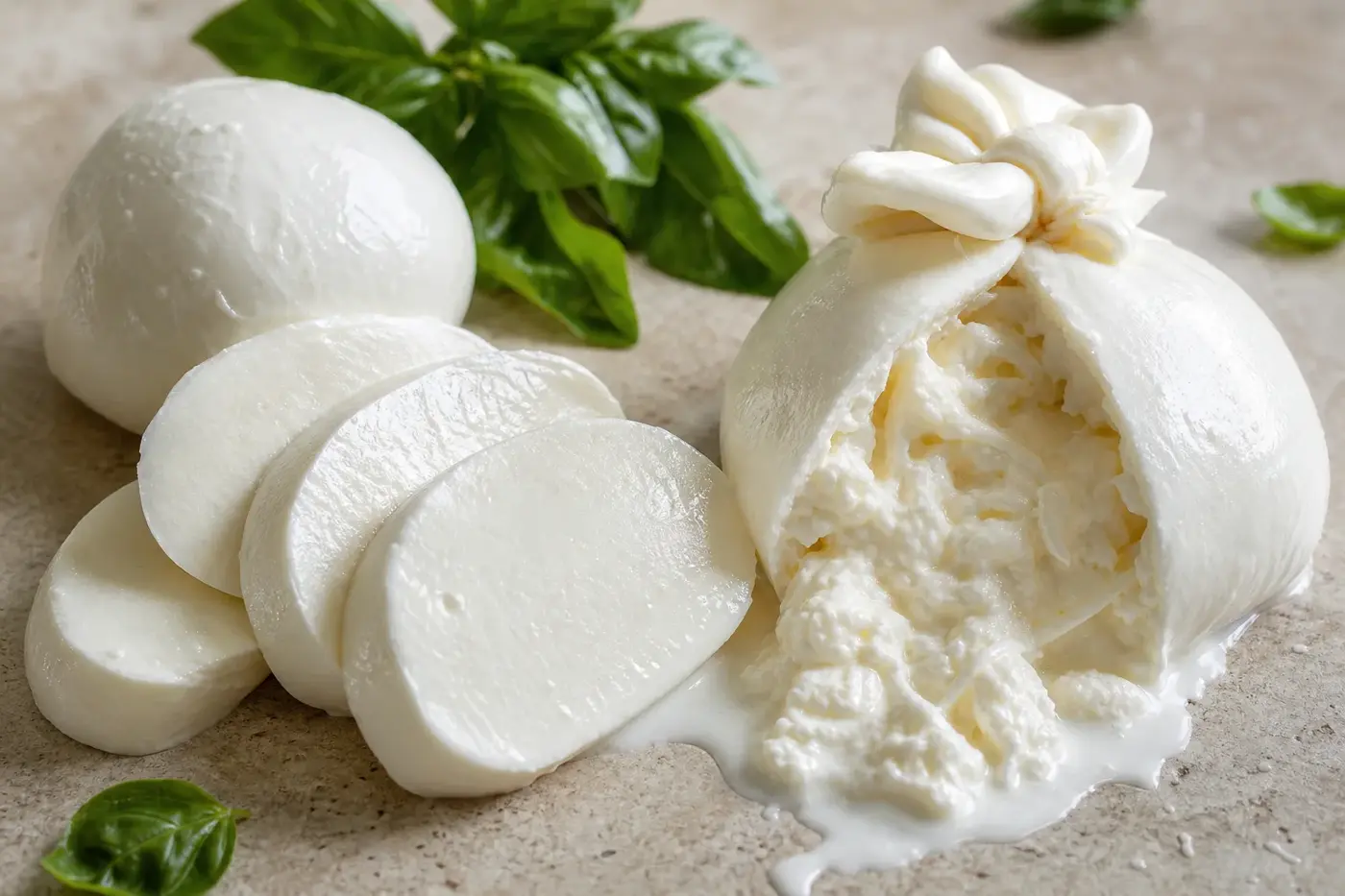
Cut into Burrata di Andria and watch the cream escape, bringing irregular shreds of stretched cheese along for the ride. Slice mozzarella and its moist, lightly elastic centre stays put. There, on your plate, is the difference: mozzarella gives you slices and melted layers; burrata spills its soft filling over tomatoes, bread or a finished dish. Keep the bread within reach. [1,2]
Meet the ball and its cream-filled cousin
With mozzarella, you get cheese all the way through. Burrata has a different arrangement: a cheese pouch holding a creamy filling. The two regional specifications and the mozzarella consortium's account describe these differences in fresh cheese, rather than every product you might buy for pizza. [1,2,3]
| What you notice | Mozzarella | Burrata |
|---|---|---|
| First impressions | White and smooth; balls, smaller pieces or plaits | A white pouch, usually gathered at the top |
| Inside | Moist, lightly elastic cheese throughout | Cheese shreds in cream, inside a stretched cheese shell |
| Your first taste | Delicate and milky; buffalo versions have their own character | Fresh dairy flavours with more pronounced cream |
| When you cut it | Holds together in slices or torn pieces | Opens up and releases its filling |
One stretchy beginning, two lovely endings
Both cheeses begin with pasta filata, meaning stretched curd. Curd is the solid part separated from milk during cheesemaking; whey is the liquid that drains away. Once the curd is suitably acidified, the cheesemaker works it with hot water until it can be stretched and shaped. [1,2,16]
For mozzarella, that stretched cheese becomes the finished ball, knot or plait. Beneath the smooth surface, fine layers give you a springy, moist bite. The Mozzarella di Bufala Campana specification describes a slightly elastic structure soon after production, softening with time. From the outside to the middle, it is cheese, without a separate filling. [1]
Burrata takes another turn. Some stretched cheese becomes the pouch; some is pulled into irregular shreds and mixed with cream to make stracciatella. The filled pouch is then closed at the top. The Burrata di Andria specification describes shreds of differing sizes, with cream escaping when you cut the cheese. [2,4] Follow the wider process in how cheese is made.
Follow the milk to southern Italy
Mozzarella di Bufala Campana has a southern Italian home with carefully drawn boundaries. Its defined area for milk and production covers specified territories in Campania, Lazio, Puglia and Molise. The name belongs within those boundaries: coming from southern Italy does not, by itself, make a buffalo mozzarella eligible. [1]
For burrata, head to Puglia, particularly Andria. Its official account records the tradition of enclosing cream and pieces of stretched cheese inside a fresh cheese casing. You may have heard the snowstorm invention story; it appears there as oral tradition. Andria sits at the heart of the cheese's identity, while the wider PGI production area encompasses Puglia. [2,4]
The milk matters, too. Mozzarella may use buffalo milk or cow's milk, but Mozzarella di Bufala Campana requires fresh whole buffalo milk. Cow's milk mozzarella is a separate choice, often called fior di latte. Burrata commonly uses cow's milk, and Burrata di Andria specifically requires it, so read the declaration: appearances will only get you so far. [1,2,5,6]
What the protected names tell you
As of November 2026, Mozzarella di Bufala Campana is registered in Great Britain as a PDO, and Burrata di Andria as a PGI. Those initials mean Protected Designation of Origin and Protected Geographical Indication. Each full name identifies cheese made to its respective specification. A packet saying only mozzarella or burrata does not establish that it meets either one. [1,2,7,8]
The geographical obligations differ. The PDO specification ties buffalo milk sourcing and cheese production to its defined area. Burrata di Andria requires processing, production and packing within Puglia, alongside its specified construction of cow's milk cheese and cream. These are distinct cheeses with distinct geographical requirements, rather than two versions of the same promise. [1,2]
Both full names are registered in Great Britain as of November 2026, but protection depends on the market where the cheese is sold. To understand the difference between a regional specification and protection in a particular jurisdiction, turn to protected names explained. [7,8]
Your first bite: a little spring, a little cream
Picture porcelain white cheese with a fresh milk aroma, resisting your first bite before softening. That is how the mozzarella consortium describes its buffalo cheese. Burrata's specification records aromas of fresh or cooked milk, butter and cream. You are looking at two different pleasures, not interchangeable soft white cheeses. [2,3]
Burrata usually feels richer because cream is part of its filling. That richness comes from the cream and loose texture, rather than a stronger aged flavour. Mozzarella gives you continuous cheese texture from surface to centre. With burrata, your mouthful moves through a firmer shell, soft shreds and cream, each playing its part. [1,2,4]
Let mozzarella melt and burrata finish
If you want cheese to soften across a pizza as it bakes, reach for mozzarella. The Associazione Verace Pizza Napoletana's production rules put mozzarella or fior di latte on the pizza before cooking, cut into strips or pieces. Take the same approach with baked pasta and melted cheese toppings: put the pieces wherever you want the cheese to melt. [5]
Burrata often earns its place at the finish. Add it to a cooked pizza, or divide it over pasta once the pan is off the heat, so its filling remains a distinct part of the dish. This is about the texture you want. Baking a filled pouch treats its cream very differently from melting pieces of mozzarella. [2,9]
Fresh mozzarella brings moisture with it. Drain the portion you plan to cook, cut or tear it, and keep the packing liquid off your pizza. Store the remaining cheese according to the packaging instructions rather than draining the whole pack in advance. You get what the dish needs without changing how the rest is kept. [1,5,12]
Bring tomatoes, bread and pasta to the table
For a tomato salad, think about how you want cheese and dressing to meet. Sliced mozzarella gives you separate bites of tomato, cheese and basil. A whole burrata makes a centrepiece: open it at the table and let the filling mingle with the dressing. Galbani's published burrata salad pairs it with tomatoes, basil and balsamic vinegar. [6,10]
With bread, try sliced mozzarella on tomato bruschetta, or serve bread beside burrata to catch the cream and shreds. This is not the moment to leave the bread basket at the other end of the table. For pasta, choose mozzarella when you want pieces that soften into the dish. Spoon burrata over individual bowls to preserve the contrast between pasta and fresh filling. [9,11]
Making a swap? Give the dish a small rethink
Either cheese works in a tomato salad if you adjust the presentation. Instead of sliced mozzarella, set a burrata in the middle and let its filling join the dressing. Going the other way, slice or tear mozzarella and dress the salad separately. You keep the fresh cheese, but lose the cream filling. [1,2,10]
For pizza or pasta bakes designed around melted mozzarella, keep mozzarella as your cooking cheese and add burrata afterwards if you fancy it. Replacing every piece with burrata changes both the distribution of cheese and the amount of cream. On finished pasta, swapping burrata for mozzarella gives you chew rather than a loose topping. [1,2,5]
Keep it fresh, from fridge to table
Start with the temperature and opening instructions on your pack. If you follow Food Standards Agency household guidance in England, Wales and Northern Ireland, your fridge should be between 0 and 5 °C (32 to 41 °F). The agency says dairy products and foods bearing a use by date belong in the fridge. [12]
If your mozzarella comes in liquid, keep that liquid for the remaining cheese when the packaging directs it. The buffalo PDO specification requires its protective liquid through to consumption. Follow burrata's own pack instructions, including any direction to consume immediately after opening. The opening instruction or the use by date applies, whichever limit comes first. [1,12,13]
For serving temperature, follow any specific pack directions and take out only what you intend to serve. The FSA advises keeping food outside refrigeration for the shortest possible time during preparation, with a maximum of four hours. That is a preparation limit, not a warming period to aim for. For food left out, follow current agency advice and the pack instructions. [12]
UK guidance says to discard food after its use by date, even if it looks and smells acceptable. For the fuller household routine, visit how to store cheese at home. [13]
This page summarises published guidance from the official sources it cites. It is not medical advice. Guidance differs between countries and changes over time, so check the current source for where you live, and ask your doctor, midwife, pharmacist or dietitian about your own circumstances.
Pregnancy and pasteurisation: what the label tells you
A cheese name cannot tell you how its milk was treated. Mozzarella di Bufala Campana's specification permits raw milk, thermised milk and pasteurised milk. Burrata di Andria's specification permits raw or pasteurised milk for the cheese, but requires heat treatment for its cream. Look for milk treatment on the label rather than relying on the protected designation. [1,2]
As of November 2026, UK NHS pregnancy guidance lists pasteurised mozzarella and burrata among soft cheeses that can be eaten. It says the cheeses it lists as foods to avoid can be eaten if cooked until steaming hot throughout. Follow its current advice for your circumstances and read the product's ingredients, including burrata's cream. If you live elsewhere, consult your own country's official guidance. [14]
For nutrition, let the packets do the talking
Cream makes a difference, but the useful comparison is between particular products. In Galbani's UK declarations below, burrata has more fat and less protein than its cow's milk mozzarella minis. These figures belong to two named products, not to all burrata, buffalo mozzarella or cow's milk mozzarella. Both ingredient declarations include milk. [6,9]
| On the label | Mozzarella minis, per 100 g | Burrata, per 100 g | Mozzarella minis, per 30 g | Burrata, per 30 g |
|---|---|---|---|---|
| Fat | 17 g | 24 g | 5.1 g | 7.2 g |
| Saturates | 12 g | 15 g | 3.6 g | 4.5 g |
| Protein | 19 g | 8 g | 5.7 g | 2.4 g |
| Salt | 0.75 g | 0.54 g | 0.225 g | 0.162 g |
Source: Galbani UK product declarations, November 2026. The figures per 30 g are calculated from the declared values per 100 g; fat means grams in the whole food. Galbani is the commercial brand describing its own products. [6,9]
Compare the labels on the products available to you, especially when moving from cow's milk mozzarella to buffalo milk mozzarella. Cream percentage, milk composition and formulation can all change the figures. If your portion is not 30 g, multiply each declared value by the portion weight divided by 100. [6,9]
Get to know your next cheese a little better
- Mozzarella: explore the wider family, from fresh cheese to cooking formats for different dishes and ways of serving.
- How to Read a Cheese Label: look at milk treatment, ingredients and the food name before you choose a particular product.
Questions people ask
What is the difference between mozzarella and burrata?
Mozzarella is cheese throughout, with a moist centre that holds together when sliced. Burrata has a stretched cheese shell filled with cream and irregular shreds of cheese.
Are mozzarella and burrata made from the same milk?
Mozzarella may be made from buffalo milk or cow’s milk, while burrata is commonly made from cow’s milk. Mozzarella di Bufala Campana requires fresh whole buffalo milk, and Burrata di Andria requires cow’s milk.
Which is better for pizza, mozzarella or burrata?
Mozzarella can be put on pizza before cooking so it melts across the surface. Burrata can be added to a cooked pizza to keep its creamy filling distinct.
How should mozzarella and burrata be stored?
Follow the temperature and opening instructions on the pack. The Food Standards Agency advises households in England, Wales and Northern Ireland to keep their fridge between 0 and 5 °C and to refrigerate dairy products.
Can you eat mozzarella or burrata during pregnancy?
NHS pregnancy guidance lists pasteurised mozzarella and burrata among soft cheeses that can be eaten. Check the current NHS pregnancy guidance and the product’s ingredients, including burrata’s cream.
Sources
- Consorzio di Tutela Mozzarella di Bufala Campana DOP, Disciplinare di produzione della DOP «Mozzarella di Bufala Campana», provision dated 11 February 2008, specification incorporating the amendment approved by Regulation (EC) No 103/2008. Articles 2 and 3, read from the document images.
- Regione Puglia, Disciplinare di produzione “Burrata di Andria”, regional government hosted specification, revision date not stated in the retrieved document. Articles 2, 3, 5 and 6.
- Consorzio di Tutela Mozzarella di Bufala Campana DOP, Bufala Campana, undated current website account, accessed November 2026. Producer consortium source for its published sensory descriptions.
- Gazzetta Ufficiale della Repubblica Italiana, Burrata di Andria, official specification material published 25 September 2023, page 45. Passages on cream, construction and the geographical origin account.
- Associazione Verace Pizza Napoletana, International Regulations for Obtaining the Use of the Collective Trademark “Verace Pizza Napoletana”, 2022 English edition. Sections on mozzarella, fior di latte and pizza toppings. This is the association's production standard.
- Galbani UK, Galbani Mozzarella Mini 150g, undated product page, accessed November 2026. Ingredients and declared nutrition per 100 g. Commercial product source.
- Department for Environment, Food & Rural Affairs, Mozzarella di Bufala Campana, Great Britain protected food name register entry, published 4 January 2021, accessed November 2026. Status: registered; protection: PDO.
- Department for Environment, Food & Rural Affairs, Burrata di Andria, Great Britain protected food name register entry, published 4 January 2021, accessed November 2026. Status: registered; protection: PGI.
- Galbani UK, Galbani Burrata 150g, undated product page, accessed November 2026. Ingredients, declared nutrition and suggested accompaniments. Commercial product source.
- Galbani UK, Galbani Burrata and Tomato Salad, undated recipe page, accessed November 2026. Commercial recipe source, used for the documented combination rather than as a site tested recipe.
- Galbani UK, Neapolitan-style Bruschetta with Galbani Mozzarella, undated recipe page, accessed November 2026. Commercial recipe source.
- Food Standards Agency, How to chill, freeze and defrost food safely, published 18 December 2017, current retrieved guidance accessed November 2026. Applies to England, Northern Ireland and Wales.
- GOV.UK, Understanding food labelling: Best before and use-by dates, undated current guidance, accessed November 2026.
- NHS, Foods to avoid in pregnancy, current retrieved guidance, accessed November 2026. Section “Cheese, milk and other dairy”.
- Food Standards Agency, Alerts, current official alert index, accessed November 2026. Editorial recall screening source.
- Regione Campania, Disciplinare di produzione della denominazione di origine “Mozzarella di bufala Campana”, older official regional compilation, including associated national decrees. Used only to corroborate established manufacturing terminology, not the current production boundary.
Researched from official specifications, government registers, agency guidance, an Italian pizza association's production standard and declared product information, with serving and substitution recommendations synthesised from their documented differences.
Last checked: November 2026
Last checked November 2026.
The editors suggest you read next
Cheddar vs Gouda: Taste, Texture and How to Use Each
Bite into a long-aged Gouda and, beneath your teeth, something crunches.