Brie vs Camembert: Rind, Texture and Other Differences
A long wedge of Brie waits on the counter.
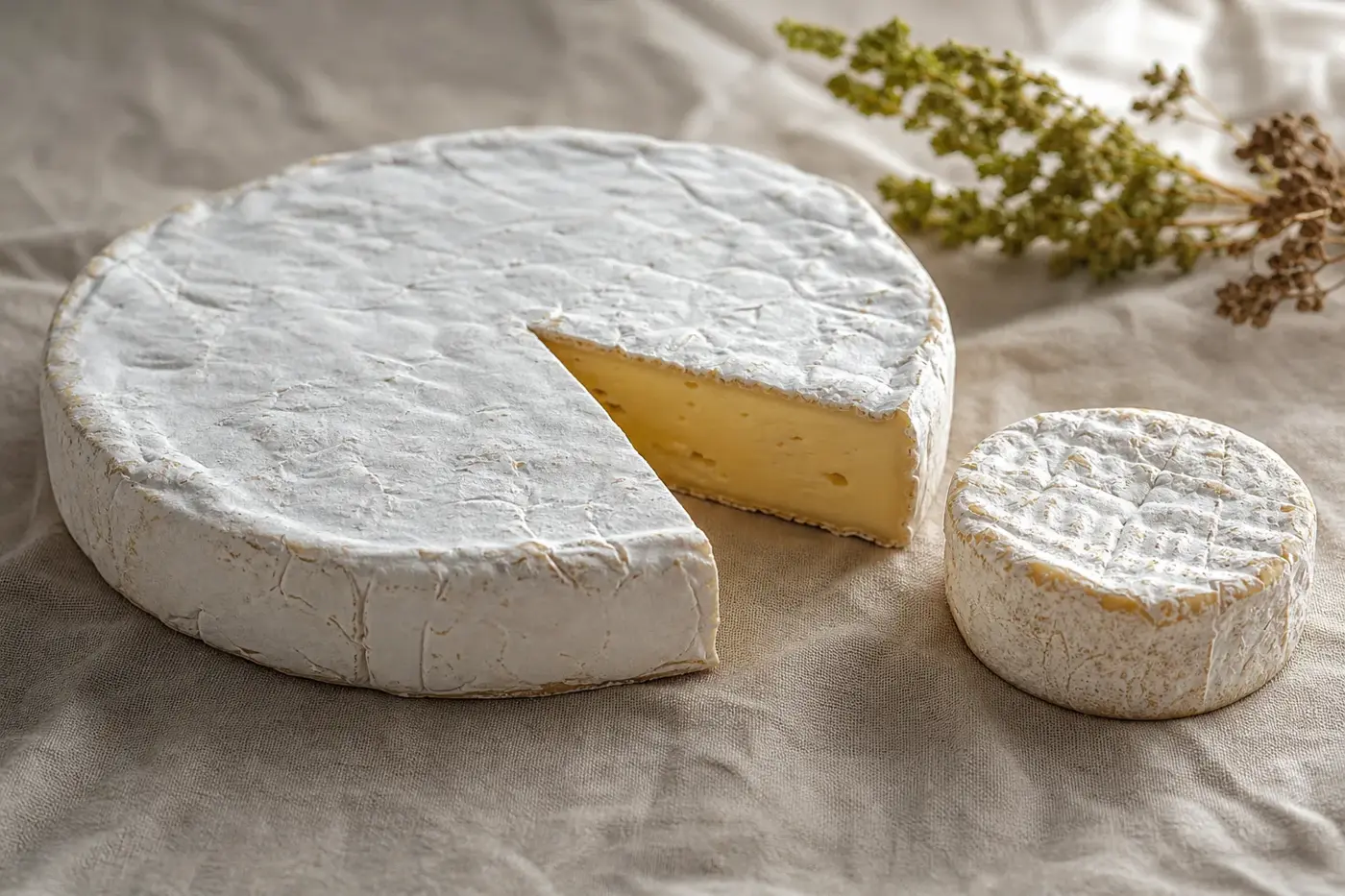
A long wedge of Brie waits on the counter. Beside it sits a small, whole Camembert, its white rind still intact. Before you take a bite, their shapes have begun telling you the story. Both are white-rinded soft cheeses, but traditional formats, regional methods and ripeness offer much more than the familiar promise of “mild Brie” or “strong Camembert”.[1][2]
Two French cheeses, ready for their close-up
For a precise comparison, start with two protected French names: Brie de Meaux and Camembert de Normandie. Each has a specification defining its dimensions, milk and maturation. Those requirements belong to those names, not to every cheese labelled Brie or Camembert.[3][4]
| What to look for | Brie de Meaux | Camembert de Normandie |
|---|---|---|
| Where the story begins | The Brie area east of Paris, with production extending towards the Meuse.[1] | Normandy; named after Camembert village in the Orne.[2] |
| Shape on the counter | Broad, flat cylinder; moulds have an internal diameter of 36 to 37 cm.[3] | Small, flat cylinder, 10.5 to 11 cm in diameter.[4] |
| Weight in the specification | 2.6 to 3.3 kg.[3] | Declared net weight of at least 250 g.[4] |
| Milk in the making | Raw cows’ milk.[3] | Raw cows’ milk.[4] |
| Time to mature | At least four weeks from renneting.[3] | At least 12 days in the ripening room; customer delivery no earlier than 21 days from renneting.[4] |
Shopping from the wider cheese families? Read the label, then look at the cut surface. The maker’s description, milk treatment and maturity tell you more about your particular cheese than the generic name alone.
Follow Brie east of Paris, then turn towards Normandy
Brie’s story takes you into the country east of Paris. INAO, France’s national institute responsible for origin and quality schemes, describes Brie de Meaux’s production territory as stretching from Seine-et-Marne towards the Meuse. Its specification separates the principal production area from additional places where maturing is permitted, reflecting the historical role of specialist cheese maturers around Paris.[1][3]
For Camembert, your route turns towards Normandy. INAO connects Camembert de Normandie with grass-growing conditions, Normande cattle and a local cheesemaking rhythm. The moulds are filled in successive portions, then the curd is left to drain naturally.[2]
Place, milk supply and method are the details worth hunting for on a label. A pastoral picture is pleasant, but it cannot answer many questions. You can explore the broader families in the individual Brie and Camembert articles.
Why you buy a Brie wedge and a whole Camembert
That long triangular Brie wedge starts life in a broad wheel. Cut from the centre towards the outer edge and each portion gets some central paste and some outer rind. The French dairy PDO industry’s cutting guidance follows exactly that direction.[1][5]
Camembert de Normandie is small enough to reach your table as a complete round. Its industry guidance also recommends cutting from the centre outwards, making radial portions.[6]
When you serve, offer slices across a Brie wedge and small radial wedges from a Camembert. Share the rind and centre, rather than quietly excavating the softest part for yourself. Brie brings height and an open cross-section to your board; Camembert gives you the outline of the whole cheese.
A white rind, with woodland in the background
White need not mean spotless. Both cheeses have a bloomy rind, a surface covering of ripening mould, and both specifications allow natural colour variations. Brie de Meaux’s thin rind can carry red streaks or spots; Camembert de Normandie’s white, felt-like covering can reveal red patches.[3][4]
Their published aromas take you towards the woods, too. The French dairy PDO industry describes mushroom and wet leaves in Brie de Meaux. For Camembert de Normandie, it describes a developed bouquet of milk and woodland.[5][6]
You can serve the rind according to preference. Try a little paste alone, then a piece with rind, and notice what the surface brings to the bite. When judging condition, consider rind appearance alongside storage history and date marking: the FSA warns that smell cannot establish the safety of food carrying a use-by date.[7]
Find your favourite texture beneath the rind
Look at the cut surface for clues to the texture you enjoy. Brie de Meaux’s specification describes its paste, the body beneath the rind, changing from brittle to supple as maturation moves inwards. At six to eight weeks, it describes a cheese matured right through to the centre.[3]
Camembert de Normandie has an ivory to pale yellow paste. Once matured through, it becomes smooth and supple. Its industry description also identifies a stronger bouquet in the fully developed cheese.[4][6]
Both styles soften from the rind towards the centre. Compare the softer layer just beneath the surface with the middle: a firmer central band helps explain why otherwise similar pieces can feel so different in your mouth. Tell your cheesemonger what you fancy, whether that is a firmer slice, a supple paste or something more flowing.
Look beyond “mild Brie, strong Camembert”
Brie de Meaux’s flavours move from milk towards cream, butter and hazelnut as it matures. At four weeks, its specification describes a milky cheese, potentially slightly salty, with a touch of bitterness. At six to eight weeks, cream, butter and hazelnut aromas enter the picture.[3]
Camembert de Normandie has a progression of its own. Its specification describes an initially mild, milky flavour becoming more pronounced and fruity with further maturation. The industry account adds woodland aromas once the cheese is fully developed.[4][6]
So “mild Brie, strong Camembert” will only get you so far at the counter. Whether you are planning sandwiches, a cheeseboard or something for a gentler palate, compare the maker’s description with the actual ripeness. The name gives you the family; the cheese’s condition tells you what this particular piece has to offer.
Read right to the end of the name
Brie and Camembert are broader names than Brie de Meaux and Camembert de Normandie. INAO explicitly distinguishes generic Camembert from the protected regional name. Both protected cheeses have specifications setting requirements for origin, milk and production.[1][2][3][4]
As of November 2026, Great Britain’s official register lists Brie de Meaux and Camembert de Normandie separately as registered Protected Designations of Origin. Both entries record UK scheme registration on 31 December 2020 and original EU registration on 21 June 1996.[8][9] INAO identifies both as French AOP cheeses, the French-language designation corresponding to PDO.[1][2]
Let your eye travel to the end of the name, rather than stopping at Brie or Camembert. Those extra words have a job to do. The guide to protected cheese names explains the difference between a style name and a name tied to a specification.
This page summarises published guidance from the official sources it cites. It is not medical advice. Guidance differs between countries and changes over time, so check the current source for where you live, and ask your doctor, midwife, pharmacist or dietitian about your own circumstances.
Patience, curds and the art of filling a mould
Both protected cheeses require raw cows’ milk, but their moulding methods take different paths. Brie de Meaux is moulded manually in thin layers with a broad, perforated tool called a pelle à brie. For Camembert de Normandie, the curd must enter the mould in at least five deposits, each separated by at least 40 minutes; its specification permits specified manual or automated moulding arrangements.[3][4]
Generic Brie and Camembert can use raw or pasteurised milk. Read your label for the actual milk treatment and production method. The protected cheeses’ requirements do not automatically extend to these wider styles.
Vegetarian claims need a separate look. Camembert de Normandie’s specification requires animal rennet, the enzyme preparation that coagulates milk into curd.[4] If milk-treatment terms leave you wondering, turn to raw, thermised and pasteurised cheese.
Buy for the moment you plan to eat it
Start with your plans, not just the name on the label. Ask for slices that will hold together in sandwiches, or a softer texture for a board. On a cut wedge, the contrast between centre and outer paste gives you and the cheesemonger a useful starting point for talking about maturity.
Next, read the storage instructions and date markings, as the FSA advises when you buy food. Follow any instruction about consumption after opening. Keep the packaging information with your cheese so you have the details when you need them.[7][10]
The red markings described above can be part of normal maturation on a white rind.[3][4] Ask the retailer or maker about unexpected changes rather than relying on colour alone, and discard cheese that appears spoiled. Never taste it to test safety: for food carrying a use-by date, the FSA says the sniff test cannot detect the organisms responsible for food poisoning.[7]
Bring out a little cheese and choose your bread
Give a modest portion a brief rest in a cool room before serving, rather than deliberately warming it beside a cooker. Follow the NHS’s UK guidance: keep your fridge at 5 °C (41 °F) or below and eat chilled ready-to-eat food within four hours of taking it out. Put out small portions and leave the remainder chilled.[11]
Begin with a small wedge, then offer more according to appetite. You get room to compare rind and centre without filling the plate at the first serving.
For Brie, the French dairy PDO industry suggests baguette, country bread, raisin bread or fig bread, with dry white wine, Champagne and cider among its suggested drinks.[5] For Camembert, it proposes country bread, brioche and apple-and-walnut bread. Cider makes an appearance here, too.[6]
Prefer an alcohol-free glass? Choose water with either cheese, or try apple juice with Camembert: the Camembert museum offers apple juice alongside cider in its tastings.[12] Alcoholic pairings are optional and only for adults of legal drinking age; people who are pregnant, driving, taking medicines that interact with alcohol, or recovering from alcohol dependence should not drink.
Make room for Brie or Camembert on your menu
Your cheeseboard does not need both, however persuasive the cheese counter becomes. Their shared white-rind character makes them useful for a side-by-side comparison, but choosing just one leaves room for another style when you want variety. Let the texture and flavour you fancy guide you.
For sandwiches, aim for supple enough to bite through, yet firm enough to slice. Try Brie with apple and plain bread, or Camembert with a little mustard. Adjust those suggestions to the flavour and ripeness of the cheese you actually have.
For baked dishes, cut a Brie wedge into portions or serve a small Camembert round whole. Choose a product with clear cooking instructions and follow them. Remove retail wrapping and use an ovenproof dish unless the manufacturer explicitly identifies the supplied container as suitable for the stated cooking method.
The FSA advises following manufacturers’ cooking instructions and checking that food is steaming hot throughout.[13] A soft surface is not proof of a thoroughly heated centre. Check beyond the top.
Pregnancy and higher-risk groups: guidance for your table
UK NHS advice, November 2026: pregnant people should thoroughly cook white-coated, mould-ripened soft cheeses such as Brie and Camembert, whether made with pasteurised or unpasteurised milk. The NHS permits these cheeses when cooked until steaming hot throughout.[14]
The NHS identifies pregnant people, newborn babies, people with weakened immune systems and older people as groups at higher risk of serious listeriosis. It advises keeping ready-to-eat foods chilled, following storage instructions and observing use-by dates.[11] For the full advice, read its current listeriosis guidance and pregnancy food guidance.
Ask the appropriate healthcare professional about your personal circumstances. The site’s cheese food safety guide gives you broader context for reading official advice alongside the particular product’s label.
Questions people ask
What is the main difference between Brie and Camembert?
Brie de Meaux is a broad, flat cheese made in moulds 36 to 37 cm across. Camembert de Normandie is a smaller round, 10.5 to 11 cm across. These measurements apply to the protected cheeses, not every cheese labelled Brie or Camembert.
Is Camembert always stronger than Brie?
No. Maturity changes both cheeses substantially. Brie de Meaux develops cream, butter and hazelnut aromas as it matures, while Camembert de Normandie becomes more pronounced and fruity.
Are Brie and Camembert made with raw milk?
Brie de Meaux and Camembert de Normandie both require raw cows’ milk. Generic Brie and Camembert can use raw or pasteurised milk, so check the label.
Is Camembert suitable for vegetarians?
Camembert de Normandie’s specification requires animal rennet. Check vegetarian claims separately when buying other Camembert.
Can I eat Brie or Camembert during pregnancy?
The NHS advises pregnant people to thoroughly cook white coated, mould ripened soft cheeses such as Brie and Camembert, whether made with pasteurised or unpasteurised milk. It permits them when cooked until steaming hot throughout. See the NHS pregnancy food guidance at https://www.nhs.uk/pregnancy/keeping-well/foods-to-avoid/.
Sources
- INAO. Brie de Meaux. Official product record, current page retrieved November 2026. Product, territory and technical information.
- INAO. Camembert de Normandie. Official product record, current page retrieved November 2026. Product, territory and distinction from generic Camembert.
- French Ministry of Agriculture. Cahier des charges de l’AOP « Brie de Meaux ». Specification published with the 2020 approval notices. Sections 2, 3 and 5.
- French Ministry of Agriculture. Cahier des charges de l’appellation d’origine « Camembert de Normandie ». Specification homologated by Décret n°2013-1059, 22 November 2013. Sections 2, 3, 5.4, 5.5 and 5.6.
- Produits laitiers AOP. Brie de Meaux. Undated industry promotional account, retrieved November 2026. Sensory descriptions, cutting and pairing suggestions are the industry’s.
- Produits laitiers AOP. Camembert de Normandie. Undated industry promotional account, retrieved November 2026. Sensory descriptions, cutting and pairing suggestions are the industry’s.
- Food Standards Agency. Home food fact checker. Updated 21 August 2026. Section “Does the sniff test work for milk and dairy food?”
- Defra. Brie de Meaux. Great Britain protected food name register entry, published 4 January 2021, retrieved November 2026.
- Defra. Camembert de Normandie. Great Britain protected food name register entry, published 4 January 2021, retrieved November 2026.
- Food Standards Agency. How to chill, freeze and defrost food safely. Published 18 December 2017, current text retrieved November 2026. Applies to England, Northern Ireland and Wales.
- NHS. Listeriosis. Last reviewed 10 November 2023, current text retrieved November 2026. Risk groups, refrigeration, time outside refrigeration and storage instructions.
- Musée du Camembert. Nos dégustations. Published visitor tasting information for 2026, retrieved November 2026. Evidence for its apple juice and cider accompaniment only.
- Food Standards Agency. Cooking your food. Published 18 December 2017, current text retrieved November 2026. Applies to England, Northern Ireland and Wales.
- NHS. Foods to avoid in pregnancy. Current text retrieved November 2026, section “Cheese, milk and other dairy”.
This desk-researched comparison draws on official specifications, register entries and UK public guidance, with industry sensory accounts attributed and editorial serving suggestions identified.
Last checked: November 2026
Last checked November 2026.
The editors suggest you read next
Cheddar vs Gouda: Taste, Texture and How to Use Each
Bite into a long-aged Gouda and, beneath your teeth, something crunches.