Parmigiano Reggiano vs Grana Padano
Stand beside the Po in Mantua and picture your next cheeseboard divided by a river.
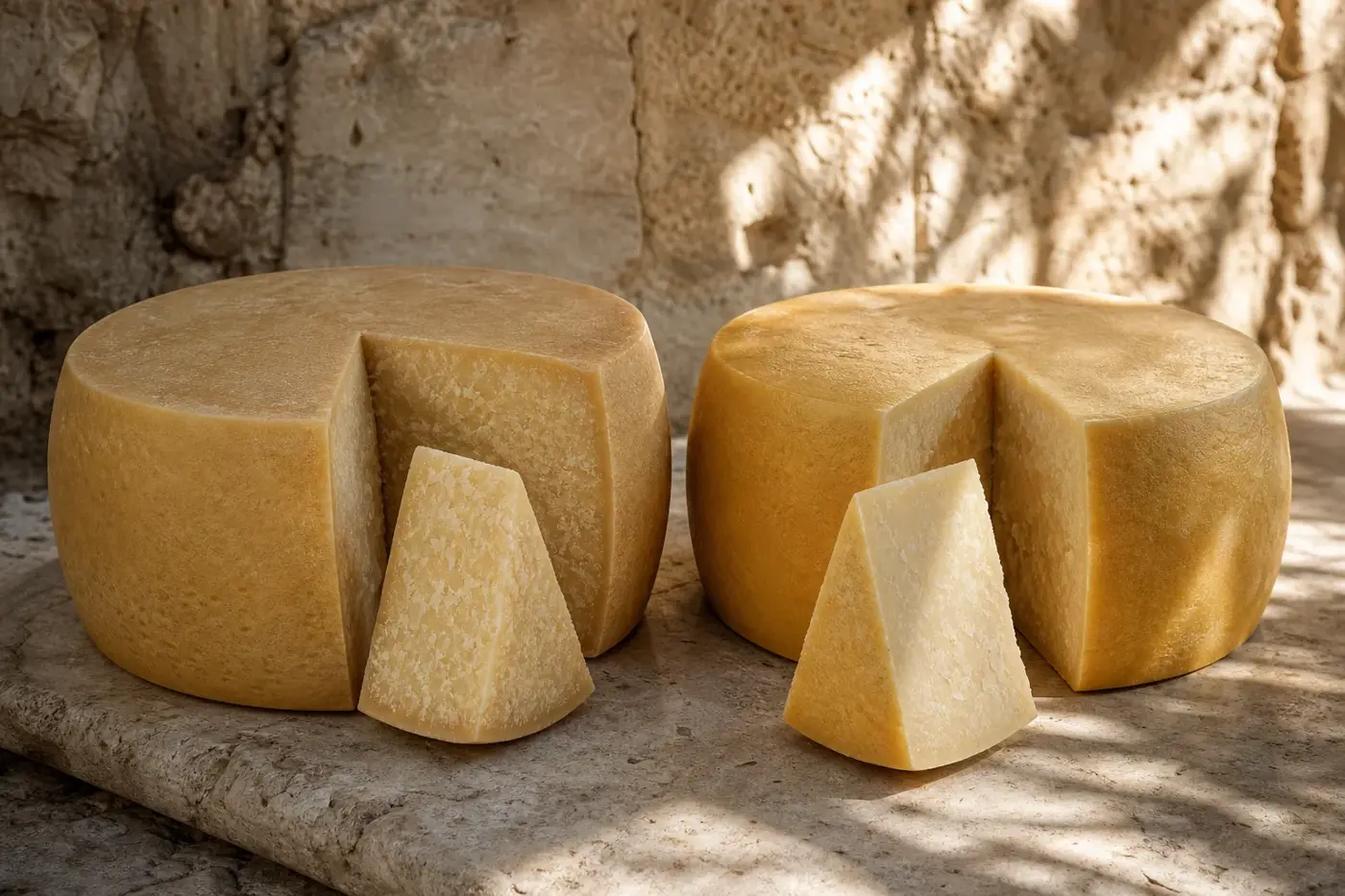
Stand beside the Po in Mantua and picture your next cheeseboard divided by a river. Parmigiano Reggiano belongs on the right bank, Grana Padano on the left. Their paths separate long before you break into a wheel: Parmigiano Reggiano forbids silage in cattle feed and matures for at least 12 months; Grana Padano generally permits silage and starts at nine. [1, 2, 3, 4]
Both are Italian cow's milk cheeses with EU protected designation of origin status and hard, granular textures. But choosing by name alone only gets you so far. The age and character of your particular wedge deserve a say, too. [1, 2, 3, 4]
Get acquainted with your two wedges
Here is how the production rules for these Italian PDO cheeses compare as at November 2026. If you spot DOP on a label, you are looking at the Italian abbreviation for the same designation. [1, 2]
| What to look for | Parmigiano Reggiano | Grana Padano |
|---|---|---|
| The milk | Raw cow's milk, partially skimmed [1] | Raw cow's milk, partially skimmed [5] |
| What the cattle eat | Silage prohibited [3] | Silage generally permitted [4] |
| What sets the curd | Calf rennet [3] | Calf rennet [5] |
| Additives | None permitted [1] | Egg-derived lysozyme permitted, with exceptions [4, 5] |
| Youngest permitted age | 12 months [3] | Nine months [4] |
| Extra ageing category | Age stated in months [11] | Riserva: at least 20 months and a further assessment [2] |
Let the rivers lead you to cheese country
Parmigiano Reggiano comes from Parma, Reggio Emilia and Modena, plus Bologna on the left bank of the Reno and Mantua on the right bank of the Po. Pay attention to those riverbanks. The designation covers specified territories, not every dairy in the surrounding regions. [1]
Grana Padano takes you on a longer journey across northern Italy. Its specification lists provinces in Piedmont, Lombardy, Veneto, Emilia-Romagna and Trentino-Alto Adige. Mantua on the left of the Po and Bologna on the right of the Reno belong here, alongside provinces such as Cremona, Brescia, Verona and Piacenza. [2]
The two cheeses have different geographical reaches. Parmigiano Reggiano's production area is more concentrated; Grana Padano embraces a broader group of northern Italian territories. More places can make Grana Padano, but that does not make it a generic cheese style: its designation remains protected. [1, 2]
Both names also appear as registered PDOs on Great Britain's official register as at November 2026. If you want to untangle a protected geographical name from a cheese style, turn to protected names explained. [14, 15]
Meet the milk, then follow the feed
Start with raw milk, partially skimmed by allowing the cream to rise naturally. For Parmigiano Reggiano, the evening milk stands so the cream can be removed before it meets the morning's supply. The current specification also allows partial natural skimming of the morning milk, a small detail that simpler comparisons often miss. [1]
Grana Padano also uses raw milk partially skimmed by natural surface separation. Both cheeses use a natural whey starter: lactic acid bacteria cultured from whey, the liquid left after the previous cheesemaking. This starts fermentation before calf rennet turns the milk into curd. [3, 5]
The clearer dividing line is in the cattle's feed. Parmigiano Reggiano prohibits silage, forage preserved through fermentation, and requires at least 75% of forage dry matter to come from its production area. Local forage is part of the rules; an entire method of preserving feed is excluded. [3]
Grana Padano permits specified silages alongside fresh forage and hay. Its consortium describes maize silage as part of the area's feeding tradition. There is an exception to remember: Trentingrana, a type within the Grana Padano PDO, excludes silage. Each cheese has its own production system. [4, 5]
Know what the egg label and rennet mean
Parmigiano Reggiano permits no additives. Grana Padano permits egg-white lysozyme, an enzyme that controls unwanted fermentation associated with certain clostridia during ageing. Its consortium explains that lysozyme helps prevent fermentation defects in a system that permits silage, and identifies Trentingrana as made without it. [1, 4, 5]
For food sold in the EU and Northern Ireland, Regulation (EU) No 1169/2011 requires declaration of allergenic ingredients and processing aids that remain in the finished product. That includes milk and egg, unless the food's name clearly refers to the allergen. Where a declaration is required and an ingredients list is provided, the allergen name must be emphasised. [6]
Your practical step is straightforward: look at the particular pack for egg-derived lysozyme. Grana Padano declarations can differ. [6]
Neither cheese is suitable for vegetarians, because both require calf rennet, an animal-derived coagulant. A vegetarian hard cheese using microbial or fermentation-produced coagulant can do a similar job in your cooking, but it is a separate product. Rennet explained takes you through the alternatives. [3, 5]
Give age a seat at the table
Parmigiano Reggiano must mature for at least 12 months; Grana Padano starts at nine months. Those are entry points, not finishing lines. Ask how old your cheese is: compare young Grana Padano with much older Parmigiano Reggiano and you risk mistaking maturity for identity. [3, 4]
Grana Padano Riserva must spend at least 20 months in the production area and develop the prescribed granular, flaky structure and other quality characteristics. It then faces a further assessment and receives a second fire-brand. The familiar words “Oltre 20 mesi” mean over 20 months; a further category identifies Riserva aged over 24 months. [2]
Time changes both the bite and the flavour. The Parmigiano Reggiano consortium describes increasing granularity and crumbliness, while Grana Padano's published age profiles move from softer, milk-led cheese towards a more pronounced grain and longer-lasting flavour. Older gives you a different eating experience, not an automatic promotion. [7, 8]
Taste from fresh milk to fruit and broth
Instead of asking which cheese is mild or strong, think about youthful milkiness and developed savouriness. In its 2026 guidance, the Parmigiano Reggiano consortium describes cheese aged 12 to 19 months through milk, yoghurt and fresh fruit. At 20 to 26 months, nuts and meat stock join fresh fruit; at 27 to 34 months, spices enter the picture. [9]
Grana Padano's consortium describes younger cheese as distinctly milky and sweet, with comparatively little crumbliness. Older profiles bring hay, dried fruit and broth notes. Riserva has a more granular, crumbly texture and a longer finish: good reason to enjoy mature Grana Padano in pieces rather than sentencing every wedge to the grater. [8]
Use those consortia tasting descriptions as a starting point, then get to know the maker and maturity of your actual wedges. Ask to taste similar ages where possible. Notice the first aroma, the balance of sweetness and savouriness, how readily the piece fractures and which flavour lingers after you swallow. [7, 8]
Find your dish its cheese
Let your dish and the cheese's maturity lead the choice. These suggestions draw on the published age profiles, rather than assuming either name deserves the better seat at dinner. [8, 9]
Finish your pasta with a little thought
Choose younger Grana Padano for a milky, gently sweet contribution, or a more mature cheese for greater aromatic presence. Parmigiano Reggiano around 24 months is a useful starting point for a savoury finish; older examples bring the stock and spice notes its consortium describes. Grate a little, taste the whole forkful, then decide whether you want more. [8, 9]
Give your salad broad shavings
Start with a younger wedge of either cheese for broad shavings. Parmigiano Reggiano's consortium specifically recommends younger ages for salads and cold dishes; younger Grana Padano brings its milk-led character. Use a vegetable peeler on a manageable piece, keep your fingers clear of the blade, and scatter the shavings through the salad to spread their flavour. [8, 9]
Put the grain on your cheeseboard
Break off irregular pieces so you can explore the grain. Younger cheeses make milkiness and sweetness easier to compare, while mature Parmigiano Reggiano beside Grana Padano Riserva offers a more revealing comparison of developed aromas. Serve them separately, label their ages and leave accompaniments aside for the first mouthful. [7, 8, 9]
Build your sauce around the flavour
Choose the flavour before the name. Start with younger cheese for a restrained sauce, or consider a more developed age when cheese is the principal seasoning. Grate finely, then stir it in gradually away from direct heat.
Adjust with the sauce's cooking liquid and taste before adding salt. Both cheeses work here as seasonings, rather than choices for a stretchy topping.
Either can stand in for the other in many everyday dishes. Keep the cheese's own name, match maturity where you can, and adjust the quantity by taste. For filled or baked pasta, the Parmigiano Reggiano consortium particularly recommends its more mature ages. [9]
Read the rind and get to know your wedge
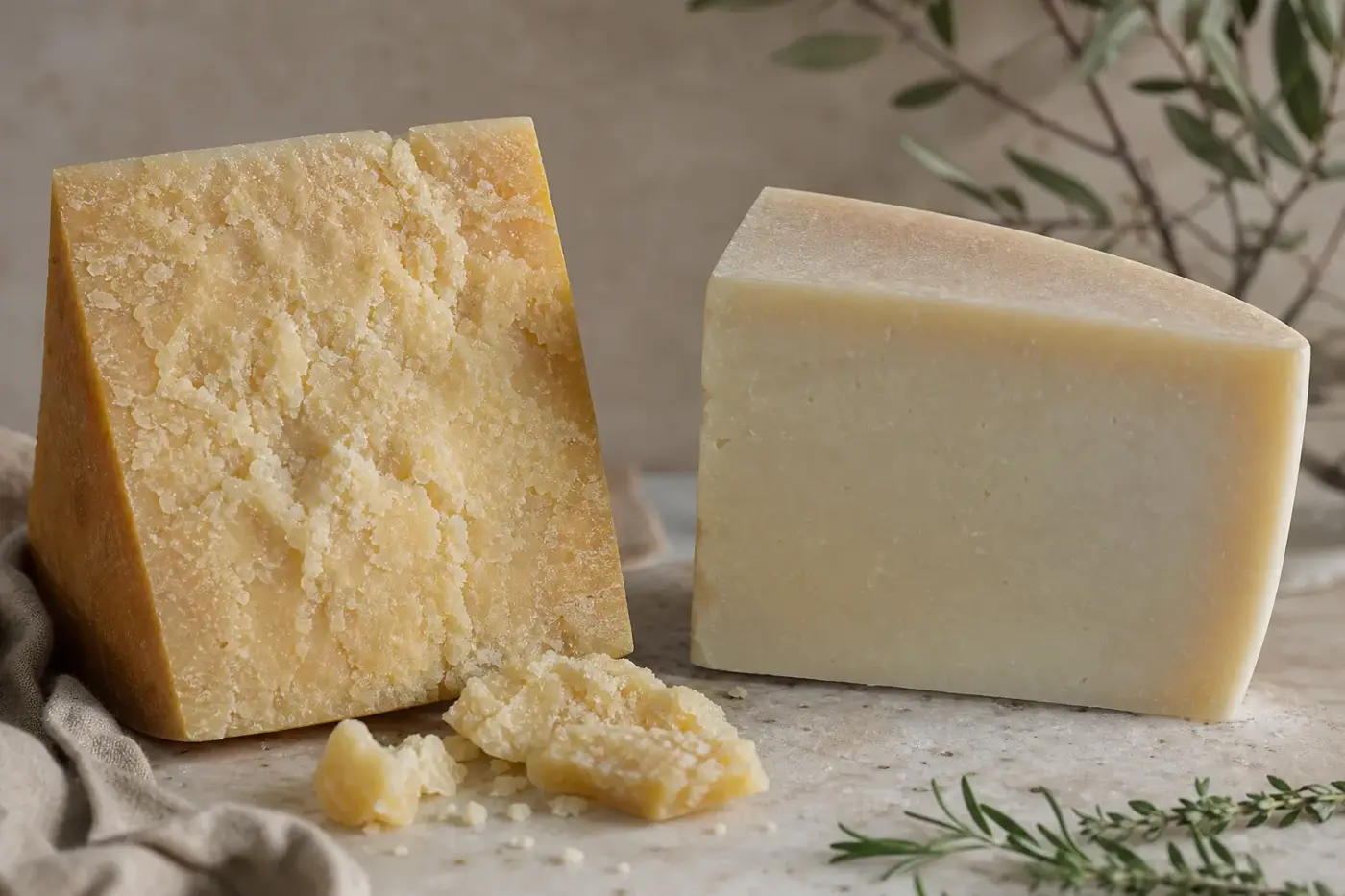
The exact name, identification marks and packaging tell you what you are taking home. Parmigiano Reggiano wheels carry the repeated name in pin-dot lettering and an oval selection mark. Grana Padano carries repeated diamond-shaped name markings and the official diamond-shaped brand. [2, 10]
On packaged portions, look for the designation and official branding. An Italian flag or an Italian-sounding product name is not the same thing. [2, 10]
A small piece of Parmigiano Reggiano can legitimately have no visible dots. Its consortium explains that portions cut from a wheel's flat faces may lack dotted lettering. Ask the seller about the original wheel and keep the packaging information; for grated cheese, the name and labelled traceability take over from the visible rind as identifying details. [11]
Generic hard cheese alternatives have their own identities and ingredients. Compare the stated milk, coagulant, origin and age, because similar looks do not mean identical production rules. At the counter, ask three useful questions about either PDO: which dairy made it, how old is it, and can you taste it?
For a closer look at that particular cheese, explore the Parmigiano Reggiano guide. Take the same curiosity back to the counter for your next wedge. Asking to taste cheese is, happily, a very agreeable form of homework.
Look after your wedge, and keep the rind
Follow the storage instructions on your pack. The Food Standards Agency's home storage guidance for England, Wales and Northern Ireland recommends a fridge between 0 and 5 °C. Keep an opened wedge covered in a suitable food container or food-grade wrapping; Parmigiano Reggiano's consortium recommends limiting air contact so the cut surface does not dry and harden. [11, 13]
Grate only what your dish needs, using a manageable, stable piece. Choose the fine face for a light finishing layer or for incorporating cheese into sauce, and a coarser face for more distinct fragments. Stop before the piece becomes too small to hold securely, then store the remainder promptly. [13]
Both consortia describe their cheese's natural rind as edible after careful cleaning. Parmigiano Reggiano's consortium says its rind receives no preserving treatment; Grana Padano's says its rind has no chemical treatment or plastic covering. Remove packaging and read the actual product's instructions before preparing the rind. [11, 12]
Add a cleaned rind to a simmering soup or bean dish, then remove it before serving if it remains tough. Keep track of which cheese you used, including any declared egg-derived lysozyme. For storage questions beyond the pack instructions, turn to how to store cheese at home. [5, 11, 12]
General information only, not medical advice: follow the official guidance where you live.
Questions people ask
What is the main difference between Parmigiano Reggiano and Grana Padano?
Parmigiano Reggiano prohibits silage in cattle feed and must mature for at least 12 months. Grana Padano generally permits silage and matures for at least nine months.
Are Parmigiano Reggiano and Grana Padano vegetarian?
Neither cheese is suitable for vegetarians because both require calf rennet. Vegetarian hard cheeses made with microbial or fermentation produced coagulant are separate products.
Does Grana Padano contain egg?
Grana Padano permits egg white lysozyme, although Trentingrana is made without it. Check the particular pack, as declarations can differ.
Can I use Grana Padano instead of Parmigiano Reggiano in pasta?
Either can replace the other in many everyday dishes. Match their maturity where possible and adjust the quantity by taste.
Can you eat the rind of Parmigiano Reggiano or Grana Padano?
Both consortia describe the natural rind of their cheese as edible after careful cleaning. Remove the packaging and check the product instructions before preparing it.
Sources
- Consorzio del Formaggio Parmigiano Reggiano, Product specification of the protected designation of origin “Parmigiano Reggiano”, English document dated 2 July 2025, linked from the consortium's specification page as the specification in force from 24 April 2025. Product specification.
- Consorzio Tutela Grana Padano, Specification of Grana Padano PDO, October 2022, English edition currently linked from its PDO page. Product specification.
- Consorzio del Formaggio Parmigiano Reggiano, Single document of the PDO Parmigiano Reggiano, file dated 24 April 2025. Single document.
- Consorzio Tutela Grana Padano, Grana Padano and Parmigiano Reggiano particular aspects and specifications, undated web edition, accessed November 2026. Consortium comparison.
- Consorzio Tutela Grana Padano, Ingredients, undated web edition, accessed November 2026. Ingredients and milk preparation.
- European Parliament and Council, Regulation (EU) No 1169/2011 on the provision of food information to consumers, consolidated version dated 1 April 2025, particularly Articles 9 and 21 and Annex II. Consolidated regulation.
- Consorzio del Formaggio Parmigiano Reggiano, Sensory analysis, undated web edition, accessed November 2026. Sensory analysis.
- Consorzio Tutela Grana Padano, Ageing, undated web edition, accessed November 2026. Age profiles.
- Consorzio del Formaggio Parmigiano Reggiano, Parmigiano Reggiano guidelines, revision February 2026, “Organoleptic characteristics”. 2026 guidelines.
- Consorzio del Formaggio Parmigiano Reggiano, Seals and marks, undated web edition, accessed November 2026. Identification marks.
- Consorzio del Formaggio Parmigiano Reggiano, FAQ, US English web edition, undated, accessed November 2026. Official FAQ.
- Consorzio Tutela Grana Padano, Nutritional properties, undated web edition, section “Is the rind of Grana Padano edible?”, accessed November 2026. Rind information.
- Food Standards Agency, How to chill, freeze and defrost food safely, published 18 December 2017, live guidance accessed November 2026; applies to England, Northern Ireland and Wales. Official storage guidance.
- Department for Environment, Food & Rural Affairs, Grana Padano, Great Britain protected food names register, live entry accessed November 2026. Register entry.
- Department for Environment, Food & Rural Affairs, Parmigiano Reggiano, Great Britain protected food names register, live entry accessed November 2026. Register entry.
This desk-researched comparison brings together published production specifications, official register entries, EU legislation, agency guidance and explicitly attributed consortium tasting descriptions; cooking choices are editorial synthesis.
Last checked: November 2026
Last checked November 2026.
The editors suggest you read next
Cheddar vs Gouda: Taste, Texture and How to Use Each
Bite into a long-aged Gouda and, beneath your teeth, something crunches.