Parmigiano Reggiano vs Pecorino Romano
Break off a piece of Parmigiano Reggiano.
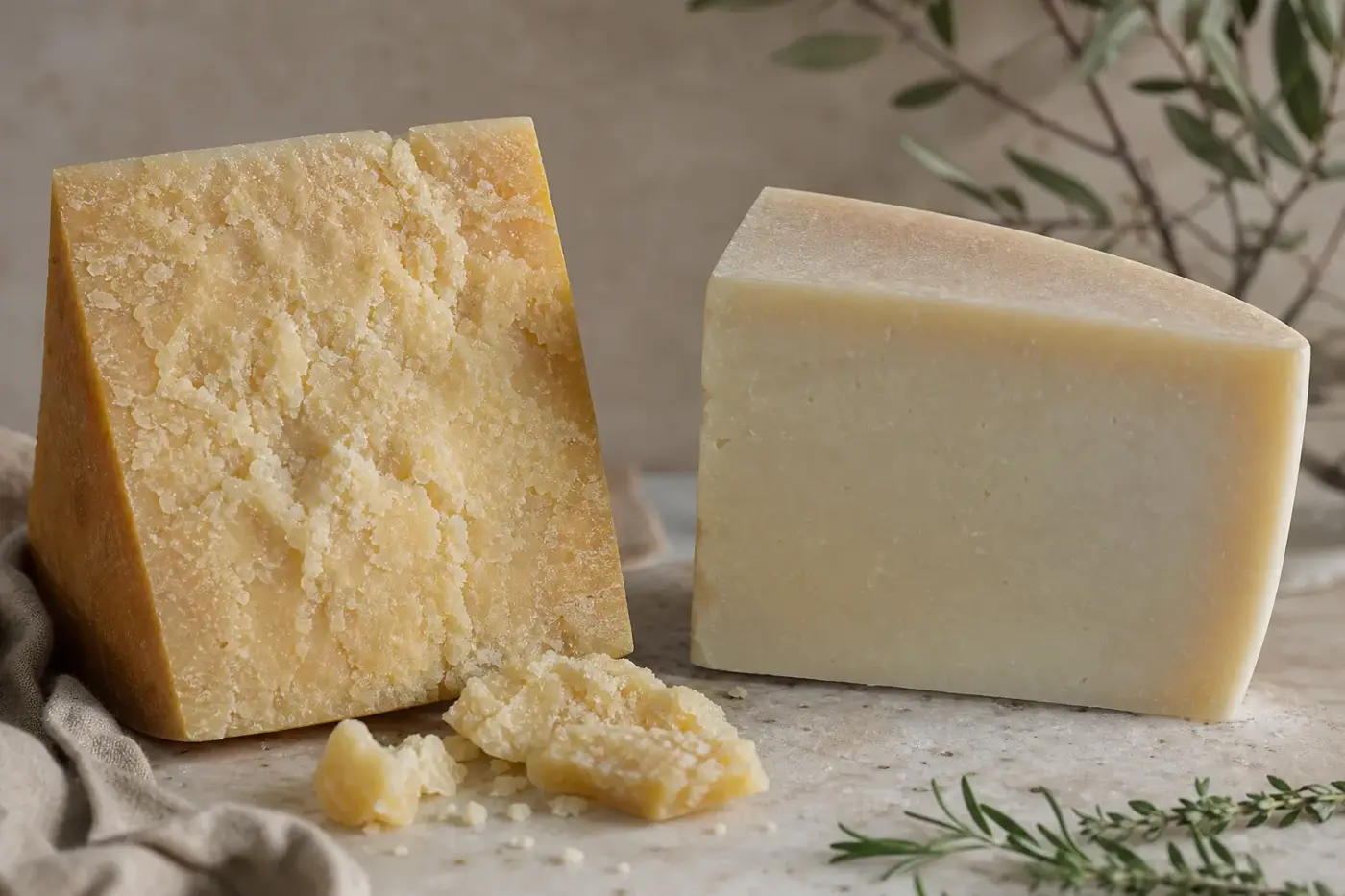
Break off a piece of Parmigiano Reggiano. There is the nutty aroma, then the savoury depth. Now try Pecorino Romano: sheep’s milk brings a sharper, tangier character than its cow’s milk counterpart. On pasta, choose Parmigiano Reggiano to support the sauce and Pecorino Romano to lead, especially in cacio e pepe or carbonara. [1,2,5,9]
Two Italian favourites, side by side
Both are Italian hard cheeses, with names rooted in particular places. In November 2026, the Great Britain register lists both under its protected designation of origin scheme, abbreviated PDO. For the wider naming rules, take a look at protected names explained. [3,4]
| What you’re choosing | Parmigiano Reggiano | Pecorino Romano |
|---|---|---|
| Milk | Cow’s milk [1] | Sheep’s milk [7] |
| Milk treatment | Raw only [1] | Raw or thermised [7] |
| Rennet | Calf rennet [1] | Lamb rennet paste [7] |
| Salting | A bath in brine [1] | Detail pending review of the operative specification |
| Minimum maturation | 12 months [1] | 5 months for eating in pieces; 8 months for grating [2] |
| The texture you’ll find | Fine-grained and flaky [13] | Compact, sometimes with small holes [2] |
| The flavour you’ll find | Nutty and savoury [5] | Tangy, becoming more pungent with age [2] |
Follow the milk home
Parmigiano Reggiano’s territory takes you through Parma, Reggio Emilia and Modena. It also covers Bologna to the left of the River Reno and Mantua to the right of the River Po. The cows supplying its milk belong within that production system, with feed rules tied to the area. [1]
Pecorino Romano takes you to a different map: all of Lazio and Sardinia, plus the province of Grosseto in Tuscany. Its whole sheep’s milk must come from farms within that production area. A Sardinian Pecorino Romano is therefore entirely at home under the name, not a cheese made outside its designated territory. [7,2]
Cow or sheep? It is a useful first question, but not the whole story of your wedge. Cultures, rennet, salting and maturation also shape what reaches your plate. To follow those connections, start with how cheese is made. [1,7]
At the vat, then in for the wait
Parmigiano Reggiano begins with raw cow’s milk, partially skimmed by letting the cream rise naturally. The cheesemaker adds a whey starter, a culture carried forward from cheesemaking, then calf rennet sets the milk into curd. That curd is broken up, cooked and gathered into moulds. [1]
After a few days, the wheels go into brine. Then the pace slows: the specification requires at least 12 months of maturation. [1]
For Pecorino Romano, the consortium describes milk used raw or thermised. Thermised means briefly heat-treated, rather than pasteurised. Its published process adds a local starter called scotta innesto, then lamb rennet paste sets the milk before the curd is broken into small grains. [7]
Your intended use determines the minimum wait: five months for table Pecorino Romano, eight months for the grating type. “Table” means cheese for eating in pieces, not a softer cheese family. These are starting points, not finishing lines, so look at the particular wedge’s age when comparing two examples. [2]
Look at the rind, then break off a piece
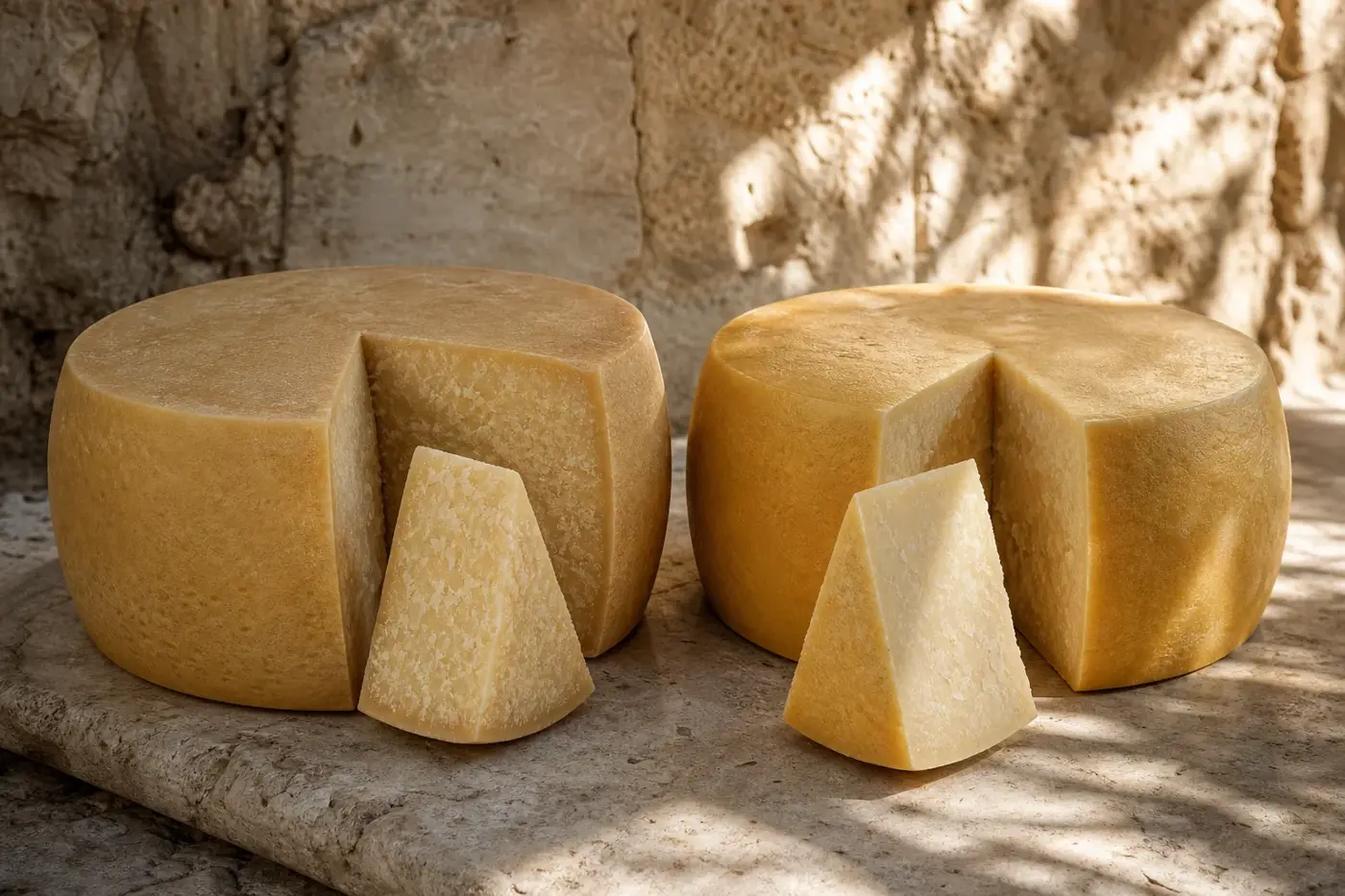
Parmigiano Reggiano has a natural straw-coloured rind, with pale straw to straw-coloured paste underneath. “Paste” simply means the cheese beneath the rind. Its wheels have flat faces and sides that are slightly convex or almost straight. [13]
The specification describes that paste as fine-grained and flaky. Break off a piece and you can appreciate its granular structure before the grater gets involved. [13]
Pecorino Romano is cylindrical, with flat faces and a thin ivory or straw-coloured rind. A protective coating can make the outside look black. Inside, you find white to straw-coloured paste: compact, with few holes or none. Follow the product’s instructions about any coating before preparing it. [2]
As Parmigiano Reggiano ages, its consortium describes increasing granularity and crumbliness. Those small white crystals you sometimes notice as you chew are tyrosine crystals, formed during maturation. The flaky break and occasional crunch are separate pleasures. Even an enthusiastic grater deserves the occasional afternoon off. [5,6]
Taste your way from milk to nuts and tang
Younger Parmigiano Reggiano can suggest milk, yoghurt and fresh fruit, according to the consortium’s tasting guidance. Around 24 months, nuts and meat-stock notes join a more crumbly texture. With longer maturation, the flavour becomes more pronounced, with spice, nuts and stock among the consortium’s descriptors. [6]
Pecorino Romano follows another path. Its consortium describes the table cheese as aromatic, tangy and lightly piquant, while the grating cheese has much stronger piquancy. That sheep’s milk tang is your practical contrast with Parmigiano Reggiano’s nut-and-stock character. Taste both before deciding how much your dish needs. [2,5]
A useful guide: choose Parmigiano Reggiano for a gentler balance of sweetness and savouriness, Pecorino Romano for a more assertive finish. Judge saltiness from your actual wedge and the whole dish. Cheese, salted cooking water and cured pork all contribute to the final seasoning. [5,9]
Find the right cheese for your forkful
For finishing pasta, reach for Parmigiano Reggiano when you want savoury depth without making tang the main event. Choose Pecorino Romano when the sauce welcomes a more forceful cheese character. Either deserves a deliberate choice, rather than an automatic shower over every bowl. [2,5]
In sauces, the cheese’s name is only part of the story. Experimental work on Pecorino Romano, water and starch found that starch concentration and temperature affected clumping. Your practical lesson: grate finely and use a method that controls heat and liquid. A different cheese is not, by itself, a cure for a lumpy sauce. [9,10]
For salads, start with younger Parmigiano Reggiano, which its consortium recommends for cold dishes. Turn to Pecorino Romano when the other ingredients welcome a sharper accent. Shave modest amounts, then taste a forkful with the dressing before adding more. [2,5]
Eating pieces lets you notice Parmigiano Reggiano’s granular fracture and the way its aromas change across ages. Table Pecorino Romano offers the less piquant end of its own range. Ask yourself what you fancy: flakes and nutty depth, or a compact bite with sheep’s milk tang. [2,6]
Cacio e pepe and carbonara: give cheese the floor
Cacio e pepe puts cheese centre stage, making Pecorino Romano the starting point for that tangy character. In carbonara, cheese also plays an essential seasoning role alongside eggs and guanciale, cured pork cheek. The amount and balance matter just as much as the name on your wedge. [9,10]
A blend has a documented place in contemporary cooking, too. La Cucina Italiana’s chef-led treatment of Roman pasta uses equal volumes of Pecorino Romano and Parmigiano Reggiano in both its carbonara and cacio e pepe. That is one published approach, not a commandment for every kitchen. [9]
Keep Pecorino Romano prominent when its bite is the reason you are making the dish. Add Parmigiano Reggiano when you want its nut-and-stock character alongside it. Using only Parmigiano changes the flavour balance, so describe that choice plainly and cook towards the result you want. [2,5]
Making a swap? Taste as you go
First, ask what job the cheese is doing. A small finishing sprinkle leaves you room to adjust at the table. A sauce led by cheese needs closer attention to cheese, liquid and starch, so begin with the original recipe’s technique. [10]
Swapping Pecorino Romano for Parmigiano Reggiano? Start with less, taste, then add more if you need it. Its piquancy can take the dish in a different direction. Going the other way, expect nutty savouriness rather than trying to recreate sheep’s milk tang with extra salt. [2,5]
Taste before adding salt, including before another ladle of salted pasta water. Let the sauce and its other ingredients guide the amount, rather than a universal replacement ratio. Hold some cheese back for the final taste, especially when guanciale or another strongly seasoned ingredient is already involved. [9,10]
Choosing for vegetarians? Follow the rennet
Neither PDO cheese suits vegetarians who avoid animal rennet. Parmigiano Reggiano requires calf rennet; Pecorino Romano uses lamb rennet paste. Rennet helps set milk into curd, and its source is a separate question from which animal supplied the milk. [1,7]
For a vegetarian swap, look for a hard grating cheese whose maker explicitly identifies a suitable non-animal coagulant. Expect a different flavour, and check how it behaves in your dish. Rennet explained takes you through animal, microbial and fermentation-produced options.
Give your wedge a good home
For home storage in England, Wales and Northern Ireland, the Food Standards Agency advises keeping your fridge between 0 and 5 °C and following the product’s storage instructions. Follow the label after opening, too. A cheese’s maturation period is not a household storage allowance. [11]
The Parmigiano Reggiano consortium recommends protecting a cut piece in a glass or plastic container or food-grade cling film. This limits drying and the absorption of other food odours. Keep the packaging information with each wedge, so its age, opening instructions and any treatment details stay close at hand. [12]
For the practical details, turn to how to store cheese at home. If you want to follow the cow’s milk cheese further through production and maturation, read Parmigiano Reggiano.
General information only, not medical advice: follow the official guidance where you live.
Sources
- Consorzio del Formaggio Parmigiano Reggiano. Product specification of the protected designation of origin “Parmigiano Reggiano”. English document dated 2 July 2025, supplied under the consortium’s specification in force from 24 April 2025. Cheese production standards, Articles 1 to 4.
- Consorzio per la Tutela del Formaggio Pecorino Romano. Characteristics. Undated live account, retrieved November 2026. Producer-group descriptions of milk, rennet, appearance, flavour and maturation.
- Department for Environment, Food & Rural Affairs. Parmigiano Reggiano. Great Britain protected food name register entry, published 2021, checked November 2026.
- Department for Environment, Food & Rural Affairs. Pecorino Romano. Great Britain protected food name register entry, published 2021, checked November 2026.
- Consorzio del Formaggio Parmigiano Reggiano. Parmigiano Reggiano: Guidelines for retail outlets and catering. Third edition, April 2026. Sections on maturation, crystals and organoleptic characteristics.
- Consorzio del Formaggio Parmigiano Reggiano. Sensory analysis. Undated live account, retrieved November 2026. Sections on tactile analysis and sensory development.
- Consorzio per la Tutela del Formaggio Pecorino Romano. Processing. Undated live account, retrieved November 2026. Production area, milk treatment, starter and rennet.
- Italian Ministry of Agricultural, Food and Forestry Policies. Provvedimento 5 novembre 2009: Modifica del disciplinare di produzione della denominazione “Pecorino Romano”. Gazzetta Ufficiale, Serie Generale, No. 271, 20 November 2009. Consortium-hosted copy consulted for the editorial verification described below.
- La Cucina Italiana. Amatriciana, Carbonara, Cacio e Pepe: The Roman Holy Trinity of Pasta. 24 February 2023. Published chef-led recipes, used as primary evidence of those particular contemporary formulations.
- Phase behavior of Cacio e Pepe sauce. Research manuscript, arXiv:2501.00536, 2024. Experiments varying Pecorino Romano, water, starch and temperature, with image-based analysis of aggregation.
- Food Standards Agency. How to chill, freeze and defrost food safely. GOV.UK publication, first published 2017, live text checked November 2026. Applies to England, Wales and Northern Ireland.
- Consorzio del Formaggio Parmigiano Reggiano. Cutting and storage. Undated live account, retrieved November 2026. Packaging and protection of cut cheese.
- Consorzio del Formaggio Parmigiano Reggiano. Single document of the PDO Parmigiano Reggiano. Document linked from the specification page in November 2026; reproduced Official Journal text dated 9 June 2023, section 3.2.
Researched through specifications, official Great Britain register entries, attributed consortium descriptions, published culinary formulations and experimental research, with unresolved specification checks recorded for the editor.
Last checked: November 2026
Last checked November 2026.
The editors suggest you read next
Cheddar vs Gouda: Taste, Texture and How to Use Each
Bite into a long-aged Gouda and, beneath your teeth, something crunches.