Cheese and Tea
Bring a piece of Comté close to a cup of toasted oolong.
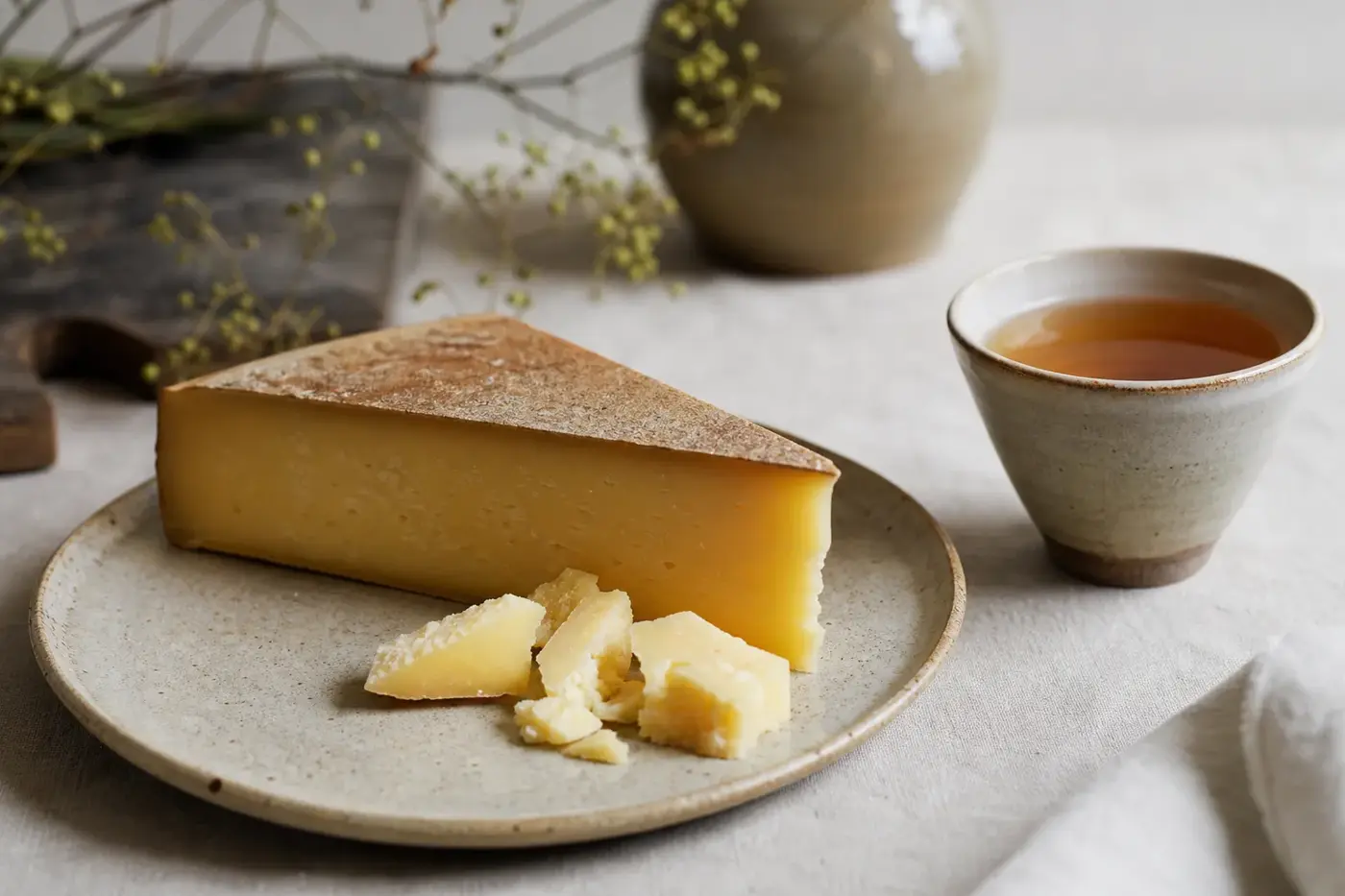
Bring a piece of Comté close to a cup of toasted oolong. Pause before the first bite. Hazelnut, honey, butter, caramel and vegetal notes all feature among Comté’s recurring aromas in INAO’s published description.[6] Smell, taste, then alternate a bite and a sip to discover which notes come forward.
You do not need to find the perfect match on your first attempt. This is a tasting, not an entrance exam. Adjust the tea’s strength and aroma until both partners hold your attention, then let the next bite tell you whether the balance works.
Put the kettle on for your cheese
After a mouth-coating bite of cheese, a lightly drying cup can feel like a welcome change. Then the aromas join in. Floral, toasted or malty notes can give the very same cheese quite different company.
That refreshing sensation has experimental support. In a 2017 study, 55 adults alternated dried meat with oolong tea or water. Oolong reduced perceived fattiness more than water at several measurement points. A separate experiment used whipped cream, comparing ordinary oolong with polyphenol-enhanced oolong.[2]
Think of the pairings below as tasting exercises built around that contrast in mouthfeel. The individual matches were not tested in the study, which concerned particular foods and drinks.[2] Your question at the table is simpler: do you want another bite and another sip, with something worth noticing in each?
Listen to what your cup is telling you
Aroma is what you smell; body is how substantial the drink feels. Bitterness is a taste, while astringency is that drying or rough feeling in your mouth. Separating them makes your tasting easier to describe. Tea polyphenols can contribute to astringency, which the oolong research examines alongside perceived fattiness.[2]
Give the cheese the same attention, noticing richness and salt separately. Does the tea offer a welcome change after a bite, and can you still recognise its aroma? Is the finish pleasantly savoury or simply drying? Those answers tell you more than declaring one drink the only correct partner for a cheese.
Green, oolong and black teas all come from Camellia sinensis, the tea plant. Processing takes them in different directions: green tea undergoes minimal oxidation, oolong is partially oxidised, and black tea undergoes more extensive oxidation. Alongside other processing choices, oxidation helps explain their different characters.[1][3]
Five pairings to bring to your table
Start with a supplier’s description of the character you want, then see whether you find it in your brewed cup. “Oolong” alone leaves plenty undecided. For the Comté tasting, look specifically for toasted or roasted notes.
| Cheese | Your tea to try | What you are looking for | Give this your attention |
|---|---|---|---|
| Fresh goat’s cheese | Gently brewed green tea | Contrast without overwhelming either partner | Tang, tea aroma, drying finish |
| Soft, bloomy rind cheese | Delicate jasmine-scented green tea | Floral aroma alongside the cheese | Centre first, then a bite with rind |
| Comté | Toasted or roasted oolong | An aromatic connection | Savoury, toasted, lingering notes |
| Mature Cheddar | Unflavoured black tea | A cup that suits the cheese’s intensity | One tea at two strengths |
| Blue cheese | Malty black tea | A substantial cup, with optional sweetness | Plain first, then a little honey |
Keep your first round simple. Taste each cheese and tea separately before bringing them together, then change just one thing at a time. Each comparison will have a clear purpose, rather than leaving you wondering which change made the difference.
Fresh goat’s cheese: give that tang a gentle green companion
Take a bite of plain fresh goat’s cheese, sip gently brewed green tea, then return to the cheese. Does its tang stay clear? Notice whether the tea leaves your mouth refreshed or dry.
Choose cheese without herbs, ash or spices, so you can concentrate on that exchange. Look for a green tea its supplier describes as fresh, grassy or gently savoury. Brew it towards the delicate end of the maker’s instructions.
Before sipping, put words to the cheese’s acidity: brisk, rounded or persistent? Look for that character again after the tea. You want to distinguish the cheese’s tang from the tea’s flavour, rather than lose both in a drying finish.
If the cup takes over, dilute a little brewed tea with hot water and repeat. Leave the cheese exactly as it is. You now have a useful first comparison without needing another tea or another cheese.
Bloomy rind cheese: let jasmine bring the flowers
Set a soft cheese with a white, bloomy rind beside jasmine-scented green tea, and you give it a floral companion. The UK Tea & Infusions Association identifies jasmine tea as green tea flavoured with jasmine flowers.[4]
Brew delicately and leave other accompaniments aside for now. Taste a little of the cheese’s centre, then a bite including some rind, following the product’s instructions about the rind. Can you still pick out the floral aroma beside both?
Keep the same cup for these two comparisons. Changing only the part of the cheese makes the result easier to follow than changing everything at once. If you would like help choosing, the guide to cheese styles explains the distinctions between rind and texture families.
Comté: explore the Jura through toasted oolong
Your piece of Comté has an unusually detailed background. Its French designation specification defines a cooked, pressed cheese made exclusively from raw cow’s milk, with a minimum maturation of 120 days. Listed communes define its permitted production area in the French Jura region, including areas of Doubs, Jura and Ain.[5]
Those hazelnut, honey, butter, caramel and vegetal notes identified by INAO vary with place, production season and age.[6] Treat them as possible reference points, not a checklist you must complete. The character of the piece in front of you matters more.
Choose an oolong whose supplier specifically mentions roasting or toasted notes. Taste cheese and tea separately before looking for a connection. Does the cheese suggest savoury depth beside the cup, and do their toasted impressions seem to overlap?
Now compare a thin shaving with a slightly thicker piece. You change the balance of cheese to drink without touching the brew. For more of the cheese’s background, turn to the dedicated Comté guide.
Mature Cheddar: try your black tea two ways
Pick a mature Cheddar you already enjoy and an unflavoured black tea. This is a straightforward strength experiment. Your familiar cheese stays put while you get to know the drink.
Prepare the tea according to its maker’s instructions. Pour some into one cup, then dilute a second sample with a little hot water. Let both reach a comparable drinking temperature before trying them with similar bites of cheese.
Ask yourself three questions: can you still recognise the tea after the cheese? Does the cheese remain interesting after the tea? Which pairing leaves the more comfortable finish? The stronger cup does not automatically deserve the crown.
Leave milk until the second round to keep that first comparison clear. You can find more help choosing and understanding the cheese in the Cheddar guide.
Blue cheese: start malty, then consider honey
Begin with plain tea and a blue cheese whose strength you know. Choose a black tea its supplier describes as malty, take a small bite, then sip. Pay attention to the cheese’s salt, the cup’s body and what stays with you after swallowing.
Next, put a tiny amount of honey on a separate bite of cheese. Keep it out of the pot. That lets you compare the original pairing with the sweetened accompaniment without changing everybody’s tea.
Honey is an optional third ingredient, not an obligation. Leave it out if you prefer the plain combination; if sweetness helps, add it sparingly and keep an unsweetened cup for comparison. You can also choose a gentler blue cheese when you want the drink to remain more prominent.
Brew for balance, not brute strength
Start with the tea maker’s instructions for leaf quantity, water volume, temperature and steeping time. As broad guidance, the UK Tea & Infusions Association suggests around 80 °C (176 °F) for green tea and 90 to 98 °C (194 to 208 °F) for black tea. It also explicitly directs drinkers to the pack instructions.[4]
Temperature and steeping time affect extraction. A 2025 study analysed 68 commercial tea samples for caffeine, preparing infusions at 80 °C and 100 °C for two, five and ten minutes. Longer brewing increased caffeine extraction in the tested samples; temperature effects differed between tea types.[3]
Make your first cup as directed and taste it before serving the cheese. Then change just one variable, so you can follow the difference:
- A little too forceful? Dilute a small sample and compare it with the original.
- Not quite enough flavour? Brew a fresh cup with a little more leaf, leaving everything else unchanged.
- Too drying? Try a shorter infusion within the maker’s recommended range.
- Where has the aroma gone? Taste first without milk, sugar or strongly flavoured accompaniments.
Write down what you changed. “More tea, same water and time” gives you something repeatable; “make it stronger” leaves several possibilities unresolved. A clear note is also your route back to a combination you enjoyed.
When the intended steep is complete, strain loose leaves or remove the bag. The association’s brewing guidance likewise recommends removing the bag before you add milk.[4]
Settle in for an unhurried tasting
Two or three pairings are enough for your first session. Set out small pieces of cheese that allow several bites, with modest pours of tea and refills available. The cheese board does not need to audition for a banquet.
Keep cheese temperature within its storage instructions and the official refrigeration limits below. Take out only what you need for the next comparison, leaving the rest refrigerated. Notice how your tasting pieces change as they lose their refrigerator chill, but keep the whole supply away from the warm teapot.
For England, Northern Ireland and Wales, the Food Standards Agency advises a home fridge temperature of 0 to 5 °C (32 to 41 °F). It also advises following storage instructions and keeping chilled food out for the shortest possible time. Its preparation guidance gives a maximum of four hours; its community event guidance says chilled buffet food should be out for no more than four hours.[7][8]
This tasting follows that guidance as of November 2026. Treat the limit as a maximum, not a serving target.[7][8]
Give your tasting a simple rhythm:
- Let your impression of intensity lead. Start with the gentlest cheese and cup, leaving the most persistent blue pairing until last.
- Meet the tea on its own. Smell and taste it, letting it cool until comfortably drinkable.
- Give the cheese a moment alone. Notice texture, salt and how long its flavour lasts.
- Alternate a bite and a sip. Repeat before deciding whether you like the combination.
- Pause between pairs. Offer plain water and, if wanted, a little plain bread or an unsalted cracker.
Save pickles, chutneys and strongly flavoured crackers for a later round. With fewer flavours competing for your attention, you can more easily identify what the tea changes.
When you put unused cheese away, follow its label. The home cheese storage guide covers that separate storage task.
Leave room for the way you like your tea
Milk or sugar? Give your favourite cup a turn
Start plain to compare flavours, then add milk or sugar to an individual cup if that is how you prefer your tea. Repeat the cheese pairing after the addition. Which version do you enjoy?
Keep a plain sample alongside it where possible. That helps you distinguish a preference for a milkier or sweeter drink from a preference for the original tea and cheese combination. A careful tasting should still leave you with a cup you actually want to drink.
Choose caffeine on its own terms
Green, oolong and black tea contained caffeine in the 2025 analytical study, with amounts affected by the sample and brewing conditions.[3] If you want a caffeine-free drink, choose a product explicitly labelled caffeine-free. The colour of the infusion is not your guide.
Herbal and fruit infusions offer another route. The UK Tea & Infusions Association explains that these use ingredients such as herbs, flowers and fruit rather than necessarily coming from the tea plant; some blends also contain tea.[9] Read the ingredients and product information before choosing.
For your bloomy rind tasting, try a floral infusion. Beside the harder cheeses, explore one described as toasted. Give these adaptations room to bring their own flavours, rather than expecting them to taste like the teas they replace.
Follow the infusion maker’s brewing directions. The association advises freshly boiled water for ordinary herbal and fruit infusions, including those you will later cool; specially labelled cold-brew products have their own instructions.[9] Whatever you pour, return to that small, rewarding question: after this sip, what do you notice in the next bite?
General information only, not medical advice: follow the official guidance where you live.
Questions people ask
Which teas go well with cheese?
Try gently brewed green tea with fresh goat’s cheese, or jasmine green tea with a soft, bloomy rind cheese. The page also suggests unflavoured black tea with mature Cheddar and malty black tea with blue cheese.
What tea should I try with Comté?
Try an oolong described by its supplier as toasted or roasted. Taste the cheese and tea separately first, then look for any overlap in their savoury and toasted notes.
How should I brew tea for a cheese tasting?
Start with the tea maker’s instructions and taste the cup before serving the cheese. If it is too forceful, dilute a small sample with hot water and compare it with the original.
Does green tea contain caffeine?
Green tea contained caffeine in the 2025 analytical study, as did oolong and black tea. If you want a drink without caffeine, choose a product explicitly labelled caffeine free.
How long can cheese be left out for a tasting?
For England, Northern Ireland and Wales, the Food Standards Agency advises keeping chilled food out for the shortest possible time and gives a maximum of four hours in its preparation guidance. See the agency’s food preparation guidance and follow the cheese’s storage instructions.
Sources
- UK Tea & Infusions Association, Tea processing and blending and Varieties of tea, undated web editions, retrieved November 2026. Industry explanations of processing and tea categories. Processing source; tea varieties.
- Food Science and Technology Research, Analysis of Active Components on Oral Fat Sensations in Oolong Tea, volume 23, issue 1, pages 71 to 78, 2017. Original sensory and laboratory research. Full paper.
- Foods, Determination of L-Theanine and Caffeine Contents in Tea Infusions with Different Fermentation Degrees and Brewing Conditions Using the Chromatographic Method, volume 14, article 2313, 2025. Original analytical research. Full paper.
- UK Tea & Infusions Association, The perfect brew, undated web edition, retrieved November 2026. Industry brewing guidance and tea descriptions. Brewing source.
- French Ministry of Agriculture, Cahier des charges de l’appellation d’origine « Comté », homologated by the order of 18 December 2025, published in the Journal officiel on 7 January 2026 and ministry bulletin number 2026-02 on 8 January 2026. Official specification.
- Institut national de l’origine et de la qualité, Comté, current product description, retrieved November 2026. Official product page.
- Food Standards Agency, How to chill, freeze and defrost food safely, current GOV.UK edition, retrieved November 2026. Guidance applicable to England, Northern Ireland and Wales. Official chilling guidance.
- Food Standards Agency, Providing food at community and charity events, current GOV.UK edition, retrieved November 2026. Official event guidance.
- UK Tea & Infusions Association, FAQ’s about infusions, undated web edition, retrieved November 2026. Industry guidance on ingredients and preparation. Infusion source.
This piece combines desk research from official cheese specifications, food safety guidance, original tea research and attributed industry guidance, with editorial tasting exercises.
Last checked: November 2026
Last checked November 2026.
The editors suggest you read next